The Triple Constraint (The Iron Triangle of Project Governance)
🗂️ Interactive Notebook: Open Study Companion (Video Summary, Flashcards, Mind Map) ↗
The Triple Constraint (also known as the Iron Triangle or the Project Management Triangle) is the foundational governance model of project delivery. Formalized by Dr. Martin Barnes in 1969, the model posits that every project is bounded by three interdependent variables: Scope, Cost, and Time, with Quality anchored at the geometric center. Because the system operates in a state of structural equilibrium, altering any single vertex mathematically and operationally forces a compensatory shift in at least one other vertex—or results in the systemic degradation of central Quality. Traditional plan-driven frameworks (Waterfall) govern uncertainty by locking Scope and flexing Cost and Time, whereas adaptive frameworks (Agile) invert the triangle by locking Time (timeboxes) and Cost (stable cross-functional capacity) while dynamically flexing Scope.
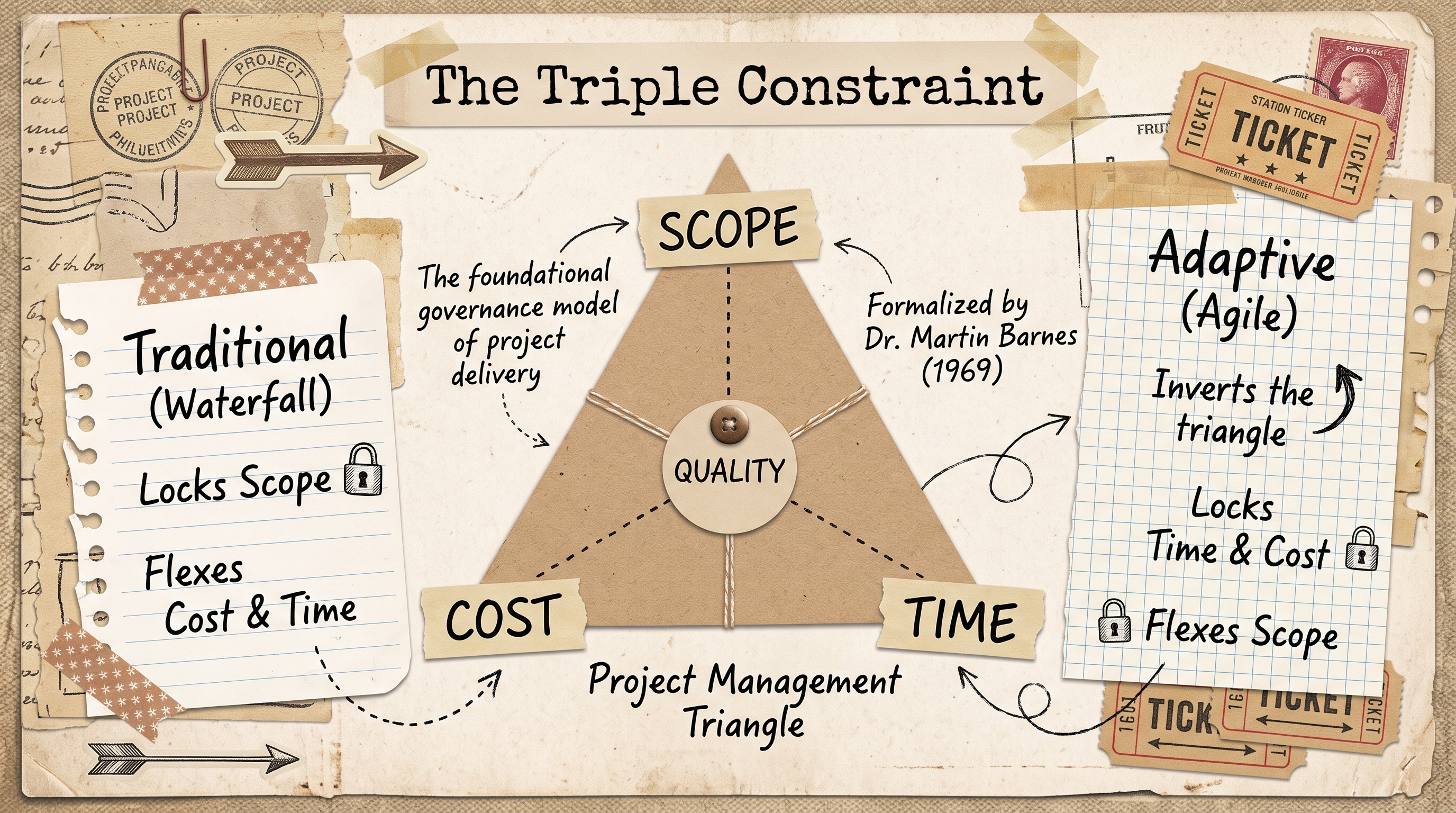
Origins and Theoretical Foundations
While informal trade-offs between schedule, budget, and output emerged alongside post-World War II defense and aerospace engineering programs (such as PERT and the Critical Path Method (CPM) in the 1950s), the visual and conceptual framework of the triangle was introduced in 1969 by British civil engineer and project management pioneer Dr. Martin Barnes.[1] Designing a course titled Time and Money in Contract Control, Barnes drew a triangle to illustrate to engineering contractors and executive sponsors that project dimensions could not be managed in isolation.[2]
Barnes originally labeled the three corners Cost, Time, and Quality, later revising "Quality" to Performance and eventually Scope (or specification) to distinguish what is being built from how well it functions.[2:1] In 1999, researcher Roger Atkinson cemented the phrase "The Iron Triangle" in academic literature, critiquing how Cost and Time represent "two best guesses" calculated at the moment of lowest project knowledge, while Quality represents an emergent "phenomenon".[3]
Anatomy of the Model
In contemporary project governance standards, the model consists of three perimeter boundary vertices and one central resultant state:
- Scope (Features / Specifications): The totality of deliverables, functional requirements, technical specifications, work packages, and explicit exclusions required to realize the project's terminal state. In predictive environments, Scope is decomposed via a Work Breakdown Structure (WBS); in adaptive environments, it is maintained as an emergent Product Backlog.[4]
- Cost (Budget / Resources): The financial capital, human labor, physical materials, equipment, software licenses, and administrative overhead required to execute the Scope. In knowledge work and software engineering, Cost is overwhelmingly a direct function of human team capacity over time.[5]
- Time (Schedule / Duration): The calendar window, milestone sequence, and critical path available to transform raw inputs into verified deliverables. Unlike capital or scope, Time is strictly inelastic and irreversible; schedule lost to delays cannot be banked, only compensated for elsewhere.[1:1]
- Quality (The Central Anchor): Positioned inside the geometric perimeter, Quality represents fitness for purpose, structural reliability, defect density, and adherence to engineering standards. Quality is not an independent fourth side of a square; rather, it is the pressurized interior surface area governed by the equilibrium of the perimeter vertices.[2:2]
Popular engineering vernacular summarizes the Iron Triangle as an impossibility theorem:
- Good + Fast = Expensive: Achieving high Scope and Quality in a compressed Time horizon requires peak capital expenditure, premium vendor rates, and maximum resource loading.
- Good + Cheap = Slow: Delivering extensive Scope and uncompromising Quality on a tight budget requires extending the schedule to avoid the high costs of overtime and crashing.
- Fast + Cheap = Low Scope or Poor Quality: Forcing a short schedule alongside a constrained budget requires ruthless scope deselecting or inevitably triggers corner-cutting and severe technical debt.[4:1]
Mathematical Mechanics and Non-Linear Realities
At an abstract governance level, the Scope-Time-Resources (STR) Model expresses the Iron Triangle as a functional relationship:
Under idealized, linear assumptions, work output scales proportionally with applied effort and calendar duration. For instance, if a linear physical task requires
However, complex socio-technical initiatives violate linear arithmetic due to coordination overhead, cognitive ramp-up, and diminishing marginal returns.
Non-Linear Friction in Constraint Trade-Offs
1. Brooks's Law and Communication Combinatorics
Formulated by Fred Brooks in The Mythical Man-Month (1975) and analyzed in Brooks' Law (The Mythical Man-Month & Communication Overhead), the foundational law states that "adding manpower to a late software project makes it later."[7] Because intellectual work is not seamlessly partitionable, onboarding new personnel siphons productive capacity away from veteran engineers. Furthermore, the number of pairwise communication channels (
Expanding a project team from 5 to 10 engineers increases bilateral communication pathways from 10 to 45. When managers treat knowledge workers as interchangeable cogs in a machine, they inadvertently inflate Cost while extending Time.[7:2]
2. Schedule Compression Penalties (Crashing vs. Fast-Tracking)
As codified in PM - Monitoring and Controlling, when sponsors mandate a reduction in Time without cutting Scope, project leaders rely on two primary techniques—both of which carry severe secondary penalties:[4:2]
- Crashing: Injecting direct capital (overtime, specialized consultants, parallel tooling) onto critical path activities. Direct costs rise sharply along a U-curve past the project's optimum least-cost duration, while team exhaustion elevates error rates and leads engineers to burn out.[4:3]
- Fast-Tracking: Executing sequential critical-path phases in parallel (e.g., commencing manufacturing tooling or software coding before architectural blueprints are signed off). While nominal initial Cost does not spike, rework risk escalates exponentially, often destroying both budget and baseline quality when late architectural changes throw a wrench in the works.[4:4]
3. Behavioral Buffer Erosion (Parkinson's Law & Student Syndrome)
As explored in Parkinson's Law and Student Syndrome (The Psychology of Schedule Slippage), individual schedule margins fail to protect project deadlines. Workers defer task initiation until deadlines loom (Student Syndrome), burning contingency buffers before real uncertainty is encountered, while finished tasks expand to fill all allotted calendar time (Parkinson's Law). When local buffers are built on sand, downstream integration milestones routinely breach schedule baselines.[3:1]
4. The Hidden Erosion of Quality (Technical Debt)
When project governance pathologically locks all three perimeter vertices—mandating fixed Scope, fixed Time, and fixed Cost—the triangle cannot geometrically deform outward. Instead, it implodes inward, crushing Quality.[5:1] Engineering teams meet artificial deadlines and feature checklists by skipping automated testing, deferring documentation, and cutting architectural corners. This accumulates catastrophic technical debt, shifting capital costs from the initial capital expenditure (CapEx) delivery budget onto multi-year operational maintenance (OpEx).[5:2]
Constraint Perturbation Matrix
| Initiating Shock | If Time is Locked | If Cost is Locked | If Scope, Cost, and Time are All Locked |
|---|---|---|---|
| Scope Increases (Scope Creep) | Cost must rise (add resources, approve overtime, subject to Brooks's Law). | Time must extend (existing team works sequentially longer to absorb work). | Quality collapses (corner-cutting, unverified testing, team burnout). |
| Time is Cut (Deadline Pulled In) | N/A (Initiating variable) | Scope must drop (ruthlessly de-scope secondary deliverables). | Quality collapses (skipped regression QA, high defect escape rate). |
| Cost is Cut (Budget Reduction) | Scope must drop (fewer features delivered within deadline). | N/A (Initiating variable) | Quality collapses (cheaper materials, junior staffing, technical debt). |
Governance Paradigms: Waterfall vs. Agile (Inverting the Triangle)
The most consequential operational application of the Triple Constraint in enterprise management is how predictive (Waterfall) and adaptive (Agile) methodologies orient the triangle to absorb real-world uncertainty. Neither methodology escapes the Iron Triangle; rather, they invert which vertices are locked as baselines and which vertices act as shock absorbers.[5:3]
Structural Inversion of the Triple Constraint
| Governance Dimension | Predictive Framework (Waterfall) | Adaptive Framework (Agile / DSDM) |
|---|---|---|
| Triangle Orientation | Upright Triangle: Scope at the apex; Cost and Time at the base. | Inverted Triangle: Cost and Time at the top; Scope at the downward apex. |
| Primary Fixed Baseline | Scope (Fixed): Signed specifications, functional requirements, and WBS. | Time & Cost (Fixed): Rigid sprint timeboxes and dedicated team capacity. |
| Primary Flexed Variable | Cost & Time (Estimated / Flexed): Budget reserves and schedule float. | Scope (Variable): Prioritized backlog; lower-value user stories flex. |
| Quality Position | Pressurized interior resultant (frequently degraded during late crunches). | Structurally fixed constraint enforced via the Definition of Done (DoD). |
| Uncertainty Buffer | Management and contingency budget reserves; schedule float. | Scope tolerance buffers (e.g., MoSCoW Could Have user stories). |
| Change Protocol | Formal Change Control Board (CCB) and baseline re-negotiation. | Continuous backlog grooming, sprint planning, and trade-off swaps. |
| Contractual Alignment | Fixed-Price / Lump-Sum contracts with exhaustive specifications. | Time & Materials, Capped T&M, or Target-Cost value contracts. |
Traditional Waterfall: Plan-Driven Governance
In civil engineering, physical hardware manufacturing, and legacy enterprise software, Waterfall treats Scope as the primary, non-negotiable contractual baseline. Exhaustive upfront requirements gathering defines the exact specification before execution begins.[8]
- Fixed Vertex: Scope (locked via signed Business Requirements Documents and an approved Scope Baseline).[8:1]
- Estimated / Flexed Vertices: Cost and Time. Project managers estimate the budget and schedule required to deliver the frozen Scope, buffering uncertainty through Contingency Reserves (for "known unknowns") and Management Reserves (for "unknown unknowns").[9]
- Governance Mechanism: Formal Change Control Boards (CCB). Any deviation from initial requirements is treated as an exception requiring a formal Change Request (CR) that legally re-baselines Cost and Time upward.[8:2]
- Systemic Vulnerability: In high-uncertainty domains, upfront Scope rests on unvalidated hypotheses discovered only during implementation. Because Scope is contractually rigid, discovery triggers chronic schedule overruns and budget blowouts—explaining why failed predictive projects frequently breach Cost and Time baselines simultaneously.[10]
Agile Governance: Value-Driven Inversion
Pioneered in the mid-1990s by the Dynamic Systems Development Method (DSDM) consortium and popularized across Scrum, Extreme Programming (XP), and SAFe, Agile explicitly inverts the Iron Triangle.[11] Recognizing that upfront requirements in complex environments are volatile hypotheses, Agile locks cadence and team capacity while deliberately flexing deliverable features.[5:4]
- Fixed Vertices: Time and Cost (alongside non-negotiable Quality).
- Time is locked via strict timeboxing (e.g., 2-week Sprints, monthly releases, or fixed market launch dates).
- Cost is locked by funding persistent, stable, cross-functional teams (
), eliminating the coordination penalties of Brooks's Law. - Quality is locked structurally via a strict Definition of Done (DoD), continuous integration (CI), and automated testing so technical debt cannot silently accumulate.[5:5]
- Flexed Vertex: Scope. Rather than promising an all-or-nothing monolithic deliverable, the Product Owner continuously curates and reprioritizes the Product Backlog by economic value.[5:6]
- Governance Mechanism: Prioritization Frameworks (e.g., MoSCoW) and Empirical Velocity. Originating in DSDM, MoSCoW (Must Have, Should Have, Could Have, Won't Have this time) establishes an explicit Scope Tolerance buffer. If unexpected technical complexity emerges mid-iteration, Could Have items drop out cleanly so the release still ships on time, on budget, and defect-free with 100% of its highest-value Must Have capabilities.[9:1]
Operationalizing the Triangle in Project Governance
A project leader cannot govern an initiative if executive sponsors refuse to yield flexibility on at least one dimension. Operationalizing the Triple Constraint requires establishing explicit trade-off protocols during project initiation—well before execution friction emerges.
The Project Priority Matrix
Developed within classical project governance literature (such as Clifford Gray and Erik Larson), a Project Priority Matrix compels executive sponsors to classify Scope, Time, and Cost into three mutually exclusive categories at charter sign-off:[12]
- Constrain (Fixed Boundary): The immutable parameter that cannot be breached under any circumstances (e.g., a regulatory compliance deadline or a statutory budget cap).
- Enhance (Optimize): The dimension the delivery team should aggressively optimize or accelerate whenever trade-off opportunities arise.
- Accept (Designated Flex): The pre-authorized release valve where variance (cost overrun, schedule slip, or feature de-scoping) is explicitly permitted to protect the Constrained parameter.
| Constraint Dimension | Constrain (Must Not Breach) | Enhance (Optimize Target) | Accept (Designated Flex Valve) |
|---|---|---|---|
| Time (Schedule) | X (e.g., Regulatory Mandate) | ||
| Scope (Performance) | X (Maximize Core User Features) | ||
| Cost (Budget) | X (Approve Contractor Overtime) |
If executive sponsors mark all three dimensions as Constrain, the governance model becomes mathematically over-determined. In commercial software procurement, disguising a fixed-scope Waterfall contract inside superficial Agile sprint ceremonies ("Water-Scrum-Fall") removes the team's ability to flex Scope while denying them schedule and budget contingency.
When project leadership maintains this deceptive facade of certainty, the resulting plan is built on sand. Because teams cannot alter perimeter constraints, the project turns into an operational house of cards that inevitably collapses into severe technical debt, employee burnout, or contentious litigation.[13]
Evolution Beyond the Iron Triangle
While the Triple Constraint remains an indispensable heuristic for project management efficiency ("doing the project right"), late-20th and 21st-century governance scholars recognize its inadequacy as a comprehensive measure of project investment success ("doing the right project").[3:2]
"We're telling agile teams, 'Be flexible. Be agile. Be open to change.' And at the same time, we were imposing the project management Iron Triangle on them—focusing on cost and saying, 'You've got to be within 10% of the scope, schedule, and cost!'" — Agile Project Management[14]
Historical anomalies vividly demonstrate the chasm between Iron Triangle compliance and long-term strategic value:
- The Sydney Opera House (1959–1973): Originally estimated at
over 4 years, it required 14 years and —a catastrophic 1,400% failure across every vertex of the Iron Triangle. Yet it stands as a global architectural icon generating hundreds of millions of dollars in annual tourism, representing an indisputable generational success.[3:3] - The Iridium Satellite Constellation (1998): Executed with brilliant operational discipline, delivering within technical specification, schedule, and budget baselines. However, the enterprise filed for Chapter 11 bankruptcy nine months after launch because terrestrial cellular networks expanded rapidly, rendering Iridium's expensive satellite handsets commercially obsolete.[15]
Modern Governance Expansions
1. PMBOK Six-Constraint & Diamond Models (PMI & PRINCE2)
Starting with the PMBOK Guide (4th Edition) and mirrored in PRINCE2, governance standards expanded the traditional triangle into six competing project tolerances: Scope, Time, Cost, Quality, Risk, and Benefits.[9:2][15:1] Under PRINCE2's Management by Exception, Project Boards assign quantitative tolerance bands (
2. Atkinson's "Square Route" Framework (1999)
Roger Atkinson argued that evaluating project outcomes purely through the Iron Triangle commits a statistical "Type II error" (classifying strategically valuable projects as failures due to initial estimation errors). He proposed the Square Route, evaluating delivery across four balanced quadrants:[3:4]
- The Iron Triangle: Cost, Time, and Quality (process efficiency).
- The Information System: Maintainability, reliability, and code validity.
- Organizational Benefits: Direct financial return, efficiency gains, and strategic alignment.
- Stakeholder Community Benefits: User satisfaction, social impact, and environmental sustainability.[3:5]
3. Jim Highsmith's Agile Triangle (2009)
In Agile Project Management, Jim Highsmith argued that Scope, Schedule, and Cost are merely constraints, not goals.[13:1] Highsmith collapsed the entire Iron Triangle into a single baseline vertex labeled Constraints, elevating two primary value-driven vertices:[13:2]
- Extrinsic Value: Delivering releasable business outcomes, verified customer utility, and return on investment (ROI).
- Intrinsic Quality: Building architectural flexibility, modularity, and automated testing suites that preserve the organization's capacity to adapt to future change.
- Constraints (Cost, Schedule, Scope): Bounding conditions within which Value and Quality are maximized, rather than rigid metrics to be worshipped for their own sake.[13:3]
4. Fidelity as the Fourth Operational Lever
Contemporary product engineering further distinguishes Scope (the breadth of capabilities) from Fidelity (the depth, polish, and complexity of implementation). Teams can hold Time, Cost, Quality, and high-level Scope constant by delivering low-fidelity Minimum Viable Products (MVPs) first—validating user adoption cheaply before investing capital into high-fidelity automation and scale.[16] This enables leaders to navigate project governance along the path of least resistance without forcing premature compromises.
🎴 Interactive Web Practice (Comprehension Check)
Question 1 (Theoretical Mechanics & Quality Anchoring): Why is Quality positioned at the geometric center of the Iron Triangle rather than as a fourth perimeter vertex, and what occurs when governance pathologically fixes Scope, Cost, and Time simultaneously?
Answer: In Dr. Martin Barnes's formalized model, Quality is not an independent fourth vertex; rather, it is the pressurized interior surface area governed by the equilibrium of the three perimeter constraints (Scope, Cost, and Time). The perimeter vertices represent tangible inputs and contractual commitments:
- Scope: What is built (features, specifications, deliverables).
- Cost: Capital, team capacity, materials, and infrastructure expended.
- Time: The calendar duration and critical path available for execution.
Question 2 (Methodological Inversion & Non-Linear Realities): How do Waterfall and Agile invert the Triple Constraint, and why does Brooks's Law prevent teams from linearly compressing project schedules by adding budget or headcount?
Answer: Predictive and adaptive frameworks invert the orientation of the Iron Triangle to manage uncertainty:
- Waterfall (Plan-Driven): Fixes Scope upfront through formal requirements specifications and a WBS baseline, while treating Cost and Time as estimated variables that expand via budget contingency and schedule float when roadblocks emerge.
- Agile (Value-Driven): Fixes Time and Cost through rigid iteration timeboxes (sprints) and stable, dedicated cross-functional teams, while treating Scope as the flexible variable. Product Owners continuously reprioritize an emergent backlog, ensuring the highest-value features ship within fixed constraints.
- Assimilation Drag: Onboarding new personnel consumes senior engineering bandwidth for mentorship and environment setup, creating an initial net deficit in delivery velocity.
- Combinatorial Communication Overhead: Pairwise communication channels scale quadratically ($C = \frac{n(n - 1)}{2}$). Expanding from 5 to 10 engineers multiplies channels from 10 to 45, shifting team effort from feature execution to coordination and merge alignment.
Question 3 (Evolutionary Governance & The Success Paradox): Why does strict adherence to the Iron Triangle fail to guarantee project success, and how do frameworks like Highsmith's Agile Triangle and Atkinson's Square Route address this limitation?
Answer: The Iron Triangle measures project management efficiency ("doing the project right"—adherence to initial estimates) rather than investment success ("doing the right project"—creating strategic organizational value). Historical cases illustrate this divergence:
- The Sydney Opera House: Breached initial cost estimates by 1,400% and took 14 years instead of 4, yet generated immense cultural prestige and billions in ongoing tourism revenue.
- The Iridium Constellation: Shipped on time, on budget, and within technical specification, yet went bankrupt within nine months because market conditions and terrestrial alternatives rendered its business model obsolete.
- Atkinson's Square Route: Balances the Iron Triangle with three post-delivery dimensions: Information System Quality (technical validity), Organizational Benefits (direct financial ROI), and Stakeholder Community Benefits (customer and societal impact).
- Jim Highsmith's Agile Triangle: Demotes Scope, Schedule, and Cost to a single foundational vertex labeled Constraints, elevating Extrinsic Value (customer ROI and validated business outcomes) and Intrinsic Quality (architectural adaptability and low technical debt) as the true goal vertices of project leadership.
Resonant Notes
The following notes in the vault share direct thematic, operational, and strategic connections with the Triple Constraint and Project Governance:
🔴 Project Governance, Baseline Scheduling & Execution Controls
- PM - Work Breakdown Structure — Details deliverable-oriented work package decomposition and dependency mapping, providing the structural mechanism used to establish the Scope Baseline in predictive lifecycles.
- PM - Monitoring and Controlling — Analyzes variance detection, change control governance, Earned Value Management (EVM), and the strategic trade-offs between schedule crashing and fast-tracking.
- PM - Managing Resources — Deconstructs human resource allocation, resource leveling, and capacity constraints that dictate Cost baselines and operational throughput.
- PM - Assessing Risk — Outlines proactive risk identification and quantitative threat modeling, establishing how contingency and management reserves protect baseline constraints.
- Project Management Lifecycles and Gate Deliverables — Details phase-gate governance and exit criteria required to validate deliverable integrity before transitioning across lifecycle gates.
- The Ultimate Project Management Jargon Lexicon — Authoritative reference defining essential domain terminology including the critical path, crashing, float, RACI governance, and stage-gate criteria.
🟡 Methodological Inversion, Agile Delivery & Systems Dynamics
- Difference Between Agile and Waterfall — Comprehensive contrastive guide analyzing how predictive sequential models and adaptive iterative frameworks absorb project uncertainty and invert constraint baselines.
- PM - Agile Methodology — In-depth exploration of Scrum values, cross-functional team structures, sprint cadence, and empirical velocity tracking that operationalize the inverted triangle.
- Brooks' Law (The Mythical Man-Month & Communication Overhead) — Sister systems principle demonstrating why adding headcount to delayed projects compounds schedule slippage through communication combinatorics and onboarding drag.
- Parkinson's Law and Student Syndrome (The Psychology of Schedule Slippage) — Explores the behavioral mechanics of schedule failure, analyzing how hyperbolic discounting and pace slackening systematically destroy local task buffers.
- Signal vs Static - Breaking Down Communication Noise — Deconstructs organizational communication friction, demonstrating why multiplying coordination pathways injects entropy into project execution.
- Frank Gehry's Master-Builder Model - De-Risking Megaprojects Through Simulation and Execution — Demonstrates how complex physical megaprojects reconcile the Triple Constraint by front-loading digital simulation to eliminate downstream execution rework.
🟢 Strategic Alignment, Economic Value & Executive Decision-Making
- Difference Between Efficiency and Effectiveness — Distinguishes between internal process compliance (efficiency / Iron Triangle adherence) and delivering authentic strategic value (effectiveness / business outcomes).
- Difference Between Cash Flow vs. Profit — Examines critical financial accounting distinctions essential for project cost budgeting, working capital management, and commercial business cases.
- Execution - The Discipline of Getting Things Done — Focuses on executive accountability, operational rhythm, and closing the gap between strategic intent and operational delivery.
- Stakeholder Mapping and Analysis — Diagnostic framework for managing stakeholder expectations and establishing explicit trade-off priorities across the Project Priority Matrix.
- The Eisenhower Matrix (Urgent vs. Important) — Prioritization heuristic used by project leaders and Product Owners to balance urgent firefighting against high-value strategic deliverables.
- The Anatomy of a Project Disaster - RMS Titanic Case Study — Post-mortem investigation illustrating how rigid schedule assumptions, commercial cost pressures, and compromised safety margins lead to catastrophic structural failure.
References
Wikipedia Contributors / Project Management Triangle / en.wikipedia.org ↩︎ ↩︎
Villanova University / Iron Triangle of Project Management: You Can't Have It All / villanovau.com ↩︎ ↩︎ ↩︎
Roger Atkinson / Project Management: Cost, Time and Quality, Two Best Guesses and a Phenomenon, Its Time to Accept Other Success Criteria / instituteprojectmanagement.com ↩︎ ↩︎ ↩︎ ↩︎ ↩︎ ↩︎
StudioMatrx / Planning, Scheduling & Control — The Triple Constraint / studiomatrx.org ↩︎ ↩︎ ↩︎ ↩︎ ↩︎
Dotwork / Agile Iron Triangle: Definition, Examples & Uses / dotwork.com ↩︎ ↩︎ ↩︎ ↩︎ ↩︎ ↩︎ ↩︎
Alan Zucker / Cheating the Triple Constraint / pmessentials.us ↩︎
Sudhir Gajre / The Mythical Man-Month Revisited: Brooks's Law and the Iron Triangle / medium.com ↩︎ ↩︎ ↩︎
Project Management Institute (PMI) / Agile versus Waterfall Approach / pmi.org ↩︎ ↩︎ ↩︎
Project Management Institute (PMI) / Six (Yes Six!) Constraints: An Enhanced Model for Project Control / pmi.org ↩︎ ↩︎ ↩︎ ↩︎
Project Management Institute (PMI) / The Triple Constraint: Erroneous and Useless or Value-Driven? / pmi.org ↩︎
YourDigitalAid / PMI-ACP Study Notes: The Agile Inverted Triangle and DSDM / yourdigitalaid.com ↩︎
Devopedia / Iron Triangle and the Project Priority Matrix / devopedia.org ↩︎
Jim Highsmith / The Ghosts of Project Management's Iron Triangle Still Haunt Agile Teams / jimhighsmith.com ↩︎ ↩︎ ↩︎ ↩︎
Agile Leadership Journey / Agile Adaptive Leadership with Jim Highsmith (Episode 50) / agileleadershipjourney.com ↩︎
Project Management Institute (PMI) / Beyond Triple Constraints — 9 Elements Defining Project Success / pmi.org ↩︎ ↩︎
Agile Manchester / The Lost Dimension of the Iron Triangle: Varying Fidelity / agilemanchester.net ↩︎