Critical Path Method (CPM) vs. Critical Chain Project Management (CCPM)
🗂️ Interactive Notebook: Open Study Companion (Video Summary, Flashcards, Mind Map) ↗
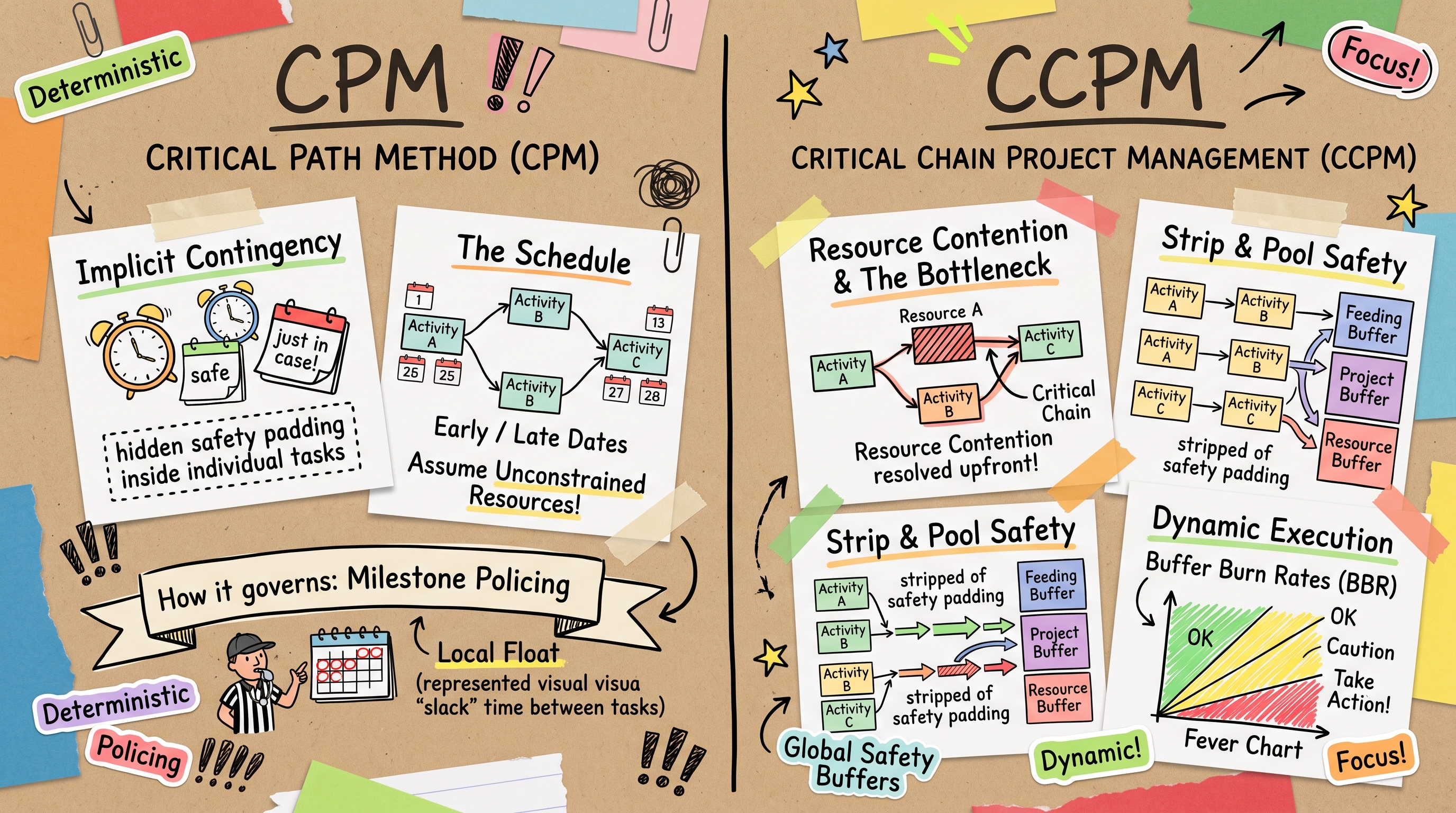
The Critical Path Method (CPM) and Critical Chain Project Management (CCPM) represent two foundational yet philosophically divergent paradigms in project network scheduling. While CPM models a project as a deterministic topological graph of sequential activities governed by mathematical float and fixed early/late calendar dates, CCPM reframes project governance through Eliyahu M. Goldratt's Theory of Constraints (TOC)—identifying human behavioral distortions, resource contention, and statistical variance aggregation as the true primary determinants of on-time delivery.[1][2] CPM embeds safety contingency implicitly inside individual task estimates and polices calendar milestones; CCPM resolves resource contention upfront to isolate a single system bottleneck (the Critical Chain), strips local padding to median durations, aggregates protection into shared strategic buffers (Project, Feeding, and Resource Buffers), and dynamically monitors project health via Buffer Burn Rates (BBR) on a Fever Chart.[3][4]
Theoretical Foundations and Historical Lineage
Traditional project scheduling historically viewed duration as a pure engineering problem dictated by technological task order. Over four decades of empirical delivery failures revealed that deterministic schedules routinely unravel because they ignore human behavioral dynamics and finite resource capacity.
Critical Path Method (CPM): Deterministic Network Logic
Developed in the late 1950s by Morgan R. Walker of DuPont and James E. Kelley Jr. of Remington Rand (first formally published in 1959), CPM emerged to solve the time-cost trade-off problem in complex industrial engineering, chemical plant construction, and shutdown maintenance turnarounds.[1:1][5] Developed concurrently with the U.S. Navy's probabilistic Program Evaluation and Review Technique (PERT) for the Polaris missile project, CPM modeled projects as directed acyclic graphs in which every activity possesses a known, deterministic duration and explicit technological precedence relationships.[1:2][5:1]
In classical CPM formulation, network topology dictates criticality:[1:3]
- Technological Precedence First: Baseline CPM formulation rests strictly on technological task dependencies while initially omitting manpower, specialist availability, and equipment constraints from the primary critical path calculation.[1:4]
- Activity-Oriented Determinism: Variance in individual task durations is assumed to be either negligible or absorbed within conservative single-point estimates, allowing schedules to assign fixed calendar start and finish dates to every work package in the Work Breakdown Structure (WBS).[1:5][5:2]
- Post-Hoc Resource Leveling: As codified in PM - Managing Resources, resource overallocations are treated as a secondary complication addressed only after the mathematical critical path is computed. Schedulers apply post-hoc smoothing or leveling heuristics that delay non-critical tasks within available float or push the project end date outward when capacity limits are breached.[1:6][6]
Critical Chain Project Management (CCPM): Theory of Constraints in Projects
Introduced by physicist and business theorist Eliyahu M. Goldratt in his 1997 management monograph Critical Chain, CCPM applies the manufacturing throughput logic of the Theory of Constraints (TOC) to single-project and multi-project environments.[2:1][3:1] Goldratt recognized that despite forty years of algorithmic refinement and enterprise software adoption, projects continued to suffer chronic cost overruns, compromised scope, and schedule slippage.[7]
CCPM maps TOC's Five Focusing Steps directly onto project portfolio delivery:[2:2][7:1]
- Identify the System Constraint: Locate the Critical Chain, defined not merely as the longest topological path of activities, but as the longest sequence of dependent tasks accounting simultaneously for logical task dependencies and resource contention (scarce shared specialists, physical test rigs, or specialized machinery).[3:2][7:2]
- Exploit the Constraint: Strip wasted time, behavioral delays, and multitasking friction from tasks on the Critical Chain so bottleneck resources execute at maximum throughput, working strictly on one high-priority task at a time without interruptions until completion.[2:3][7:3]
- Subordinate Everything Else: Align all non-critical paths to serve the constraint. Insert Feeding Buffers at merge points and deploy early-warning Resource Buffers ahead of critical-chain handoffs so subordinate workstreams absorb their own variances without starving or stalling the Critical Chain.[2:4][3:3]
- Elevate the Constraint: Only after eliminating behavioral waste and synchronizing handoffs should leadership invest capital to elevate capacity—such as hiring additional bottleneck specialists, cross-training staff, or procuring redundant tooling.[2:5][7:4]
- Prevent Inertia: If an organizational intervention breaks the constraint and the bottleneck shifts to another resource group or workflow chain, re-identify the new constraint immediately rather than allowing obsolete scheduling policies to govern execution.[2:6]
Schedule Mechanics: Deterministic Float vs. Pooled Aggregate Buffers
The fundamental divergence between CPM and CCPM lies in how each paradigm models scheduling flexibility and absorbs stochastic variance across dependent networks.
Forward/Backward Passes, Float, and Critical Path Drag in CPM
CPM constructs a baseline schedule using two deterministic algorithmic sweeps across the Precedence Diagramming Method (PDM) network:[1:7][5:3]
- Forward Pass: Propagates forward from project start (
) to compute the Early Start ( ) and Early Finish ( ) for each activity of duration , taking the maximum among all immediate predecessors at merge nodes: - Backward Pass: Propagates backward from the terminal project deadline to compute the Late Finish (
) and Late Start ( ) for each activity, taking the minimum among all immediate successors at burst nodes:
From these two algorithmic sweeps, CPM calculates Float (Slack) as its primary measure of scheduling flexibility:[1:8]
Activities where
In CPM, float is a passive mathematical byproduct of network topology—dispersed unevenly across non-critical paths while providing zero direct protection to the critical path itself.[8] Because standard CPM defaults to an Early Start schedule, non-critical float is routinely consumed early by casual delays. In CCPM, buffers are deliberate, centralized, statistically sized shock absorbers positioned explicitly at vulnerability junctions to protect throughput and customer commitments.[8:1]
Behavioral Pathologies of Embedded Task Padding
In traditional CPM environments, project accountability centers on hitting intermediate task milestones. Knowing they will be scrutinized when commitments slip, individual contributors and functional managers embed substantial safety padding into every estimate—quoting durations pegged to an
As explored in Parkinson's Law and Student Syndrome (The Psychology of Schedule Slippage), embedding contingency inside individual tasks creates a severe operational blind spot: safety time is systematically destroyed by four reinforcing behavioral and statistical mechanisms:[2:7][3:5]
- Student Syndrome (Procrastination): When assignees know an estimate contains generous padding, initial urgency remains low. Driven by hyperbolic discounting, contributors follow the path of least resistance, deferring active focus until deadline pressure spikes. The safety margin is burned before technical hurdles are discovered.[2:8][3:6]
- Parkinson's Law and Disincentivized Early Finishes: "Work expands to fill the time available for its completion." When execution proceeds smoothly, workers rarely report early completion. Delivering in half the allotted time risks having future baseline estimates ratcheted downward by management, while downstream specialists are seldom positioned to accept early handoffs. Surplus time is absorbed by pace slackening or unnecessary gold-plating.[2:9][3:7]
- Bad Multitasking: When organizations treat knowledge workers as interchangeable cogs in a machine, assignees are forced to cycle across multiple concurrent projects to demonstrate visible progress. Context switching destroys deep focus: interleaving three 10-day tasks in 2-day increments stretches the lead time of every task to 25–30 days, even before accounting for cognitive reset penalties.[2:10][3:8]
- Asymmetric Variance Propagation: Because Parkinson's Law and rigid handoff schedules suppress early completions while unexpected delays pass forward in full, delays accumulate additively downstream, whereas early finishes evaporate.[2:11] When individual task margins are built on sand, deterministic CPM schedules collapse like a house of cards.
Stripping Safety Padding and Consolidating CCPM Buffers
CCPM neutralizes these behavioral traps by decoupling task duration estimation from project risk protection. First, individual task durations are aggressively stripped down to median (
Second, resource contentions are resolved upfront before baseline finalization, establishing a resource-feasible Critical Chain.[2:12][9] Non-critical feeding chains are scheduled as late as safely permissible (ALAP, protected by buffers) to minimize work-in-progress (WIP) and reduce upfront cash burn.[2:13]
Third, the contingency stripped from individual tasks is consolidated into three strategic, pooled buffer types:[3:11][9:1]
- Project Buffer (PB): A centralized time reserve inserted between the final task on the Critical Chain and the promised delivery milestone.[4:3] Overruns on critical-chain activities consume the Project Buffer; early finishes replenish it.[4:4]
- Feeding Buffers (FB): Pooled reserves placed at every convergence junction where a non-critical chain merges into the Critical Chain.[8:2][4:5] Feeding Buffers insulate the main constraint, preventing parallel branch delays from penetrating the Critical Chain and inducing merge bias.[4:6]
- Resource Buffers (RB): Unlike Project and Feeding Buffers, Resource Buffers add zero calendar duration and zero direct cost to the schedule.[2:14][3:12] Functioning as staged early-warning alerts (e.g., countdown notifications at 10 days, 5 days, and 1 day prior to handoff), Resource Buffers ensure scarce specialists clear active queues and prepare their tools so work transitions in a frictionless, relay-runner handoff.[2:15][3:13] (In multi-project portfolios, a fourth construct—the Drum Buffer—staggers project releases around the primary organizational constraint).[4:7]
Under independent task probability distributions, the total variance of a sequential chain equals the sum of individual variances. Consequently, the standard deviation of the aggregate chain scales with the square root of the sum of squared standard deviations, rather than growing linearly:[8:3][9:2]
By pooling stripped task padding into a centralized Project Buffer, CCPM provides equal or greater due-date protection while compressing the total scheduled project timeline by
Buffer Sizing Methodologies in CCPM
Sizing Project and Feeding Buffers correctly is critical: undersized buffers create chronic firefighting and client distress, whereas oversized buffers inflate quoted lead times and erode market competitiveness.[9:4] Two primary analytical methodologies govern buffer sizing in CCPM literature:
1. Cut and Paste Method (C&PM — Goldratt's 50% Heuristic)
Proposed originally by Goldratt in 1997, the Cut and Paste Method slashes safe, padded task estimates (
For a traditional linear chain of four 10-day padded tasks (
Despite its intuitive simplicity, C&PM scales linearly with chain length—tending to oversize buffers on long chains of low-uncertainty tasks and undersize buffers on short chains dominated by volatile R&D activities.[9:6]
2. Root Square Error Method (RSEM)
Formalized by Robert Newbold (1998) and Larry Leach (1999), the Root Square Error Method incorporates task-specific uncertainty by soliciting two duration figures from estimators: a safe estimate (
RSEM mirrors true statistical variance aggregation for independent activities, preventing buffer bloat on large, complex networks.[9:9] Where systemic risks, weather patterns, or shared technical dependencies violate statistical independence, practitioners append a linear risk coefficient or apply network-density and resource-tightness scaling multipliers.[9:10]
Execution Control: Milestone Variance vs. Buffer Burn Rate
Project control methodologies diverge dramatically during execution. While CPM enforces compliance with static calendar dates, CCPM monitors dynamic buffer consumption relative to completed work.
Activity-Level Tracking and Earned Value in CPM
As detailed in PM - Monitoring and Controlling, CPM governs execution by comparing actual progress against baseline start/finish dates using Earned Value Management (EVM) metrics, notably Schedule Variance (
- Masking Critical Slippage: Because Earned Value (
) aggregates monetary budgets across all work packages, a project team can mask severe delays on high-risk critical path activities by accelerating capital-intensive, non-critical tasks ahead of schedule—generating a healthy while the delivery date quietly slips.[8:5] - Percent-Complete Subjectivity: Activity-level tracking relies on subjective "percent complete" estimates, falling prey to the notorious "
complete syndrome," where tasks advance smoothly from to on status dashboards and then stall indefinitely during final debugging, testing, and integration. Planners operate on autopilot, mistaking superficial status reports for genuine deliverable completion.
Buffer Burn Rate (BBR) and Fever Chart Diagnostics in CCPM
CCPM discards percent-complete reporting and task-level due dates entirely, replacing them with a single forward-looking inquiry: Remaining Duration.[4:10] Active task assignees report daily or weekly how many focused days remain to complete their current work. Any difference between remaining duration and the baseline estimate automatically recalculates buffer penetration.[4:11]
Execution health is governed through a single leading indicator—the Buffer Burn Rate (BBR) (or Buffer Consumption Index):[4:12]
Because the Project Buffer exists specifically to absorb expected statistical variance around median (
CCPM visualizes this trajectory on a Fever Chart, plotting % Project Buffer Consumed (y-axis, % Critical Chain Completed (x-axis,
- 🟢 Green Zone (Normal Execution): Buffer penetration is comfortably proportionate to chain progress. Project managers take no intervention, allowing teams to execute without distracting administrative micromanagement.[4:15]
- 🟡 Yellow Zone (Watch and Plan): Buffer burn accelerates beyond chain progress (e.g.,
buffer consumed at chain completion). Management does not disrupt active tasks, but teams diagnose root causes and formulate concrete recovery plans (such as staging backup resources, clearing downstream roadblocks, or re-sequencing non-critical feeds).[4:16] - 🔴 Red Zone (Execute Recovery): Buffer erosion reaches dangerous thresholds, jeopardizing the external delivery commitment.[4:17] Crossing into the Red Zone triggers immediate deployment of the recovery plans formulated during the Yellow phase, recovering buffer capacity before the final milestone is compromised.[4:18]
In multi-project enterprises (Multi-Project Critical Chain, MPCC), plotting the current Fever Chart coordinate of every active project onto a single Portfolio Fever Chart provides executive leadership with an objective priority rule: whenever multiple initiatives contend for a scarce shared resource, dispatch the resource to the task belonging to the project deepest in the Red Zone / highest BBR.[2:16][4:19] This eliminates political escalation battles and prevents toxic context switching across the enterprise.
Comparative Architecture: CPM vs. CCPM
The structural differences between deterministic network logic and constraint-based buffer governance are summarized across key scheduling dimensions:
| Architectural Dimension | Critical Path Method (CPM) | Critical Chain Project Management (CCPM) |
|---|---|---|
| Theoretical Origin | Operations Research & Graph Theory (Kelley & Walker, 1959)[1:10] | Theory of Constraints & Systems Dynamics (Goldratt, 1997)[2:17][7:5] |
| Definition of Criticality | Longest sequence of topologically dependent tasks ( | Longest sequence of precedence- and resource-dependent tasks[3:15][7:6] |
| Resource Constraints | Handled post-hoc via resource leveling and smoothing heuristics[1:12][6:1] | Integrated upfront during network baseline construction[7:7][9:11] |
| Task Duration Basis | Conservative, high-confidence single-point estimates ( | Aggressive median estimates ( |
| Contingency Placement | Hidden locally inside individual tasks; passive float on side paths[8:6] | Pooled into strategic Project, Feeding, and Resource Buffers[3:18][9:12] |
| Default Scheduling Logic | As Soon As Possible (ASAP), inflating early WIP and capital outlay[1:13] | As Late As Safely Possible (ALAP), minimizing WIP and inventory holding |
| Task Execution Ethic | Monitored against fixed start/finish dates; frequent multitasking | Relay-runner ethic: no task due dates; zero bad multitasking[2:18] |
| Execution Metric | Percent Complete ( | Remaining Duration, Buffer Burn Rate (BBR), and Fever Charts[4:22] |
| Multi-Project Priority | Static project priority lists or reactive executive escalation | Dynamic resource dispatch based on relative Project Buffer penetration[2:19][4:23] |
| Primary Behavioral Risk | Parkinson's Law, Student Syndrome, and gold-plating | Estimate inflation if management punishes median ( |
Academic Critiques, Edge Cases, and Domain Fit
While CCPM resolved systemic behavioral flaws in classical scheduling, operations research scholarship—most notably Willy Herroelen and Roel Leus (2000, 2001) alongside Thomas Lechler, Boaz Ronen, and Edward Stohr (2005)—has identified key algorithmic boundary conditions and organizational prerequisites that dictate domain fit.[7:8][6:2]
- Feeding Buffer Insertion Conflicts: Inserting a sized Feeding Buffer into a resource-leveled schedule can push upstream tasks backward prior to project start (
), introduce secondary resource contention, or create a buffered feeding chain whose duration exceeds the original Critical Chain.[6:3][9:13] - NP-Hard Sub-Optimality in RCPSP: Finding the true minimum-makespan resource-feasible schedule is an NP-hard Resource-Constrained Project Scheduling Problem (RCPSP). Herroelen and Leus demonstrated that commercial CCPM heuristics frequently deviate by
to on average—and over in dense networks—from true branch-and-bound mathematical optima.[6:4] - Baseline Rigidity vs. Dynamic Rescheduling: Goldratt discouraged recalculating the Critical Chain during execution to preserve organizational priority stability. However, major scope changes or severe resource outages can shift the true bottleneck onto an unbuffered feeding path if networks are never re-evaluated.[6:5][9:14]
- The Psychological Safety Prerequisite: Slashing task durations by
succeeds only if executive leadership stops penalizing teams when individual tasks overrun their median estimate. Because median estimates overrun of the time by definition, punitive management leads contributors to covertly double their initial bids before applying the cut.[3:20]
Selecting the Optimal Scheduling Methodology by Environment
Organizational context, contracting structures, and uncertainty profiles determine whether CPM, CCPM, or a hybrid model represents the superior framework:
- Where CPM Remains Superior: Large-scale civil engineering, heavy infrastructure, and Engineering-Procurement-Construction (EPC) megaprojects governed by rigid contractual frameworks. When specialized sub-contractors, concrete pours, road closures, and municipal inspection agencies must mobilize on legally locked calendar dates, CPM's fixed milestone dates, contractual float allocation clauses, and Forensic As-Built Critical Path delay-claim auditing remain legally indispensable.[5:6][7:9]
- Where CCPM Excels: High-uncertainty, knowledge-intensive, or internal-resource-constrained environments—including semiconductor development, aerospace engineering, pharmaceutical clinical trials, complex software product portfolios, and high-tempo Maintenance, Repair, and Overhaul (MRO) facilities.[7:10][4:24] Whenever shared engineering specialists bottleneck concurrent workstreams and duration variance is wide, CCPM's elimination of multitasking and Fever Chart buffer governance dramatically outperform deterministic milestone tracking.[7:11][4:25]
- Hybrid Convergence: Modern project delivery organizations increasingly synthesize both frameworks—using CPM network logic and RCPSP algorithms to negotiate contractual release gates with external clients, while utilizing CCPM median estimates, pooled Feeding/Project Buffers, and Fever Chart diagnostics to govern internal execution flow.[8:8][6:6]
🎴 Interactive Web Practice (Comprehension Check)
Question 1 (Network Topology & Criticality Definition): How does the definition of the Critical Chain in CCPM differ fundamentally from the Critical Path in CPM, and why does ignoring resource contention during initial network passes distort project scheduling?
Answer: In classical Critical Path Method (CPM), the critical path is defined strictly as the longest sequence of technologically dependent activities ($TF = 0$) across the network graph. In this initial formulation, resource constraints (labor, specialist availability, physical machinery) are omitted. Resource overallocations are treated only secondarily through post-hoc leveling or smoothing heuristics, which frequently push activities into different time slots, altering float and unexpectedly shifting the critical path.
In Critical Chain Project Management (CCPM), the Critical Chain is defined from the outset as the longest sequence of dependent activities accounting simultaneously for both task precedence and resource contention. If two technologically unrelated activities require the same scarce specialist or test rig concurrently, CCPM recognizes them as sequentially dependent. By resolving resource bottlenecks upfront, CCPM establishes a realistic, resource-feasible constraint that reflects the true operational bottleneck of the enterprise.
Question 2 (Statistical Pooling & Behavioral Buffer Erosion): Why does distributing safety contingency locally inside individual task estimates fail to protect the final delivery date, and how does CCPM leverage the Central Limit Theorem to compress schedules?
Answer: Distributing contingency locally inside individual task estimates fails due to behavioral distortions and asymmetric variance propagation:
- Student Syndrome: Because assignees perceive generous time margins, they delay focused initiation until deadlines become acute, squandering safety margins before technical challenges emerge.
- Parkinson's Law: Work expands to fill available calendar time. Early finishes are not reported or handed off early due to fear of future estimate ratcheting and unready downstream resources.
- Asymmetric Propagation: Early task completions evaporate into idle waiting gaps or gold-plating, whereas delays pass forward unconditionally to downstream dependencies. At network merge points, merge bias forces successor tasks to wait for the latest incoming path, locking in worst-case overruns.
Question 3 (Execution Governance & Fever Chart Diagnostics): Contrast CPM's Earned Value Schedule Performance Index (SPI) with CCPM's Buffer Burn Rate (BBR), and explain how a Fever Chart prevents premature management intervention.
Answer: In CPM, schedule execution is monitored via Earned Value Management (EVM) metrics such as Schedule Variance ($SV = EV - PV$) and the Schedule Performance Index ($SPI = EV / PV$). Because $EV$ aggregates budgeted cost across all work packages, EVM suffers from a dangerous blind spot: project teams can mask critical-path delays by over-producing non-critical, capital-heavy tasks, maintaining an $SPI \approx 1.0$ while the actual completion date slips.
CCPM replaces milestone tracking with the Buffer Burn Rate (BBR):
$$\text{BBR} = \frac{\% \text{ Project Buffer Consumed}}{\% \text{ Critical Chain Completed}}$$
Project health is visualized dynamically on a Fever Chart, which maps buffer consumption against chain completion across three diagnostic zones:- 🟢 Green Zone: Buffer consumption is proportionate to chain progress. Management takes zero action, avoiding micromanagement of normal statistical noise around 50% task estimates.
- 🟡 Yellow Zone: Buffer consumption outpaces chain progress. Teams formulate contingency recovery plans without interrupting active execution flow.
- 🔴 Red Zone: Severe buffer erosion threatens the committed delivery date. Management immediately executes the pre-formulated recovery plans to recover buffer capacity.
Resonant Notes
The following notes in the vault share direct thematic, operational, and mathematical connections with Critical Path Method (CPM) and Critical Chain Project Management (CCPM):
🔴 Project Scheduling, Constraint Governance & Network Optimization
- PM - Work Breakdown Structure — Details activity decomposition, dependency sequencing, Precedence Diagramming Method (PDM), and mathematical float calculations underlying classical CPM.
- PM - Monitoring and Controlling — Analyzes schedule performance metrics (
and ), change control systems, and the operational trade-offs between schedule crashing and fast-tracking. - PM - Managing Resources — Deconstructs resource allocation, leveling, and smoothing, demonstrating why unconstrained initial network passes create severe execution bottlenecks.
- The Triple Constraint (The Iron Triangle of Project Governance) — Sister governance framework illustrating how deterministic scheduling locks Time and Scope baselines, forcing execution variance to degrade central Quality.
- The Ultimate Project Management Jargon Lexicon — Authoritative reference defining essential domain terminology including the critical path, total float, free float, feeding buffers, and crashing.
- Project Management Lifecycles and Gate Deliverables — Details phase-gate governance and formal deliverables required to establish schedule baselines before committing capital.
🟡 Behavioral Economics, Cognitive Distortions & Time Elasticity
- Parkinson's Law and Student Syndrome (The Psychology of Schedule Slippage) — Deconstructs the core behavioral mechanisms that destroy local task buffers, explaining why CPM schedules slip despite generous contingency padding.
- The Planning Fallacy and Reference Class Forecasting — Examines cognitive optimism bias and strategic misrepresentation, demonstrating why internal engineering estimates systematically underestimate project duration and cost.
- Brooks' Law (The Mythical Man-Month & Communication Overhead) — Analyzes the combinatorial communication penalties of adding headcount to late projects, reinforcing why resource contention cannot be solved by simply injecting personnel.
- The McNamara Fallacy — Warns against relying exclusively on quantitative milestone dates and subjective percent-complete metrics while ignoring systemic flow and behavioral realities.
- Cognitive Load Theory — Demonstrates how bad multitasking and constant context switching degrade working memory and multiply execution lead times.
- The Flow State — Explores the neurological conditions required for uninterrupted deep work, contrasting focused single-task flow with fractured multitasking.
🟢 Agile Flow, Resource Management & Systems Dynamics
- Difference Between Agile and Waterfall — Contrasts predictive, deterministic network planning (CPM) with adaptive, empirical iteration and timeboxing that flexes scope.
- Difference Between Just-in-Time (JIT) and Just-in-Case (JIC) — Explores buffer management philosophies, comparing unpooled task padding (Just-in-Case safety) with centralized, pull-based buffer replenishment (Just-in-Time flow).
- Difference Between Efficiency and Effectiveness — Distinguishes between localized resource utilization (busywork and bad multitasking) and systemic project throughput (on-time delivery).
- Frank Gehry's Master-Builder Model - De-Risking Megaprojects Through Simulation and Execution — Illustrates how megaprojects de-risk complex physical networks by front-loading digital simulation to eliminate downstream schedule rework.
- Execution - The Discipline of Getting Things Done — Focuses on executive cadence, operational synchronization, and closing the gap between strategic targets and delivery realities.
- The Pareto Principle (80-20 Rule) — Demonstrates how 80% of project delays typically originate from 20% of shared resource bottlenecks and unmanaged merge junctions.
References
James E. Kelley Jr. and Morgan R. Walker / Critical-Path Planning and Scheduling (1959 Proceedings of the Eastern Joint Computer Conference) / mosaicprojects.com.au ↩︎ ↩︎ ↩︎ ↩︎ ↩︎ ↩︎ ↩︎ ↩︎ ↩︎ ↩︎ ↩︎ ↩︎ ↩︎ ↩︎
Eliyahu M. Goldratt / Critical Chain / books.google.com ↩︎ ↩︎ ↩︎ ↩︎ ↩︎ ↩︎ ↩︎ ↩︎ ↩︎ ↩︎ ↩︎ ↩︎ ↩︎ ↩︎ ↩︎ ↩︎ ↩︎ ↩︎ ↩︎ ↩︎
Baylor University Institutional Repository / Critical Chain Project Management / baylor-ir.tdl.org ↩︎ ↩︎ ↩︎ ↩︎ ↩︎ ↩︎ ↩︎ ↩︎ ↩︎ ↩︎ ↩︎ ↩︎ ↩︎ ↩︎ ↩︎ ↩︎ ↩︎ ↩︎ ↩︎ ↩︎ ↩︎
Praxis Framework / Critical Chain / praxisframework.org ↩︎ ↩︎ ↩︎ ↩︎ ↩︎ ↩︎ ↩︎ ↩︎ ↩︎ ↩︎ ↩︎ ↩︎ ↩︎ ↩︎ ↩︎ ↩︎ ↩︎ ↩︎ ↩︎ ↩︎ ↩︎ ↩︎ ↩︎ ↩︎ ↩︎ ↩︎
Wikipedia Contributors / Critical Path Method / en.wikipedia.org ↩︎ ↩︎ ↩︎ ↩︎ ↩︎ ↩︎ ↩︎
Willy Herroelen and Roel Leus / On the Merits and Pitfalls of Critical Chain Scheduling / semanticscholar.org ↩︎ ↩︎ ↩︎ ↩︎ ↩︎ ↩︎ ↩︎
Thomas G. Lechler, Boaz Ronen, and Edward A. Stohr / Critical Chain: A New Project Management Paradigm or Old Wine in New Bottles? / researchgate.net ↩︎ ↩︎ ↩︎ ↩︎ ↩︎ ↩︎ ↩︎ ↩︎ ↩︎ ↩︎ ↩︎ ↩︎
Project Management Institute / Critical Path or Critical Chain—Combining the Best of Both / pmi.org ↩︎ ↩︎ ↩︎ ↩︎ ↩︎ ↩︎ ↩︎ ↩︎ ↩︎
ResearchGate / Buffer Sizing in Critical Chain Project Management by Network Decomposition / researchgate.net ↩︎ ↩︎ ↩︎ ↩︎ ↩︎ ↩︎ ↩︎ ↩︎ ↩︎ ↩︎ ↩︎ ↩︎ ↩︎ ↩︎ ↩︎