The Planning Fallacy and Reference Class Forecasting
🗂️ Interactive Notebook: Open Study Companion (Video Summary, Flashcards, Mind Map) ↗
The Planning Fallacy is a cognitive phenomenon first formally introduced by psychologists Daniel Kahneman and Amos Tversky in 1979.[1] It describes the systematic tendency of individuals and executive committees to underestimate the time, costs, and risks required to complete future actions while simultaneously overestimating their benefits.[2] This distortion occurs because planners naturally default to the Inside View—constructing idealized, step-by-step mental simulations of the project at hand while remaining captive to an acute cognitive blind spot regarding base-rate historical realities.[3] Economic geographer Bent Flyvbjerg operationalized Kahneman and Tversky's corrective theory into Reference Class Forecasting (RCF), an empirical methodology based on the Outside View that anchors forecasts to the actual historical distributions of comparable completed projects.[2:1]
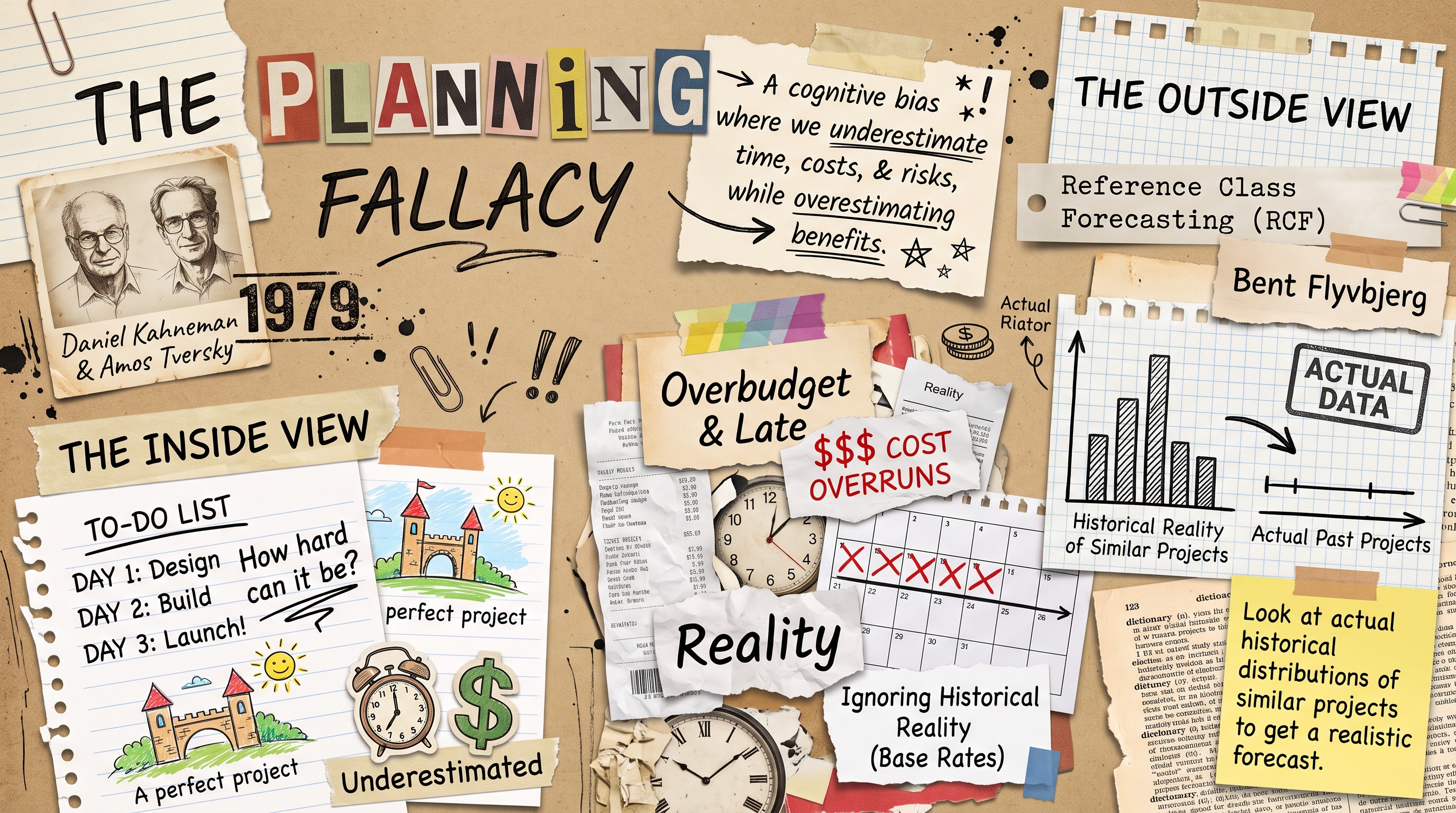
Origins and Cognitive Foundations
In 1979, Daniel Kahneman and Amos Tversky published their seminal framework on intuitive prediction, distinguishing between two fundamentally different types of evidence available to forecasters: singular information (case-specific details about the unique endeavor under consideration) and distributional information (statistical base-rate data drawn from analogous past events).[1:1] Human intuition overwhelmingly favors singular narratives over dry statistical distributions, leading decision-makers to fall into the trap of the planning fallacy.[1:2]
The Curriculum Textbook Anecdote
The real-world genesis of Kahneman's insight occurred in 1976, when he joined a committee tasked with designing a curriculum and writing a textbook on judgment and decision-making for Israeli high schools.[4] After the team had worked together for about a year and drafted a couple of chapters, Kahneman polled every member on how long it would take to submit a finished manuscript.[4:1] Every committee member gave an estimate between 1.5 and 2.5 years, centering around two years.[4:2]
Kahneman then turned to Seymour Fox, the curriculum expert on the team, and asked him to recall other teams with similar profiles that had built new curricula from scratch.[4:3] Momentarily shifting from his specific team to his broader professional memory, Fox went silent before admitting two jarring facts: roughly 40 percent of comparable curriculum teams eventually abandoned their efforts without ever finishing, and of those that succeeded, none completed the task in fewer than seven years—nor more than ten.[4:4] Furthermore, Fox judged Kahneman's group to be slightly below average in resources and cohesion compared to past teams.[4:5]
Despite receiving explicit base-rate proof from their own resident expert that their two-year timeline was statistically impossible, the committee ignored the distributional data and pressed forward without modifying their plan.[4:6] The textbook ultimately took eight years to finish—by which time Kahneman had moved away and the Israeli Ministry of Education no longer had much enthusiasm for the product.[4:7]
Psychological Drivers of the Fallacy
Subsequent laboratory and field research—most notably by Roger Buehler, Dale Griffin, and Michael Ross in 1994—validated Kahneman and Tversky's observations across academic, personal, and corporate tasks.[5] In their classic study tracking university honors theses, students estimated their "most realistic" completion time at an average of 33.9 days, yet actual completion averaged 55.5 days, with only 29.7 percent finishing by their predicted date.[5:1]
Several interconnected cognitive mechanisms drive this systematic bias:
- WYSIATI (What You See Is What You Get): Coined by Kahneman in Thinking, Fast and Slow, this principle describes how System 1 (fast, associative thinking) constructs the most coherent story possible solely from information currently in focus.[4:8] Because planners cannot consciously visualize unknown unknowns—unforeseen supply chain shocks, regulatory shifts, illness, or technical dead-ends—those risks are assigned an implicit probability of zero.[4:9]
- Optimism Bias and the Illusion of Control: Decision-makers harbor an exaggerated belief in their own managerial skill relative to peers and assume they can steer clear of obstacles that derailed others.[3:1] When teams follow the path of least resistance, wishful projections replace empirical risk modeling.
- Anchoring to Initial Plans: Once a preliminary timeline or budget is sketched—often under conditions of incomplete engineering or scope clarity—that initial figure acts as a psychological anchor.[3:2] Subsequent adjustments away from an anchor are almost always insufficient, leaving schedules built on sand.[3:3]
- Asymmetric Attribution of Past Failures: Buehler, Griffin, and Ross demonstrated that even when individuals vividly remember missing past deadlines, they attribute those prior delays to external, transient, one-off flukes ("my computer crashed" or "a vendor failed once") rather than systemic planning errors, thereby walling off historical lessons from current estimates.[5:2]
- Competitor Neglect: In executive strategy, Dan Lovallo and Daniel Kahneman noted that committees focus intensely on their own firm's capabilities and plans while failing to model how rivals will react to the same market opportunity, leading to glutted markets and exaggerated revenue forecasts.[3:4]
Executive Committees and Strategic Misrepresentation
While cognitive psychologists initially treated the planning fallacy as an honest error of human intuition, economic geographer Bent Flyvbjerg demonstrated that when forecasts move from individuals to executive committees and public agencies, psychological delusions fuse with organizational politics and misaligned incentives.[6]
Survival of the Unfittest
In a sharp 2003 commentary in the Harvard Business Review responding to Lovallo and Kahneman, Flyvbjerg argued that cognitive bias alone could not account for the magnitude and directional consistency of executive forecasting failures.[6:1] He introduced strategic misrepresentation—the deliberate, politically or economically motivated "cooking" of costs downwards and benefits upwards in order to get a project approved and funded.[6:2]
Within capital-allocation committees, business units and public contractors compete fiercely for finite capital budgets.[3:5] When governance frameworks reward compelling business cases rather than historical realism, an evolutionary perversion occurs that Flyvbjerg calls the Survival of the Unfittest:
- Selection Bias for Fantasy: Projects whose sponsors present honest, realistic budgets and sober benefit projections look unattractive on paper and are rejected at the gate.[3:6]
- Rewarding Underestimation: Projects whose sponsors present artificially low costs and inflated returns win executive approval, locking the institution into the very initiatives most guaranteed to blow past their budgets.[6:3]
- Suppression of Dissent: Inside executive committees, bearers of pessimistic sensitivity analyses are stigmatized as disloyal or lacking vision, causing individual optimism biases to become mutually reinforcing groupthink.[3:7] Subordinates learn to turn a blind eye to mounting schedule friction.
- Principal-Agent Moral Hazard: Project champions, consultants, and politicians routinely capture career promotions or political credit at the ribbon-cutting or ground-breaking stage, long before final cost overruns materialize years later under a successor's tenure.[7] When crises emerge, executives reflexively point the finger at unexpected external conditions or throw junior contractors to the wolves.
The Iron Law of Megaprojects
To quantify the real-world fallout of the Inside View and strategic misrepresentation, Flyvbjerg and his colleagues at the University of Oxford compiled the world's largest database of major capital ventures—encompassing more than 16,000 projects across 136 countries and more than 20 distinct fields, from bridges, tunnels, and airports to defense acquisitions, Olympic Games, and enterprise IT transformations.[7:1]
From this empirical archive, Flyvbjerg formulated the Iron Law of Megaprojects: "Over budget, over time, under benefits, over and over again".[7:2] Across the entire 16,000-plus project dataset published in How Big Things Get Done (2023), the empirical completion rates expose a catastrophic failure of conventional executive planning, operating in plain sight across decades of infrastructure data:[8]
- 47.9% of projects are completed on or under budget.[7:3]
- 8.5% of projects hit both their budget and schedule targets.[7:4]
- 0.5%—just one in two hundred projects—deliver on budget, on time, and with the promised benefits.[7:5]
Furthermore, project risk exhibits fat-tailed distributions (extreme right-skewness). For certain categories—such as enterprise IT replacements, nuclear power plants, and Olympic infrastructure—mean cost overruns exceed 100 percent in real terms, and tail events routinely threaten the solvency of sponsoring corporations or municipalities.[7:6]
"No less than 92% of megaprojects come in over budget or over schedule, or both... Approximately one in ten megaprojects is on budget, one in ten is on schedule, and one in ten delivers the promised benefits." — The Iron Law of Megaprojects[7:7]
Inside View vs. Outside View
The foundational dichotomy at the heart of Kahneman, Tversky, and Flyvbjerg's work is the contrast between two incompatible modes of forecasting: the Inside View and the Outside View.[3:8] While traditional organizations maintain an outward facade of quantitative rigor, bottom-up plans often deploy complex spreadsheets as smoke and mirrors that conceal structural vulnerability.
| Dimension | The Inside View (Conventional Planning) | The Outside View (Reference Class Forecasting) |
|---|---|---|
| Primary Question | "How will our specific plan unfold step-by-step?" | "What actually happened to comparable projects in the past?" |
| Evidence Type | Singular information (project architecture, WBS, internal milestones) | Distributional information (empirical base rates, historical variance) |
| Core Assumption | Our project is unique; our team and mitigation plans will prevail | Our project is no more special or immune to friction than its statistical peers |
| Treatment of Unknowns | Fails to account for "unknown unknowns"; uses arbitrary rules of thumb (e.g., 10–15%) | Automatically captures all historical "unknown unknowns" embedded in actual past outcomes |
| Vulnerability to Bias | Highly vulnerable to WYSIATI, anchoring, and strategic misrepresentation | Bypasses cognitive optimism and political manipulation via external empirical anchors |
Why Bottom-Up Contingency Modeling Fails
Conventional project management relies on bottom-up engineering estimates—such as Work Breakdown Structures (WBS), Gantt charts, Critical Path Method (CPM), and Monte Carlo simulations parameterized by internal experts.[2:2] While essential for operational coordination during execution, these tools remain trapped inside the Inside View when used for upfront cost and schedule forecasting.[3:9]
When planners add a standard 10 percent or 15 percent contingency reserve onto a bottom-up estimate, they anchor to an idealized base number and only price in "known unknowns" (risks they can explicitly imagine).[4:10] As soon as unpredicted geotechnical hurdles or regulatory changes throw a wrench in the works, the arbitrary buffer is instantly wiped out, turning deterministic projections into an operational house of cards.
By contrast, the Outside View treats the project as an unexceptional black box drawn from a broader statistical population, ensuring that every unforeseen permitting battle, scope expansion, and vendor bankruptcy that afflicted past peers is mathematically priced into the baseline distribution.[2:3]
Reference Class Forecasting (RCF): Methodology and Practice
Building directly on Kahneman and Tversky's 1979 corrective procedures,[1:3] Flyvbjerg worked with the UK Department for Transport and Dutch ministries in the early 2000s—and gained formal endorsement from the American Planning Association (APA) in 2005—to turn the Outside View into a rigorous, auditable protocol known as Reference Class Forecasting.[2:4][9]
The Three-Step RCF Protocol
Implementing Reference Class Forecasting requires executing three sequential empirical steps:[2:5][9:1]
- Identify a Relevant Reference Class: Select a sample of completed historical projects that is broad enough to be statistically meaningful (typically
to at minimum) yet narrow enough to share core structural risk characteristics with the proposed venture (e.g., urban underground metro extensions rather than generic surface rail, or cloud ERP migrations in regulated financial firms rather than routine software patches).[2:6] - Establish the Empirical Probability Distribution: Gather audited actual-versus-estimated data for the chosen reference class regarding cost overruns, schedule slippage, and benefit shortfalls.[2:7] Plot the empirical cumulative distribution to reveal both the mean/median overrun and the thickness of the tail risk.[2:8]
- Compare the Specific Project and Determine Required Uplifts: Situate the current project's baseline Inside View estimate against the reference class distribution to calculate the exact optimism bias uplift required to achieve the organization's chosen risk tolerance (acceptable probability of overrun).[2:9]
In Flyvbjerg's landmark transportation infrastructure implementation, empirical curves map acceptable risk of overrun directly to required budget uplifts.[2:10] If an executive board or treasury accepts a 50% probability of cost overrun (P50)—meaning a coin-flip chance of staying within budget—a rail project might require roughly a 40% capital uplift over its conventional engineering estimate, whereas a 20% acceptable risk of overrun (P80 certainty) requires roughly a 57% uplift above the baseline Inside View budget.[2:11]
Institutional Adoption and Policy Impact
Reference Class Forecasting has transitioned from behavioral economics theory into mandatory public and corporate governance standards worldwide:
- United Kingdom (HM Treasury Green Book): Following Flyvbjerg's studies, HM Treasury integrated mandatory "Optimism Bias Uplifts" into its Green Book appraisal guidelines, requiring public infrastructure proposals to adjust capital budgets upward based on empirical reference classes before receiving funding approval.[9:2]
- American Planning Association (APA): In April 2005, the APA issued an official policy endorsement instructing planners never to rely solely on conventional Inside View engineering techniques, recommending RCF alongside traditional methods for all non-routine projects.[2:12]
- Global Infrastructure & Enterprise Governance: Governments and oversight bodies in Denmark, the Netherlands, Switzerland, Australia, and Hong Kong—alongside major capital-allocation committees in Fortune 500 corporations—use RCF to audit flagship capital expenditures and IT transformations prior to final investment decisions.[8:1]
Balancing Optimism and Realism in Governance
A subtle tension raised by Lovallo and Kahneman in Delusions of Success—and refined by Flyvbjerg and Dan Gardner in How Big Things Get Done—is that executive realism and operational optimism serve distinct organizational roles.[3:10][8:2]
Separation of Forecasting and Delivery Incentives
Lovallo and Kahneman point out that while delusional optimism is ruinous when selecting which projects to fund and allocating capital reserves, a healthy degree of optimism and urgency remains vital during execution to maintain morale, persistence, and creative problem-solving in the face of inevitable setbacks.[3:11] If operational delivery teams are simply handed a massive P80 budget and an elongated RCF schedule as their working target, Parkinson's Law takes hold—work and spending expand to consume the entire padded allowance, and early finishes evaporate.[3:12]
To prevent both catastrophic insolvency and operational slack, mature executive committees separate governance contingencies from delivery targets:[3:13][8:3]
- Executive Portfolio Level (Outside View): The CFO and Investment Committee hold the Reference Class uplift (e.g., the difference between P50 or P80 and the baseline estimate) at the portfolio or treasury level to guarantee liquidity and evaluate return on invested capital realistically.[3:14]
- Project Delivery Level (Disciplined Execution): Project managers remain incentivized against tight, modular milestones, accessing executive risk reserves only through transparent governance triggers rather than treating contingency funds as free spending authority.[3:15]
Complementary Debiasing Heuristics
Alongside Reference Class Forecasting, Kahneman, Gary Klein, and Flyvbjerg advocate three structural safeguards to inoculate executive committees against the planning fallacy:
- The Premortem (Gary Klein): Advocated enthusiastically by Kahneman, a premortem convenes the project team just before formal commitment and presents a hypothetical prompt: "Imagine we are looking into a crystal ball one year from today, and this project has failed catastrophically. Take ten minutes to write down the exact history of why it failed".[4:11] By legitimizing dissent and framing risk-spotting as a puzzle of prospective hindsight, the premortem breaks organizational groupthink.[4:12]
- "Think Slow, Act Fast" (Bent Flyvbjerg): Flyvbjerg's empirical data shows that successful projects spend disproportionate time in the planning, simulation, and prototyping phase—iterating cheaply in digital twins, storyboards (as practiced by Pixar), or testbeds—before ever breaking ground or signing massive construction contracts.[8:4] As demonstrated in Frank Gehry's master-builder approach, front-loading digital simulation de-risks megaprojects. Rushing into physical execution ("acting fast before thinking slow") exposes the project to multi-year delays inside its highest-burn-rate window.[8:5]
- Modularity and Reversibility: Megaprojects with monolithic, bespoke designs ("monoliths") suffer extreme tail risk.[8:6] Breaking ambitious initiatives into small, replicable, standardized building blocks (such as solar arrays, modular data centers, or iterative software releases) allows teams to build an internal reference class rapidly, compounding positive learning curves with every repetition.[8:7]
🎴 Interactive Web Practice (Comprehension Check)
Question 1 (Cognitive Foundations & The Inside View): Why do planners systematically underestimate completion times and budgets according to Kahneman and Tversky, and why did the Israeli curriculum committee press forward despite explicit distributional warnings?
Answer: Kahneman and Tversky identify the root cause of the planning fallacy as an intuitive cognitive asymmetry: planners default to singular information (the Inside View), constructing detailed, idealized mental simulations of how their specific project will proceed step-by-step. Because human System 1 cognition operates on WYSIATI (What You See Is What You Get), risks that cannot be readily visualized—unforeseen vendor delays, regulatory pivots, technical bugs, or team illnesses—are assigned an implicit probability of zero.
In the case of the Israeli curriculum textbook committee, Seymour Fox provided explicit distributional information (the Outside View): 40% of comparable initiatives failed entirely, and successful projects required 7 to 10 years. The committee nonetheless ignored this statistical reality because human intuition views its own effort as unique, talented, and immune to historical friction. The vivid, coherent narrative of their internal plan psychologically overwhelmed the abstract, dry base rates of past peers.
Question 2 (Strategic Misrepresentation & The Iron Law): How does Bent Flyvbjerg distinguish cognitive bias from strategic misrepresentation, and why does capital-allocation governance produce the "Survival of the Unfittest"?
Answer: While cognitive psychologists treat the planning fallacy as an honest psychological error (delusional optimism), Bent Flyvbjerg demonstrates that in corporate and public governance, forecasting failures are heavily amplified by strategic misrepresentation—the deliberate political and economic distortion of estimates to win project approval and funding. Proponents intentionally underestimate costs and inflate promised benefits because capital budgets are finite and fiercely contested.
This creates Flyvbjerg's evolutionary perversion, the Survival of the Unfittest:
- Sponsors presenting honest, realistic budgets and sober returns look unattractive on paper and are rejected during capital allocation.
- Sponsors presenting artificially low costs and exaggerated benefits win executive sign-off, systematically selecting and funding the very projects most structurally guaranteed to blow past their budgets.
- Principal-Agent Moral Hazard: Project champions, politicians, and consultants capture reputational or financial rewards at project approval or groundbreaking, long before catastrophic cost overruns materialize years later under successor management.
Question 3 (Reference Class Forecasting & Dual-Level Governance): Explain the three-step Reference Class Forecasting (RCF) protocol and describe how mature organizations separate governance reserves from delivery targets to prevent Parkinson's Law.
Answer: Reference Class Forecasting (RCF) operationalizes the Outside View across three empirical steps:
- Identify a Relevant Reference Class: Select a statistically meaningful historical sample ($N \ge 20\text{--}30$) of completed past projects sharing core structural risk profiles with the proposed venture.
- Establish the Empirical Distribution: Compile audited actual-versus-estimated data for cost overruns, schedule slippage, and benefit shortfalls to map the empirical cumulative probability distribution (revealing median overruns and fat-tail risks).
- Calculate Risk-Adjusted Uplifts: Position the baseline Inside View estimate against the empirical distribution to determine the exact percentage uplift required to match the sponsor's risk appetite (e.g., a 40% uplift for P50 certainty, or 57% for P80 certainty in rail infrastructure).
- Portfolio / Treasury Level (Outside View): The CFO and Investment Committee hold the empirical RCF uplift centrally to ensure organizational solvency and evaluate authentic ROI.
- Project Team Level (Disciplined Execution): Project delivery managers are held accountable to aggressive, modular baseline targets without direct access to the RCF reserve, accessing pooled contingency only through formal governance change gates.
Resonant Notes
The following notes in the vault share direct thematic, operational, and psychological connections with the Planning Fallacy and Reference Class Forecasting:
🔴 Project Governance, Risk Modeling & Infrastructure Planning
- The Triple Constraint (The Iron Triangle of Project Governance) — Sister governance framework illustrating how the planning fallacy distorts upfront Scope, Cost, and Time baselines before projects even launch.
- PM - Assessing Risk — Outlines proactive risk identification, threat assessment matrices, and why conventional contingency percentages fail to buffer tail risks.
- PM - Work Breakdown Structure — Analyzes bottom-up work package decomposition, illustrating how deterministic CPM networks remain inherently trapped inside the Inside View.
- PM - Monitoring and Controlling — Deconstructs variance analysis, cost performance baselines, and why initial project anchors distort ongoing progress tracking.
- Project Risk Management - A Comprehensive Guide to Identifying and Managing Project Threats — Synthesizes enterprise threat modeling, showing how cognitive optimism leads teams to ignore fat-tailed distributions.
- Project Management Lifecycles and Gate Deliverables — Details phase-gate governance and exit criteria required to challenge singular narratives before capital commitment.
- The Ultimate Project Management Jargon Lexicon — Authoritative reference defining critical execution concepts including optimism bias uplifts, stage gates, risk reserves, and baseline variance.
🟡 Behavioral Economics, Cognitive Heuristics & Decision Theory
- Parkinson's Law and Student Syndrome (The Psychology of Schedule Slippage) — Analyzes the behavioral mechanics of deadline failure, showing how optimistic schedules interact with pace slackening and student procrastination.
- Brooks' Law (The Mythical Man-Month & Communication Overhead) — Demonstrates how reactive management interventions and adding headcount to late projects compound schedule slippage through communication overhead.
- Confirmation Bias — Explains why executive sponsors selectively hunt for evidence confirming their optimistic business cases while ignoring contrary base rates.
- Cognitive Dissonance — Analyzes the psychological discomfort experienced by executive sponsors when actual performance diverges from optimistic forecasts, driving defensive escalation of commitment.
- The McNamara Fallacy — Warns against relying exclusively on narrow, quantifiable singular metrics while ignoring broader systemic realities and distributional base rates.
- The Eisenhower Matrix (Urgent vs. Important) — Prioritization heuristic used by project leaders and Product Owners to balance urgent firefighting against high-value strategic deliverables.
🟢 Megaproject Execution, Modular Design & Strategic Management
- Frank Gehry's Master-Builder Model - De-Risking Megaprojects Through Simulation and Execution — Case study of Flyvbjerg's exemplar for "thinking slow and acting fast," using 3D digital twins to de-risk complex architecture before physical execution.
- The Anatomy of a Project Disaster - RMS Titanic Case Study — Post-mortem investigation illustrating how unchecked executive optimism, commercial schedule pressure, and compromised risk margins lead to catastrophic failure.
- Difference Between Efficiency and Effectiveness — Distinguishes between internal process execution (efficiency) and selecting the right projects through unbiased reference class evaluation (effectiveness).
- Difference Between Agile and Waterfall — Contrasts predictive long-horizon planning (vulnerable to the planning fallacy) with adaptive, empirical feedback loops that adjust baselines iteratively.
- Execution - The Discipline of Getting Things Done — Focuses on executive realism, operational accountability, and closing the gap between strategic optimism and execution discipline.
- Stakeholder Mapping and Analysis — Diagnostic framework for managing stakeholder expectations and neutralizing political pressures that incentivize strategic misrepresentation.
References
Daniel Kahneman & Amos Tversky / Intuitive Prediction: Biases and Corrective Procedures / cambridge.org ↩︎ ↩︎ ↩︎ ↩︎
Bent Flyvbjerg / From Nobel Prize to Project Management: Getting Risks Right / arxiv.org ↩︎ ↩︎ ↩︎ ↩︎ ↩︎ ↩︎ ↩︎ ↩︎ ↩︎ ↩︎ ↩︎ ↩︎ ↩︎
Dan Lovallo & Daniel Kahneman / Delusions of Success: How Optimism Undermines Executives' Decisions / gurooproducer.com ↩︎ ↩︎ ↩︎ ↩︎ ↩︎ ↩︎ ↩︎ ↩︎ ↩︎ ↩︎ ↩︎ ↩︎ ↩︎ ↩︎ ↩︎ ↩︎
Daniel Kahneman / Thinking, Fast and Slow / wikipedia.org ↩︎ ↩︎ ↩︎ ↩︎ ↩︎ ↩︎ ↩︎ ↩︎ ↩︎ ↩︎ ↩︎ ↩︎ ↩︎
Roger Buehler, Dale Griffin & Michael Ross / Exploring the "Planning Fallacy": Why People Underestimate Their Task Completion Times / mit.edu ↩︎ ↩︎ ↩︎
Bent Flyvbjerg / Delusions of Success: Comment on Dan Lovallo and Daniel Kahneman / arxiv.org ↩︎ ↩︎ ↩︎ ↩︎
Bent Flyvbjerg / The Iron Law of Megaprojects / budgetoverrun.com ↩︎ ↩︎ ↩︎ ↩︎ ↩︎ ↩︎ ↩︎ ↩︎
Bent Flyvbjerg & Dan Gardner / How Big Things Get Done / prh.com ↩︎ ↩︎ ↩︎ ↩︎ ↩︎ ↩︎ ↩︎ ↩︎
Bent Flyvbjerg / Curbing Optimism Bias and Strategic Misrepresentation in Planning: Reference Class Forecasting in Practice / repec.org ↩︎ ↩︎ ↩︎