The Architecture of Precarity - Low-Road Capitalism, Workplace Fissuring, and Algorithmic Labor Control
🗂️ Interactive Notebook: Open Study Companion (Video Summary, Flashcards, Mind Map) ↗
Engineered precarity describes a deliberate corporate strategy wherein organizations systematically manufacture workplace instability, temporal unpredictability, and legal fragmentation to compress operational labor costs and maximize short-term capital margins.[1][2] Rather than an accidental byproduct of competitive market forces, contemporary labor precarity is actively architected across three interdependent dimensions: macro-organizational restructuring (low-road employment, corporate boundary fissuring, and contract casualization), temporal, statutory, and market controls (just-in-time algorithmic scheduling, statutory benefit-cliff hours rationing, and geographic labor monopsony), and sector-wide operational templates (the Wal-Martization of frontline labor and algorithmic churn-and-burn fulfillment networks).[2:1][3][4] By decoupling brand equity and operational command from statutory employer liability, lead enterprises externalize the social costs of workforce subsistence onto public safety nets and frontline families while treating human labor as a frictionless, on-demand variable cost.[3:1][5][6]
1. Macro-Organizational Structures & Corporate Boundary Fissuring
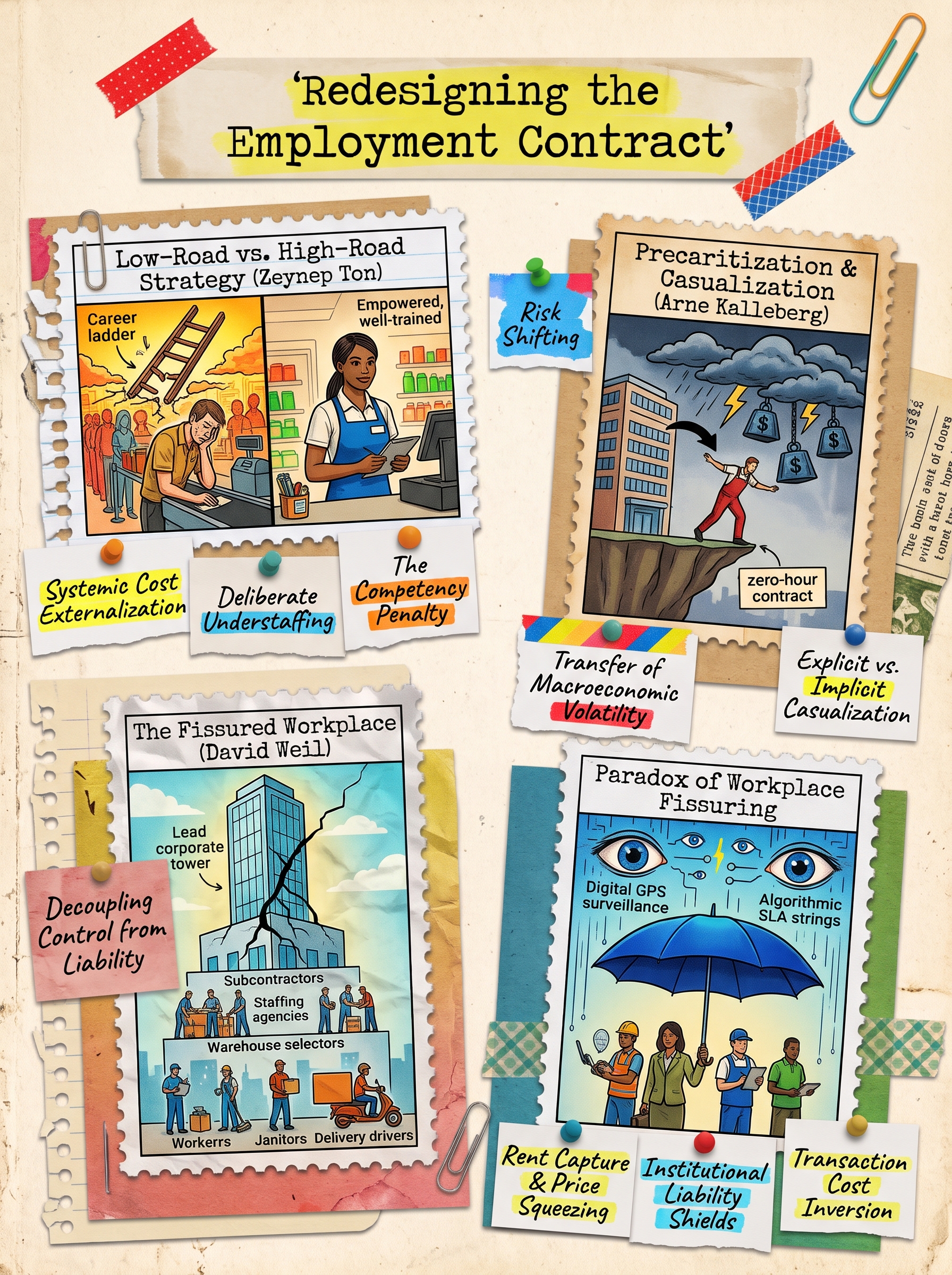
At the macro-organizational level, corporations reduce fixed structural liabilities by redesigning the traditional employment contract itself. By dissolving the post-World War II standard employment relationship, enterprises transform predictable career ladders into fragmented, contingent, and variable-cost transactions.[2:2][3:2]
Low-Road Capitalism vs. The High-Road Strategy
In institutional labor economics and operations management, low-road capitalism (or the low-road employment model) defines an operational regime that treats frontline labor strictly as an accounting expense to be minimized rather than a productive human capability to be cultivated.[1:1]
Management scholar Zeynep Ton contrasts this "bad jobs strategy" with the high-road strategy (or "Good Jobs Strategy"). Exemplified by retail and logistics operators such as Costco, Trader Joe's, QuikTrip, and Mercadona, the high-road approach recognizes that well-compensated, thoroughly trained, and empowered employees generate higher operational efficiency, inventory precision, and customer lifetime value.[1:2]
Conversely, low-road enterprises follow the path of least resistance, institutionalizing a self-reinforcing operational doom loop:[1:3]
- Systemic Cost Externalization: Low-road firms build high employee attrition, suppressed entry wages, and minimal statutory benefits directly into their corporate pro formas. Within these organizations, employee turnover is not viewed as a management failure, but as a calculated mechanism to prevent tenure-based wage increments and pension vesting.[1:4][2:3]
- Deliberate Understaffing as an Operating Margin Buffer: While high-road firms maintain operational "slack"—ensuring baseline staffing buffers to manage peak volume and maintain service standards—low-road organizations operate on razor-thin headcount.[1:5] They accept operational friction, inventory shrinkage, long checkout queues, and worker exhaustion as acceptable trade-offs for immediate payroll compression.[1:6]
- The Competency Penalty: Because low wages and erratic conditions generate chronic attrition, low-road firms continuously onboard inexperienced personnel, degrading organizational memory and customer service while executives construct a defensive facade of operational efficiency.[1:7]
Precaritization, Casualization, and Risk Transference
Sociologists utilize the concept of precaritization to describe the structural dismantling of the "standard employment relationship"—the mid-twentieth-century industrial compact characterized by full-time, indefinite, direct employment backed by employer-funded health coverage, paid leave, and retirement pensions.[2:4][7]
As formulated by sociologist Arne Kalleberg, precarious work is fundamentally defined by risk shifting:[2:5]
- The Transfer of Macroeconomic Volatility: In traditional employment models, the corporate firm absorbed market fluctuations, buffering workers from demand downturns through retained earnings.[2:6] Under engineered precarity, corporations shift macroeconomic, cyclical, and operational risks entirely onto the balance sheets of individual workers and households.[2:7][7:1]
- Explicit vs. Implicit Casualization: Casualization refers specifically to the systematic restructuring of a firm's workforce around contingent, part-time, seasonal, temporary-agency, or zero-hour contracts.[7:2] Through casualization, enterprise leadership maintains an elastic labor pool that can be deployed or discarded instantaneously, ensuring that frontline workers remain in a permanent sink-or-swim predicament while the corporation preserves balance sheet agility.[7:3]
David Weil's Fissured Workplace: Decoupling Control from Liability
Coined by labor economist and former U.S. Department of Labor Wage and Hour Administrator David Weil, the fissured workplace represents the core structural blueprint of contemporary low-road employment.[3:3] Lead corporations systematically shed the direct legal employment of their operational workforces—including warehouse selectors, janitors, security officers, delivery drivers, call-center agents, and hotel housekeepers—by outsourcing these functions to sprawling tiers of third-party staffing agencies, subcontractors, independent franchisees, and labor brokers.[3:4][8]
Workplace fissuring decouples operational command from legal employer liability. Lead brand corporations utilize proprietary software, stringent Service Level Agreements (SLAs), and real-time algorithmic telemetry to enforce exacting operational control over every minute of frontline work, while legally delegating wage compliance, workplace safety, payroll taxes, and collective bargaining obligations to thin-margin subcontractors.[3:5][8:1]
This structural disintegration generates severe economic distortions across the value chain:
- Rent Capture and Downward Price Squeezing: Lead enterprises orchestrate hyper-competitive bidding environments where secondary and tertiary subcontractors compete fiercely on price.[3:6] Because labor represents virtually 100% of a subcontractor's variable costs in service industries, the only way for a third-party vendor to secure a contract and extract profit is by aggressively compressing wages, cutting safety training, or committing wage theft.[3:7][8:2]
- Institutional Liability Shields: When wage-and-hour violations, workplace fatalities, or sexual harassment scandals occur, the lead corporation uses its fissured legal structure to wash its hands of culpability, claiming that frontline workers are technically employees of an independent vendor.[3:8] When regulators investigate, lead executives readily throw the subcontractor to the wolves, terminating the vendor agreement while leaving systemic working conditions unchanged.[3:9][8:3]
- Transaction Cost Inversion: As explored in Transaction Cost Economics, while Ronald Coase demonstrated that firms internalize transactions when contracting friction is high, modern digital surveillance, cloud software, and GPS tracking slash monitoring costs.[3:10] Lead firms can now coordinate external vendor labor with the same precision as internal departments without bearing the legal obligations of the employment contract.[3:11]
2. Temporal, Statutory, and Market Mechanisms of Labor Control
Beyond structural fissuring, corporations operating in retail, food service, hospitality, and warehousing retain workers directly on corporate rosters while engineering precarity through algorithmic shift allocation, statutory threshold evasion, and local labor market dominance.[5:1][9][10]
Just-in-Time (JIT) Algorithmic Scheduling
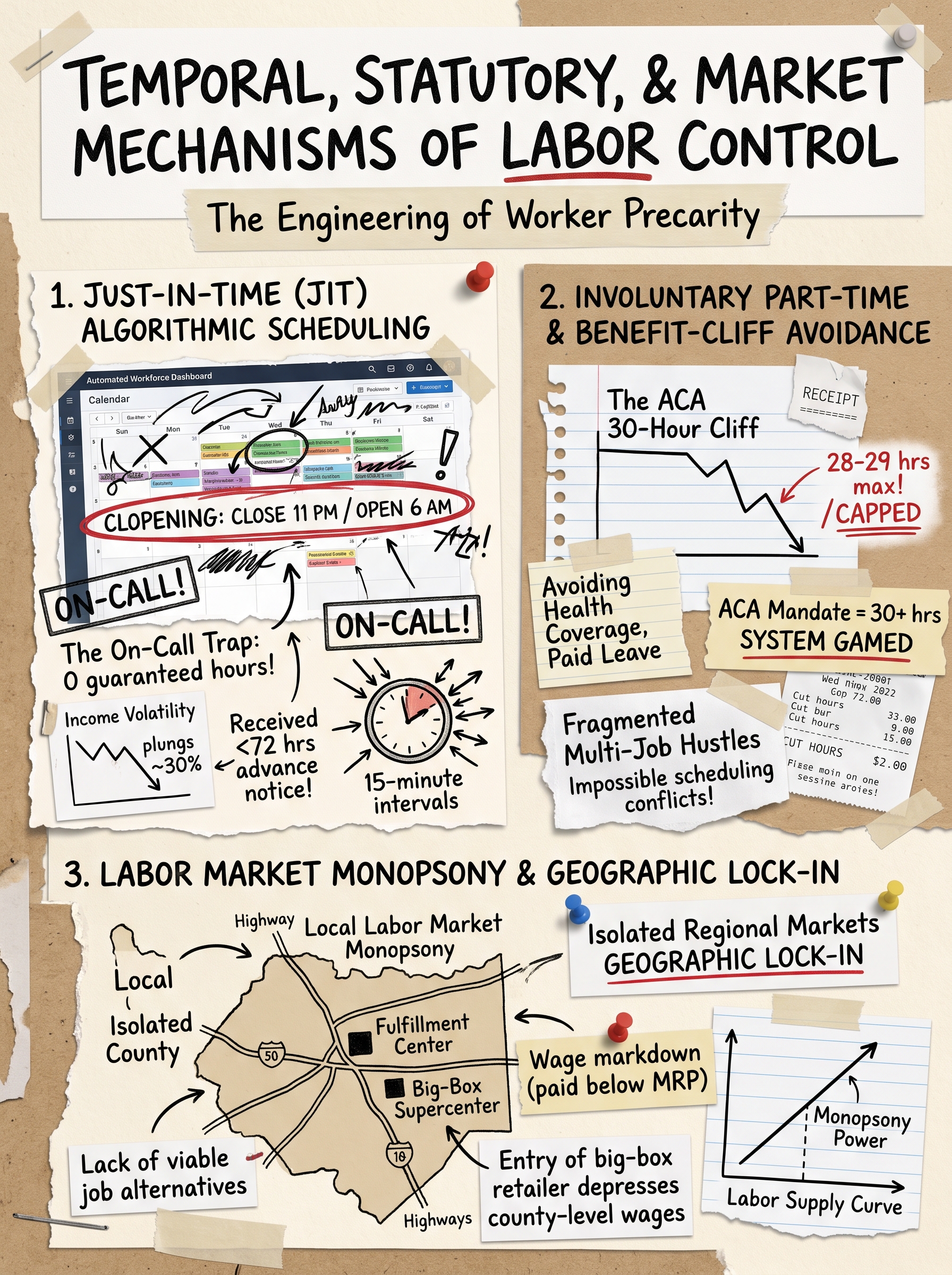
Adapted from Toyota's lean manufacturing principles and global supply-chain logistics, just-in-time (JIT) scheduling (or automated workforce management) synchronizes labor inputs with consumer demand in real time.[5:2] Sophisticated scheduling software integrates point-of-sale (POS) terminal activity, foot-traffic footfall sensors, weather forecasts, and historical transactional patterns to calibrate staffing allocations down to 15-minute intervals.[5:3][11]
Empirical research led by Daniel Schneider and Kristen Harknett at The Shift Project documents the devastating human and economic impacts of algorithmic scheduling on service-sector employees:[5:4]
- Temporal Instability and Unpredictability: Workers receive their weekly schedules with minimal advance notice (often less than 48 to 72 hours), experiencing volatile week-to-week income swings of 30% or more.[5:5] Schedules feature "clopening" shifts (requiring an employee to close a store late at night and reopen it early the following morning, leaving fewer than eight hours for sleep and commute) and split shifts that fragment the working day.[5:6]
- The On-Call Trap: Workers are routinely mandated to keep wide temporal windows completely open for "call-in" or "on-call" shifts without any guarantee of paid hours if customer foot-traffic algorithms indicate a dip.[5:7][11:1] Frontline employees effectively subsidize corporate inventory fluctuations, giving up personal time and childcare stability for zero compensation while their livelihoods perpetually hang by a thread.[5:8]
- Public Safety-Net Disruption: Erratic, fluctuating monthly earnings wreak havoc on household budgeting and create an administrative nightmare. Unpredictable income spikes cause workers to abruptly and temporarily exceed eligibility ceilings for means-tested public assistance—such as Medicaid, Supplemental Nutrition Assistance Program (SNAP), or child-care subsidies—only to lose critical safety-net access when hours are cut the following week.[5:9]
Involuntary Part-Time & Statutory Benefit-Cliff Avoidance
Labor economists classify workers as involuntary part-time (or part-time for economic reasons) when individuals desire and need full-time schedules, but are restricted to truncated hours due to employer-imposed caps.[9:1]
Rather than employing a stable core of 40-hour full-time employees, low-road retail, food-service, and hospitality chains maintain bloated rosters of two or three times as many part-time workers, programming automated scheduling software to enforce strict weekly hour limits.[9:2][12]
- The ACA 30-Hour Cliff: Under the U.S. Patient Protection and Affordable Care Act (ACA), the Employer Shared Responsibility provisions mandate that Applicable Large Employers (firms employing 50 or more full-time equivalent employees) must offer affordable, comprehensive health coverage to employees working an average of 30 or more hours per week or face statutory penalties.[9:3][12:1]
- Econometric Evidence of Threshold Gaming: Econometric analyses utilizing Current Population Survey (CPS) microdata conducted by Even & Macpherson and Dillender, Heinrich & Houseman demonstrate that low-wage service employers systematically responded to the mandate by expanding involuntary short-hours part-time rosters.[9:4][12:2] Algorithms were hardcoded to cap weekly schedules at 28 or 29 hours, avoiding employer health coverage obligations, paid family leave accruals, and statutory overtime premiums.[9:5][12:3]
- Fragmented Multi-Job Hustles: To earn a basic living wage, workers are forced to cobble together multiple part-time jobs across competing low-road employers.[5:10][9:6] However, because each employer's scheduling algorithm demands open availability, workers face impossible scheduling conflicts, leaving them exhausted as they struggle just to stay afloat.[5:11]
Labor Market Monopsony & Geographic Lock-In
In neoclassical economic textbooks, labor markets are assumed to be perfectly competitive: if a company suppresses wages or imposes degrading conditions, workers simply walk across the street to an alternative employer.[10:1][13] In real-world regional economies, however, large corporate employers frequently exercise labor market monopsony (or oligopsony), acting as the sole or dominant buyer of labor across a rural county or exurban logistics corridor.[10:2][14]
- Upward-Sloping, Inelastic Labor Supply: In commuting zones where an employer operates the primary fulfillment center, big-box supercenter, or poultry processing facility, workers face severe geographical lock-in, high relocation friction, and a lack of viable job alternatives.[10:3][13:1] Consequently, the monopsonistic enterprise faces an upward-sloping labor supply curve, granting it unilateral wage-setting power.[10:4][13:2]
- Wage Markdowns and Precarity Enforcement: Monopsony power enables the firm to enforce a substantial wage markdown—paying workers significantly below their marginal revenue product (MRP)—while simultaneously dictating erratic shifts and aggressive speedups.[10:5][14:1] Frontline job seekers in these isolated markets operate as defenseless sitting ducks, lacking outside exit options and forced to accept low-road terms.[10:6][14:2]
- Empirical Field Findings: Quantitative research by Bonanno & Lopez into retail labor markets confirms that the entry of a dominant big-box retailer depresses county-level retail wages and overall labor earnings, permanently shifting the local economic equilibrium toward structural precarity.[14:3]
3. Sectoral Blueprints & Operational Templates
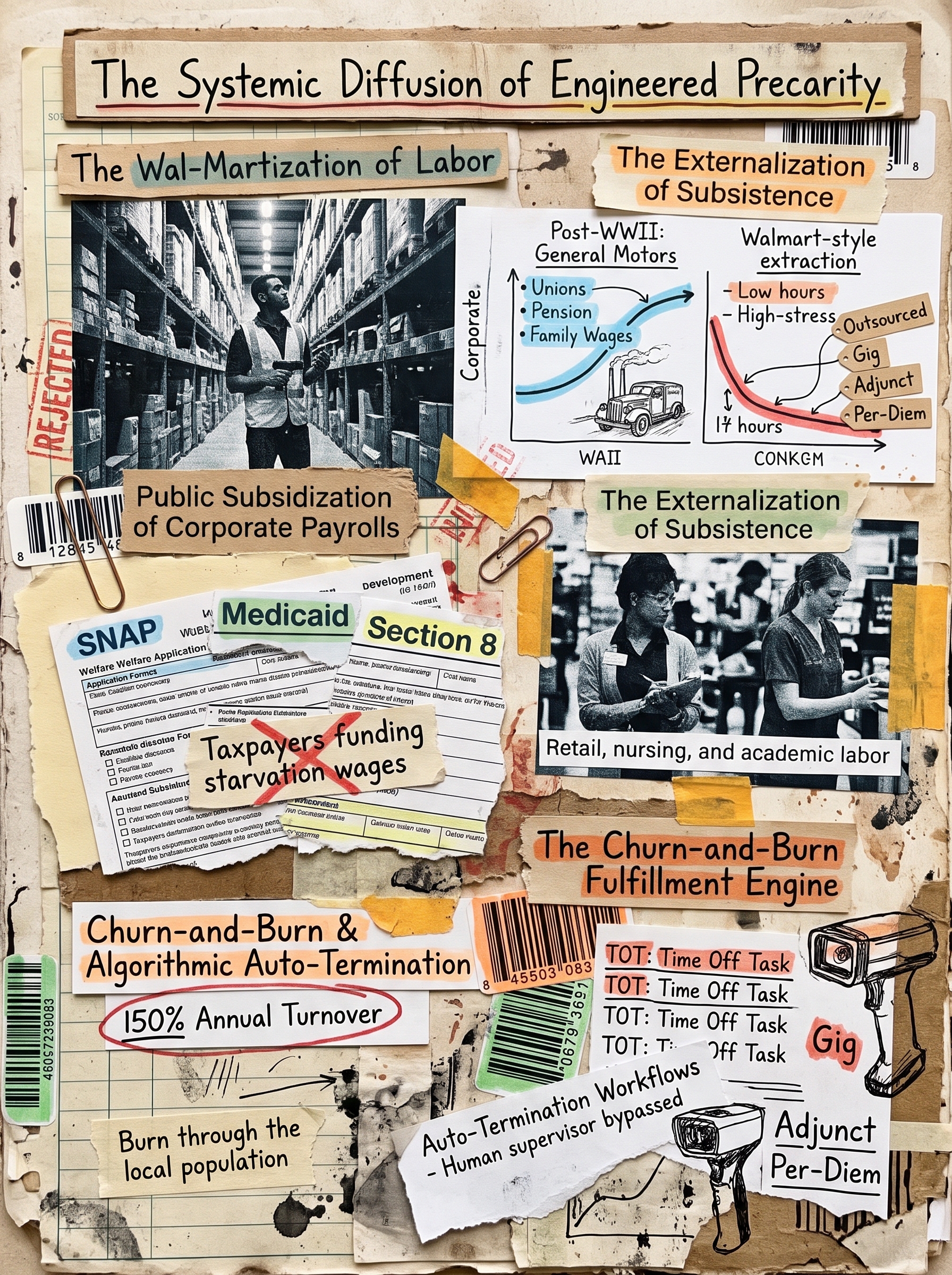
The systemic diffusion of engineered precarity has produced two dominant operational templates that have migrated from their native industries to reshape labor practices across the global economy.[4:1][15]
The Wal-Martization of Labor & The Externalization of Subsistence
Formalized by labor historians such as Nelson Lichtenstein, the Wal-Martization of labor describes the historical transition from mid-twentieth-century industrial labor norms to twenty-first-century retail labor extraction.[4:2]
Whereas General Motors established the post-WWII corporate standard—characterized by high union density, collectively bargained family-supporting wages, robust healthcare, and defined-benefit pensions—Walmart pioneered an aggressive low-cost retail template engineered around extreme supply-chain cost suppression, algorithmic inventory tracking, and aggressive union avoidance.[4:3]
- Cross-Sector Contagion: The Wal-Martization template has expanded far beyond general merchandise retail, penetrating sectors historically shielded by professional standards.[4:4] Healthcare systems increasingly replace full-time staff nurses with per-diem contingent labor and outsourced travel agencies; higher education has replaced tenured faculty lines with precarious semester-to-semester adjunct instructors; and white-collar enterprises increasingly outsource specialized technical functions to contingent gig contractors.[4:5]
- Public Subsidization of Corporate Payrolls: A structural pillar of Wal-Martization is the deliberate reliance on the welfare state to bridge the gap between starvation wages and basic human survival.[5:12][4:6] By capping worker hours and withholding health benefits, low-road corporations externalize their baseline cost of labor reproduction onto public assistance programs (Medicaid, SNAP, Section 8 housing, and the Earned Income Tax Credit).[4:7] In effect, taxpayer funds provide an indirect corporate subsidy that covers the living costs of an underpaid workforce, boosting corporate profit margins while fraying the broader fabric of society.[5:13][4:8]
Churn-and-Burn Fulfillment & Algorithmic Auto-Termination
In e-commerce fulfillment, warehousing, customer call centers, and gig delivery platforms, precarity is weaponized through churn-and-burn operations—an operational framework engineered around high employee turnover, automated surveillance, and rapid workforce replacement.[15:1][16]
The primary real-world manifestation of this model was documented by investigative reporters Jodi Kantor, Karen Weise, and Grace Ashford in their landmark New York Times investigation into Amazon's logistics network.[16:1][6:1] Prior to the pandemic, Amazon's hourly warehouse network experienced an annual turnover rate of roughly 150 percent—meaning the company completely replaced the equivalent of its entire frontline workforce every eight months.[16:2][6:2]
Rather than an operational defect, rapid attrition was integrated directly into corporate philosophy. Founder Jeff Bezos historically argued that a long-tenured hourly workforce breeds institutional complacency, "marching toward entropic decay," and advocated for continuous operational turnover to maintain urgency.[6:3]
The churn-and-burn engine operates through distinct technological mechanisms:
- Algorithmic Pacing & Real-Time Surveillance: Frontline warehouse selectors and pickers are outfitted with handheld radio-frequency scanners that track their physical movements down to the second.[15:2][6:4] The system calculates proprietary metrics such as Time Off Task (TOT); pausing to catch one's breath, stretch, or walk to a distant restroom triggers automated algorithmic warnings.[15:3][16:3]
- Auto-Termination Workflows: In mature algorithmic fulfillment centers, the human supervisor is largely bypassed. Management software operates on autopilot, automatically generating formal write-ups and termination notices when a worker's picking velocity falls below the algorithmic threshold, treating human labor as an expendable cog in the machine.[15:4][6:5]
- Anti-Tenure Financial Economics: By de-skilling fulfillment tasks so that a new hire can be trained in less than four hours, the corporate onboarding cost approaches zero.[15:5] High turnover prevents workers from reaching step-pay raises, qualifying for 401(k) vesting, or accumulating workplace injury claims, while simultaneously disrupting the long-term interpersonal trust required to organize labor unions.[15:6][6:6]
- The Thermodynamic Limit: By 2021, internal Amazon memos leaked to the press revealed that the churn-and-burn strategy was approaching a hard physical barrier: in key logistics hubs (such as California's Inland Empire and parts of the Midwest), the corporation was churning through the local population so quickly that it risked depleting the entire regional labor pool.[6:7] An operational strategy built on infinite human churn proved to be built on sand, forcing executive leadership to re-evaluate their reliance on unrestrained attrition.[6:8]
4. Comprehensive Taxonomy of Engineered Precarity
To analyze how corporations systematically construct labor instability, the following matrices classify the specific mechanisms, operational instruments, economic objectives, and institutional manifestations of engineered precarity.
Structural Mechanisms of Engineered Precarity
| Precarity Mechanism | Primary Operational Instrument | Target Economic Objective | Risk Transfer Vector | Concrete Enterprise Manifestation |
|---|---|---|---|---|
| Workplace Fissuring | Subcontracting tiers, franchised networks, third-party staffing agencies, independent contractor 1099 classification.[3:12] | Decouple brand rents from legal employer liability; evade collective bargaining; compress labor costs via vendor price wars.[3:13][8:4] | Shifts safety hazards, wage-and-hour compliance risks, and payroll taxes onto thin-margin subcontractors.[3:14] | Major hotel chains outsourcing housekeeping to staffing agencies; parcel carriers utilizing independent delivery networks.[3:15][8:5] |
| Just-in-Time Scheduling | Algorithmic demand-forecasting software, POS foot-traffic sensors, weather-calibrated scheduling models.[5:14] | Eliminate all paid "idle" labor; calibrate shift hours to match transactional demand fluctuations in 15-minute increments.[5:15][11:2] | Shifts cyclical demand volatility and sales fluctuations directly onto hourly employees' weekly wages.[5:16] | Big-box retail and fast-food chains issuing schedules 48 hours in advance; mandatory on-call shifts; "clopening" rotations.[5:17][11:3] |
| Statutory Benefit-Cliff Rationing | Algorithmic hours capping (hard constraints programmed at 28–29 hours per week).[9:7] | Bypass statutory employer healthcare mandates (ACA 30-hour cliff); avoid paid sick leave accruals and overtime rates.[9:8][12:4] | Shifts basic healthcare financing, disability risk, and retirement costs onto workers and public assistance programs.[9:9] | Retail and hospitality chains maintaining large rosters of involuntary part-time workers while banning full-time positions.[9:10][12:5] |
| Labor Market Monopsony | Geographic clustering in isolated labor sheds; wage-fixing cartels; restrictive non-compete agreements.[10:7][13:3] | Suppress local wage benchmarks below marginal revenue product; reduce worker exit options and bargaining leverage.[10:8][14:4] | Imposes geographical lock-in, forcing workers to absorb declining real wages and worsening working conditions.[10:9] | Rural fulfillment hubs, poultry processing plants, and isolated retail centers dominating local county employment.[13:4][14:5] |
| Algorithmic Churn-and-Burn | Automated telemetry, scan-rate tracking, Time Off Task (TOT) monitoring, automated termination workflows.[15:7] | Extract maximum physical output per hour; eliminate tenure-based wage increments, 401(k) vesting, and union organizing.[15:8][6:9] | Shifts the physical toll of extreme speedups, musculoskeletal disorders, and burn out onto workers.[15:9][16:4] | E-commerce mega-warehouses operating with 150% annual employee turnover, relying on automated performance firings.[16:5][6:10] |
Contrastive Operating Models: High-Road Strategy vs. Low-Road Model
| Operational Dimension | High-Road Strategy (Good Jobs Strategy) | Low-Road Model (Engineered Precarity) | Strategic Business Impact |
|---|---|---|---|
| Frontline Labor Philosophy | Strategic operational capability and core value-generating asset.[1:8] | Replaceable, commodified accounting expense to be minimized at all costs.[1:9] | Higher customer lifetime value vs. chronic brand degradation.[1:10] |
| Wage & Compensation Model | Above-market base pay, comprehensive health coverage, and retirement security.[1:11] | Minimum wage benchmarks, capped hours, and zero employer benefits.[1:12][9:11] | High talent retention vs. reliance on taxpayer-funded safety nets.[1:13][4:9] |
| Workplace Scheduling | Predictable, stable schedules published weeks in advance; guaranteed minimum hours.[1:14] | Algorithmic JIT scheduling, on-call shifts, and involuntary hours capping.[5:18] | Reliable operational performance vs. acute household instability and stress.[5:19] |
| Turnover & Retention Target | Low attrition; long-tenured workforce cross-trained across multiple domains.[1:15] | Hyper-turnover (100–150% annually); anti-tenure cost suppression.[15:10][6:11] | Institutional knowledge retention vs. risk of local labor pool depletion.[1:16][6:12] |
| Operational Slack & Buffering | Intentional staffing buffers to manage surge volume and maintain store execution.[1:17] | Chronic understaffing; zero operational buffers; maximum speedup.[1:18] | Pristine inventory accuracy vs. shelf stockouts and operational errors.[1:19] |
| Organizational Boundary | Unified, direct corporate employment relationship; direct accountability.[3:16] | Fissured workplace: complex subcontracting, franchising, and 1099 gig labor.[3:17][8:6] | Transparent corporate governance vs. structural liability evasion.[3:18] |
The Multi-Tier Fissured Value Chain
| Corporate Hierarchy Tier | Institutional Identity | Economic Function | Operational Reality | Legal & Financial Accountability |
|---|---|---|---|---|
| Tier 1: Lead Enterprise | Global Consumer Brand / Platform Orchestrator | Captures high-margin market rents; commands brand strategy, product design, and algorithmic systems.[3:19] | Dictates rigid operational standards, delivery windows, and performance benchmarks via software telemetry.[3:20][8:7] | Decoupled from direct legal employer liability; utilizes contracts as smoke and mirrors to avoid wage claims.[3:21] |
| Tier 2: Primary Subcontractor / Franchisee | Independent Operating Company / Franchise Owner | Invests local capital in facilities, vehicles, and direct management to service lead firm contracts.[3:22] | Trapped between inflexible corporate SLA demands and fixed capital costs, forced to compress labor budgets.[3:23][8:8] | Absorbs primary contractual risk; operates on wafer-thin operating margins vulnerable to contract cancellation.[3:24] |
| Tier 3: Labor Broker / Staffing Agency | Temporary Staffing Agency / On-Demand Labor Platform | Recruits, screens, and manages payroll for contingent, temporary, or per-diem worker pools.[3:25] | Competes purely on price, frequently cutting corners on safety training, workers' compensation, and wage laws.[3:26][8:9] | Serves as an institutional liability sponge; readily liquidated or abandoned if regulatory sanctions occur.[3:27] |
| Tier 4: Frontline Precariat | Hourly Worker / 1099 Contractor / Temp Worker | Executes physical warehouse picking, driving, janitorial cleaning, hospitality, and care labor.[2:8][3:28] | Subject to extreme algorithmic pacing, unpredictable scheduling, split shifts, and income volatility.[5:20][15:11] | Bears 100% of economic, health, and career risks with zero organizational safety net or tenure protections.[2:9][5:21] |
5. Strategic, Economic, and Governance Implications
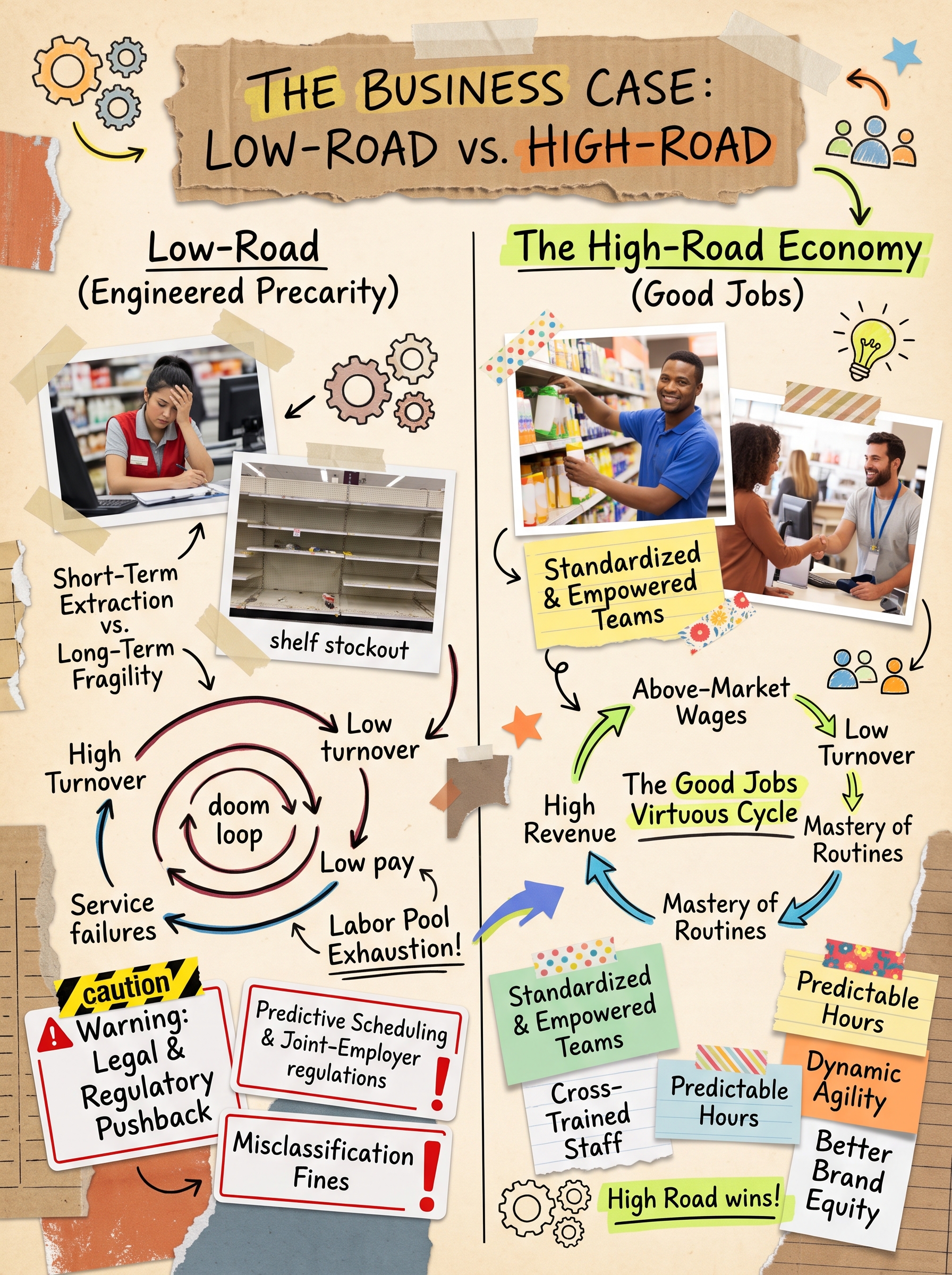
The systemic reliance on engineered precarity introduces significant operational vulnerabilities, regulatory challenges, and macroeconomic headwinds that threaten the long-term viability of low-road business models.[1:20][3:29][6:13]
Short-Term Extraction vs. Long-Term Fragility
While engineered precarity delivers immediate, quarter-to-quarter reductions in reported operational expenditures, it creates compounding enterprise risks:
- Erosion of Operational Capabilities: Extreme employee turnover strips enterprises of tacit operational knowledge, problem-solving capacity, and frontline initiative.[1:21] Retailers operating under low-road models experience chronic shelf stockouts, inaccurate inventory data, and damaged brand equity, ultimately destroying more economic value than was saved in direct payroll.[1:22]
- The Fragility of Just-in-Time Labor: Lean staffing models lack the resilience to absorb sudden demand spikes, public health crises, or supply-chain bottlenecks. When operational shocks occur, thinly staffed systems collapse, triggering severe customer defection.[1:23][3:30]
- Labor Pool Exhaustion: As discovered in high-density logistics corridors, an enterprise cannot indefinitely treat regional workforces as disposable resources.[6:14] Churning through an entire community's workforce destroys an employer's local reputation, driving up recruitment expenditures and eventually forcing wage concessions.[6:15]
Regulatory Counter-Movements & Legal Re-regulation
Governments, labor standards agencies, and worker advocacy groups have increasingly recognized engineered precarity as a market failure that externalizes private costs onto the public ledger, driving substantial regulatory pushback:
- Fair Workweek Legislation: Municipalities and states (including Seattle, New York City, Chicago, San Francisco, and Oregon) have enacted predictive scheduling ordinances.[5:22] These statutes mandate that retail and fast-food employers provide schedules 14 days in advance, penalize short-notice shift cancellations through "predictability pay," prohibit clopening shifts without mandatory rest windows, and require firms to offer open shifts to existing part-time workers before hiring new contingent staff.[5:23][11:4]
- Joint-Employer Standard Revisions: Labor regulators (including the U.S. National Labor Relations Board and Department of Labor) have repeatedly sought to update joint-employer rules.[3:31] Under expanded standards, if a lead brand exercises direct or indirect control over essential terms and conditions of employment (via algorithmic pacing, scheduling software, or rigid contractual specs), the lead corporation is classified as a joint employer, legally liable for wage-and-hour violations and mandated to bargain with certified unions.[3:32][8:10]
- Worker Reclassification and Algorithmic Auditing: Jurisdictions worldwide (including the European Union's Platform Work Directive and California's AB 5 statutory frameworks) are cracking down on independent contractor misclassification in the gig economy.[3:33] These regulatory frameworks establish legal presumptions of employment for workers directed by algorithmic platforms, threatening to force gig companies to internalize payroll taxes, minimum wage floors, and workers' compensation coverage.[3:34]
The Business Case for the High-Road Economy
As operational complexity increases and consumer expectations rise, forward-looking enterprises are recognizing that the low-road model is an operational dead end.[1:24]
By transitioning to the High-Road (Good Jobs) framework, companies can break out of the low-wage, high-turnover doom loop:[1:25]
- The Good Jobs Virtuous Cycle: Investing in above-market wages and comprehensive benefits lowers turnover, attracting higher-caliber candidates who master operational routines.[1:26] Reduced attrition cuts recruitment and onboarding expenses, while experienced staff identify process improvements, prevent inventory errors, and deliver superior customer service that drives revenue expansion.[1:27]
- Standardizing Work & Empowering Teams: High-road operations cross-train frontline workers to perform multiple tasks—such as stocking shelves during low-traffic hours and opening registers during customer surges.[1:28] This operational flexibility provides workers with stable, predictable full-time schedules while giving the enterprise the dynamic agility needed to respond to customer demand without resorting to abusive JIT scheduling algorithms.[1:29]
🎴 Interactive Web Practice (Comprehension Check)
Question 1 (Macro-Organizational Fissuring & Liability Decoupling): In David Weil's framework, how does workplace fissuring decouple operational control from legal liability, and what are the economic consequences for frontline workers and third-party contractors?
Answer: David Weil's framework of the fissured workplace demonstrates that lead brand corporations systematically shed direct legal employment of their operational workforces—such as janitorial staff, hotel housekeepers, logistics drivers, and customer service representatives—by outsourcing these roles to complex networks of subcontractors, staffing agencies, and franchisees.
The core paradox of this structure is the decoupling of operational command from legal liability:
- Total Operational Command: Lead corporations utilize proprietary digital platforms, real-time telemetry, and stringent Service Level Agreements (SLAs) to control the precise speed, standards, and execution of frontline work down to the minute.
- Evading Legal Liability: By inserting independent corporate intermediaries between themselves and the frontline workforce, lead brands legally disclaim responsibility for wage-and-hour compliance, workplace health and safety, payroll taxes, workers' compensation, and collective bargaining rights.
- Subcontractor Squeeze: Because lead firms force multiple subcontractors to compete in hyper-aggressive price-bidding wars, and because labor represents nearly all variable operating costs in service sectors, subcontractors are economically compelled to cut wages, eliminate benefits, compromise on safety, and engage in wage theft just to maintain solvency.
- Worker Precarity: Frontline workers bear the full economic burden of suppressed wages and high injury risks, while being denied career ladders within the lead brand.
- Institutional Evasion: When structural abuses or wage violations are exposed by regulators, the lead brand uses its contract structure to wash its hands of responsibility, terminating the subcontractor while leaving the underlying extractive model intact.
Question 2 (Algorithmic Temporal Control & Statutory Avoidance): How do just-in-time algorithmic scheduling and statutory hours capping (such as the ACA 30-hour cliff) transfer macroeconomic risk onto hourly workers while undermining public safety nets?
Answer: Just-in-time (JIT) algorithmic scheduling and statutory benefit-cliff rationing function as powerful instruments of temporal and financial control in low-road employment models:
1. Transferring Macroeconomic Volatility to Workers:
Using point-of-sale data, foot-traffic sensors, and demand-forecasting algorithms, JIT scheduling systems adjust staffing levels in 15-minute increments. Instead of the corporation bearing the financial cost of slow sales or poor weather, the financial risk is transferred directly onto hourly employees through short-notice shift cancellations, split shifts, \"clopening\" rotations, and unpaid on-call requirements. Workers are forced to subsidize corporate flexibility with their own unpaid time and erratic weekly paychecks.
2. Statutory Avoidance (The ACA 30-Hour Cliff):
Under regulations such as the Affordable Care Act's employer mandate, large firms face financial penalties if they fail to provide affordable health insurance to employees averaging 30 or more hours per week. Low-road service firms deliberately program their scheduling algorithms to impose hard weekly caps (e.g., strictly at 28 or 29 hours) across a large pool of involuntary part-time workers. This allows the firm to evade health benefit obligations, paid sick leave accrual, and overtime premiums.
3. Undermining Public Safety Nets:
This combination distorts public social welfare systems in two ways:
- Corporate Payroll Subsidization: By paying below-subsistence wages and rationing hours, low-road employers force their workforces to rely on means-tested government programs (Medicaid, SNAP, housing vouchers) to survive, effectively converting public safety nets into an indirect taxpayer subsidy for corporate profit margins.
- Administrative Disqualification Traps: Volatile, fluctuating weekly hours cause low-income workers to experience unpredictable monthly income spikes that temporarily disqualify them from public benefits, only to have their hours cut the following week, leaving families without either adequate wages or essential social safety nets.
Question 3 (Labor Market Monopsony & Churn-and-Burn Fulfillment): How does geographic labor monopsony enable high-attrition \"churn-and-burn\" fulfillment models to operate sustainably in the short term, and what structural limits threaten this strategy over the long run?
Answer: The high-attrition \"churn-and-burn\" operational template—exemplified by e-commerce fulfillment centers operating at 100% to 150% annual turnover—relies heavily on labor market monopsony to maintain operational viability in the short term, but faces acute structural limits over the long run:
Short-Term Viability via Monopsony & De-Skilling:
- Inelastic Local Labor Supply: By locating massive fulfillment facilities in economically distressed rural counties or exurban transit corridors, lead corporations establish local labor monopsony. With few alternative employers offering comparable immediate cash wages, local workers face high commuting friction and lack outside exit options, making them captive to the firm's unilateral wage and pacing mandates.
- Zero-Cost Onboarding: Churn-and-burn operators design tasks to be completely de-skilled, allowing new hires to reach full productivity within hours. This reduces onboarding costs to near zero, enabling the company to continuously replace departing workers without severe training expenditures.
- Anti-Tenure Financial Gains: Continuous attrition ensures that workers rarely achieve tenure-based step raises, stock or 401(k) vesting thresholds, or expensive disability claims. Furthermore, rapid turnover fragments the workplace social cohesion required to organize sustained collective bargaining or union drives.
Over the long run, the churn-and-burn model is fundamentally built on sand because regional labor pools are finite. When a company burns through 150% of its workforce annually in a concentrated geographic area, it rapidly exhausts the entire working-age population willing to endure high-strain, surveillance-heavy conditions. As documented in internal corporate studies, regional logistics hubs risk completely running out of employable labor, forcing organizations to raise entry wages, offer retention incentives, and automate operations to prevent catastrophic supply-chain failure.
Resonant Notes
The following notes in the vault share direct thematic, sociological, and strategic connections with The Architecture of Precarity:
🔴 Political Economy, Labor Sociology & Alienation
- Karl Marx - Economic and Philosophic Manuscripts of 1844 — Analyzes the fourfold alienation of the industrial worker (from the product, the act of production, species-being, and other workers), providing the classical materialist foundation for modern fissured workplaces where labor is commodified into an interchangeable operational input.
- Zygmunt Bauman's sociological framework of Liquid Modernity — Details the transition from solid modern bureaucratic enclosures to liquid modern deregulation and precarious work, illustrating how capital achieves extraterritorial mobility while localized workers are immobilized in precarious conditions.
- Max Weber (1864-1920) — Outlines formal rationalization (Zweckrationalität) and bureaucratic calculability, which find their contemporary culmination in automated, algorithmic scheduling and surveillance-driven fulfillment metrics.
- Georg Lukács's formulation of reification (Verdinglichung) in History and Class Consciousness (1923) — Examines how human social relations and living labor are transformed into "phantom objectivity," rationalizing corporate workflows into quantitative, mechanical subroutines.
- The Great Realignment - Deconstructing the Post-Pandemic Labor Market Correction — Examines contemporary labor market counter-maneuvers (quiet quitting, rage applying, and generational rejection of hustle culture) that arise directly as defensive psychological reactions against low-road corporate employment.
- William H. Whyte's The Organization Man — Chronicles the post-WWII solid corporate compact of lifetime tenure and institutional loyalty, serving as the historical contrast against which contemporary workplace precarity and contract casualization are measured.
🟡 Strategic Management, Governance & Enterprise Models
- Transaction Cost Economics — Ronald Coase's theory of the firm and Oliver Williamson's governance framework illuminate the boundaries of the firm, explaining how modern digital telematics and low monitoring costs incentivize vertical disintegration and workplace fissuring.
- Douglas McGregor, The Human Side of Enterprise — Explores Theory X and Theory Y assumptions, demonstrating how low-road management strategies embody extreme Theory X cynicism, designing workplaces around coercive surveillance that actively provokes worker detachment.
- Platform Enshittification — Sister analysis examining how two-sided digital monopolies degrade conditions for both users and gig-economy workers, leveraging algorithmic lock-in to extract maximum economic rents.
- From Toxic Blitzscaling to Corporate Governance - Investigating Uber's Systemic Reforms — Case study detailing the real-world operational and regulatory fallout of aggressive corporate cultures, dynamic wage suppression, and worker misclassification in the gig economy.
- Corporate Social Responsibility (CSR) and Environmental, Social, and Governance (ESG) — Critiques the divergence between corporate public relations rhetoric ("social responsibility") and internal labor realities, exposing how fissured supply chains are used to obscure labor exploitation from ESG audits.
- Shareholder Primacy (Milton Friedman) — Traces the ideological origins of low-road capitalism to the mid-1970s doctrine that corporate leadership's sole social responsibility is maximizing quarterly shareholder equity, legitimizing aggressive labor cost externalization.
- Stakeholder Theory (R. Edward Freeman) — Provides the competing normative framework that mandates corporate accountability to frontline employees, local communities, and suppliers alongside financial shareholders.
- Goodhart's Law & The McNamara Fallacy — Diagnose the management pathology that prioritizes easily quantifiable efficiency indicators (such as Time Off Task or payroll-to-sales ratios) while remaining blind to qualitative human exhaustion, brand decay, and operational failure.
- Institutional Isomorphism — Explains why low-road employment templates (such as JIT scheduling and fissured subcontracting) diffuse rapidly across entire industries through mimetic and competitive pressures, forcing rival firms to adopt extractive labor practices to preserve short-term parity.
- Difference Between a Shareholder and a Stakeholder — Articulates the fundamental governance clash between narrow equity owners demanding immediate labor cost compression and broad stakeholder coalitions bearing the long-term social costs of precarity.
🟢 Applied Metaphoric Models & Lexical Priming
- cog-in-the-machine — Metaphoric cognitive picture capturing the extreme reduction of living human workers into interchangeable, automated mechanical inputs within algorithmic logistics and retail apparatuses.
- wash-your-hands-of — Metaphoric picture illustrating how lead corporations utilize multi-tiered subcontracting, franchising, and staffing agencies to abdicate legal and moral liability for workplace injuries, wage theft, and labor violations.
- a-sitting-duck — Captures the extreme vulnerability of localized workers trapped within rural or exurban monopsony labor markets, lacking outside employment alternatives and exposed to unilateral wage markdowns.
- hang-by-a-thread — Conceptualizes the chronic financial and psychological fragility of frontline workers whose weekly schedules, income levels, and healthcare access fluctuate unpredictably under JIT algorithms.
- stay-afloat — Embodies the continuous, exhausting physical and economic scramble required of casualized workers juggling multiple part-time jobs just to cover basic living expenses.
- sink-or-swim — Reflects the unforgiving market logic of casualized gig work and fissured employment, where institutional safety nets are eliminated and workers are left entirely to their own devices.
- burn-out — Diagnoses the severe somatic, muscular, and psychological exhaustion generated by algorithmic speedups, relentless scan rates, and punitive Time Off Task tracking in fulfillment centers.
- built-on-sand — Illustrates the structural fragility of corporate business models predicated on 150% annual workforce turnover, which inevitably face operational collapse once regional labor pools are exhausted.
- a-facade — Represents the deceptive corporate branding and public relations campaigns that project an outward image of customer obsession and community care while concealing systemic labor precarity behind the scenes.
- the-fabric-of-society — Articulates how shifting the costs of basic human subsistence from profitable corporations onto public safety nets and low-income families frays the foundational social contract.
- on-autopilot — Frames the automated administrative routines of modern management software that monitors, penalizes, and auto-terminates frontline workers without human managerial oversight.
- path-of-least-resistance — Captures how corporate leadership instinctively follows the effortless path of least resistance by cutting frontline payroll and hours rather than undertaking the difficult operational work of process innovation.
- smoke-and-mirrors — Diagnoses the opaque productivity metrics, algorithmic shift distributions, and third-party corporate structures deployed to disguise workplace speedups and evade statutory labor obligations.
- to-throw-someone-to-the-wolves — Embodies the ruthless corporate maneuver wherein lead brands instantly sacrifice third-party labor subcontractors to appease regulatory scrutiny while preserving their own institutional power.
References
Zeynep Ton / The Good Jobs Strategy: How the Smartest Companies Invest in Employees to Lower Costs and Boost Profits / Houghton Mifflin Harcourt, 2014; and The Case for Good Jobs, Harvard Business Review Press, 2023. ↩︎ ↩︎ ↩︎ ↩︎ ↩︎ ↩︎ ↩︎ ↩︎ ↩︎ ↩︎ ↩︎ ↩︎ ↩︎ ↩︎ ↩︎ ↩︎ ↩︎ ↩︎ ↩︎ ↩︎ ↩︎ ↩︎ ↩︎ ↩︎ ↩︎ ↩︎ ↩︎ ↩︎ ↩︎ ↩︎
Arne L. Kalleberg & Steven P. Vallas / Probing Precarious Work: Theory, Research, and Politics / Research in the Sociology of Work, Vol. 31, 2018; and Arne L. Kalleberg / Good Jobs, Bad Jobs: The Rise of Polarized and Precarious Employment Systems in the United States, 1970s to 2000s, Russell Sage Foundation, 2011. ↩︎ ↩︎ ↩︎ ↩︎ ↩︎ ↩︎ ↩︎ ↩︎ ↩︎ ↩︎
David Weil / The Fissured Workplace: Why Work Became So Bad for So Many and What Can Be Done to Improve It / Harvard University Press, 2014. ↩︎ ↩︎ ↩︎ ↩︎ ↩︎ ↩︎ ↩︎ ↩︎ ↩︎ ↩︎ ↩︎ ↩︎ ↩︎ ↩︎ ↩︎ ↩︎ ↩︎ ↩︎ ↩︎ ↩︎ ↩︎ ↩︎ ↩︎ ↩︎ ↩︎ ↩︎ ↩︎ ↩︎ ↩︎ ↩︎ ↩︎ ↩︎ ↩︎ ↩︎ ↩︎
Nelson Lichtenstein (Ed.) / Wal-Mart: The Face of Twenty-First-Century Capitalism / The New Press, 2006; and Seth D. Harris & Nelson Lichtenstein / Next Wave Organizing and the Shift to a New Paradigm of Labor Law, New York Law School Law Review, Vol. 50, 2006. ↩︎ ↩︎ ↩︎ ↩︎ ↩︎ ↩︎ ↩︎ ↩︎ ↩︎ ↩︎
Daniel Schneider & Kristen Harknett / Hard Times: Routine Schedule Unpredictability and Material Hardship among Service Sector Workers / Social Forces, Vol. 99, No. 4, 2021; and The Shift Project / Working in the Service Sector, shift.hks.harvard.edu. ↩︎ ↩︎ ↩︎ ↩︎ ↩︎ ↩︎ ↩︎ ↩︎ ↩︎ ↩︎ ↩︎ ↩︎ ↩︎ ↩︎ ↩︎ ↩︎ ↩︎ ↩︎ ↩︎ ↩︎ ↩︎ ↩︎ ↩︎ ↩︎
Jodi Kantor, Karen Weise & Grace Ashford / The Amazon That Customers Don't See / The New York Times, June 15, 2021; and Jason Del Rey / Amazon Risks Running Out of People to Hire in Its Warehouses, Vox / Recode, 2022. ↩︎ ↩︎ ↩︎ ↩︎ ↩︎ ↩︎ ↩︎ ↩︎ ↩︎ ↩︎ ↩︎ ↩︎ ↩︎ ↩︎ ↩︎ ↩︎
Dennis Arnold & Joseph R. Bongiovi / Precarious, Informalizing, and Flexible Work: Transforming Concepts and Understandings / American Behavioral Scientist, Vol. 57, No. 3, 2013. ↩︎ ↩︎ ↩︎ ↩︎
Marc Stern / Review of The Fissured Workplace: Why Work Became So Bad for So Many and What Can Be Done to Improve It / Business History Review, Vol. 89, No. 1, 2015. ↩︎ ↩︎ ↩︎ ↩︎ ↩︎ ↩︎ ↩︎ ↩︎ ↩︎ ↩︎ ↩︎
William E. Even & David A. Macpherson / The Affordable Care Act and the Growth of Involuntary Part-Time Employment / IZA Institute of Labor Economics, Discussion Paper No. 9324, 2015. ↩︎ ↩︎ ↩︎ ↩︎ ↩︎ ↩︎ ↩︎ ↩︎ ↩︎ ↩︎ ↩︎ ↩︎
José Azar, Ioana Marinescu & Marshall Steinbaum / Labor Market Concentration / Journal of Human Resources, Vol. 57, No. S, 2022; and Monopsony Power in the Labor Market: From Theory to Policy, NBER Working Paper No. 27760, 2020. ↩︎ ↩︎ ↩︎ ↩︎ ↩︎ ↩︎ ↩︎ ↩︎ ↩︎ ↩︎
National Women's Law Center / The Schedules That Work Act: Giving Workers the Tools They Need to Succeed / NWLC Policy Brief, 2019. ↩︎ ↩︎ ↩︎ ↩︎ ↩︎
Marcus Dillender, Carolyn J. Heinrich & Susan N. Houseman / Effects of the Affordable Care Act on Part-Time Employment: Early Evidence / Journal of Human Resources, Vol. 57, No. 1, 2022. ↩︎ ↩︎ ↩︎ ↩︎ ↩︎ ↩︎
Alan Manning & Barbara Petrongolo / Monopsony in Local Labour Markets / Oxford Open Economics, Vol. 3, Supplement 1, 2024. ↩︎ ↩︎ ↩︎ ↩︎ ↩︎
Alessandro Bonanno & Rigoberto A. Lopez / Wal-Mart's Monopsony Power in Local Labor Markets / Journal of Agricultural & Food Industrial Organization, Vol. 7, No. 2, 2009. ↩︎ ↩︎ ↩︎ ↩︎ ↩︎ ↩︎
National Employment Law Project (NELP) / High Injury and Turnover Rates at Fulfillment Centers in California / NELP Research Brief, 2020. ↩︎ ↩︎ ↩︎ ↩︎ ↩︎ ↩︎ ↩︎ ↩︎ ↩︎ ↩︎ ↩︎ ↩︎
Jodi Kantor & David Streitfeld / Amazon.com, Inc. Shareholder Filing Citing "Inside Amazon" / U.S. Securities and Exchange Commission (SEC), 2020. ↩︎ ↩︎ ↩︎ ↩︎ ↩︎ ↩︎