Institutional Isomorphism
🗂️ Interactive Notebook: Open Study Companion (Video Summary, Flashcards, Mind Map) ↗
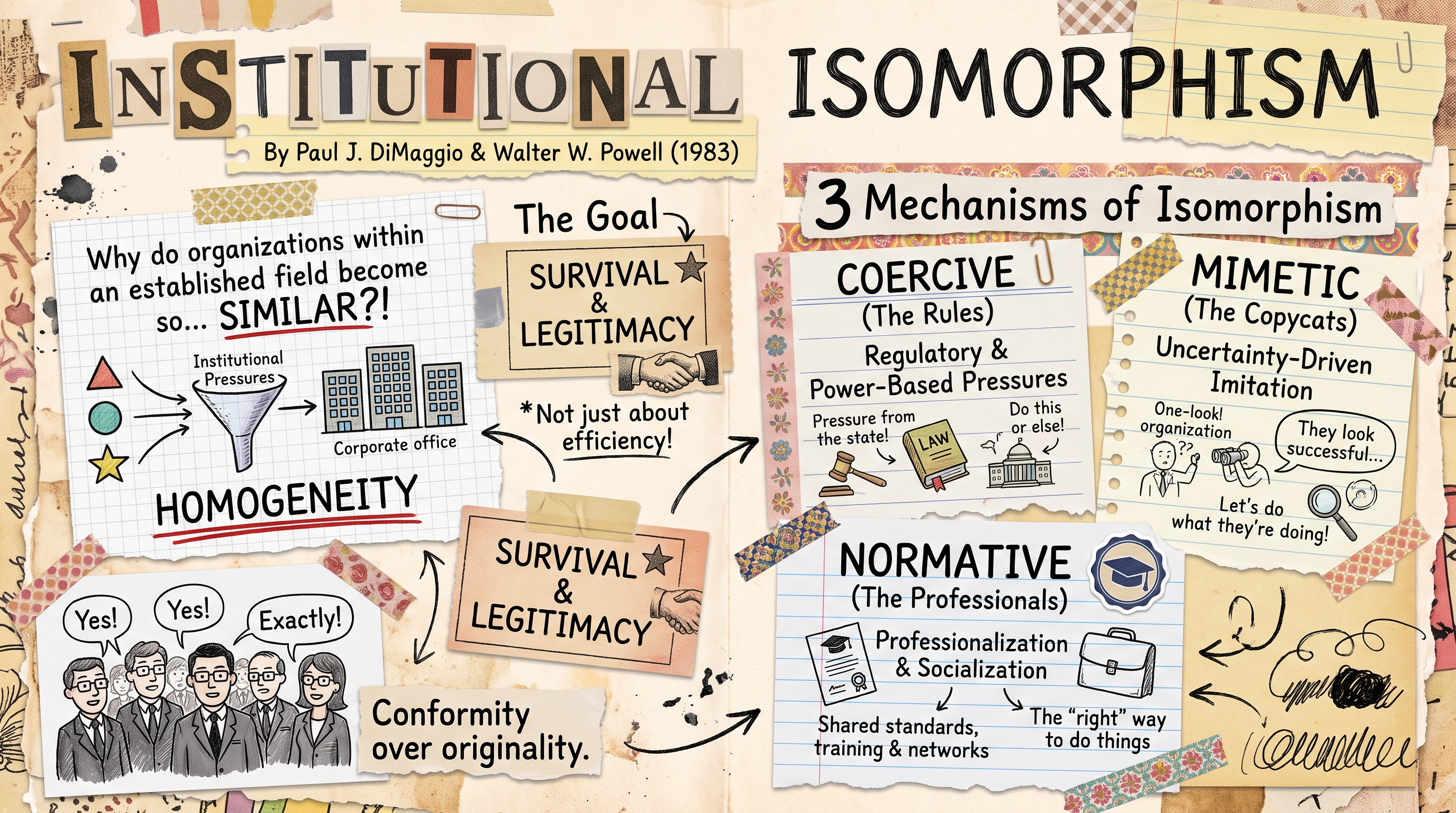
Institutional Isomorphism is a foundational sociological theory developed by Paul J. DiMaggio and Walter W. Powell (1983) explaining why organizations within an established field converge toward startling structural, cultural, and operational homogeneity.[1] Rather than optimizing strictly for technical efficiency or competitive market differentiation, multinational enterprises (MNEs) and domestic institutions conform to external pressures through coercive (regulatory and power-based), mimetic (uncertainty-driven imitation), and normative (professionalization and socialization) mechanisms to secure institutional legitimacy and ensure long-term survival.[1:1][2]
Theoretical Heritage: Revisiting Weber's Iron Cage
To understand DiMaggio and Powell's contribution, one must trace its lineage back to Max Weber's classic analysis of rationalization. In The Protestant Ethic and the Spirit of Capitalism (1905), Weber argued that the rationalist spirit of modern capitalism had constructed an inescapable bureaucratic order—famously translated by Talcott Parsons as an "iron cage" (stahlhartes Gehäuse)—driven by relentless market competition and the capitalist demand for technical efficiency, speed, and administrative precision.[1:2] In Weber's classical view, bureaucracy spread because it was technically superior to all other administrative forms, operating like a calculating machine that reduced human employees to functional cogs in the machine.
By the late twentieth century, however, organizational sociologists observed a striking empirical anomaly: organizations continued to homogenize rapidly even when structural changes yielded zero measurable gains—or outright declines—in operational efficiency.[1:3][2:1] Building upon John W. Meyer and Brian Rowan's seminal 1977 work on "rationalized myths" and ceremonial conformity, DiMaggio and Powell published The Iron Cage Revisited: Institutional Isomorphism and Collective Rationality in Organizational Fields in 1983.[1:4][2:2]
"What makes organizations so similar? We contend that the engine of rationalization and bureaucratization has moved from the competitive marketplace to the state and the professions. Once a set of organizations emerges as a field, a paradox arises: rational actors make their organizations increasingly similar as they try to change them." — DiMaggio & Powell (1983)[1:5]
Competitive vs. Institutional Isomorphism
Drawing originally on Amos Hawley's human ecology framework (1968) and contrasting their view against Michael T. Hannan and John Freeman's population ecology model (1977), DiMaggio and Powell distinguish between two fundamental types of isomorphism (the constraining process that forces one unit in a population to resemble other units facing the same set of environmental conditions):[1:6][3]
- Competitive Isomorphism: Assumes a system rationality emphasizing market competition, niche change, and fitness measures.[1:7][3:1] Suboptimal organizational forms are selected out of the market through economic natural selection, leaving only the technically most efficient structures standing.[3:2] While useful for analyzing early-stage innovation or atomistic, freely competitive markets, it harbors a profound blind spot regarding mature, oligopolistic, or politically mediated corporate environments.[1:8]
- Institutional Isomorphism: Recognizes that modern organizations compete not merely for economic resources and customers, but for political power, social fitness, and institutional legitimacy.[1:9][4] Organizations adopt prevailing forms because failing to look and act like a "proper" enterprise invites skepticism from capital markets, sovereign regulators, and elite talent pools.[2:3][4:1]
Structuration of the Organizational Field
Isomorphic pressures do not operate in a vacuum; they intensify only after disparate organizations coalesce into a recognized organizational field—defined as those organizations that, in the aggregate, constitute a recognized area of institutional life, including key suppliers, resource and product consumers, regulatory agencies, and direct competitors.[1:10] According to DiMaggio and Powell, the institutional definition (or "structuration") of a field unfolds across four stages:[1:11]
- An increase in the density and extent of interaction among organizations within the field.[1:12]
- The emergence of sharply defined interorganizational structures of domination and patterns of coalition.[1:13]
- An increase in the information load with which organizations in the field must contend.[1:14]
- The development of mutual awareness among participants that they are involved in a common enterprise.[1:15]
Once a field crosses this threshold of structuration, early innovators who adopted changes to boost performance are overtaken by late adopters who copy those exact structures simply to appear legitimate, locking the entire sector into self-reinforcing homogeneity where corporate structures appear cut from the same cloth.[1:16][2:4]
The Three Mechanisms of Institutional Isomorphism
DiMaggio and Powell identify three analytically distinct—though empirically overlapping—mechanisms through which institutional isomorphic change occurs.[1:17]
| Mechanism | Primary Antecedent | Core Driver | Typical Manifestations in International Business |
|---|---|---|---|
| Coercive | Political influence & resource dependence | Legal compliance, state mandates, & dominant partner power | GDPR privacy architectures, EU CSRD sustainability audits, IFRS accounting, Walmart/Apple supplier mandates |
| Mimetic | Environmental uncertainty & goal ambiguity | Risk mitigation via modeling perceived industry leaders | Enterprise Agile ("Spotify Model") rollouts, Chief AI Officer appointments, generative AI task forces |
| Normative | Professionalization & cognitive socialization | Shared educational filtering & elite inter-firm networks | MBA curriculum orthodoxy, McKinsey/BCG strategic frameworks, Big Four audit norms, ISO certifications |
1. Coercive Isomorphism
Coercive isomorphism results from both formal and informal pressures exerted on organizations by other organizations upon which they are dependent, as well as by cultural expectations in the broader society within which they function.[1:18] Such pressures may be experienced as direct force, persuasion, or explicit invitations to join in collusion.[1:19]
- Sovereign Regulatory Mandates and Extraterritoriality: The modern regulatory state is one of the most potent engines of global structural convergence.[1:20] In international business management (IBM), this frequently manifests via what Columbia Law scholar Anu Bradford terms the Brussels Effect—whereby multinational corporations adopt strict European Union standards globally rather than maintaining fragmented regional compliance architectures (connected to The CAGE Distance Framework and IBM - International Business Law):[5][6]
- For example, the EU General Data Protection Regulation (GDPR) forced enterprises headquartered in North America and Asia to establish standardized Data Protection Officer (DPO) roles, uniform data-mapping protocols, and global consent interfaces.[6:1]
- Similarly, the EU Corporate Sustainability Reporting Directive (CSRD) mandates double-materiality ESG disclosures and third-party assurance audits across global value chains.[7]
- International Accounting and Financial Standards: Access to global capital markets requires strict adherence to standardized reporting frameworks, such as International Financial Reporting Standards (IFRS) or US Generally Accepted Accounting Principles (GAAP), forcing disparate conglomerates into identical financial control structures (explored in IBM - International Financial Management and Transaction Cost Economics):[1:21]
- Asymmetric Supply Chain Mandates: Coercive pressure frequently operates outside state apparatuses through resource-dependence asymmetries.[1:22] When dominant lead firms—such as Apple, Toyota, or Walmart—mandate specific Enterprise Resource Planning (ERP) integrations, zero-carbon manufacturing targets, or ISO quality certifications as non-negotiable prerequisites for procurement contracts, tier-one and tier-two suppliers across emerging markets are coerced into structural alignment.[1:23][7:1]
- Parent-to-Subsidiary Imposition: Within multinational corporations, corporate headquarters routinely impose standardized human resource policies, budget cycles, and compliance hierarchies onto foreign subsidiaries regardless of local cultural norms (analyzed in IBM - Understanding Organizational Structure):[1:24][8]
2. Mimetic Isomorphism
Not all institutional isomorphism derives from coercive authority; uncertainty is a powerful force that encourages imitation.[1:25] When organizational technologies are poorly understood, when strategic goals are ambiguous, or when the macroeconomic environment creates acute symbolic uncertainty, organizations model themselves on other organizations they perceive to be more legitimate or successful.[1:26]
- Economizing on Search Costs: Mimetic behavior offers a low-cost, politically defensible heuristic for executives operating under bounded rationality.[1:27] As DiMaggio and Powell note, when an organization faces a problem with ambiguous causes or unclear solutions, copying a high-status peer yields a viable template at minimal search expense, taking the path of least resistance while insulating leadership from boardroom blame ("nobody ever got fired for copying the market leader").[1:28]
- Enterprise Agility Rollouts: Over the past decade, legacy commercial banks, telecommunications giants, and heavy manufacturers worldwide dismantled traditional hierarchies to adopt the "Spotify Model" of Squads, Tribes, Chapters, and Guilds.[9] Even though Spotify's own engineers publicly noted the framework was an aspirational snapshot rather than a rigid blueprint, corporations mimetically adopted the exact nomenclature and matrix structures on an executive level to cope with the existential ambiguity of digital transformation.[9:1]
- Generative AI Task Forces and Executive Titles: During waves of technological disruption, organizations engage in rapid structural mimicry to signal modernity to equity analysts.[1:29] Following the commercialization of large language models, Fortune 500 firms across unrelated sectors simultaneously established centralized "Generative AI Centers of Excellence" and appointed Chief AI Officers (CAIOs)—converging on identical governance templates long before clear return-on-investment metrics existed.[1:30]
- Unconscious Innovation: Imperfect attempts to imitate distant peers—such as Western manufacturers attempting to copy Japanese Total Quality Management (TQM) or lean circles in the late twentieth century—often result in unintended mutations that acquire local legitimacy and are subsequently copied by others.[1:31]
3. Normative Isomorphism
Normative isomorphism stems primarily from professionalization—defined as the collective struggle of members of an occupation to define the conditions and methods of their work, control the "production of producers," and establish a cognitive base and legitimation for their occupational autonomy.[1:32] Two primary aspects of professionalization drive corporate homogeneity:
- Formal Education and Cognitive Filtering: Elite business schools (e.g., Harvard, INSEAD, Wharton), law schools, and engineering academies rely on standardized curricula, case-study methodologies, and analytical vocabularies.[1:33] Graduates enter multinational executive tracks carrying identical mental models regarding capital allocation, organizational design, and shareholder primacy, steering corporate operations on autopilot according to dominant managerial dogmas.[1:34]
- Management Consulting Firms as Institutional Diffusers: DiMaggio and Powell observe that large management consulting firms (such as McKinsey & Company, Boston Consulting Group, and Bain & Company) and Big Four accounting partnerships act as "Johnny Appleseeds," spreading a handful of organizational models throughout the global economy.[1:35][10] When competing firms across Tokyo, Frankfurt, and Toronto retain the same strategy consultancies, they receive harmonized restructuring blueprints, identical KPI dashboards, and uniform M&A integration playbooks.[1:36][10:1]
- Professional Networks and Executive Homosociality: Trade associations, World Economic Forum summits, and professional accreditation bodies (e.g., CFA Institute, SHRM, Project Management Institute) rapidly diffuse normative rules across corporate boundaries.[1:37] Furthermore, personnel filtering—the practice of hiring C-suite executives exclusively from within the same industry tier and educational pedigree—ensures that leaders view problems through identical lenses and endorse identical structural remedies.[1:38]
While coercive, mimetic, and normative pressures are analytically distinct, they frequently commingle in practice.[1:39] For instance, an ESG reporting overhaul may begin as a coercive EU regulatory mandate (CSRD), trigger mimetic copying of a competitor's sustainability governance committee due to technical ambiguity, and become entrenched via normative assurance standards designed by Big Four sustainability auditors.[1:40][7:2][10:2]
Predictive Hypotheses of Isomorphic Change
In the second half of their 1983 paper, DiMaggio and Powell formulate twelve formal predictors—divided into organization-level (A) and field-level (B) hypotheses—governing the rate and intensity of isomorphic convergence.[1:41]
Organization-Level Predictors
- Resource Dependence (A-1 & A-2): The greater the dependence of an organization on another organization—and the greater the centralization of its resource supply—the more similar it will become to that organization in structure, climate, and behavioral focus.[1:42]
- Technological Uncertainty & Goal Ambiguity (A-3 & A-4): The more uncertain the relationship between means and ends, and the more ambiguous an organization's goals, the greater the extent to which it will model itself after organizations it perceives to be successful.[1:43]
- Academic & Network Filtering (A-5 & A-6): The greater the reliance on academic credentials in choosing managerial and staff personnel—and the greater the participation of managers in trade and professional associations—the more similar the organization will become to peers in its field.[1:44]
Field-Level Predictors
- Centralized Resource & State Transactions (B-1 & B-2): The greater the extent to which an organizational field depends upon a single (or several similar) source of support for vital resources—and the greater the extent to which organizations transact with agencies of the state—the higher the level of isomorphism across the field as a whole.[1:45]
- Lack of Visible Alternatives (B-3): The fewer the number of visible alternative organizational models in a field, the faster the rate of isomorphism in that field.[1:46]
- Technological & Goal Ambiguity at Scale (B-4): The greater the extent to which technologies are uncertain or goals are ambiguous within a field, the greater the rate of isomorphic change.[1:47]
- Professionalization & Structuration (B-5 & B-6): The greater the extent of professionalization and structuration in a field, the greater the amount of institutional isomorphic change.[1:48]
International Business Management (IBM) Extensions & Tensions
Applying DiMaggio and Powell's framework to cross-border management solves the central paradox of globalization: why corporations operating in vastly different cultural traditions (e.g., Confucian, Anglo-Saxon, Nordic, or Latin American) exhibit nearly identical C-suite titles, divisional architectures, compliance committees, and HR appraisal systems.[1:49][8:1] However, operating across sovereign borders introduces unique institutional frictions that subsequent scholars have formalized.
Institutional Duality in Multinational Subsidiaries
In a landmark 2002 Academy of Management Journal study, Tatiana Kostova and Kendall Roth introduced the concept of institutional duality to describe the competing isomorphic pressures confronting every foreign subsidiary of a multinational enterprise (MNE) (connected to The CAGE Distance Framework and Institutional Voids):[8:2]
- Internal Isomorphic Pressure (Host-to-HQ): The subsidiary faces intense coercive and resource-dependence pressure from corporate headquarters to adopt global parent practices, standardized IT architectures, and corporate cultural values to maintain internal legitimacy and secure capital allocations.[8:3]
- External Isomorphic Pressure (Subsidiary-to-Host Country): Simultaneously, the subsidiary must conform to the regulatory, cognitive, and normative institutions of the host nation—such as German Mitbestimmung (codetermination labor boards), Japanese lifetime-employment norms, or local data-sovereignty statutes—to earn external legitimacy in the local market.[8:4]
When internal HQ mandates clash sharply with host-country institutional norms or local operational efficiency, subsidiaries frequently resort to ceremonial adoption or decoupling to erect an outward facade of conformity.[2:5][8:5][11] Originally conceptualized by Meyer and Rowan (1977) and expanded by Patricia Bromley and Walter W. Powell (2012), decoupling occurs when an organization formally adopts an institutionalized policy on paper to satisfy external monitors while leaving daily technical operations unchanged.[2:6][11:1] Bromley and Powell distinguish between two modern forms:
- Policy–Practice Decoupling ("Smoke and Mirrors"): Symbolic adoption where rules are unimplemented or routinely circumvented in daily workflows—functioning as pure corporate smoke and mirrors (e.g., a foreign subsidiary displaying HQ's flat-hierarchy empowerment charter while operating strictly through traditional paternalistic authority).[8:6][11:2]
- Means–Ends Decoupling ("Walking the Talk" Without Efficacy): Organizations diligently implement formal compliance structures, internal audits, and ESG metrics, consuming vast administrative resources even when those internal activities bear a weak or opaque relationship to the organization's core productive mission or intended societal outcomes, leaving strategic goals built on sand.[11:3]
Critiques, Agency, and Theoretical Evolution
While The Iron Cage Revisited remains one of the most cited works in the social sciences, subsequent decades of organizational scholarship have challenged its early deterministic assumptions, expanding neo-institutional theory to account for human agency, strategic resistance, and institutional change.[10:3][12][13]
- The Paradox of Embedded Agency: Critics argued that early institutionalism portrayed executives as overly passive "cultural dopes" trapped inside structural iron cages.[10:4] This raised a theoretical puzzle known as the paradox of embedded agency: if actors' cognitions, values, and interests are wholly conditioned by existing institutions, how can they ever envision or enact divergent change?[10:5] Royston Greenwood and Roy Suddaby (2006) addressed this by studying institutional entrepreneurship among Big Five accounting firms, demonstrating how elite actors at the center of mature fields leverage boundary-spanning network positions and institutional contradictions to pioneer entirely new organizational forms (such as multidisciplinary legal-consulting practices).[10:6]
- Strategic Responses to Institutional Pressures: Rather than assuming blind conformity, Christine Oliver (1991) integrated institutional theory with resource-dependence perspectives to create a typology of five strategic responses organizations deploy when confronted with isomorphic pressures, ordered from passive conformity to active resistance:[12:1]
- Acquiescence (habit, imitation, compliance)[12:2]
- Compromise (balancing, pacifying, bargaining with regulators)[12:3]
- Avoidance (concealing nonconformity, buffering technical cores, escaping the jurisdiction)[12:4]
- Defiance (dismissing rules, challenging legal mandates, attacking institutional sources)[12:5]
- Manipulation (co-opting regulators, lobbying to rewrite standards, controlling institutional definitions)[12:6]
- Legitimacy Management vs. Structural Convergence: Mark C. Suchman (1995) refined the underlying driver of isomorphism by categorizing pragmatic, moral, and cognitive legitimacy, demonstrating that firms do not merely absorb environmental templates passively, but actively manage, repair, and manipulate symbolic disclosures to preserve stakeholder trust.[4:2] Where corporate leaders draw the line between substantive operational adaptation and symbolic posturing dictates their institutional longevity.[4:3][13:1]
Synthesis for International Business Strategy
| Strategic Dimension | Neoclassical / Market Competition Model | Institutional Isomorphism Model (DiMaggio & Powell) |
|---|---|---|
| Primary Goal of Organization | Technical efficiency, profit maximization, and sustained competitive advantage.[1:50][3:3] | Institutional legitimacy, social fitness, and organizational survival.[1:51][4:4] |
| Explanation for Structural Homogeneity | Economic natural selection weeds out inefficient structures; only optimal designs survive.[3:4] | Coercive state/partner mandates, mimetic imitation under uncertainty, and normative professionalization.[1:52] |
| View of Organizational Structure | A functional coordination tool designed to execute productive tasks.[1:53][2:7] | A symbolic ceremonial display designed to satisfy external monitors and secure resources.[2:8][11:4] |
| Handling of Environmental Uncertainty | Investment in market research, strategic forecasting, and rational decision-making.[1:54] | Modeling structures after high-status peer organizations to minimize search costs and blame.[1:55] |
| Cross-Border Subsidiary Dynamics | Efficient alignment with local factor costs and host-country demand preferences.[8:7] | Navigating institutional duality: balancing internal HQ mandates against host-country regulatory/cultural norms.[8:8] |
| Operational Reality of Formal Rules | Seamless execution of corporate policies across all divisional operating units.[11:5] | Decoupling: maintaining formal policy on paper while buffering informal daily practices to preserve technical performance.[2:9][11:6] |
🎴 Interactive Web Practice (Comprehension Check)
Question 1 (Weber's Iron Cage & Competitive vs. Institutional Isomorphism): How does DiMaggio and Powell's neo-institutional formulation of the "iron cage" diverge from Max Weber's classical rationalization thesis, and why does competitive isomorphism fail to explain corporate homogeneity in mature organizational fields?
Answer: In Max Weber's classical analysis, modern bureaucratization was driven by capitalist market competition and the unrelenting demand for technical efficiency, speed, calculability, and administrative precision—creating an inescapable rationalized "iron cage."
- DiMaggio and Powell fundamentally re-center the engine of rationalization. They observe that in mature organizational fields, corporate structures continue to homogenize rapidly even when adoption yields zero measurable improvements—or outright declines—in operational efficiency. Rather than being driven by market competition, bureaucratization is propelled by the state and the professions. While competitive isomorphism (rooted in population ecology) explains early-stage market selection where inefficient forms are eliminated by economic competition, it fails in mature fields characterized by oligopoly, state regulation, and resource dependencies. In these mature fields, institutional isomorphism dominates: organizations compete not merely for customers and revenue, but for political power, social fitness, and institutional legitimacy. Conforming to prevailing structural templates is necessary to appease capital markets, sovereign regulators, and professional accreditation bodies.
Question 2 (The Three Mechanisms & The Structuration of Organizational Fields): Distinguish among coercive, mimetic, and normative isomorphism in international business management, and explain how the four stages of field structuration catalyze these pressures.
Answer: DiMaggio and Powell identify three distinct mechanisms:
- Coercive Isomorphism: Derives from formal and informal power exerted by sovereign regulators and resource-dominant partners (e.g., the extraterritorial "Brussels Effect" of EU GDPR and CSRD mandates, IFRS financial reporting standards, or Apple's supply chain audits forcing suppliers across Asia into compliance).
- Mimetic Isomorphism: Driven by environmental uncertainty and goal ambiguity. When technologies are poorly understood or strategic outcomes are unpredictable, firms economize on search costs by copying high-status peers (e.g., legacy banks adopting the Spotify Agile model, or Fortune 500 corporations establishing Generative AI Centers of Excellence and appointing Chief AI Officers to reassure equity analysts).
- Normative Isomorphism: Stems from professionalization and cognitive socialization. Standardized curricula from elite business schools (MBA programs), management consultancies (McKinsey, BCG) acting as structural diffusers, and professional accreditation bodies (CFA, PMI) socialize executives into identical mental models and restructuring playbooks.
Question 3 (Institutional Duality, Decoupling & Oliver's Strategic Responses in MNEs): What is institutional duality in multinational subsidiaries, how does decoupling resolve institutional friction, and how does Christine Oliver's typology restore agency to neo-institutional theory?
Answer: In multinational management, institutional duality (Kostova & Roth) describes the conflicting isomorphic pressures confronting foreign subsidiaries:
- Internal Pressures (Host-to-HQ): Corporate headquarters exerts coercive and resource-dependence pressure to enforce global corporate policies, standardized IT architectures, and cultural values.
- External Pressures (Subsidiary-to-Host): Simultaneously, the subsidiary must conform to host-country regulatory statutes, labor norms (e.g., German codetermination), and cultural conventions to retain local operational legitimacy.
- Policy-Practice Decoupling: The subsidiary creates a symbolic facade of compliance on paper (e.g., displaying an HQ DEI or empowerment charter) while daily workflows continue according to traditional local authority.
- Means-Ends Decoupling: The firm diligently implements elaborate compliance protocols that consume administrative resources despite bearing no measurable connection to substantive performance.
Resonant Notes
The following notes in the vault share direct thematic, sociological, and strategic connections with Institutional Isomorphism:
🔴 International Business Strategy, Governance & Organizational Fields
- IBM - Understanding Organizational Structure — Details how multinational enterprises design divisional, functional, and matrix hierarchies, illustrating how normative consulting templates and coercive HQ mandates shape subsidiary architecture.
- The CAGE Distance Framework — Pankaj Ghemawat's diagnostic tool directly complements institutional theory by mapping administrative, cultural, and economic distance, highlighting why institutional duality emerges in cross-border expansion.
- Institutional Voids — Tarun Khanna and Krishna Palepu examine environments where specialized market intermediaries are missing, forcing firms to build internal institutions or mimetically adapt business models.
- Transaction Cost Economics — Ronald Coase and Oliver Williamson analyze the boundary of the firm and governance choices (Markets, Hybrids, Hierarchies), providing the economic efficiency counterpart to institutional legitimacy theory.
- IBM - Global Market Entry — Operationalizes foreign market entry mode selection, evaluating when host-country regulatory pressures mandate local joint ventures to secure political legitimacy.
- IBM - International Business Strategy — Explores the Integration-Responsiveness grid, illustrating the structural tension between global corporate standardization (HQ isomorphism) and national responsiveness (host isomorphism).
- IBM - International Business Law — Examines the formal regulatory mechanisms, extraterritorial legal regimes (e.g., GDPR, FCPA), and international arbitration tribunals that exert coercive isomorphic pressure on global supply chains.
- Competitive Strategy — Michael Porter's industry structure framework provides the neoclassical market competition model that DiMaggio and Powell contrast against institutional structuration and social fitness.
🟡 Sociological Theory, Institutional Dynamics & Bureaucratic Power
- Max Weber (1864-1920) — Weber's rational-legal bureaucracy and the metaphor of the "iron cage" provide the foundational theoretical bedrock that DiMaggio and Powell revisit and update for modern organizational fields.
- William H. Whyte's The Organization Man — Whyte's classic study of mid-twentieth-century corporate conformity and groupthink provides an empirical sociology parallel to normative isomorphism and professional socialization.
- Satisficing (Herbert Simon) — Herbert Simon's formulation of bounded rationality and administrative heuristics explains why managers under acute uncertainty resort to mimetic copying rather than exhaustive optimization.
- Douglas McGregor, The Human Side of Enterprise — McGregor's Theory X and Theory Y illuminate how normative managerial dogmas and organizational structures become institutionalized myths that dictate executive behavior.
- Georg Lukács's formulation of reification (Verdinglichung) in History and Class Consciousness (1923) — Lukács's critique of formal rationalization and commodity fetishism provides a critical theory lens on how institutionalized corporate practices take on a "phantom objectivity."
- Zygmunt Bauman's sociological framework of Liquid Modernity — Bauman's analysis of institutional precariousness and short-term corporate disengagement contrasts with the rigid structural homogenization of solid modern bureaucracy.
- Michel Foucault — Foucault's analysis of disciplinary power, surveillance, and institutional normativity parallels how professionalization and regulatory regimes discipline organizations into structural uniformity.
🟢 Metaphoric Cognitive Models & Strategic Discriminations
- a-facade — Illustrates how organizations construct an outward display of procedural compliance and governance structures to project a facade of legitimacy while daily technical routines remain decoupled.
- smoke-and-mirrors — Captures the deceptive utility of policy-practice decoupling, where corporate reporting, symbolic audits, and PR initiatives serve as smoke and mirrors to mask operational realities.
- cut-from-the-same-cloth — Metaphorically embodies how disparate corporations across an organizational field end up with identical executive titles, committee structures, and strategic playbooks.
- cog-in-the-machine — Conceptualizes the extreme formalization of rational-legal bureaucracy, where human workers are structured as interchangeable cogs within standardized administrative machines.
- on-autopilot — Frames the unreflective state of corporate leadership teams that adopt popular managerial fads and consulting templates on autopilot without evaluating underlying technical efficacy.
- path-of-least-resistance — Captures why boundedly rational executives under acute uncertainty follow the path of least resistance by mimetically copying industry leaders to avoid personal accountability.
- built-on-sand — Diagnoses the structural vulnerability of means-ends decoupling, where elaborate compliance programs and ESG committees are built on sand when disconnected from substantive operational change.
- draw-the-line — Represents the critical governance threshold where executive leadership must draw the line between necessary ceremonial adaptation and active strategic resistance.
- blind-spot — Characterizes the epistemological limitation of traditional neoclassical strategy, which harbors a blind spot regarding social legitimacy, political power, and symbolic conformity.
References
Paul J. DiMaggio and Walter W. Powell / The Iron Cage Revisited: Institutional Isomorphism and Collective Rationality in Organizational Fields (American Sociological Review, Vol. 48, No. 2, 1983) / JSTOR ↩︎ ↩︎ ↩︎ ↩︎ ↩︎ ↩︎ ↩︎ ↩︎ ↩︎ ↩︎ ↩︎ ↩︎ ↩︎ ↩︎ ↩︎ ↩︎ ↩︎ ↩︎ ↩︎ ↩︎ ↩︎ ↩︎ ↩︎ ↩︎ ↩︎ ↩︎ ↩︎ ↩︎ ↩︎ ↩︎ ↩︎ ↩︎ ↩︎ ↩︎ ↩︎ ↩︎ ↩︎ ↩︎ ↩︎ ↩︎ ↩︎ ↩︎ ↩︎ ↩︎ ↩︎ ↩︎ ↩︎ ↩︎ ↩︎ ↩︎ ↩︎ ↩︎ ↩︎ ↩︎ ↩︎ ↩︎
John W. Meyer and Brian Rowan / Institutionalized Organizations: Formal Structure as Myth and Ceremony (American Journal of Sociology, Vol. 83, No. 2, 1977) / JSTOR ↩︎ ↩︎ ↩︎ ↩︎ ↩︎ ↩︎ ↩︎ ↩︎ ↩︎ ↩︎
Michael T. Hannan and John Freeman / The Population Ecology of Organizations (American Journal of Sociology, Vol. 82, No. 5, 1977) / JSTOR ↩︎ ↩︎ ↩︎ ↩︎ ↩︎
Mark C. Suchman / Managing Legitimacy: Strategic and Institutional Approaches (Academy of Management Review, Vol. 20, No. 3, 1995) / JSTOR ↩︎ ↩︎ ↩︎ ↩︎ ↩︎
Anu Bradford / The Brussels Effect: How the European Union Rules the World (Oxford University Press, 2020) / Oxford Academic ↩︎
Cedric Ryngaert and Mistale Taylor / The GDPR as Global Data Protection Regulation? (AJIL Unbound, Cambridge University Press, 2020) / Cambridge Core ↩︎ ↩︎
European Parliament and Council of the European Union / Directive (EU) 2022/2464: Corporate Sustainability Reporting Directive (CSRD) / EUR-Lex ↩︎ ↩︎ ↩︎
Tatiana Kostova and Kendall Roth / Adoption of an Organizational Practice by Subsidiaries of Multinational Corporations: Institutional and Relational Effects (Academy of Management Journal, Vol. 45, No. 1, 2002) / JSTOR ↩︎ ↩︎ ↩︎ ↩︎ ↩︎ ↩︎ ↩︎ ↩︎ ↩︎
University of Groningen Research / Digital Transformation and Organizational Implications: Mimetic Isomorphism and the Spotify Model / University of Groningen Repository ↩︎ ↩︎
Royston Greenwood and Roy Suddaby / Institutional Entrepreneurship in Mature Fields: The Big Five Accounting Firms (Academy of Management Journal, Vol. 49, No. 1, 2006) / Academy of Management ↩︎ ↩︎ ↩︎ ↩︎ ↩︎ ↩︎ ↩︎
Patricia Bromley and Walter W. Powell / From Smoke and Mirrors to Walking the Talk: Decoupling in the Contemporary World (Academy of Management Annals, Vol. 6, No. 1, 2012) / Taylor & Francis Online ↩︎ ↩︎ ↩︎ ↩︎ ↩︎ ↩︎ ↩︎
Christine Oliver / Strategic Responses to Institutional Processes (Academy of Management Review, Vol. 16, No. 1, 1991) / JSTOR ↩︎ ↩︎ ↩︎ ↩︎ ↩︎ ↩︎ ↩︎
Eva Boxenbaum and Stefan Jonsson / Isomorphism, Diffusion and Decoupling: Concept Evolution and Theoretical Challenges (The SAGE Handbook of Organizational Institutionalism, 2017) / Copenhagen Business School ↩︎ ↩︎