Platform Enshittification
🗂️ Interactive Notebook: Open Study Companion (Video Summary, Flashcards, Mind Map) ↗
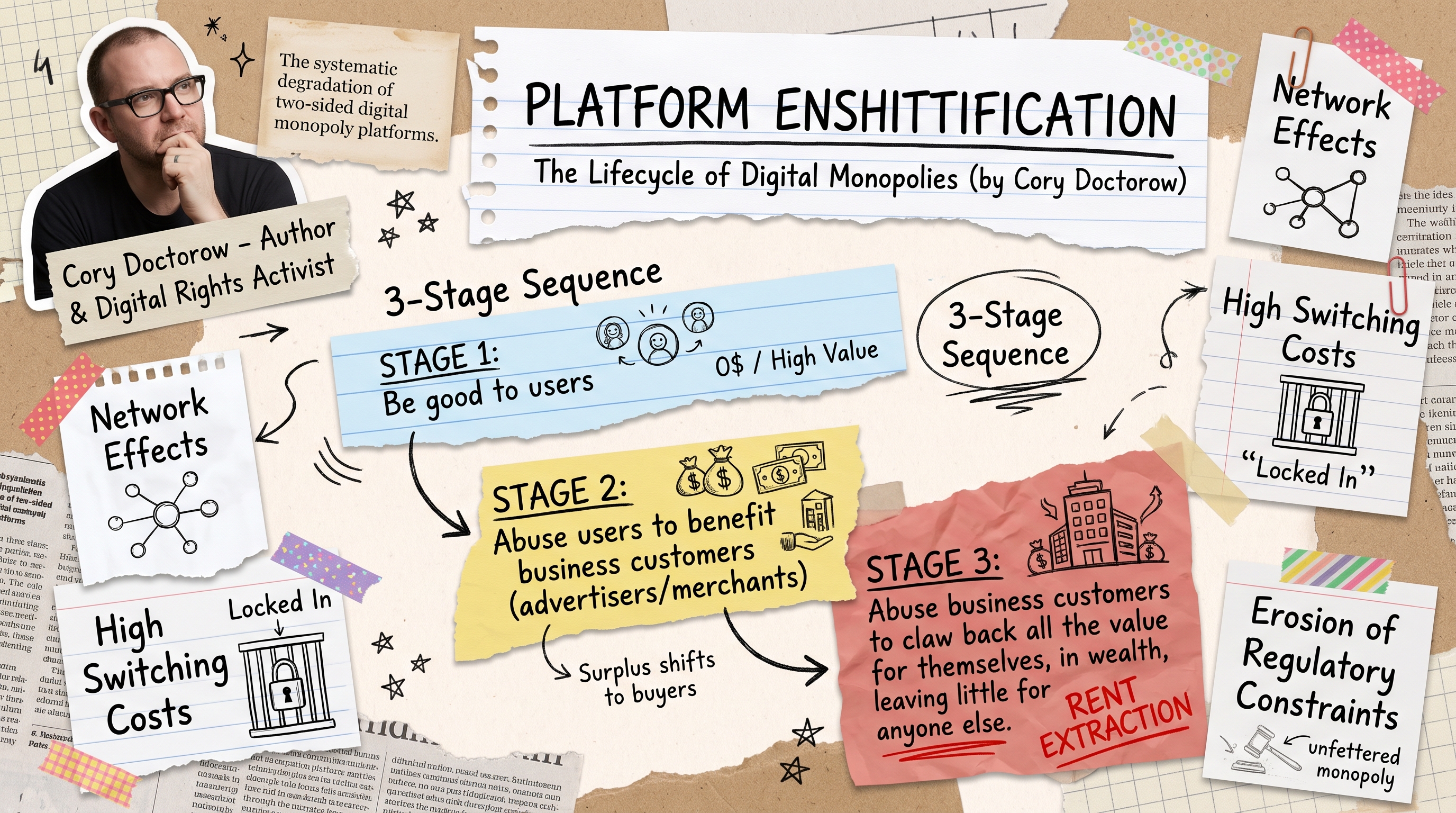
Platform Enshittification is a political-economic theory formulated by author and digital rights activist Cory Doctorow to explain the systematic degradation of two-sided digital monopoly platforms.[1] Rather than resulting from managerial incompetence or inevitable technological decay, enshittification operates as a deliberate three-stage sequence of surplus reallocation and rent extraction enabled by high switching costs, network effects, and the erosion of external regulatory constraints.[2]
Theoretical Foundations and Etymology
First coined by Cory Doctorow in November 2022 and expanded in his landmark 2023 essay on TikTok—and later formalized in his 2025 book Enshittification: Why Everything Suddenly Got Worse and What to Do About It—the concept traces the structural pathology of digital intermediaries.[1:1][3] Recognizing its cultural and analytical resonance in diagnosing platform decay, the American Dialect Society selected enshittification as its 2023 Word of the Year, followed by the Macquarie Dictionary in 2024.[4][5]
In classical microeconomics, as modeled by Jean-Charles Rochet and Jean Tirole, two-sided markets (or multi-sided platforms) serve as intermediaries that bring together two distinct user groups—such as consumers and merchants, or readers and advertisers—whose mutual participation generates cross-side network externalities.[6] In a competitive two-sided market, a platform must carefully balance its price and value allocation across both sides so neither group abandons the ecosystem for a rival (a practice known as multi-homing).[6:1]
Doctorow demonstrates that when a digital platform achieves monopoly status on the buyer side and monopsony power over suppliers, this balancing mechanism collapses.[7] Behind an outward facade of consumer convenience, once both sides are locked in, the platform transitions from facilitating mutually beneficial transactions to acting as an extractive tollbooth that captures maximum economic rent.[7:1]
"Here is how platforms die: first, they are good to their users; then they abuse their users to make things better for their business customers; finally, they abuse those business customers to claw back all the value for themselves. Then, they die." — Cory Doctorow[1:2]
The Three-Stage Life Cycle of Platform Decay
Enshittification follows a predictable, three-act structural progression governed by the strategic shifting of economic surplus—the net value or utility participants receive above what they pay or contribute.[1:3][8]
Stage 1: End-User Surplus Allocation (Capture via Subsidy)
In its nascent growth phase, a platform requires critical mass to ignite self-sustaining network effects.[1:4] Utilizing venture capital or public equity subsidies, the platform operates at a loss or razor-thin margin to deliver exceptional utility, clean UI/UX design, chronological feeds, and below-cost goods to end users.[1:5]
- Lock-in Mechanisms: While delighting users, the platform quietly erects barriers to exit.[8:1] These include collective switching costs (leaving a social network means severing ties with friends and communities), proprietary ecosystems, and Digital Rights Management (DRM) (such as encrypted media libraries that cannot be ported to competing hardware).[9][10]
- Market Consolidation: Predatory pricing starves brick-and-mortar and independent digital competitors, steering consumers along a path of least resistance until alternatives cease to exist.[1:6]
Stage 2: Business Customer Surplus Reallocation (Monetizing Lock-In)
Once end users are thoroughly locked in by network effects or sunk investments, the platform pivots.[8:2][10:1] It degrades the user experience to subsidize commercial suppliers, content creators, media publishers, and advertisers within the attention economy.[1:7][8:3]
- Surveillance and Algorithmic Injection: Platforms harvest granular user data to offer advertisers low-cost, hyper-targeted ad placements, operationalizing the behavioral extraction principles of surveillance capitalism while injecting commercial content into user feeds.[8:4]
- Artificial Reach ("Heating"): Platforms deliberately inflate visibility or subsidize traffic for commercial creators and publishers—a tactic analogous to a carnival operator letting an early player win a giant prize to lure more paying customers into a rigged game.[1:8][11] Seeing massive returns on investment, businesses dismantle their independent distribution channels and reorganize their operations around the platform.[7:2][11:1]
Stage 3: Shareholder Value Clawback (Total Rent Extraction)
Once business suppliers and creators are dependent on the platform's captive audience to reach the market (monopsony capture), the platform withdraws the subsidies from businesses as well, funneling nearly all remaining surplus to executives and shareholders.[1:9][7:3][8:5]
- Pay-to-Play Throttling: Organic reach between businesses/creators and the users who explicitly asked to follow them is throttled.[1:10][9:1] Suppliers must pay escalating placement fees or buy advertisements simply to reach their existing customers.[7:4][11:2]
- Fee Proliferation and Self-Preferencing: Marketplaces layer mandatory fulfillment, listing, and advertising fees onto third-party merchants while cloning top-selling merchant products with house brands.[7:5]
- Terminal Equilibrium: The platform degrades to the minimum viable quality required to prevent mass simultaneous defection—calibrating friction so that leaving remains slightly more painful than enduring the degraded service.[2:1][8:6]
| Lifecycle Stage | Primary Beneficiary | Core Platform Mechanism | Lock-In Strategy |
|---|---|---|---|
| 1. User Capture | End Users | Venture-subsidized pricing, high search relevance, clean UX | Social graphs, DRM, proprietary file formats, habitual convenience |
| 2. Supplier Capture | Business Customers / Creators | Subsidized ad rates, algorithmic amplification, behavioral tracking | Destruction of rival retail/media channels, audience dependency |
| 3. Rent Extraction | Platform Shareholders | Payola search rankings, reach throttling, junk fees, ad saturation | Bilateral monopoly/monopsony chokepoints, weaponized IP laws |
Core Operational Mechanics: "Twiddling"
Unlike brick-and-mortar businesses, where repricing inventory or redesigning store layouts incurs substantial physical friction, digital platforms govern markets entirely through software.[2:2][8:8] Deployed behind algorithmic smoke and mirrors, back-end engineers and automated optimization systems constantly adjust variables to extract micro-rents from every interaction, hiding structural degradation in plain sight:[8:9]
- Search & Discovery Manipulation: Deliberately worsening initial search accuracy so users scroll past more sponsored listings before locating their target item, weaponizing choice architecture through subtle deceptive patterns.[7:6][8:10]
- Algorithmic Wage Discrimination: In two-sided gig-economy platforms (e.g., rideshare and delivery networks), dynamic algorithms calculate the lowest possible payout a specific worker will accept for a task while charging the consumer the highest price their behavioral profile suggests they will tolerate, reducing workers to disposable cogs in the machine.[8:11][11:4]
- Attention Arbitrage ("Heating"): Manually overriding algorithmic meritocracy to boost specific creators or commercial partners during contract negotiations, then covertly dialing down their traffic once they are locked in.[1:11]
Empirical Case Studies
Amazon (E-Commerce & Retail Marketplace)
- Stage 1: Operated at a loss for years to offer below-cost goods, free shipping, hassle-free returns, and clean, objective product search.[1:12] Locked in over 80% of American households via pre-paid Amazon Prime subscriptions and DRM-encumbered Kindle/Audible media ecosystems.[7:7][10:2]
- Stage 2: Courted third-party merchants with access to Prime's massive buyer pool and streamlined warehousing infrastructure, decimating independent e-commerce sites and physical retail competitors.[1:13][7:8]
- Stage 3: Converted product search into a "payola" advertising auction.[11:5] The first screens of search results became dominated by sponsored placements rather than organic relevance, forcing merchants into margin-destroying bidding wars.[7:9][11:6] Combined platform and fulfillment fees grew to consume over 45% of seller revenue in many categories, forcing sellers to raise off-platform prices (via "most-favored-nation" parity clauses) and inflating consumer costs across the broader economy.[7:10][11:7]
Meta / Facebook (Social Graph & Digital Publishing)
- Stage 1: Offered a clean, chronological feed strictly displaying updates from friends and family users explicitly chose to follow, surmounting MySpace by promising superior privacy and utility.[9:2][11:8] Network effects made individual departure socially costly.[2:3][9:3]
- Stage 2: Lured media companies and advertisers with granular behavioral surveillance and artificially inflated video viewership metrics (the "Pivot to Video"), convincing publishers to lay off print/web staff and publish directly inside Facebook's walled garden.[1:14][8:12][11:9]
- Stage 3: Throttled organic reach for publisher pages to near zero, forcing media outlets to pay to reach their own subscribers.[11:10] Simultaneously flooded end-user feeds with ad-heavy algorithmic recommendations, AI-generated engagement bait, and sponsored posts while raising ad prices, habituating users to consume content on autopilot.[8:13][9:4]
TikTok & Google Search (Information & Creator Discovery)
- TikTok: Initially bypassed social graph lock-in through an uncannily accurate recommendation engine that connected users to niche creators without charging creators for reach, analyzed in TikTok's Impact on Privacy and Cognition.[1:15][9:5] Once creators relied on TikTok for their livelihoods, ByteDance introduced manual "heating" and commercialized the feed with TikTok Shop integrations and paid promotional throttling, pitting creator income against platform ad-spend extraction.[1:16]
- Google Search: Rose to dominance by abandoning portal clutter and delivering instantaneous links taking users away from Google to the exact information sought.[8:14] After locking in search market share via default browser contracts and ad-tech vertical integration, Google saturated top viewports with paid ad auctions, self-preferenced verticals, and generative summaries that retain traffic while starving external web publishers, eroding the traditional balance between SEO and SEM.[8:15][9:6]
The Pathology: Erosion of the Four Constraints
Enshittification is not driven by a sudden moral decline among corporate executives; corporate actors have always sought to maximize profit.[2:4] Rather, Doctorow identifies four structural constraints whose systematic dismantling since the late 20th century enabled unchecked platform rent extraction.[2:5][8:16]
- Erosion of Competition (Antitrust Retreat): Beginning in the late 1970s and 1980s under the influence of Robert Bork's Chicago School "consumer welfare" standard, antitrust regulators ceased blocking vertical mergers and predatory pricing, creating a regulatory blind spot that permitted tech giants to acquire nascent rivals (e.g., Meta acquiring Instagram and WhatsApp; Google acquiring DoubleClick) and establish durable monopolies.[2:6][8:17][12]
- Regulatory Capture: Concentrated market share translates directly into lobbying power.[8:18] Monopolies outspend public-interest advocates to weaken data privacy laws, defund consumer protection agencies, or exploit jurisdictional arbitrage—creating an environment where regulatory fines function merely as minor operating expenses.[2:7][8:19][12:1]
- Criminalization of Interoperability ("Felony Contempt of Business Model"): Historically, computing's inherent modularity allowed third parties to build adversarial interoperability tools—ad blockers, alternative clients, format converters, and third-party ink cartridges—whenever an incumbent degraded its product, combating manufactured planned obsolescence.[2:8][8:20][13] Through Section 1201 of the 1998 US Digital Millennium Copyright Act (DMCA), international WIPO treaties, the Computer Fraud and Abuse Act (CFAA), and restrictive Terms of Service, corporations made bypassing digital locks or reverse-engineering APIs a civil and criminal offense, even when no copyright infringement occurs.[8:21][13:1]
- Weakening of Tech Worker Power: For decades, acute software engineering talent shortages and strong "vocational awe" gave tech workers informal veto power over overtly abusive or user-hostile product changes.[2:9] Coordinated mass layoffs, non-compete clauses, and algorithmic management eroded worker leverage, eliminating the final internal check against executive rent-seeking and pushing labor to somatic burn out.[2:10][8:22]
Disenshittification: Structural Remedies
Reversing platform decay requires rebuilding the four constraining forces through targeted legal, technical, and labor interventions rather than relying on corporate self-regulation or waiting for speculative business models built on sand to collapse on their own:[2:11][12:2]
- Structural Separation & Antitrust Enforcement: Breaking up vertically integrated platforms so an entity cannot simultaneously operate a marketplace and compete as a merchant or ad broker within that same marketplace.[7:11][12:3] Blocking killer acquisitions restores credible exit threats for users and suppliers.[2:12][8:23]
- Mandated & Adversarial Interoperability: Combining legal mandates—such as the European Union's Digital Markets Act (DMA) requiring gatekeepers to open messaging and app store interfaces—with a statutory right to repair and modify.[12:4][13:2] Repealing anti-circumvention provisions like DMCA Section 1201 would allow startups, cooperatives, and open-source developers (such as the ActivityPub/Fediverse ecosystem) to build clean interfaces that plug directly into dominant networks without needing the monopolist's permission, causing closed walled gardens to systematically unravel.[8:24][12:5][13:3]
- Bright-Line Privacy & End-to-End Rules: Enacting strict bans on behavioral surveillance advertising and algorithmic wage/price discrimination ("twiddling"), forcing platforms to compete on transparent service quality rather than asymmetric information extraction.[8:25][12:6]
- Sectoral Collective Bargaining: Strengthening unionization across both salaried tech engineering roles and gig-economy labor forces to establish an internal institutional counterweight against predatory product design, empowering workers to pull the plug on abusive implementations.[2:13][12:7]
For a concise spoken synthesis of how these structural mechanisms operate across modern digital ecosystems and how policy interventions can reverse them, watch Cory Doctorow – The "Enshittification" of Everything, a 2026 keynote address that directly outlines the pathology of platform capture and the roadmap for disenshittification:
🎴 Interactive Web Practice (Comprehension Check)
Question 1 (Theoretical Framework & Two-Sided Markets): How does Cory Doctorow's enshittification theory challenge the assumption that platform degradation stems from managerial incompetence or natural product aging?
Answer: Enshittification demonstrates that platform decay is not accidental, technical rot, or managerial incompetence, but rather a rational, deliberate three-stage reallocation of economic surplus engineered to maximize monopoly rent extraction. In a competitive two-sided market (as modeled by Rochet and Tirole), intermediaries must balance value distribution between buyers and suppliers to prevent either side from multi-homing (defecting to rivals). Once a digital platform achieves monopoly control over consumers and monopsony power over suppliers, switching costs and network effects lock both sides in. The platform can then systematically degrade service quality, claw back surplus, and convert itself into a predatory tollbooth without immediate fear of competitive defection.
Question 2 (The Three-Stage Lifecycle): What occurs during each of the three stages of the enshittification lifecycle, and how is economic surplus strategically shifted across them?
Answer: The three stages unfold through a systematic reallocation of surplus:
1. Stage 1 (End-User Surplus Allocation / Capture via Subsidy): The platform uses investor capital to operate at an intentional loss, offering pristine interfaces, high search relevance, below-cost services, and chronological feeds to end users. The goal is to ignite critical mass and lock users in through social graph ties, proprietary formats, and digital rights management (DRM).
2. Stage 2 (Business Customer Surplus Reallocation / Monetizing Lock-In): With end users captive, the platform degrades user experience to subsidize business suppliers, media publishers, and advertisers. It introduces granular surveillance, cheap hyper-targeted ads, and artificially boosted reach ("heating") to lure businesses into dismantling their independent sales channels and becoming dependent on the platform.
3. Stage 3 (Shareholder Value Clawback / Total Rent Extraction): Once businesses are dependent on the platform's audience to survive, the platform revokes their subsidies as well. It throttles organic reach to force suppliers into payola advertising auctions, layers on junk listing and fulfillment fees, clones top merchant products, and degrades the service to the absolute minimum viable quality needed to prevent simultaneous mass exit, routing all extracted surplus to platform shareholders and executives.
Question 3 (Operational Mechanics & "Twiddling"): What is "twiddling," and how does software-enabled digital governance make micro-rent extraction fundamentally different from traditional brick-and-mortar commerce?
Answer: "Twiddling" is the continuous, opaque, algorithmic adjustment of back-end system parameters (such as search ranking weights, ad density, pay rates for gig workers, and feed distribution) in real time to locate the exact threshold of user and supplier pain tolerance. In physical brick-and-mortar commerce, changing store layouts, repricing physical goods, or renegotiating supplier contracts incurs significant labor and logistical friction. In digital platform environments, software allows monopolists to dynamically alter market rules with zero marginal friction—worsening search results to force users past sponsored ads, running payola bidding auctions, or algorithmically suppressing gig worker payouts to probe the boundary where departure remains slightly more costly than enduring abuse.
Question 4 (Empirical Case Dynamics): How did Amazon, Meta, and Google execute the enshittification playbook across their respective market domains?
Answer: Each firm followed the three-stage extraction pattern:
- Amazon: Initially subsidized free two-day shipping, below-cost retail goods, and clean search results, locking in households via Amazon Prime and Kindle DRM (Stage 1). It then brought in third-party merchants to decimate independent e-commerce (Stage 2). Finally, it converted product search into a pay-to-play advertising auction where merchants must pay over 45% of gross revenue in combined advertising and fulfillment fees simply to maintain visibility (Stage 3).
- Meta (Facebook): Began with a clean chronological feed strictly displaying posts from chosen friends and family (Stage 1). It then courted media publishers with promises of massive audiences and inflated video metrics ("Pivot to Video"), inducing publishers to fire staff and host content inside Facebook (Stage 2). Finally, it throttled organic reach to near zero, forcing publishers to buy ads to reach their own followers while saturating user feeds with algorithmic recommendations and AI junk (Stage 3).
- Google Search: Gained dominance by providing clean, fast search that instantly directed users away to high-quality external web pages (Stage 1). After capturing dominant market share via default browser placement deals, it saturated top viewports with sponsored ads, self-preferenced proprietary widgets, and AI overviews that keep users inside Google's ecosystem while starving original content creators of traffic (Stage 3).
Question 5 (The Structural Pathology & The Four Constraints): Why does Doctorow reject moral explanations for enshittification, and what four structural constraints were dismantled to allow unchecked rent-seeking?
Answer: Doctorow rejects moralistic explanations because corporate executives have always sought to maximize profit; what has changed is the legal and economic architecture that previously kept corporate greed in check. Enshittification became ubiquitous because four external structural constraints were systematically dismantled:
1. Antitrust Enforcement (Competition): The adoption of the Chicago School "consumer welfare" standard in the late 1970s stopped regulators from blocking predatory pricing and killer acquisitions, allowing tech giants to buy up potential competitors and establish permanent monopoly chokepoints.
2. Regulation: Concentrated tech monopolies converted financial scale into political lobbying power, defunding regulators, weakening privacy legislation, and ensuring that regulatory fines function as trivial costs of doing business.
3. Adversarial Interoperability: Laws like DMCA Section 1201, the CFAA, and restrictive Terms of Service criminalized reverse-engineering, ad blocking, and third-party modification tools ("felony contempt of business model"), preventing competitors and users from repairing degraded products or building clean alternative front-ends.
4. Tech Worker Power: Historically, engineering talent shortages and vocational pride gave tech employees internal leverage to veto user-hostile changes. Mass tech layoffs, non-compete covenants, and algorithmic performance management weakened worker autonomy, dismantling the internal ethical check on executive decisions.
Question 6 (Disenshittification & Policy Interventions): How do structural separation and mandated/adversarial interoperability restore consumer sovereignty and reverse platform decay?
Answer: True disenshittification relies on enforceable legal, structural, and technical remedies rather than corporate ethical appeals:
- Structural Separation: Prohibits platform operators from competing as merchants, content creators, or ad brokers on the very platforms they administer (e.g., barring Amazon from selling private-label knockoffs against third-party sellers, or breaking up Google's ad broker and ad exchange operations). This eliminates the structural conflict of interest that incentivizes self-preferencing.
- Mandated & Adversarial Interoperability: Enforces statutory interoperability (such as the EU Digital Markets Act) requiring dominant networks to allow external messaging, app stores, and social feeds to connect via open APIs. Crucially, it also decriminalizes adversarial interoperability by repealing anti-circumvention provisions (DMCA Section 1201), granting developers the legal right to scrape, build third-party ad-free clients, and construct interoperable protocols (like the Fediverse/ActivityPub). This restores a credible exit threat: users can leave a degraded platform while retaining their social connections and data, dismantling monopoly lock-in at its root.
Resonant Notes
The following notes in the vault share direct thematic, structural, and strategic connections with Platform Enshittification:
🟣 Core Lexical Syllabus & Applied Metaphoric Expressions
- critical-mass (Classical Physics, Force & Equilibrium) — Captures Stage 1 platform dynamics, wherein massive venture capital subsidies are deployed to operate at a loss until user density and two-sided network participation achieve critical mass, locking participants into self-sustaining ecosystems.
- path-of-least-resistance (Classical Physics, Force & Equilibrium) — Conceptualizes predatory pricing and frictionless onboarding funnels that guide consumers along the path of least resistance until independent digital alternatives and brick-and-mortar rivals are starved out of the market.
- a-facade (Buildings & Structures) — Illustrates how digital monopolies project an outward appearance of consumer utility, free connectivity, and objective search to construct a facade that conceals systemic lock-in, surveillance extraction, and predatory rent collection.
- smoke-and-mirrors (Magic & The Supernatural) — Diagnoses back-end "twiddling," opaque ad-auction algorithms, and artificially inflated engagement metrics deployed as smoke and mirrors to disguise the systematic reallocation of surplus from creators and suppliers to the platform.
- in-plain-sight (Light & Vision) — Captures how the incremental degradation of feed quality, search relevance, and merchant margins unfolds in plain sight, habituating captive users and suppliers to chronic value extraction without triggering immediate mass defection.
- cog-in-the-machine (Machines & Mechanics) — Frames the algorithmic management and dynamic wage suppression of gig workers and marketplace merchants, reducing autonomous economic agents into interchangeable, disposable cogs in the machine.
- on-autopilot (Machines & Mechanics) — Epitomizes the unreflective, dissociative state of captive platform users who, ensnared by continuous scroll mechanics and engagement loops, navigate degraded feeds and sponsored listings on autopilot.
- blind-spot (Light & Vision) — Diagnoses the severe ideological blind spot engineered by the Chicago School "consumer welfare" antitrust doctrine, which focused exclusively on short-term retail prices while remaining oblivious to predatory acquisitions, vertical integration, and monopsony chokepoints.
- burn-out (Fire & Heat) — Reflects the acute exhaustion of tech workers, gig couriers, and digital content creators who suffer somatic burn out under relentless algorithmic speedups, reach throttling, and the dismantling of collective labor protections.
- unravel (Weaving, Textiles & The Loom) — Embodies the structural promise of disenshittification, wherein mandatory open APIs, adversarial interoperability rights, and structural antitrust breakups cause closed monopolistic walled gardens to systematically unravel.
🔴 Platform Economics, Monopoly Power & Two-Sided Markets
- Shoshana Zuboff-The Age of Surveillance Capitalism — Establishes the macroeconomic foundation of behavioral extraction, detailing how tech monopolies harvest behavioral surplus to fuel predictive ad markets, directly underpinning Stage 2 of the enshittification cycle.
- The Attention Economy — Analyzes how digital platforms commodify scarce human cognitive focus, deploying algorithmic feeds, notification triggers, and engagement loops that drive platform lock-in.
- Consumers — Investigates consumer behavior, switching costs, and bounded rationality under digital monopoly environments, illustrating why locked-in users endure degraded service quality.
- Pricing Strategy — Examines penetration pricing, venture-subsidized loss leaders, and monopolistic price discrimination, contrasting sustainable market pricing with predatory enshittification subsidies.
- Product-Market Fit — Explores the tension between authentic product-market fit (Stage 1 user delight) and engineered financial extraction (Stage 3 rent clawback).
🟡 Digital Marketing, Behavioral Extraction & Deceptive Design
- Dark Patterns and Deceptive Design — Examines weaponized choice architecture, Roach Motels, and asymmetric friction deployed by platforms during Stage 3 to trap consumers and prevent account cancellation.
- Difference Between UI and UX Design — Details how visual hierarchy and user experience principles are inverted by platform designers to prioritize sponsored payola listings over organic relevance.
- Difference Between SEO and SEM — Explores the structural evolution of search results from organic algorithmic meritocracy (SEO) into pay-to-play sponsored advertising auctions (SEM).
- Planned Obsolescence — Draws a direct structural parallel between engineered physical hardware degradation and software-enabled platform decay, both representing deliberate anti-consumer obsolescence strategies.
- TikTok's Impact on Privacy and Cognition — Details the micro-behavioral tracking, dopamine reinforcement, and "heating" mechanics that enabled TikTok's hyper-rapid Stage 1 user capture and subsequent Stage 2 monetization.
🟢 Regulatory Governance & Media Ecology
- McLuhan's The Medium is the Message — Contextualizes platform capture through media ecology, showing how digital intermediary environments reshape cognitive and cultural habits while content acts as a distracting lure.
- Why Canada Will Never Have a WeChat — Case study analyzing regulatory antitrust barriers, privacy legislation, and interoperability mandates that restrict digital conglomerate lock-in.
- Postscript on the Societies of Control — Explores Deleuze's concept of continuous modulation and digital control networks, illuminating how back-end "twiddling" governs user and worker behavior through software parameters.
- Georg Simmel's Tragedy of Culture — Contextualizes how the runaway accumulation of objective technical systems and institutional apparatuses dwarfs subjective individual autonomy.
- Zygmunt Bauman's sociological framework of Liquid Modernity — Examines the deregulation of markets and the precarity of the digital precariat operating as disposable labor within gig-economy platforms.
References
Cory Doctorow / Pluralistic: Tiktok's enshittification / pluralistic.net ↩︎ ↩︎ ↩︎ ↩︎ ↩︎ ↩︎ ↩︎ ↩︎ ↩︎ ↩︎ ↩︎ ↩︎ ↩︎ ↩︎ ↩︎ ↩︎ ↩︎
Cory Doctorow / My McLuhan lecture on enshittification / medium.com ↩︎ ↩︎ ↩︎ ↩︎ ↩︎ ↩︎ ↩︎ ↩︎ ↩︎ ↩︎ ↩︎ ↩︎ ↩︎ ↩︎
Cory Doctorow / Enshittification: Why Everything Suddenly Got Worse and What to Do About It / munrobooks.com ↩︎
American Dialect Society / 2023 Word of the Year Is "Enshittification" / americandialect.org ↩︎
Tory Shepherd / 'What many of us feel': why 'enshittification' is Macquarie Dictionary's word of the year / theguardian.com ↩︎
Jean-Charles Rochet & Jean Tirole / Two-Sided Markets: An Overview / mit.edu ↩︎ ↩︎
Cory Doctorow / How monopoly enshittified Amazon / medium.com ↩︎ ↩︎ ↩︎ ↩︎ ↩︎ ↩︎ ↩︎ ↩︎ ↩︎ ↩︎ ↩︎ ↩︎
Tanner Humanities Center / Cory Doctorow on enshittification and resistance / utah.edu ↩︎ ↩︎ ↩︎ ↩︎ ↩︎ ↩︎ ↩︎ ↩︎ ↩︎ ↩︎ ↩︎ ↩︎ ↩︎ ↩︎ ↩︎ ↩︎ ↩︎ ↩︎ ↩︎ ↩︎ ↩︎ ↩︎ ↩︎ ↩︎ ↩︎ ↩︎
Cory Doctorow / Tiktokification shall set us free / medium.com ↩︎ ↩︎ ↩︎ ↩︎ ↩︎ ↩︎ ↩︎
Cory Doctorow / Way past its prime: how did Amazon get so rubbish? / theguardian.com ↩︎ ↩︎ ↩︎
Wikipedia Contributors / Enshittification / wikipedia.org ↩︎ ↩︎ ↩︎ ↩︎ ↩︎ ↩︎ ↩︎ ↩︎ ↩︎ ↩︎ ↩︎
Crash Course Economics / Enshittification: The Rise and Fall of Big Tech — with Cory Doctorow / crashcourseeconomics.org ↩︎ ↩︎ ↩︎ ↩︎ ↩︎ ↩︎ ↩︎ ↩︎
Wikipedia Contributors / The Internet Con: How to Seize the Means of Computation / wikipedia.org ↩︎ ↩︎ ↩︎ ↩︎