The Decoy Effect
🗂️ Interactive Notebook: Open Study Companion (Video Summary, Flashcards, Mind Map) ↗
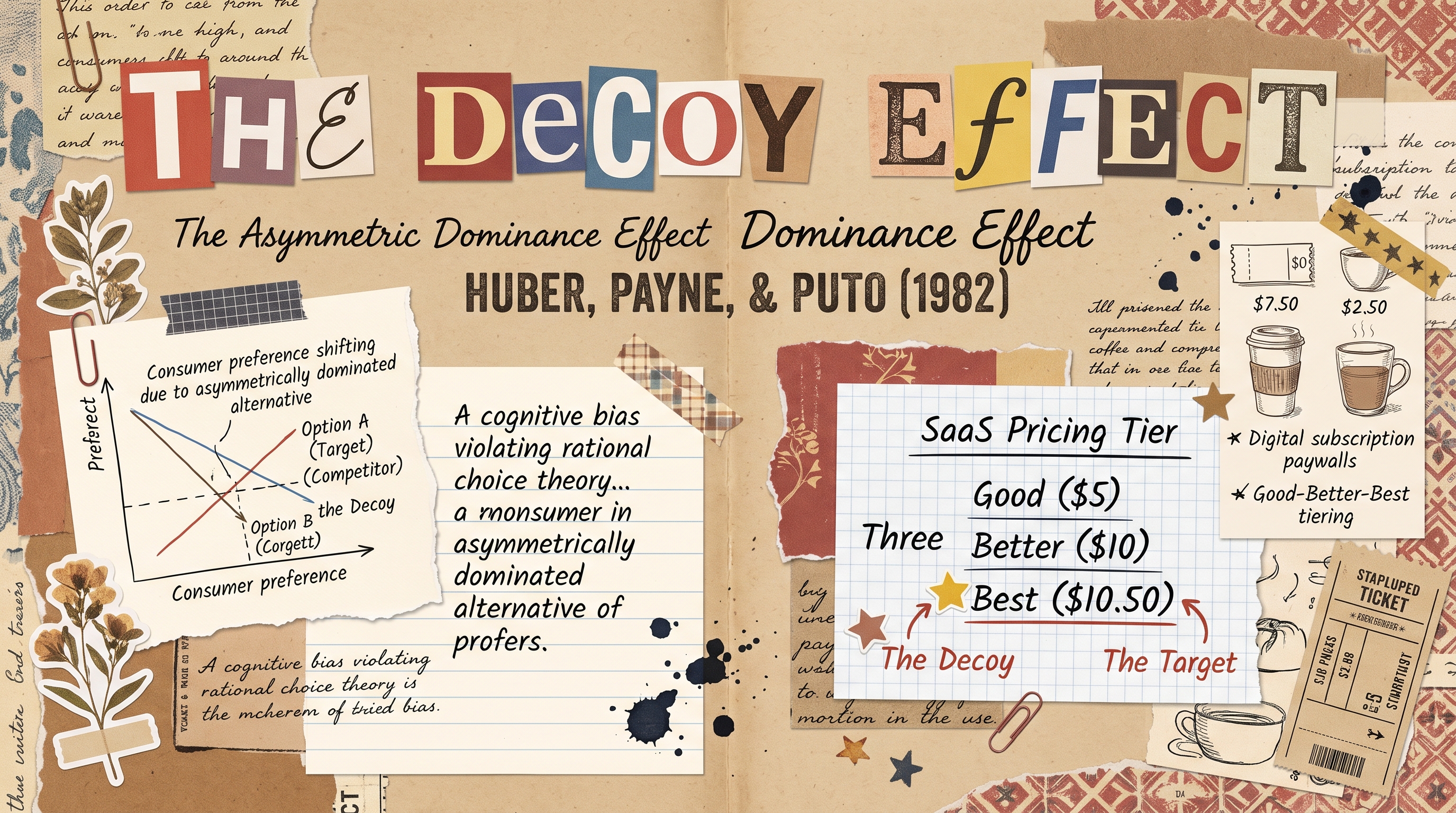
The Decoy Effect (formally known as the asymmetric dominance effect or attraction effect) is a behavioral economics phenomenon in which consumer preference between two original options shifts decisively upon the introduction of a third, asymmetrically dominated alternative. First formalized by Joel Huber, John W. Payne, and Christopher Puto in 1982, this cognitive bias directly violates foundational axioms of neoclassical rational choice theory.[1] In modern digital pricing architecture, asymmetric dominance serves as a primary structural mechanism governing Software-as-a-Service (SaaS) Good-Better-Best tiering, digital media subscription paywalls, and freemium-to-premium conversion funnels.[2]
Theoretical Foundations & Rational Choice Violations
Standard microeconomic utility models assume that consumers possess stable, well-defined internal preferences and evaluate alternatives based on their absolute intrinsic utility. Early neoclassical frameworks harbored an analytical blind spot regarding context-dependent evaluation: when decision-makers evaluate multi-attribute digital products where attributes conflict—such as low monthly cost versus high cloud storage capacity—constructing an absolute valuation is cognitively taxing. Instead, consumers construct preferences dynamically using comparative context.[3]
In a baseline binary choice set containing a Competitor (
- Competitor (
): Low price, restricted feature set (e.g., Basic Tier at $15/month for 10 GB storage). - Target (
): High price, expansive feature set (e.g., Pro Tier at $45/month for 100 GB storage).
Because neither option strictly dominates the other, consumers experience trade-off friction. Introducing a Decoy (
Violations of Regularity and IIA
The empirical success of the decoy effect overturns two core axioms of classical probabilistic choice models:
- The Regularity Axiom: Regularity dictates that adding a new option to a consideration set cannot increase the absolute probability of selecting any existing member of the original subset.[1:2] Formally, for any option
within subset , where is a subset of , the probability of choosing must satisfy .[1:3] Asymmetric dominance violates regularity by increasing the absolute choice share of after is added to the menu. - Independence of Irrelevant Alternatives (IIA) & The Similarity Hypothesis: Proposed by R. Duncan Luce, IIA asserts that the relative odds of choosing
over should remain invariant regardless of whether is present.[3:1] Furthermore, Amos Tversky's Similarity Hypothesis predicts that introducing a new option should cannibalize disproportionately more market share from options similar to it rather than dissimilar ones.[1:4] Asymmetric dominance reverses this: even though closely resembles in price and features, it boosts 's share at the expense of .[1:5]
Taxonomy of Asymmetric Decoy Geometries
Huber, Payne, and Puto categorized decoy placement along two-dimensional attribute grids according to how the decoy alters the perceived psychological distance between options:[1:6]
| Decoy Geometry | Attribute Manipulation | Mechanism of Distortion | Empirical Lift (Huber et al.) |
|---|---|---|---|
| Range-Increasing ( | Extends the boundary of the dimension on which the Target is weakest (e.g., making | Compresses the perceived price gap between | +13 percentage points[1:7] |
| Range-Frequency ( | Simultaneously degrades both the price and quality dimensions of | Combines range compression with an immediate two-dimensional dominance win for | +8 percentage points[1:8] |
| Frequency-Increasing ( | Places | Increases the density of high-tier options, drawing attentional weight toward feature richness rather than price. | +4 percentage points[1:9] |
Pricing architects frequently pair asymmetric dominance with two sibling context biases:
- The Compromise Effect: Consumers exhibit extremeness aversion, gravitating toward the middle tier in a Good-Better-Best lineup (where no option is strictly dominated) because the center option splits the risk of overpaying vs. under-buying.[4]
- Phantom Decoys: Presenting an ultra-attractive superior option that is labeled "Sold Out," "Invite Only," or "Waitlist Closed." The unavailable option establishes a high aspirational anchor, steering frustrated buyers toward the closest available high-margin Target tier.
Psychological & Cognitive Mechanisms
Behavioral scientists attribute the effectiveness of digital decoys to three primary cognitive mechanisms:
1. Reason-Based Choice and Justifiability
In his landmark 1989 study, Itamar Simonson demonstrated that when consumers face uncertainty about their exact utility weights, they pivot from calculating absolute value to seeking compelling reasons to justify a choice to themselves or stakeholders.[4:1] Comparing
2. Loss Aversion and Reference Point Shifting
Amos Tversky and Itamar Simonson formalized the Componential Context Model (1993), illustrating how decoys shift a buyer's internal reference point.[3:2] In a binary choice (
3. Trade-Off Contrast and Quantitative Salience
Digital pricing tables excel at triggering asymmetric dominance because software attributes are overwhelmingly numeric (seats, API calls, storage limits, retention days). Research by Shane Frederick, Leonard Lee, and Ernest Baskin (2014) revealed a crucial boundary condition: the attraction effect is dramatically amplified when attributes are presented as clean abstract numbers in comparison matrices, and weakens or vanishes when attributes are experiential, visual, or qualitative.[5] Because SaaS pricing grids explicitly format product tiers into structured numerical matrices, digital interfaces replicate the exact stylized laboratory conditions where asymmetric dominance exerts maximum psychological pull.[5:1]
Classic Empirical Benchmark: The Economist Paywall
The most famous real-world validation of asymmetric dominance in digital subscription architecture was documented by behavioral economist Dan Ariely in Predictably Irrational, analyzing a live subscription paywall deployed by The Economist.[6]
Prospective subscribers were presented with three annual tiers:
- Web-Only Subscription (Competitor): $59.00
- Print-Only Subscription (Decoy): $125.00
- Print & Web Subscription (Target): $125.00
The Print-Only decoy sat in plain sight directly on the order page, appearing as a genuine purchase option even though its sole architectural function was to act as an unchosen catalyst.
When Ariely tested this exact three-tier architecture on 100 MIT Sloan students, 16% chose Web-Only ($59), 0% chose Print-Only ($125), and 84% selected the Print & Web bundle ($125)—generating $11,444 in total simulated revenue.[6:1] When Ariely removed the unchosen Print-Only decoy and presented only the two active tiers to a matched cohort, preferences inverted completely: 68% selected Web-Only ($59) and only 32% chose Print & Web ($125), dropping total revenue to $8,012—a 30% revenue collapse caused solely by removing an option nobody bought.[6:2]
The Print-Only tier functioned as a pure Frequency/Dominance Decoy: by pricing Print-Only identically to Print & Web, The Economist framed digital web access as a "free" bonus bolted onto the print edition, short-circuiting the consumer's willingness-to-pay evaluation of whether print was actually worth an extra $66 over web-only access.[6:3]
Applications in Digital Pricing Architecture
Modern digital product teams operationalize asymmetric dominance across three primary monetization surfaces:
1. SaaS Good-Better-Best (GBB) Tiering
In B2B and prosumer SaaS pricing grids, asymmetric dominance is routinely engineered within overall pricing strategy to maximize Average Revenue Per User (ARPU) and Net Revenue Retention (NRR):[2:1]
- The "Crippled Mid-Tier" Upsell Architecture: When a company wants to drive users into its highest-margin Best tier (e.g., $99/mo), it designs the Better tier ($89/mo) as a range-frequency decoy—pricing it within 10–15% of the top tier while withholding a mission-critical workflow feature (such as SSO, role-based permissions, or unlimited exports). The $10 marginal jump makes the top tier an effortless upgrade, steering buyers along the path of least resistance directly into high-tier enterprise commitments.
- The Enterprise Anchor Decoy: Conversely, to drive volume into the middle Pro tier ($49/mo) over a Starter tier ($19/mo), SaaS vendors introduce a high-priced Scale/Enterprise tier ($249/mo) with only incremental feature additions for standard teams. This combines a Range-Increasing Decoy with the Compromise Effect, making $49/mo feel conservative and high-value.
- Visual Salience Multipliers: Digital UI designers reinforce the mathematical dominance relationship using visual choice architecture—leveraging UI and UX design principles to highlight the Target tier with elevated card drop-shadows, contrasting border colors, pre-selected toggle states, and badges reading "Most Popular" or "Best Value."
2. Subscription Billing Cadence (Monthly vs. Annual Paywalls)
Consumer subscription apps (streaming platforms, fitness apps, productivity tools) rely on decoy cadence framing to lock in upfront cash flow and reduce monthly churn:
- Competitor: Monthly Plan at $14.99/month ($179.88/year billed monthly; high flexibility).
- Decoy: Quarterly Plan at $39.99/quarter ($13.33/month; 3-month commitment with negligible savings).
- Target: Annual Plan at $99.99/year ($8.33/month; 12-month commitment, framed as "Save 45%").
Without the quarterly tier, users weigh maximum flexibility ($14.99 today) against a $100 upfront outlay. Adding a poorly priced quarterly decoy introduces a commitment hurdle without meaningful discount relief, making the Annual Plan's effective monthly rate appear disproportionately generous and providing a frictionless path toward annual commitment.
3. Freemium-to-Premium Conversion Funnels & Usage Gates
In product-led growth (PLG) funnels, users on a $0 Freemium plan suffer from the Zero-Price Effect, where moving from $0 to any positive dollar amount triggers intense psychological friction. To bridge this chasm:
- Micro-Transaction / Credit Pack Decoys: Generative AI tools, cloud design platforms, and API services frequently price one-off "Top-Up Credit Packs" (e.g., $15 for 50 credits, non-renewing) right alongside a full Monthly Subscription ($19/month for 500 credits + watermark removal + priority queue). The one-off credit pack acts as an asymmetrically dominated decoy on unit economics ($0.30/credit vs. $0.038/credit), converting Pay-As-You-Go buyers into recurring subscribers on autopilot.
Failure Modes, Backfire Risks, and Ethical Boundaries
While asymmetric dominance frequently lifts immediate checkout conversion, misapplied decoy pricing introduces severe operational and regulatory liabilities.
Empirical conversion experiments in B2B and consumer SaaS identify three distinct failure modes where decoys degrade long-term enterprise value:[2:2]
- The Churn Amplifier (Plan-Usage Mismatch): If an aggressive decoy lures price-sensitive SMB customers into an expensive tier whose features they never utilize, short-term trial-to-paid conversion spikes while 90-day retention plummets due to buyer's remorse and billing fatigue.[2:3]
- The Sophistication Trap (B2B Procurement Distrust): Experienced enterprise software buyers and procurement teams benchmark unit pricing closely. Transparently absurd decoys (such as charging the exact same price for strictly fewer features in a B2B table) signal manipulative pricing, eroding vendor trust and slowing deal velocity.[2:4]
- Choice Overload & Cognitive Fatigue: As Huber et al. noted, when pricing pages exceed 4–5 tiers or list dozens of granular feature rows, cognitive load prevents buyers from detecting the dominance relationship, collapsing conversion back toward default inaction.[1:10]
Regulatory Scrutiny and Online Choice Architecture (OCA)
Global consumer protection authorities increasingly scrutinize behavioral pricing tactics under dark patterns and Online Choice Architecture (OCA) enforcement frameworks.[7] Under the European Union's Digital Services Act (DSA), the Unfair Commercial Practices Directive (UCPD), the UK Digital Markets, Competition and Consumers Act (DMCCA), and the EU's Digital Fairness Act initiatives, regulators distinguish between legitimate product tiering and unlawful behavioral manipulation:[7:1][8]
- Permissible Asymmetric Tiering: Offering genuine Good-Better-Best packages or volume discounts where every tier delivers transparent, deliverable utility at clearly disclosed total prices.
- Actionable Dark Patterns: Coupling decoy tiers with deceptive UI interference—such as drip pricing (hiding mandatory platform fees on the Competitor tier until the final checkout step to manufacture a facade of dominance for the Target tier), phantom stock manipulation (deploying smoke and mirrors to falsely claim cheaper tiers are "sold out"), or asymmetric exit friction (allowing one-click upgrades into an annual Target tier while burying cancellation behind multi-step support mazes).[7:2][8:1]
To remain durable and compliant, modern digital pricing architecture uses asymmetric dominance as a decision-simplification scaffold—helping uncertain buyers recognize genuine unit-value economies in comprehensive tiers—rather than trapping users in mismatched commitments that erode lifetime value.[2:5]
---\n\n## 🎴 Interactive Web Practice (Comprehension Check)
Question 1 (Choice Geometry & Asymmetric Dominance): What geometric and attribute conditions must an alternative satisfy to function as an asymmetrically dominated decoy, and how does it resolve trade-off friction between competing options?
Answer: For an alternative to qualify as an asymmetrically dominated decoy ($D$), it must be strictly inferior to the intended Target ($T$) across all evaluated attribute dimensions (or inferior on one dimension and equal on the other), while remaining only partially inferior or ambiguous relative to the Competitor ($C$). In a baseline two-option set, consumers experience trade-off friction because $C$ excels on one attribute (e.g., lower price) while $T$ excels on another (e.g., higher capacity/quality), forcing a difficult trade-off calculation. Introducing $D$ immediately adjacent to $T$ establishes a local dominance vector where $T$ is self-evidently superior to $D$ with zero cognitive ambiguity. This asymmetric dominance simplifies the decision calculus by providing an effortless reason to choose $T$, bypassing the taxing trade-off computation against $C$.
Question 2 (Axiomatic Violations of Rational Choice Theory): How does the decoy effect systematically violate neoclassical microeconomic models, specifically the Regularity Axiom and the Independence of Irrelevant Alternatives (IIA)?
Answer: Neoclassical choice theory assumes stable, context-independent utility functions. The decoy effect violates two core axioms:
1. The Regularity Axiom: Mandates that adding an option to an existing choice set cannot increase the absolute probability of selecting any pre-existing member ($Pr(x; A) \ge Pr(x; B)$ where $A \subseteq B$). Decoy pricing violates this by causing the absolute choice share of the Target ($T$) to expand upon the addition of the dominated Decoy ($D$).
2. Independence of Irrelevant Alternatives (IIA) & The Similarity Hypothesis: IIA (Luce's choice axiom) asserts that the relative odds between two options must remain constant regardless of other alternatives in the set. Furthermore, Tversky's Similarity Hypothesis posits that a new entrant should cannibalize market share primarily from the option it most resembles. Asymmetric dominance reverses both principles: adding a decoy that closely mirrors the Target in price or features actually cannibalizes the dissimilar Competitor and amplifies the Target's relative and absolute market share.
Question 3 (Cognitive and Psychological Drivers): How do reason-based choice, loss aversion, and numerical salience combine to drive consumer preference toward the Target?
Answer: The decoy effect operates through three interlocking cognitive mechanisms:
1. Reason-Based Choice: As demonstrated by Simonson, when consumers face complex trade-offs, they search for easily communicable, indisputable justifications. Strict dominance between $T$ and $D$ delivers an immediate heuristic argument (e.g., receiving substantial extra capacity for a negligible price differential), which is particularly persuasive in corporate environments where decisions must be defended to stakeholders.
2. Reference Point Shifting & Loss Aversion: Under Tversky and Simonson's Componential Context Model, placing $D$ near $T$ shifts the consumer's mental anchor. In a binary choice ($C$ vs. $T$), $C$ is the default anchor and upgrading to $T$ feels like a financial loss. Positioning $D$ next to $T$ re-anchors the consumer such that choosing $T$ over $D$ is perceived as a costless gain with zero additional loss.
3. Trade-Off Contrast and Numerical Salience: Frederick, Lee, and Baskin found that the attraction effect is strongest when options are displayed as explicit, structured numerical attributes (e.g., gigabytes, seats, dollars) on standardized comparison grids, as opposed to subjective, experiential descriptions.
Question 4 (Empirical Case Benchmark): In Dan Ariely's analysis of The Economist's subscription paywall, what role did the $125 Print-Only tier play, and what occurred when it was removed?
Answer: The Economist offered three subscription tiers: Web-Only ($59), Print-Only ($125), and Print & Web ($125). The Print-Only tier functioned as a classic frequency/dominance decoy ($D$): because Print & Web was priced identically, digital access was cognitively framed as an entirely free bonus bundled with print. In Ariely's experimental replication with MIT students, 84% chose Print & Web, 16% chose Web-Only, and 0% selected Print-Only, yielding $11,444 in simulated revenue. When the unchosen Print-Only tier was removed, leaving only a binary choice between $59 Web-Only and $125 Print & Web, consumer preferences dramatically inverted: 68% opted for Web-Only and only 32% chose Print & Web, causing a 30% collapse in total revenue to $8,012. This demonstrated that an option with zero direct conversion can be the primary revenue driver of a choice menu.
Question 5 (Digital Product Monetization & SaaS Architectures): How do digital product managers deploy asymmetric decoys in Good-Better-Best SaaS tiering, billing cadence toggles, and freemium funnels?
Answer: Digital pricing managers deploy asymmetric dominance across three core surfaces:
1. SaaS Good-Better-Best Tiering: A vendor engineers a "crippled mid-tier" (Better) priced within 10–15% of the top tier (Best) but withholding key enterprise capabilities (e.g., SSO, unlimited exports), making the top tier an obvious upgrade. Alternatively, an ultra-high Enterprise anchor tier is introduced to trigger the compromise effect and make the middle Pro tier feel conservative and cost-effective.
2. Billing Cadence Framing: Platforms pair a flexible Monthly Plan ($14.99/mo) and a discounted Annual Plan ($99.99/yr, or $8.33/mo) with a poorly priced Quarterly Plan ($39.99/quarter, or $13.33/mo). The quarterly decoy imposes commitment friction with minimal savings, accentuating the annual plan's perceived discount.
3. Freemium & Credit Gate Decoys: AI platforms and SaaS tools price one-off credit packs (e.g., $15 for 50 credits; $0.30/credit) alongside recurring subscriptions ($19/month for 500 credits; $0.038/credit), positioning the subscription as an overwhelming unit-economic bargain to overcome the zero-price threshold.
Question 6 (Strategic Pitfalls, Failure Modes & Regulatory Compliance): Under what conditions does decoy pricing backfire in digital markets, and how do consumer protection frameworks (e.g., EU DSA, UK DMCCA, FTC) distinguish legitimate tiering from unlawful dark patterns?
Answer: Decoy pricing backfires in three primary scenarios:\n
1. Churn Amplification: Luring customers into overpowered tiers they underutilize creates post-purchase remorse and high 90-day cancellation rates.
2. Sophistication & Procurement Resistance: B2B enterprise procurement teams benchmark feature matrices mathematically; blatant decoys signal bad faith, destroying trust and stalling sales cycles.
3. Cognitive Overload: Overly complex grids with 5+ tiers obscure dominance relationships and trigger decision paralysis.
From a regulatory standpoint, authorities under the EU Digital Services Act (Article 25), UK DMCCA, and US FTC evaluate Online Choice Architecture (OCA). Legitimate asymmetric tiering involves transparent, fully deliverable packages where all fees and commitments are visible upfront. In contrast, pairing decoys with deceptive UI practices—such as drip pricing, phantom scarcity ("only 1 seat remaining"), or asymmetric cancellation mazes (Roach Motels)—crosses the boundary into illegal deceptive design and dark patterns.
Resonant Notes
The following notes in the vault share direct thematic, structural, and strategic connections with The Decoy Effect:
🟣 Core Lexical Syllabus & Applied Metaphoric Expressions
- tip-the-scales (Classical Physics, Force & Equilibrium) — Captures how introducing an asymmetrically dominated decoy adds targeted psychological weight to an adjacent option, tipping the scales of consumer preference away from the baseline competitor toward the high-margin target.
- sleight-of-hand (Magic & The Supernatural) — Illustrates the cognitive misdirection engineered by decoy pricing, functioning as an attentional sleight of hand that distracts consumers from evaluating absolute utility by fixating their focus on effortless local dominance.
- in-plain-sight (Light & Vision) — Captures how the decoy tier sits in plain sight directly on the pricing grid, masquerading as a legitimate purchase option when its true architectural purpose is purely catalytic.
- blind-spot (Light & Vision) — Diagnoses the foundational blind spot of neoclassical rational choice theory, which assumed stable, context-free utility preferences while overlooking how comparative choice geometry systematically distorts human valuation.
- fall-into-a-trap (Hunting, Tracking & Trapping) — Embodies how consumers and enterprise buyers fall into the trap of asymmetric dominance, mistaking local dominance contrast for genuine personal necessity or economic value.
- path-of-least-resistance (Classical Physics, Force & Equilibrium) — Conceptualizes how decoy choice architecture eliminates cognitive trade-off friction, steering buyers along the path of least resistance directly into high-margin target tiers.
- frictionless (Classical Physics, Force & Equilibrium) — Captures how SaaS monetization architects engineer a frictionless upgrade path toward annual commitments by positioning awkward, unattractive quarterly decoys adjacent to them.
- on-autopilot (Machines & Mechanics) — Frames the reflexive, System 1 cognitive state of consumers who navigate tiered pricing tables on autopilot, relying on superficial contrast heuristics rather than rigorous calculation.
- smoke-and-mirrors (Magic & The Supernatural) — Diagnoses deceptive pricing displays, phantom decoys, and fabricated benchmark tiers deployed as smoke and mirrors to inflate the perceived value of the target tier.
- a-facade (Buildings & Structures) — Illustrates how tiered pricing tables construct an outward facade of democratic consumer autonomy and transparent choice, concealing an engineered behavioral funnel designed to dictate user selection.
🔴 Behavioral Economics, Choice Architecture & Cognitive Biases
- Pricing Strategy — Outlines core microeconomic pricing frameworks, price elasticity of demand, and psychological anchoring, detailing how asymmetric decoys manipulate willingness-to-pay thresholds.
- Costco Treasure Hunt Strategy — Analyzes how sensory disorientation, hyper-curated SKU limits, and calculated price anchors manipulate consumer reference points to drive basket size and impulse spending.
- Consumers — Investigates consumer decision-making models, bounded rationality, and heuristic information processing under complex digital choice environments.
- The Attention Economy — Explores how finite cognitive processing capacity and platform overstimulation force consumers to rely on comparative heuristics and reason-based choice rather than absolute valuation.
🟡 Digital Monetization, SaaS Pricing & Interface Strategy
- Difference Between UI and UX Design — Examines how visual hierarchy, button styling, drop-shadow elevation, and information architecture systematically guide users through SaaS pricing tables and checkout funnels.
- Product-Market Fit — Connects monetization tiering to customer willingness-to-pay, demonstrating how poorly designed pricing tiers can cause customer churn even when core product utility is validated.
- Shoshana Zuboff-The Age of Surveillance Capitalism — Analyzes the macro-economic imperative of behavioral modification, detailing how automated choice architectures shepherd user decisions to extract commercial surplus.
- Planned Obsolescence — Draws a structural parallel with manufactured product obsolescence, demonstrating how artificial tier constraints are engineered into software packages to force subscription upgrades.
- Dark Patterns and Deceptive Design — Explores weaponized choice architecture, Roach Motels, and regulatory enforcement (EU DSA, FTC Section 5) against manipulative subscription and pricing practices.
References
Joel Huber, John W. Payne, and Christopher Puto / Adding Asymmetrically Dominated Alternatives: Violations of Regularity and the Similarity Hypothesis / duke.edu ↩︎ ↩︎ ↩︎ ↩︎ ↩︎ ↩︎ ↩︎ ↩︎ ↩︎ ↩︎ ↩︎
Atticus Li / How To Test Decoy Pricing On SaaS Pricing Pages / medium.com ↩︎ ↩︎ ↩︎ ↩︎ ↩︎ ↩︎
Amos Tversky and Itamar Simonson / Context-Dependent Preferences / repec.org ↩︎ ↩︎ ↩︎ ↩︎
Itamar Simonson / Choice Based on Reasons: The Case of Attraction and Compromise Effects / stanford.edu ↩︎ ↩︎ ↩︎
Shane Frederick, Leonard Lee, and Ernest Baskin / The Limits of Attraction / semanticscholar.org ↩︎ ↩︎
Dan Ariely (via Wikipedia Contributors) / Decoy Effect and Predictably Irrational: The Economist Experiment / wikipedia.org ↩︎ ↩︎ ↩︎ ↩︎
Martin Brenncke / Regulating Dark Patterns / arxiv.org ↩︎ ↩︎ ↩︎
Druces LLP / Online Choice Architecture and Dark Patterns: From User Experience to Enforcement in the EU and UK / druces.com ↩︎ ↩︎