The Diderot Effect
🗂️ Interactive Notebook: Open Study Companion (Video Summary, Flashcards, Mind Map) ↗
The Diderot Effect is a behavioral and anthropological phenomenon in which the acquisition of a single new possession disrupts the symbolic harmony of an individual's existing environment, catalyzing a reactive spiral of complementary upgrades. Originating in Denis Diderot's 1769 essay on the psychological fallout of acquiring a luxurious scarlet dressing gown, the concept was formalized by anthropologist Grant McCracken in 1988. In modern markets, the Diderot Effect extends beyond aesthetic interior decorating into digital hardware ecosystems, lifestyle branding, and software lock-in, transforming isolated purchases into self-reinforcing consumption cascades.
Historical Origins: The Scarlet Dressing Gown
Despite his prominence as the co-founder and chief editor of the Encyclopédie, French Enlightenment philosopher Denis Diderot lived much of his adult life in financial precarity.[1] By 1765, at age 52, Diderot lacked the funds to provide a dowry for his daughter's upcoming marriage.[2] Hearing of his distress, Empress Catherine the Great of Russia intervened with a strategic act of patronage: she purchased Diderot's 3,000-volume personal library, permitted him to retain the books in Paris, and appointed him as her official librarian with an advance stipend.[1:1]
Shortly after this sudden windfall—and through the intervention of salonnière Madame Geoffrin—Diderot parted with his worn, ink-stained robe and acquired a plush scarlet dressing gown.[3] While initially pleased by the garment's elegance, Diderot quickly noticed a jarring visual dissonance between the opulent robe and his modest study.[1:2] In his 1769 essay Regrets sur ma vieille robe de chambre (Regrets on Parting with My Old Dressing Gown), first circulated in Baron Grimm's Correspondance littéraire and printed in 1772, Diderot documented the ensuing psychological unraveling.[3:1]
"I was the absolute master of my old dressing gown, but I have become a slave to my new one... My old robe was one with the other rags that surrounded me. A straw chair, a wooden table, a rug from Bergamo, a wood plank that held up a few books, a few smoky prints without frames, hung by their corners on that tapestry. Between these prints, three or four suspended plasters formed, along with my old robe, the most harmonious indigence. All is now discordant. No more coordination, no more unity, no more beauty." — Denis Diderot (1769)[1:3]
Rather than existing as an isolated garment, the plush robe exerted an irresistible gravitational pull over his modest surroundings, compelling every adjacent furnishing to align with its aristocratic tier. To eliminate the perceived shabbiness of his study, Diderot systematically purged his once-beloved belongings.[1:4] He replaced his frayed Bergamo tapestry with a wall covering from Damascus, swapped his straw-seated chair for a Moroccan leather armchair, upgraded his simple wooden table to an expensive writing bureau, replaced smoky unframed prints with costly engravings, and mounted a gilt-framed mirror above his mantelpiece.[1:5] Instead of deriving lasting satisfaction from his upgraded surroundings, Diderot found himself financially strained and alienated within a room whose fragility and status forbade his former scholarly ease.[3:2]
Anthropological Framework: Diderot Unities and Departure Purchases
For over two centuries, Diderot's essay remained primarily a literary cautionary tale against sudden affluence. In 1988, Canadian cultural anthropologist Grant McCracken codified the underlying consumer dynamic in Culture and Consumption: New Approaches to the Symbolic Character of Consumer Goods and Activities, coining the term Diderot Effect.[4]
McCracken challenged classical economic models, which treated consumer purchases as isolated, utility-maximizing events.[5] Instead, he demonstrated that consumer goods carry cultural meaning primarily in relation to one another, operating through two linked mechanisms: Diderot unities and departure purchases.[6]
Diderot Unities and Consumption Constellations
A Diderot unity is a culturally coherent cluster of complementary consumer goods that project a consistent aesthetic, social status, or lifestyle identity.[7] In marketing and consumer psychology, this aligns closely with Michael Solomon and Henry Assael's 1987 concept of consumption constellations—clusters of complementary products, specific brands, and consumption activities used by individuals to define, signify, and perform a social role.[8]
- Stabilizing Function (Conservative Mode): Under normal circumstances, the Diderot Effect acts as a barrier against erratic spending.[5:1] Consumers reject gifts, impulses, or advertisements for goods that clash with their established Diderot unity, thereby preserving identity equilibrium.[5:2]
- Destabilizing Function (Radical Mode): When an "intruder product" breaches a consumer's environment—whether via an aspirational impulse buy, a status windfall, or an extravagant gift—it fractures the existing unity.[7:1] Rather than discarding the superior item, the consumer reorganizes their surrounding material ecosystem upward to match the newcomer's symbolic tier.[5:3]
The Departure Purchase
McCracken identified the initial catalyst of a radical consumption spiral as the departure purchase (also termed a keystone or trigger purchase).[6:1] Empirical research by Teresa Davis and Gary Gregory (2003) connects departure purchases to psychological theories of possible selves—cognitive representations of who an individual aspires to become.[7:2] When an individual acquires a departure item tied to an aspirational identity (such as high-end athletic equipment, luxury tailoring, or professional-grade studio gear), the object demands material reinforcement to make the "new self" credible.[7:3]
Consumers unwittingly fall into the trap of the departure purchase: seduced by the isolated allure of an aspirational keystone item, they fail to anticipate how its presence will render surrounding possessions intolerable, initiating a compulsory chain reaction of complementary spending.
Psychological and Behavioral Mechanisms
The transition from a single departure purchase to a full-scale upgrade cascade is sustained by several overlapping cognitive biases and sociological pressures:
| Mechanism | Role in the Consumption Spiral | Behavioral Manifestation |
|---|---|---|
| Cognitive Dissonance & Identity Congruence | Humans experience psychological friction when external surroundings contradict internal self-concept or newly claimed status.[9] | Upgrading surrounding items resolves the visual and symbolic tension created by the standout possession.[9:1] |
| Contrast Effect | Human perception evaluates quality relatively rather than absolutely. | Functional, satisfactory items suddenly appear degraded, obsolete, or "cheap" when placed directly beside a pristine counterpart.[5:4] |
| Unidirectional Reference Creep | Economist Juliet Schor notes that material standards are "relentlessly unidirectional, always ascending."[2:1] | Consumers resolve discordance by upgrading older items to match the newest item, almost never by downgrading the superior item.[2:2] |
| Habit Cues & Behavioral Chaining | Author James Clear frames the Diderot Effect as a material parallel to habit stacking, where one completed action acts as an immediate environmental cue for the next.[2:3] | Purchasing a primary object alters daily routines in ways that expose friction points, cueing sequential accessory acquisitions.[2:4] |
| Hedonic Adaptation | The novelty and dopamine reward of the upgraded unity decay rapidly once environmental harmony is restored.[10] | Achieving aesthetic completeness establishes a new baseline equilibrium, leaving the consumer vulnerable to the next departure trigger.[9:2] |
Rather than enduring ongoing cognitive and visual friction, consumers naturally follow the path of least resistance engineered by commercial environments, systematically upgrading older possessions upward to restore symbolic harmony.
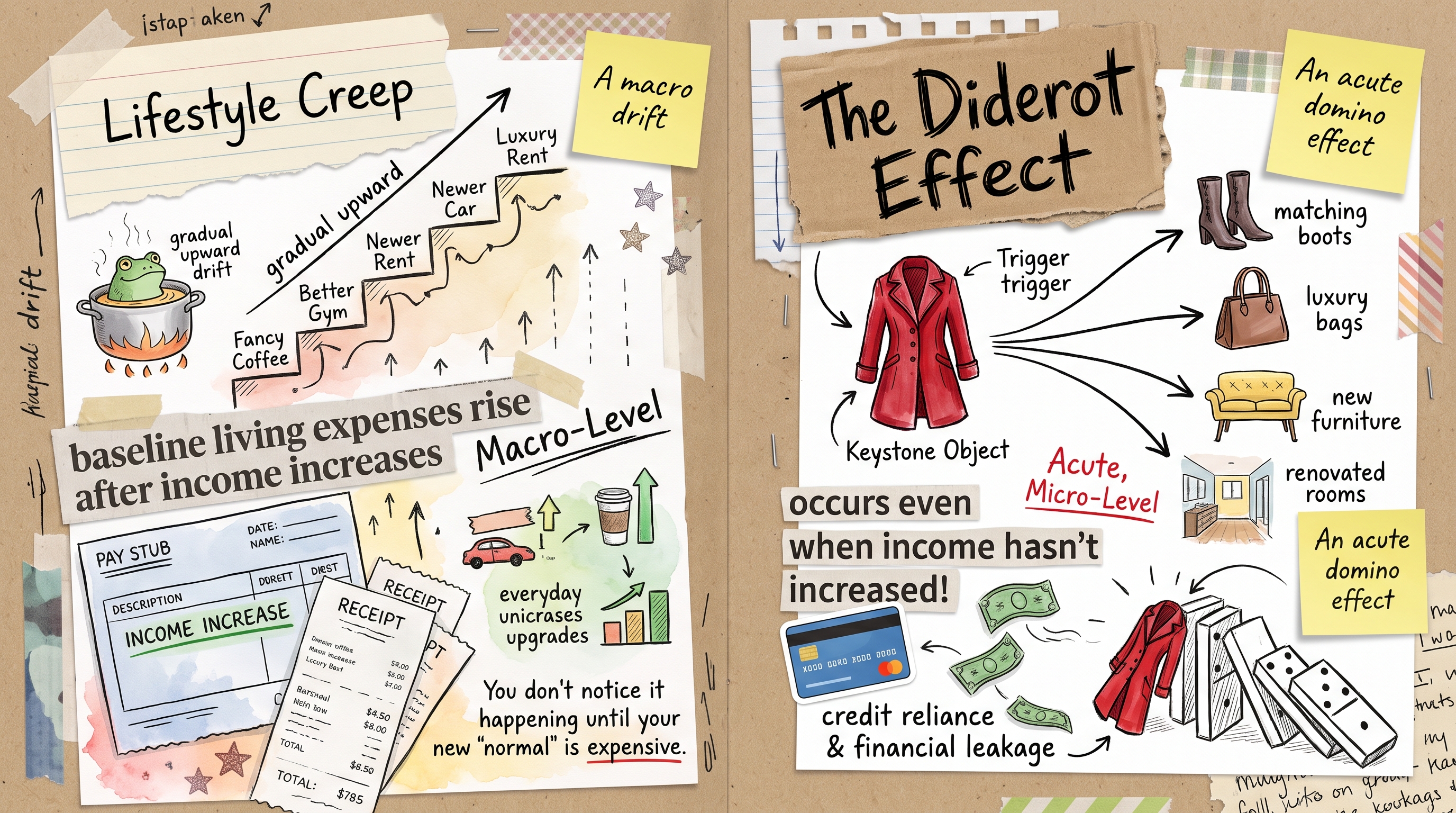
While often conflated, lifestyle creep describes the gradual, macro-level upward drift in baseline living expenses following increases in disposable income.[10:1] The Diderot Effect is an acute, micro-level cascading event triggered by a specific keystone object—capable of occurring even when a consumer's income has not increased, frequently driving credit reliance and financial leakage.[5:5]
Commercial Exploitation and Ecosystem Lock-In
Modern retail architecture and product engineering deliberately manufacture Diderot unities to maximize customer lifetime value (LTV) and erect high switching costs. Retailers no longer market standalone utilities; they market interdependent consumption constellations.[7:4]
Curated Spatial Retail and Lifestyle Bundling
Brick-and-mortar showrooms (such as IKEA room vignettes or luxury apparel flagships) and digital lookbooks present merchandise inside fully realized Diderot unities.[5:6] By displaying a sofa alongside specific lighting, textiles, cabinetry, and tableware, retailers establish a pre-packaged aesthetic baseline.[5:7] Extracting a single item from the showroom and placing it into an uncurated home environment reliably reproduces Diderot's study dilemma, prompting return visits to acquire the remaining constellation—a dynamic closely connected to the retail navigation techniques of the Gruen Effect and the co-creative effort justification of the IKEA Effect.[5:8]
While the initial keystone product may be reasonably priced, the full constellation of complementary adapters, specialized cleaners, and matching designer accessories inevitably ends up costing an arm and a leg.
Hardware Interdependence and the Digital Diderot Effect
In consumer electronics and software, aesthetic Diderot unities are reinforced by technical interoperability—a strategy known as ecosystem lock-in.[9:3]
- Asymmetric Interoperability: Tech manufacturers engineer proprietary protocols (e.g., seamless spatial audio handoffs, unified clipboard sharing, proprietary magnetic charging, or ecosystem-exclusive health metrics) that function optimally only when every node in the hardware stack belongs to the same brand.[9:4] Introducing a flagship laptop or smartphone makes existing third-party peripherals feel like "technical debt" due to minor latency, dongle requirements, or UI friction, driving users along a frictionless upgrade path.[9:5]
- Identity-Driven Tooling: Within knowledge work, gaming, and creative industries, hardware setups and software stacks function as professional competence signals.[9:6] Acquiring a high-resolution monitor exposes the inadequacy of a laptop's integrated webcam and microphone, which subsequently demands desk-mounted lighting, mechanical input devices, and acoustic treatment—principles deeply entwined with UI/UX design environments.[9:7]
- Subscription and SaaS Cascades: Adopting an enterprise or personal productivity platform frequently triggers secondary software dependencies—cloud storage expansions, automation middleware, plugin subscriptions, and companion mobile apps—turning a one-time workflow change into recurring monthly overhead that operates on autopilot.[10:2]
Aesthetic Micro-Trends and Social Media Acceleration
Algorithmic visual feeds compress the timeline of Diderot cascades within the attention economy.[8:1] Curated subcultural aesthetics—such as minimalist desk setups, ultrarunning gear kits, or specialty espresso stations—define rigid visual checklists for group membership.[8:2] Whereas Diderot's cascade unfolded across Parisian workshops over months, one-click e-commerce frictionlessness allows modern consumers to execute a multi-item departure spiral in a single evening.[10:3]
Macroeconomic and Ecological Externalities
In The Overspent American (1998) and subsequent research on sustainable consumption, economist Juliet Schor highlights the Diderot Effect as a primary engine of premature product obsolescence and ecological strain.[11] Because Diderot-driven replacements are motivated by symbolic obsolescence rather than functional failure, millions of durable goods—furniture, textiles, appliances, and functional electronics—are discarded well before the end of their operational lifespans, mirroring the manufactured turnover of planned obsolescence.[4:1]
By driving individuals to continuously finance escalating consumption constellations on credit, departure cascades erect debt-fueled living standards that are fundamentally built on sand. Predicated on superficial aesthetic unity rather than organic solvency, such lifestyle architectures function as a precarious house of cards, prone to immediate collapse whenever macroeconomic headwinds or unexpected personal expenses disrupt cash flow.
Not every cascading upgrade is a psychological trap.[10:4] System analysts distinguish between symbolic cascades (replacing functional chairs because their color clashes with a new desk) and measurable engineering dependencies (upgrading camera lenses to resolve a new sensor's resolution, or replacing climbing ropes alongside a harness to meet safety ratings).[10:5] True Diderot spirals fail functional necessity audits while passing subjective coherence rationalizations.[9:8]
Mitigation Frameworks: Arresting the Consumption Spiral
Counteracting the Diderot Effect requires interrupting automatic complementarity matching before a departure purchase resets baseline expectations:
- Pre-Acquisition Compatibility Audits & Boundary Setting: Evaluate prospective purchases against existing Diderot unities rather than isolated showroom contexts.[2:5] Prioritize clothing, furniture, and open-standard electronics that integrate cleanly with current possessions without requiring adapters, subscriptions, or aesthetic overhauls.[2:6] Mindful consumers and procurement teams must learn to draw the line at the point of primary acquisition, establishing strict operational boundaries that prohibit unbudgeted companion upgrades regardless of aesthetic dissonance.
- Scope Bounding and Total Cost of Ownership (TCO): Price keystone acquisitions by calculating their full constellation cost upfront.[9:9] Before buying an espresso machine, electric vehicle, or modular camera body, itemize every mandatory peripheral (grinders, home charging installation, memory cards, protective cases) and treat the aggregate figure as the true sticker price.[9:10]
- The Complementarity Pause Protocol: Enforce mandatory decision latency (typically a 30-day cooling-off window) between acquiring a keystone item and purchasing any non-essential companion upgrades.[10:6] Allowing initial novelty to subside weakens the contrast effect and restores objective utility assessment.[10:7]
- Deliberate Eclecticism: Cultivate tolerance for material asymmetry.[12] Diderot noted at the close of his essay that he swore to preserve one humble rag carpet from his impoverished youth as a daily visual anchor against vanity.[3:3] Intentionally mixing vintage, worn, and modern items immunizes living spaces against the fragility of uniform perfection.[12:1]
- One-In, One-Out Constraints: Cap inventory expansion within fixed physical or financial boundaries (e.g., maintaining a fixed number of hangers or a strict quarterly hardware budget) to prevent reactive accumulation from spilling across life domains.[2:7]
🎴 Interactive Web Practice (Comprehension Check)
Question 1 (Historical Origin & Foundational Narrative): What specific catalyst triggered Denis Diderot's consumption cascade in his 1769 essay, and why did his study transition from "harmonious indigence" into financial and psychological strain?
Answer: The catalyst was a gifted scarlet dressing gown acquired following Catherine the Great's financial patronage. While the robe was luxurious, its elegance introduced severe visual dissonance against Diderot's modest, frayed furnishings (his Bergamo tapestry, straw chair, and wooden desk). To resolve this perceived discordance, Diderot embarked on a systematic replacement campaign—upgrading to Damascus wall hangings, a Moroccan leather chair, a costly bureau, and a gilded mirror. Instead of providing lasting contentment, this cascade exhausted his finances and alienated him within a fragile, formal environment where he no longer felt the comfort and creative ease of his previous scholarly setting.
Question 2 (Anthropological Theory & Consumption Constellations): How did Grant McCracken codify the Diderot Effect, and what distinguishes a Diderot unity's "conservative mode" from its "radical mode"?
Answer: Grant McCracken (1988) codified the effect by establishing that consumer goods convey cultural meaning not in isolation, but in relation to complementary product clusters termed Diderot unities (or consumption constellations). In conservative mode, a Diderot unity stabilizes consumer behavior by serving as a defensive filter: individuals reject items, styles, or gifts that clash with their established aesthetic and social identity. In radical mode, an "intruder" or departure purchase breaches the boundary; rather than rejecting the outlier, the consumer reorganizes their surrounding material possessions upward to match the newcomer's symbolic tier, initiating a self-reinforcing upgrade spiral.
Question 3 (Cognitive Drivers & Psychological Mechanisms): How do cognitive dissonance, the contrast effect, and unidirectional reference creep sustain the Diderot spiral, and how does the effect differ fundamentally from general lifestyle creep?
Answer: The spiral is sustained by three interlocking mechanisms:
1. Cognitive Dissonance & Identity Congruence: Discrepancies between an aspirational new object and older possessions create psychological friction, compelling the consumer to upgrade surrounding items to restore symbolic coherence.
2. Contrast Effect: Perception is relativistic; placing a pristine, high-tier object beside functional, older belongings causes the older items to suddenly appear shabby, degraded, and inadequate.
3. Unidirectional Reference Creep: As noted by Juliet Schor, material standards ascend unidirectionally—consumers virtually never downgrade a superior item to restore equilibrium; they upgrade everything else to match it.
Distinction from Lifestyle Creep: Lifestyle creep is a macro-level, gradual inflation of baseline spending occurring in tandem with rising disposable income. In contrast, the Diderot Effect is an acute, micro-level cascade triggered by a specific departure object, frequently occurring without any increase in income and leading to acute financial distress and debt.
Question 4 (Digital Ecosystems & Commercial Exploitation): How do modern technology firms and digital product designers operationalize the Diderot Effect through ecosystem lock-in and SaaS dependencies?
Answer: Modern tech firms operationalize the Diderot Effect by engineering asymmetric interoperability and lifestyle ecosystems. When a consumer buys a primary hardware device (e.g., a flagship smartphone or laptop), proprietary protocols (such as unified clipboards, exclusive wireless codecs, or magnetic accessories) make third-party peripherals feel clunky or degraded. This induces a hardware cascade (smartwatches, earbuds, monitors, and adapters from the same brand). In digital software and SaaS, adopting a core productivity tool triggers complementary software cascades—cloud storage add-ons, automation middleware, paid templates, and companion apps—converting a single workflow transition into recurring subscription overhead.
Question 5 (Macroeconomic Externalities & Obsolescence): Why does economist Juliet Schor identify the Diderot Effect as a primary driver of ecological damage, and how do analysts distinguish symbolic cascades from engineering dependencies?
Answer: Juliet Schor highlights that the Diderot Effect drives premature product disposal governed by symbolic obsolescence rather than functional failure. Consumers discard perfectly serviceable furniture, electronics, and textiles simply because they no longer harmonize aesthetically with a newly acquired item, accelerating landfill waste and raw material extraction. Analysts distinguish symbolic cascades (replacing a working desk because its color tone clashes with a new chair) from legitimate engineering dependencies (upgrading a power supply or cable to meet safety ratings or bandwidth requirements of a new component), where functional necessity rather than symbolic coherence dictates the upgrade.
Question 6 (Strategic Mitigation Frameworks): What actionable protocols can consumers and organizational buyers implement to interrupt the Diderot consumption cascade?
Answer: Five primary mitigation strategies include:
1. Pre-Acquisition Compatibility Audits: Assessing prospective purchases against existing possessions rather than isolated showroom displays, prioritizing items that integrate seamlessly without secondary purchases.
2. Constellation Cost / Total Cost of Ownership (TCO): Itemizing all mandatory peripherals and secondary subscriptions prior to buying a keystone item, treating the full constellation cost as the real purchase price.
3. The Complementarity Pause Protocol: Instituting a mandatory 30-day cooling-off period between buying a trigger item and acquiring any non-essential companion goods, allowing hedonic adaptation and contrast spikes to subside.
4. Deliberate Eclecticism: Actively cultivating tolerance for material asymmetry and aesthetic diversity, preserving older or vintage anchor objects to break the demand for uniform perfection.
5. One-In, One-Out Constraints: Imposing rigid physical boundaries (e.g., fixed closet hangers, limited shelf space) or financial budget caps to halt secondary accumulation.
Resonant Notes
The following notes in the vault share direct thematic, structural, and strategic connections with The Diderot Effect:
🟣 Core Lexical Syllabus & Applied Metaphoric Expressions
- unravel (Weaving, Textiles & The Loom) — Metaphoric cognitive picture capturing Diderot's psychological disintegration and loss of equanimity, illustrating how an established, harmonious material environment unwinds and breaks down step-by-step when an alien luxury keystone disrupts domestic equilibrium.
- gravitational-pull (Classical Physics, Force & Equilibrium) — Conceptualizes the immense aesthetic and symbolic force exerted by an aspirational departure purchase, forcibly bending its surrounding material environment into its orbit and compelling adjacent furnishings or tech peripherals to match its status tier.
- fall-into-a-trap (Hunting, Tracking & Trapping) — Diagnoses how consumers unwittingly walk into commercial snares when acquiring an aspirational keystone item, seduced by isolated novelty only to find themselves captive to an escalating loop of mandatory secondary upgrades.
- path-of-least-resistance (Classical Physics, Force & Equilibrium) — Captures how consumers instinctively minimize cognitive friction by following the path of least resistance through pre-packaged lifestyle constellations and default upgrade bundles rather than enduring acute aesthetic discordance.
- frictionless (Classical Physics, Force & Equilibrium) — Embodies modern digital checkout architecture, 1-click ordering, and unified hardware ecosystems that systematically eliminate transactional drag, accelerating multi-item departure spirals into instantaneous consumer habits.
- on-autopilot (Machines & Mechanics) — Frames the reflexive, dissociative state of System 1 consumers who execute sequential companion purchases and recurring SaaS renewals on autopilot without deliberative budgeting or functional necessity audits.
- cost-an-arm-and-a-leg (The Human Body) — Articulates the deceptive reality of total cost of ownership (TCO), wherein an ostensibly affordable keystone acquisition initiates an expansive constellation of secondary accessories and subscriptions that ultimately cost an arm and a leg.
- built-on-sand (Buildings & Structures) — Illustrates the profound structural fragility of lifestyle creep and debt-financed consumption constellations; lacking organic financial foundations, these upwardly ratcheted living standards are built on sand and vulnerable to liquidity shocks.
- a-house-of-cards (Buildings & Structures) — Conceptualizes the precarious equilibrium of newly assembled luxury unities: because the lifestyle edifice is bound together by superficial aesthetic conformity rather than genuine utility, the entire structure functions as a fragile house of cards that collapses under minor economic strain.
- draw-the-line (Color & Art) — Represents the indispensable cognitive and operational mitigation protocol: establishing non-negotiable pre-acquisition boundaries where mindful consumers and procurement leaders draw the line against unbudgeted companion upgrades.
🔴 Behavioral Economics, Consumer Psychology & Identity Framing
- Consumers — Investigates psychological decision-making models, consumer habituation, and bounded rationality under retail environments.
- Snob Effect vs. Veblen Goods vs. Bandwagon Effect — Explores conspicuous consumption, social signaling, and positional goods, illuminating how departure purchases signal aspirational identity.
- The Decoy Effect — Examines asymmetric dominance and comparative choice framing, showing how choice architecture shifts reference points and willingness-to-pay.
- The Attention Economy — Analyzes how digital platforms and algorithmic feeds manufacture artificial needs and accelerate viral aesthetic micro-trends.
🟡 Ecosystem Lock-In, Product Architecture & Retailing Strategy
- IKEA Effect — Analyzes how consumer co-creation and physical assembly generate psychological ownership, complementing the lifestyle room vignettes that trigger Diderot unities.
- Gruen Effect — Explores how retail architectural disorientation shifts consumers from disciplined shopping into impulse-driven basket inflation.
- Costco Treasure Hunt Strategy — Details how curated product turnover, bulk packaging, and rotating seasonal items induce impulse purchases within warehouse retail ecosystems.
- Planned Obsolescence — Compares engineered physical and software degradation with the symbolic obsolescence driven by Diderot upgrade cascades.
- Difference Between UI and UX Design — Highlights how digital interface layouts, visual hierarchies, and interaction flows shepherd users through multi-tiered product ecosystems.
- Pricing Strategy — Details Good-Better-Best tiering, bundle packaging, and value-based pricing models designed to capture full customer lifetime value through complementary offerings.
🟢 Sociological Critiques, Material Culture & Conceptual Foils
- Georg Simmel's Tragedy of Culture — Contextualizes how the runaway accumulation of objective material culture dwarfs subjective assimilative capacity, mirroring Diderot's alienation among his upgraded furnishings.
- Zygmunt Bauman's sociological framework of Liquid Modernity — Examines the commodification of identity and the relentless consumer search for fleeting fulfillment within an unstable social order.
- Shoshana Zuboff-The Age of Surveillance Capitalism — Analyzes how behavioral modification and predictive telemetry nudge consumers toward continuous digital consumption cycles.
- Dark Patterns and Deceptive Design — Investigates how manipulative interface architectures, sneak-into-basket tactics, and hidden continuity exploit consumer inertia.
References
Stefan Kloo / Diderot Effect: Cursed Be the Precious Garment / goethe.de ↩︎ ↩︎ ↩︎ ↩︎ ↩︎ ↩︎
James Clear / The Diderot Effect: Why We Want Things We Don't Need / jamesclear.com ↩︎ ↩︎ ↩︎ ↩︎ ↩︎ ↩︎ ↩︎ ↩︎
Denis Diderot / Regrets on Parting with My Old Dressing Gown, or A Piece of Advice for Those with More Taste than Fortune / scribd.com ↩︎ ↩︎ ↩︎ ↩︎
Wikipedia Contributors / Diderot effect / en.wikipedia.org ↩︎ ↩︎
ING THINK / What is the Diderot effect? / think.ing.com ↩︎ ↩︎ ↩︎ ↩︎ ↩︎ ↩︎ ↩︎ ↩︎ ↩︎
Grant McCracken / Culture and Consumption: New Approaches to the Symbolic Character of Consumer Goods and Activities / books.google.com ↩︎ ↩︎
Teresa Davis & Gary Gregory / Creating Diderot unities – quest for possible selves? / emerald.com ↩︎ ↩︎ ↩︎ ↩︎ ↩︎
Lan Nguyen Chaplin & Tina M. Lowrey / The Development of Consumer-Based Consumption Constellations in Children / researchgate.net ↩︎ ↩︎ ↩︎
Billy Okeyo / The Diderot Effect: A Subtle System Bug in How We Consume Technology / billyokeyo.dev ↩︎ ↩︎ ↩︎ ↩︎ ↩︎ ↩︎ ↩︎ ↩︎ ↩︎ ↩︎ ↩︎
Goals and Progress / The Diderot Effect: How One Purchase Triggers Endless Upgrades / goalsandprogress.com ↩︎ ↩︎ ↩︎ ↩︎ ↩︎ ↩︎ ↩︎ ↩︎
Juliet B. Schor / The Overspent American: Why We Want What We Don't Need / bookey.app ↩︎
Psychology Today / The Cautionary Tale of Diderot (and How He Spent His Dough) / psychologytoday.com ↩︎ ↩︎