Mental and Physical Availability
🗂️ Interactive Notebook: Open Study Companion (Video Summary, Flashcards, Mind Map) ↗
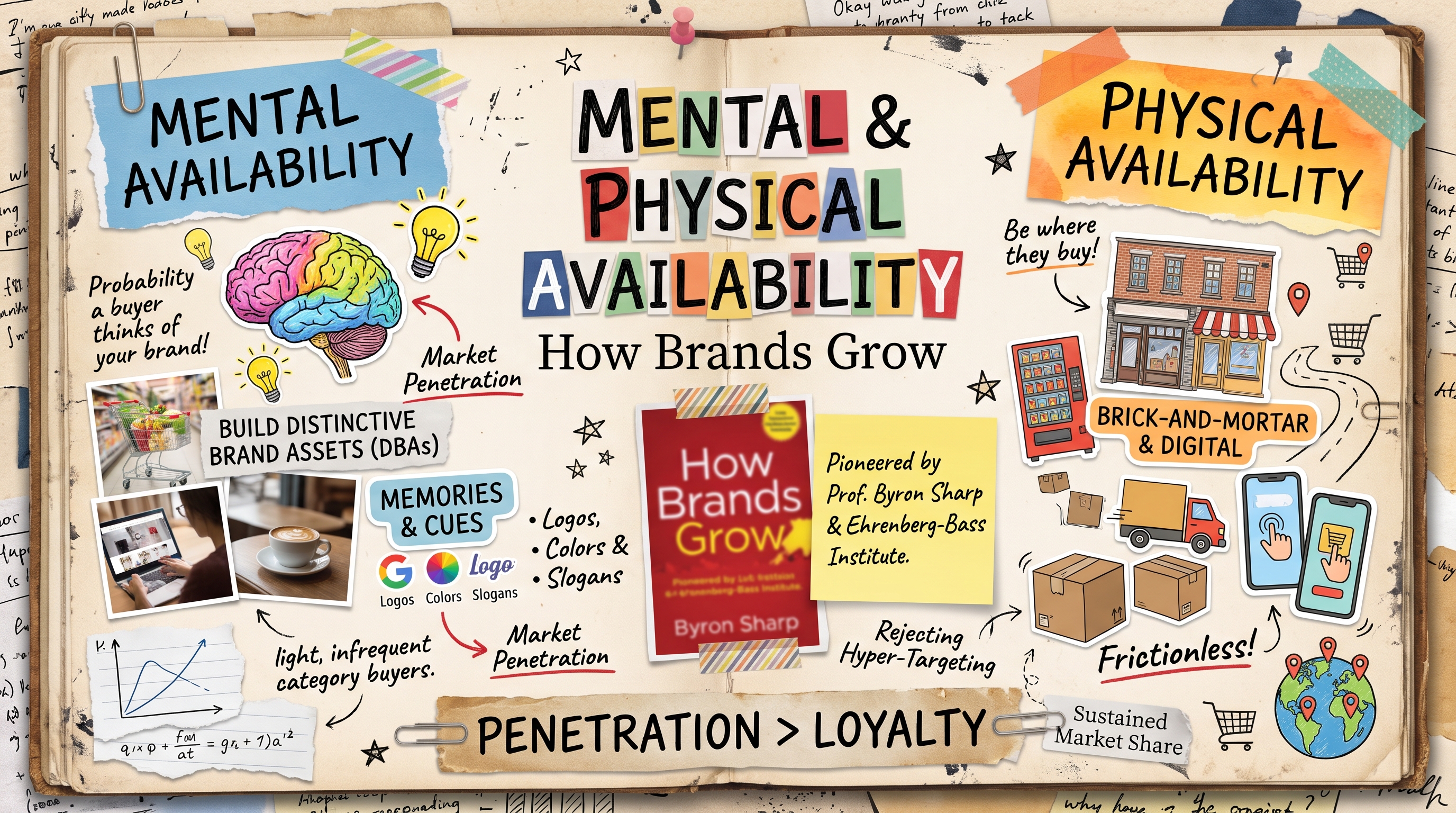
Mental and Physical Availability is the foundational strategic framework of empirical marketing science pioneered by Professor Byron Sharp and the Ehrenberg-Bass Institute for Marketing Science in How Brands Grow: What Marketers Don't Know (2010).[1] Rejecting unverified marketing dogmas around hyper-targeted customer segmentation, meaningful brand differentiation, and deep emotional loyalty, Sharp demonstrates that consumer buying behavior follows predictable statistical regularities across categories, geographies, and eras.[1:1] Sustained market-share growth is driven predominantly by increasing market penetration among light, infrequent category buyers.[2] Marketers achieve this penetration by systematically building two market-based assets: Mental Availability (the probability that a buyer notices, recognizes, or thinks of a brand across diverse buying situations) and Physical Availability (the breadth, depth, and ease of a brand's presence across physical and digital purchasing channels).[3]
Theoretical Foundations: The Empirical Critique of Classical Marketing
Prior to the widespread adoption of Ehrenberg-Bass marketing science, orthodox brand management—heavily influenced by Philip Kotler, Rosser Reeves's Unique Selling Proposition (USP), and Al Ries and Jack Trout's Positioning—operated on a rationalist, attitudinal paradigm.[4] This traditional worldview assumed that brands grow by identifying a tightly defined target segment, crafting a meaningfully differentiated value proposition within broader marketing and advertising strategies, persuading consumers to hold superior brand attitudes, and cultivating repeat-purchase loyalty among heavy buyers.[2:1] This conceptual architecture created an institutional blind spot regarding how actual purchasing decisions are executed in high-clutter environments.[4:1]
Building on decades of longitudinal panel data initiated by statistician Andrew Ehrenberg (creator of the Negative Binomial Distribution, or NBD-Dirichlet model of buyer behavior) and Gerald Goodhardt, Byron Sharp and his colleagues at the University of South Australia subjected these orthodoxies to large-scale empirical testing.[5] Across thousands of Consumer Packaged Goods (CPG), retail, services, automotive, pharmaceutical, and Business-to-Business (B2B) categories, the empirical data invalidated core pillars of traditional marketing theory.[6]
The Consumer as an "Uncaring Cognitive Miser"
Cognitive psychology and behavioral observation reveal that shoppers rarely engage in deep, deliberative evaluation when purchasing goods or services.[2:2] Drawing on dual-process psychology (System 1 reflexive processing versus System 2 deliberative reasoning), Sharp characterizes everyday consumers as uncaring cognitive misers who actively minimize mental effort.[2:3] Rather than maintaining exclusive allegiance to a single "lovemark" brand, consumers satisfice: they rely on habitual heuristics, environmental cues, and fast associative memory retrieval to navigate choice sets on autopilot, moving rapidly from recognizing a category need along the path of least resistance to completing a purchase.[7]
Searching for profound emotional bonding in everyday commercial categories is frequently barking up the wrong tree, as brand selection is overwhelmingly guided by salience and convenience rather than existential commitment.[2:4]
Polygamous Loyalty and Repertoire vs. Subscription Markets
Empirical panel data demonstrates that sole, 100% brand loyalty is extraordinarily rare over extended timeframes.[8] Instead, buyers exhibit divided or polygamous loyalty, maintaining a small, habitual set of acceptable brands that they rotate through depending on context, shelf position, or whim.[6:1] Ehrenberg-Bass categorizes markets into two primary structural types, both of which obey the same underlying mathematical laws across both consumer and B2B sectors:
- Repertoire Markets: Categories such as groceries, apparel, fast-moving consumer goods, and B2B spot procurement, where buyers routinely purchase across a personal portfolio of two to five competing brands.[6:2] Switching from Brand A on Monday to Brand B on Thursday does not represent permanent defection or dissatisfaction; it reflects normal cycling within an established repertoire.[6:3]
- Subscription Markets: Categories such as retail banking, telecommunications, enterprise software, and insurance, where buyers allocate nearly all their category requirements to a single provider at any given point in time due to formal contracts or switching costs.[6:4] Even here, brand defection and retention rates vary strictly in accordance with overall market share rather than proprietary "relationship bonding."[6:5]
The Empirical Laws of Buyer Behavior
Sharp's strategic prescription of mental and physical availability is not an arbitrary framework; it is the direct operational consequence of four replicated statistical regularities in buyer behavior that operate in plain sight across global consumer data.[8:1]
The Penetration Imperative: Across virtually all competitive categories, brands of markedly different market shares differ massively in how many people buy them (penetration), but differ only slightly in how often those buyers purchase them (purchase frequency or loyalty).[9] Consequently, you cannot grow a small brand into a large brand simply by squeezing higher loyalty out of an existing customer base.[10]
1. The Law of Double Jeopardy
Originally observed by sociologist William McPhee (1963) and mathematically formalized in marketing by Andrew Ehrenberg, the Double Jeopardy Law states that brands with smaller market shares suffer twice: first, far fewer people buy them (low penetration), and second, the few people who do buy them purchase them slightly less frequently and exhibit slightly higher defection rates than buyers of larger brands.[6:6]
- Loyalty is predominantly a statistical function of market share and availability—not an independent lever that marketers can pull in isolation.[10:1]
- The law dismantles the persistent strategic myth of the high-loyalty "niche brand" (small penetration paired with abnormally high repeat purchase), revealing that strategies assuming outsized customer devotion without mass penetration are built on sand.[8:2] Apparent niche outliers almost invariably result from restricted geographic distribution or specialized functional formats rather than superior emotional resonance.[8:3]
2. The Duplication of Purchase Law
Formalized by Ehrenberg and Goodhardt, the Duplication of Purchase (DoP) Law demonstrates that any brand shares its customer base with competing brands strictly in proportion to each competitor's market penetration.[11] Expressed algebraically as
- Strategic Implication: A brand's primary competitor is almost always the market leader in the category, regardless of perceived positioning, price tier, or brand image.[11:1]
- Unless empirical cross-purchasing tables reveal a true "market partition" (excess sharing caused by distinct sub-categories like decaffeinated coffee or heavy commercial machinery), small look-alike brands compete within the broad category universe rather than against an isolated direct rival.[5:2]
3. The Natural Monopoly Law
First identified by McPhee, the Natural Monopoly Law shows that larger brands monopolize light category buyers—consumers who purchase from the product category infrequently.[11:2] Because infrequent category buyers think about the category rarely, their cognitive bandwidth is constrained within the attention economy; they hold weak memory structures and recognize only the most salient, ubiquitous market leaders when an occasional need arises.[10:2] Heavy category buyers, having greater exposure to the shelf and category media, are far more likely to discover and buy smaller brands.[10:3] Therefore, as a brand grows in market share, the proportion of light category buyers within its customer base systematically increases.[12]
4. The Pareto Law (Moderated) and the Law of Buyer Moderation
Traditional marketing folklore asserts the rigid 80/20 rule—that 20% of heavy buyers generate 80% of a brand's sales volume.[10:4] Empirical audits show the ratio is substantially flatter over standard annual horizons: the heaviest 20% of a brand's buyers typically account for roughly 50% to 60% of sales volume, leaving the remaining 40% to 50% of revenue dependent on the vast "long tail" of light and occasional buyers.[10:5]
Furthermore, the Law of Buyer Moderation captures statistical regression to the mean in purchasing data.[8:4] Consumers classified as "heavy buyers" in Period 1 predictably reduce their purchase frequency in Period 2 (due to pantry stocking, life stage transitions, or random variance), whereas "light" and "non-buyers" in Period 1 exhibit the highest upward growth potential.[10:6] Marketers who hyper-target solely heavy buyers fall into the trap of anchoring their growth to a naturally contracting customer cohort.[10:7]
| Empirical Law | Core Statistical Pattern | Strategic Consequence |
|---|---|---|
| Double Jeopardy | Smaller brands have far fewer buyers and slightly lower repeat-buying loyalty.[9:1] | Prioritize customer acquisition (penetration) over retention-only loyalty schemes.[6:7] |
| Duplication of Purchase | Brands share customers in direct proportion to competitor market share.[11:3] | Compete broadly against category leaders rather than obsessing over niche look-alikes.[11:4] |
| Natural Monopoly | Large brands capture a disproportionately high share of light category buyers.[11:5] | Mass reach and high salience are mandatory to win infrequent category shoppers.[10:8] |
| Buyer Moderation | Heavy buyers regress downward toward the mean; light buyers regress upward.[10:9] | Avoid hyper-targeting heavy buyers; continuously reach the whole category universe.[12:1] |
Pillar I: Mental Availability
In How Brands Grow and subsequent research expansions by Professor Jenni Romaniuk (Building Distinctive Brand Assets and Better Brand Health), Mental Availability is defined as the propensity of a brand to be noticed, recognized, or thought of by a buyer in buying situations.[3:1]
"In most buying situations people want to move quickly and easily from generating a category need to satisfying this need." — Professor Jenni Romaniuk, Better Brand Health (2023)[7:1]
Mental Availability vs. Traditional Brand Awareness
Traditional "top-of-mind" or unprompted brand awareness tests ask consumers a single static prompt: "When you think of [Category X], which brands come to mind?"[13] Linear hierarchy-of-effects frameworks such as The AIDA Model assume consumers methodically progress from abstract awareness to interest and desire.[13:1]
Mental availability models human associative memory as an interconnected neural network of concept nodes.[7:2] A brand can register 90% prompted recognition in a laboratory survey yet suffer dangerously low mental availability if it is linked to only a single, narrow consumption occasion (e.g., champagne thought of exclusively for New Year's Eve, rather than casual Friday celebrations or gifting).[13:2] Mental availability depends on both the quantity (network size) and freshness (mental salience) of memory links connecting the brand node to diverse real-world retrieval cues.[7:3]
Category Entry Points (CEPs)
Coined and operationalized by Jenni Romaniuk, Category Entry Points (CEPs) are the internal motives, environmental contexts, and situational cues that buyers use to access their memories when transitioning into a category buyer.[14] Rather than searching for a single "Unique Selling Proposition" to own exclusively, brands expand penetration by establishing presence behind as many mental entryways (CEPs) as possible—building wider, fresher memory networks across diverse consumer occasions.[14:1] Romaniuk organizes CEPs around the 7 Ws heuristic:
- Why (motives, functional problems, emotional states: "Need an afternoon energy boost", "Need to comply with new audit regulations").
- When (time of day, season, lifecycle trigger: "Quick weekday breakfast", "Preparing for an annual tax filing").
- Where (physical or digital context: "Waiting at an airport terminal", "Browsing on a mobile device while commuting").
- With / For Whom (social setting: "Hosting executive clients", "Preparing a quick meal for toddlers").
- With What (co-consumption or complementary items: "Paired with morning coffee", "Integrating with an existing enterprise CRM").
- How (mode of purchase or consumption: "Ordering for instant home delivery", "Bulk procurement via procurement portal").
- How Feeling (affective states before or after consumption: "Seeking indulgence after a stressful project", "Relieving operational anxiety").
Distinctive Brand Assets (DBAs)
Because consumers navigate retail aisles and digital media environments in low-attention, distracted states, verbal brand names alone often fail to register.[15] Distinctive Brand Assets (DBAs) are sensory brand cues—non-name visual, auditory, and structural markers—that trigger instantaneous, effortless recognition of the brand identity in consumer memory.[16] These assets act as neurological shortcuts that anchor advertising exposures and point-of-sale packaging directly to the brand node.[16:1] Core DBA classes include:
- Visual & Chromatic Codes: Proprietary color palettes (Cadbury purple, Tiffany blue, Caterpillar yellow).[16:2]
- Structural & Packaging Forms: Distinct physical silhouettes (the contour Coca-Cola bottle, Toblerone's triangular prism, Absolut Vodka's medicine bottle profile).[16:3]
- Characters & Mascots: Enduring brand characters (the Michelin Man, the Geico Gecko, the Duracell Bunny) that achieve exceptional memorability and emotional attribution across generations.[14:2]
- Sonic & Audio Mnemonics: Sound logos, audio signatures, and musical stings (Netflix's "tudum", Intel's four-note chime, McDonald's "ba-da-ba-ba-ba").[15:1]
- Typography, Layouts & Taglines: Unmistakable font hierarchies, geometric layouts, and multi-decade campaign slogans.[15:2]
Ehrenberg-Bass evaluates DBAs through rigorous empirical testing—stripping the brand name completely away in consumer audits—using the Distinctive Asset Grid, which plots assets across two core axes:[15:3]
- Fame: What percentage of category buyers link this stripped sensory asset directly to your brand?[15:4]
- Uniqueness: Of all brand associations triggered by this asset across the category, what percentage belong exclusively to your brand rather than being attributed to competitors?[15:5]
| Distinctive Asset Grid | Low Fame (<50%) | High Fame (>50%) |
|---|---|---|
| High Uniqueness (>50%) | Use or Lose (Emerging Potential): High Uniqueness, Low Fame. Heavy media weight needed to build fame. | Core Asset: High Uniqueness, High Fame. Defend, protect, and integrate across all consumer touchpoints. |
| Low Uniqueness (<50%) | Avoid / Drop: Low Uniqueness, Low Fame. Waste of resources to build from scratch. | Category Cliché: Low Uniqueness, High Fame. Dangerous cue that advertises category rivals. |
Assets qualifying as Core Assets (>50% benchmark thresholds on both Fame and Uniqueness) must be defended and integrated into every consumer touchpoint.[15:6] Low Fame / High Uniqueness cues represent Emerging Potential that can transition into core assets with continuous media support.[15:7] In contrast, High Fame / Low Uniqueness cues represent dangerous Category Clichés (e.g., green leaves on eco-packaging or generic blue globes in software) that inadvertently subsidize category rivals.[15:8]
When maintained with disciplined consistency, distinctive brand codes pay dividends over decades of commercial exposure.[15:9] As analyzed in Think Twice Before Updating Your Brand, impulsive corporate rebrands that abandon accumulated Distinctive Brand Assets frequently trigger catastrophic market-share declines by erasing hard-won mental availability overnight.[16:4]
Distinctiveness Over Meaningful Differentiation
One of the most consequential intellectual departures in How Brands Grow is the clear theoretical distinction Byron Sharp draws between brand differentiation and brand distinctiveness.[17] Classical marketing doctrine insists that sustained competitive advantage requires persuading consumers that a product is meaningfully different and superior.[4:2]
Sharp and Romaniuk analyze decades of cross-category brand image data showing that consumers perceive competing brands within a repertoire as remarkably interchangeable; the brand association profiles of Coca-Cola and Pepsi, or Visa and Mastercard, are virtually identical once adjusted for overall brand size.[2:5] Sharp draws the line between superficial distinctiveness and meaningful differentiation: in practice, perceived differentiation often functions merely as an executive facade that masks the underlying functional similarity of competing goods.[17:1]
Rather than exhausting marketing capital attempting to convince indifferent shoppers that a brand possesses a unique personality, marketers achieve vastly superior returns on investment by making the brand unmistakably distinct, easy to identify, and impossible to overlook.[17:2]
Pillar II: Physical Availability
Mental availability alone generates zero commercial return if a motivated buyer encounters friction at the critical point of purchase.[1:2] Physical Availability is defined as making a brand as easy to find, choose, and purchase as possible across as many buying situations, retail channels, delivery formats, and price tiers as feasible—while minimizing competitors' opportunity to intercept the transaction.[3:2] Physical availability operationalizes the classical "Place" pillar within The Marketing Mix (4 Ps), adapting physical distribution to omnichannel, automated environments.[3:3]
Synergy of the Two Pillars: Advertising falls on barren ground when it reaches buyers who cannot easily locate the brand at a point of sale.[1:3] Conversely, prominent physical placement on a retail shelf or e-commerce search results page refreshes mental availability every time a shopper walks down an aisle or scrolls past a digital thumbnail.[3:4]
Ehrenberg-Bass divides physical availability into three operational dimensions:
1. Presence (Distribution Breadth and Channel Coverage)
Presence measures the geographic, operational, and digital reach of a brand across the total category buying landscape.[3:5]
- Brick-and-Mortar Retail: Maximizing numeric distribution (percentage of total retail stores stocking the product) and All Commodity Volume (ACV) / weighted distribution (ensuring stock presence in high-velocity outlets where category sales concentrate), supported by extended operating hours and convenience touchpoints.[3:6]
- Digital & Omnichannel Commerce: Securing ubiquitous presence across direct-to-consumer storefronts, major online marketplaces (Amazon, Walmart, regional delivery aggregators), organic category rankings via Search Engine Optimization (SEO), sponsored shopping carousels via Search Engine Marketing (SEM), and algorithmic shopping engines.[10:10]
2. Prominence (Standout at the Point of Choice)
Once stocked within a retail or digital environment, a brand must rapidly seize visual and physical attention amid overwhelming commercial clutter.[3:7]
- The Physical Shelf: Securing eye-level shelf positioning, expanding the number of shelf facings to match or exceed market share, securing secondary promotional displays (end-caps, checkout coolers, free-standing display units), and applying Distinctive Brand Assets to packaging so shoppers locate the product in milliseconds.[3:8] As analyzed in the retail layout mechanics of the Costco Treasure Hunt Strategy, prominent spatial placement directly dictates unplanned basket additions.[3:9]
- The Digital Shelf: Capturing top-three organic and sponsored placements on Product Listing Pages (PLPs), deploying mobile-optimized "hero image" pack designs that highlight DBAs on tiny smartphone screens, and maintaining high review volumes and trusted merchant badges to ensure a frictionless browsing experience, leveraging principles of UI and UX design.[3:10]
3. Portfolio Relevance (Assortment and Friction Removal)
Physical availability collapses if structural barriers prevent a transaction during specific purchasing occasions.[3:11]
- Pack Size and Price Architecture: Providing single-serve impulse formats for convenience channels alongside bulk multi-packs for family stock-ups, integrated into broader pricing strategy to ensure entry points for both cash-constrained shoppers and enterprise buyers.[3:12]
- Friction Elimination & Out-of-Stock Prevention: When an item is out of stock, it immediately throws a wrench in the works of physical availability; repertoire buyers rarely postpone purchase, reflexively switching to an available competitor.[3:13] Friction elimination requires maintaining near-perfect On-Shelf Availability (OSA), enabling one-click digital checkouts (Apple Pay, Shop Pay), and providing transparent B2B contract terms, ensuring direct alignment with authentic Product-Market Fit.[3:14]
Operationalizing and Measuring Availability
In Better Brand Health: Measures and Metrics for a How Brands Grow World, Jenni Romaniuk replaced noisy, lagging attitudinal metrics (such as Net Promoter Score or generic "brand love" indexes) with four quantitative, validated metrics derived from surveying category buyers across an empirical battery of Category Entry Points:[13:3]
- Mental Market Share (MMS): The total number of CEP-to-brand associations captured by a brand divided by the aggregate number of CEP associations recorded across all brands in the category.[18] Comparing MMS directly against actual Sales Market Share (SMS) diagnoses core commercial bottlenecks:
- If MMS > SMS, the brand suffers from a physical availability deficit (consumers think of the brand across diverse occasions, but cannot readily find, access, or afford it in retail channels).[13:4]
- If SMS > MMS, the brand possesses a mental availability deficit; it is currently coasting on legacy physical distribution or heavy price promotions, leaving it highly vulnerable to dynamic competitors if distribution slips.[13:5]
- Mental Penetration (MPen): The percentage of category buyers who link the brand to at least one Category Entry Point—measuring the sheer breadth of mental reach across the category universe.[18:1]
- Network Size (NS): Among buyers who link the brand to at least one CEP, the average number of distinct CEPs linked to that brand—measuring how versatile, thick, and multi-situational the brand's memory network is.[18:2]
- Share of Mind (SoM): Among the specific subset of category buyers who hold mental associations for the brand, the brand's proportion of their total category CEP links—measuring competitive mental dominance within established repertoires.[7:4]
Media and Execution Rules for Building Availability
- Prioritize Continuous Mass Category Reach: Because light and infrequent buyers purchase at unpredictable intervals throughout the year, concentrating ad budgets into short, heavy seasonal "bursts" leaves the brand mentally dark during the vast majority of category purchase decisions.[2:6] Brands should deploy always-on, recency-focused media schedules designed to achieve cost-effective reach across the entire category buyer population rather than high-frequency waste against narrow target segments.[14:3]
- Co-Present CEPs and DBAs in Creative: Advertising creative should consistently link a priority Category Entry Point (e.g., "rushed morning breakfast on the go") directly with prominent Distinctive Brand Assets (colors, characters, packaging silhouettes, sonic logos) to reinforce associative pathways in long-term memory.[7:5]
- Avoid Creative Destruction: Marketers frequently grow fatigued by their own advertising campaigns long before distracted, occasional category buyers have even registered the core brand assets.[3:15] Continually overhauling slogans, packaging palettes, and logos during executive transitions destroys accumulated mental availability; brands should evolve topical messaging while preserving core Distinctive Brand Assets across decades.[3:16]
Extensions to B2B Marketing and Ad Effectiveness
While initial critics dismissed How Brands Grow as a framework applicable only to fast-moving consumer packaged goods (CPG), subsequent empirical investigations conducted by the Ehrenberg-Bass Institute in collaboration with the LinkedIn B2B Institute (How B2B Brands Grow) verified that Double Jeopardy, Duplication of Purchase, and Availability laws apply with equal statistical rigor across B2B markets.[6:8] Panel studies of corporate banking, commercial insurance, concrete manufacturing, enterprise software, and commercial aviation prove that business procurement committees obey the same fundamental laws of buyer behavior as supermarket shoppers.[6:9]
The 95-5 Rule in Out-of-Market B2B Buying
Formulated by Ehrenberg-Bass Professor John Dawes, the 95-5 Rule establishes that in typical B2B categories—where corporate software or equipment contracts renew on multi-year cycles—roughly 95% of prospective business buyers are out-of-market in any given quarter, while only 5% are actively in-market seeking vendor proposals.[14:4]
- Short-term performance marketing and lead-generation campaigns (pay-per-click search ads, gated whitepapers, outbound sales development calls) compete exclusively over the 5% currently buying—a cohort that has usually already formed a mental shortlist before initiating a formal procurement search.[14:5]
- Broad brand advertising functions to plant mental seeds within the 95% out-of-market audience.[14:6] Building mental availability ensures that when a corporate trigger occurs—a compliance failure, executive turnover, or technical obsolescence—the brand already occupies a prominent position in the buying committee's collective memory.[13:6]
Alignment with Binet & Field's The Long and the Short of It
Ehrenberg-Bass's empirical findings align directly with the econometric analysis of advertising effectiveness conducted by Les Binet and Peter Field in The Long and the Short of It (2013), utilizing the UK Institute of Practitioners in Advertising (IPA) database.[13:7] Binet and Field demonstrate that sustainable commercial profit requires orchestrating two complementary marketing mechanisms:
- Long-Term Brand Building (~60% budget in B2C; ~46% in B2B): Broad-reach, emotionally resonant campaigns that create future mental availability, prime category entry points, and strengthen pricing power over multi-year horizons.[13:8]
- Short-Term Sales Activation (~40% budget in B2C; ~54% in B2B): Targeted, promotional campaigns that harvest existing in-market demand by maximizing physical and digital availability at the immediate point of purchase.[13:9] Over-indexing on short-term performance marketing creates a plateau of diminishing returns, whereas balanced allocation ensures ongoing customer acquisition.[13:10]
Academic Debates, Nuances, and Criticisms
Despite transforming global marketing practice across multinational enterprises such as Procter & Gamble, Unilever, Mars, Diageo, and McDonald's, Sharp's empirical framework remains the subject of active academic and strategic debate.[2:7]
Availability Is Not a Substitute for Product Viability or Pricing Strategy: Byron Sharp explicitly emphasizes that mental and physical availability operate under the ceteris paribus assumption that a brand offers acceptable functional quality and competitive value.[1:4] Superior availability cannot save an inherently defective product, nor does it negate the strategic necessity of disciplined margin and pricing management.[1:5]
1. The Differentiation vs. Distinctiveness Debate (Mark Ritson & Kantar)
Marketing scholar Mark Ritson, alongside researchers from Kantar (leveraging the global BrandZ equity database), contends that Sharp constructs a false dichotomy by dismissing brand differentiation.[19] Ritson argues that while distinctiveness (being recognized) is essential for choice efficiency and volume penetration, meaningful differentiation (delivering a distinct customer benefit, unique service model, or cultural resonance) remains vital for establishing pricing power and gross margin expansion.[19:1]
Critics cite category innovators such as Apple, Tesla, or Dyson, arguing that their initial market disruption and extraordinary price premiums stemmed from authentic product and positioning differentiation before mass distribution scaled.[17:3] In luxury categories, as analyzed in Snob Effect vs. Veblen Goods vs. Bandwagon Effect, brands deliberately restrict physical availability to cultivate scarcity and social distinction.[19:2] Sharp counters that competitors rapidly replicate functional features, ensuring that long-term market-share defense inevitably depends on superior mental and physical availability.[2:8] Furthermore, behavioral choice experiments such as The Decoy Effect demonstrate that comparative context, rather than intrinsic attribute differentiation, routinely dictates consumer selection.[2:9]
2. Targeted Segmentation vs. Sophisticated Mass Marketing
Critics suggest that interpreting How Brands Grow as a prohibition against market segmentation risks wasteful ad spend—particularly for early-stage startups, niche B2B suppliers, or boutique brands with limited working capital. Strategists like Ritson advocate a "bothism" approach: deploying broad-reach category marketing where resources permit, while utilizing targeted segmentation for specific regional launches or constrained budgets.[3:17]
The Ehrenberg-Bass Institute clarifies that their framework does not advocate undisciplined mass marketing to every human on earth; rather, it prescribes sophisticated mass marketing—reaching all actual and potential buyers of the product category while eliminating artificial demographic and psychographic micro-segmentation.[12:2] In modern platform environments characterized by platform enshittification, excessive micro-targeting often enriches ad intermediaries through inflated surveillance fees while starving brands of organic, scalable penetration.[12:3]
3. Descriptive Regularities vs. Prescriptive Breakthroughs
Econometricians note that the NBD-Dirichlet model describes stationary (equilibrium) markets with remarkable mathematical fidelity, mapping the operational characteristics of brands after they have achieved scale.[5:3] However, mathematical laws of equilibrium do not fully outline the creative alchemy, technological breakthrough, or business-model disruption required to disrupt a category in the first place.[5:4] Mental and physical availability supply the indispensable operational engine for scaling and defending market share, yet they operate alongside strategic innovation and human creative excellence.[3:18]
🎴 Interactive Web Practice (Comprehension Check)
Question 1 (Empirical Foundations & The Uncaring Cognitive Miser): How does Byron Sharp's empirical marketing science challenge traditional marketing doctrines regarding brand positioning, segmentation, and consumer loyalty?
Answer: Traditional marketing orthodoxy (influenced by Kotler, Reeves, Ries, and Trout) assumes that brands grow by selecting a narrow demographic segment, establishing a unique and meaningfully differentiated positioning statement, and cultivating deep, emotional brand loyalty among a loyal core of heavy buyers. Byron Sharp and the Ehrenberg-Bass Institute overturned these assumptions using decades of empirical panel data. They demonstrated that consumers are "uncaring cognitive misers" who satisfice rather than deliberate, relying on fast heuristics and environmental cues. Brand growth is driven overwhelmingly by increasing market penetration among light, infrequent category buyers through broad mental and physical availability, rather than extracting higher loyalty from existing customers.
Question 2 (The Empirical Laws of Buyer Behavior): What are the Double Jeopardy and Duplication of Purchase Laws, and what are their direct strategic implications for brand managers?
Answer: The Double Jeopardy Law states that smaller market-share brands suffer twice: they have far fewer buyers (lower penetration), and those fewer buyers purchase the brand slightly less often and exhibit slightly higher defection rates than buyers of large brands. This proves that loyalty is largely a reflection of market share, meaning brands cannot grow simply by running loyalty programs. The Duplication of Purchase Law shows that all brands share their customer base with competitors strictly in proportion to each competitor's market share ($b_{X \cdot Y} = D \cdot b_X$). Its strategic implication is that a brand's primary competitive threat is always the category market leader, disproving the idea that brands compete only within narrow "niche" brand partitions.
Question 3 (Mental Availability vs. Brand Awareness & Category Entry Points): What is the operational difference between traditional brand awareness and Mental Availability, and how do Category Entry Points (CEPs) function in consumer memory?
Answer: Traditional brand awareness measures passive, static recognition or recall in response to an abstract prompt (e.g., "Name three soft drinks"). Mental Availability measures the likelihood of a brand coming to mind across diverse, real-world buying situations. It models memory as an associative network where nodes are activated by environmental cues. Category Entry Points (CEPs)—organized around the 7 Ws (Why, When, Where, With Whom, With What, How, How Feeling)—are the situational triggers, emotional states, and contextual motives that buyers use to retrieve brands from memory when a category need arises. Brands grow by linking their identity to a wide, fresh array of CEPs rather than attempting to own a single narrow association.
Question 4 (Distinctive Brand Assets & The Fame-Uniqueness Grid): How do Distinctive Brand Assets (DBAs) differ from brand differentiation, and how does the Ehrenberg-Bass Distinctive Asset Grid evaluate brand cues?
Answer: Brand differentiation refers to convincing buyers that a product is meaningfully superior or unique in its attributes or personality. Brand distinctiveness refers to making the brand easily recognizable and unmistakably identifiable through non-name sensory assets (colors, packaging shapes, mascots, sonic logos, taglines). The Distinctive Asset Grid evaluates sensory cues stripped of the brand name across two empirical metrics: Fame (% of category buyers who link the asset to the brand) and Uniqueness (% of asset-triggered associations that point exclusively to the brand). Assets scoring high on both (>50%) are Core Assets that must be protected. High Fame / Low Uniqueness cues are Category Clichés that waste spend by reminding buyers of competitors.
Question 5 (Physical Availability Architecture): What are the three core dimensions of Physical Availability, and how do stock-outs and digital friction impair market penetration?
Answer: The three dimensions are:
1. Presence: Ensuring broad distribution breadth across physical outlets (numeric and ACV/weighted distribution) and digital channels (marketplaces, search visibility, delivery aggregators).
2. Prominence: Winning sensory and visual attention at the point of choice through eye-level shelf placement, multiple facings, secondary displays, mobile-optimized hero pack designs, and top PLP search rankings.
3. Portfolio Relevance & Assortment: Offering pack sizes, delivery formats, and pricing tiers that accommodate diverse buying occasions while eliminating friction (such as one-click checkouts).
Because category buyers exhibit divided, polygamous loyalty, an out-of-stock event or clunky checkout process destroys physical availability: rather than waiting or seeking out the item elsewhere, consumers reflexively substitute the missing brand with an available competitor from their consideration repertoire.
Question 6 (B2B Dynamics: The 95-5 Rule & Econometric Balancing): How does the 95-5 Rule apply Ehrenberg-Bass principles to B2B markets, and how does it integrate with Binet and Field's research on ad effectiveness?
Answer: Developed by Professor John Dawes, the 95-5 Rule reveals that in B2B categories with long replacement or contract cycles, roughly 95% of prospective buyers are out-of-market at any given time, while only 5% are actively in-market seeking solutions. Performance lead-generation campaigns only reach the 5% currently buying. Brand advertising must continuously reach the 95% out-of-market universe to build mental availability so that when a future purchase trigger occurs, the brand is already on the buying committee's mental shortlist. This converges with Les Binet and Peter Field's econometric findings, which prescribe balancing long-term brand building (~60% B2C / ~46% B2B) to create mental availability and price elasticity with short-term sales activation (~40% B2C / ~54% B2B) to harvest current demand via physical availability.
Resonant Notes
The following notes in the vault share direct thematic, empirical, and strategic connections with Mental and Physical Availability:
🟣 Core Lexical Syllabus & Applied Metaphoric Expressions
- blind-spot (Light & Vision) — Diagnoses traditional marketing's rationalist, attitudinal blind spot regarding low-involvement buyer heuristics, divided loyalty, and how real purchase decisions happen in high-clutter environments.
- on-autopilot (Machines & Mechanics) — Frames the System 1 cognitive state of everyday shoppers as "uncaring cognitive misers" who navigate retail aisles and digital marketplaces on autopilot, relying on fast mental heuristics rather than active deliberation.
- path-of-least-resistance (Classical Physics, Force & Equilibrium) — Captures how consumers minimize mental and physical energy by naturally moving from category need along the path of least resistance to the most accessible brand.
- barking-up-the-wrong-tree (Hunting, Tracking & Trapping) — Epitomizes the futile quest of brand managers seeking exclusive emotional "lovemark" loyalty, barking up the wrong tree when buyer choice is governed by salience and convenience.
- in-plain-sight (Light & Vision) — Captures how the empirical laws of buyer behavior (Double Jeopardy, Duplication of Purchase, Natural Monopoly) operate in plain sight across decades of panel data, yet were overlooked by traditional marketing dogma.
- built-on-sand (Buildings & Structures) — Illustrates the structural fragility of brand strategies predicated on high-loyalty niche devotion or deep emotional differentiation without mass penetration, which are built on sand.
- fall-into-a-trap (Hunting, Tracking & Trapping) — Diagnoses how marketers fall into the trap of hyper-targeting heavy buyers due to the Law of Buyer Moderation, inadvertently anchoring their growth to a naturally contracting customer cohort.
- pay-dividends (Money & Wealth) — Captures the compounding commercial value of disciplined, consistent investment in Distinctive Brand Assets (DBAs) and mental salience over decades, which continuously pay dividends in market penetration.
- frictionless (Classical Physics, Force & Equilibrium) — Conceptualizes the core operational standard of physical availability: eliminating channel, search, and checkout drag so that purchasing is seamless and frictionless.
- throw-a-wrench-in-the-works (Machines & Mechanics) — Illustrates how out-of-stock events, broken digital links, or supply-chain bottlenecks abruptly throw a wrench in the works of physical availability, causing repertoire buyers to instantly substitute competing brands.
🔴 Brand Strategy, Consumer Behavior & Empirical Economics
- Difference Between Product vs Brand — Analyzes the operational threshold where a functional product is transformed into a market-based asset through mental availability and distinctive brand codes.
- Consumers — Investigates consumer cognitive models, bounded rationality, and satisficing behavior, providing the behavioral psychological foundation for the "uncaring cognitive miser."
- Pricing Strategy — Explores price elasticity, Good-Better-Best tiering, and promotional discounts, examining the strategic tension between margin expansion and penetration pricing.
- Product-Market Fit — Examines how foundational functional viability and customer problem-solution alignment establish the baseline utility required before availability scaling succeeds.
- Snob Effect vs. Veblen Goods vs. Bandwagon Effect — Investigates positional consumption, status signaling, and luxury goods that intentionally restrict physical availability to cultivate scarcity.
- The Decoy Effect — Demonstrates how comparative choice architecture and asymmetric dominance shift consumer selection at the point of choice without changing intrinsic brand attributes.
🟡 Digital Marketing, Channel Architecture & Positioning
- Difference Between Marketing and Advertising — Clarifies the conceptual boundary between holistic value-chain distribution (marketing) and paid mental salience amplification (advertising).
- Difference Between B2B and B2C — Explores procurement cycles, committee buying dynamics, and the operational application of the 95-5 Rule across enterprise and consumer categories.
- The Marketing Mix (4 Ps) — Contextualizes physical availability within modern omnichannel distribution ("Place") and mental availability within advertising and promotion ("Promotion").
- The AIDA Model — Contrasts classical, linear hierarchy-of-effects sales funnels with empirical associative memory networks and non-linear Category Entry Points.
- DM - Search Engine Optimization — Examines technical and content strategies for securing organic prominence on search engine result pages to maximize digital physical availability.
- Difference Between SEO and SEM — Details how organic search visibility and sponsored ad placements interact to capture both in-market demand and passive category searchers.
- Think Twice Before Updating Your Brand — Case study analyzing the commercial risks of corporate rebrands that recklessly discard accumulated Distinctive Brand Assets and destroy mental availability.
- Costco Treasure Hunt Strategy — Analyzes how physical retail prominence, warehouse merchandising, and curated SKU rotation influence consumer purchasing repertoires.
- Platform Enshittification — Explores how digital intermediaries manipulate digital physical availability, search prominence, and merchant reach to extract platform rents.
🟢 Cognitive Heuristics & Systems Theory
- The Attention Economy — Explores the macroeconomic constraints of finite human attention, explaining why light buyers rely on salient market leaders and Distinctive Brand Assets.
- Shoshana Zuboff-The Age of Surveillance Capitalism — Analyzes how digital ad platforms commercialized behavioral prediction, contrasting broad category reach with invasive hyper-targeting.
- The Diffusion of Innovations Theory — Examines how new ideas and technologies penetrate markets over time, contrasting early adopter dynamics with mass category penetration.
- Goodhart's Law — Examines how proxy metrics become corrupted when chosen as targets, mirroring the strategic dysfunction of managing for vanity loyalty scores rather than empirical penetration.
References
Byron Sharp / How Mental And Physical Availability Drives Brand Growth / Branding Strategy Insider ↩︎ ↩︎ ↩︎ ↩︎ ↩︎ ↩︎
Byron Sharp / How Brands Grow: What Marketers Don't Know / Oxford University Press ↩︎ ↩︎ ↩︎ ↩︎ ↩︎ ↩︎ ↩︎ ↩︎ ↩︎ ↩︎
Umbrex / Mental and Physical Availability Framework / umbrex.com ↩︎ ↩︎ ↩︎ ↩︎ ↩︎ ↩︎ ↩︎ ↩︎ ↩︎ ↩︎ ↩︎ ↩︎ ↩︎ ↩︎ ↩︎ ↩︎ ↩︎ ↩︎ ↩︎
ResearchGate / How Brands Grow (Chapter Excerpts & Overview) / researchgate.net ↩︎ ↩︎ ↩︎
John Dawes / Testing the Robustness of Brand Partitions Identified from Purchase Duplication Analysis / ResearchGate ↩︎ ↩︎ ↩︎ ↩︎ ↩︎
Ehrenberg-Bass Institute / The Double Jeopardy Law in B2B Shows the Way to Grow / marketingscience.info ↩︎ ↩︎ ↩︎ ↩︎ ↩︎ ↩︎ ↩︎ ↩︎ ↩︎ ↩︎
SmilingCFO / Mental Availability: A Strategic Guide for Brand Leaders (citing Jenni Romaniuk, Better Brand Health) / smilingcfo.co.uk ↩︎ ↩︎ ↩︎ ↩︎ ↩︎ ↩︎
Dreamdata / Scientific Laws of Marketing with Professor Byron Sharp / dreamdata.io ↩︎ ↩︎ ↩︎ ↩︎ ↩︎
Peel Research / How Brands Grow: Part 1—The Double Jeopardy Law Explained / peelresearch.com ↩︎ ↩︎
Deep Marketing / How Light Buyers Grow the Brand: Ehrenberg-Bass Evidence / deepmarketing.it ↩︎ ↩︎ ↩︎ ↩︎ ↩︎ ↩︎ ↩︎ ↩︎ ↩︎ ↩︎ ↩︎
Jenni Romaniuk / How Do B2B Brands Compete? The Duplication of Purchase and Natural Monopoly Laws / marketingscience.info ↩︎ ↩︎ ↩︎ ↩︎ ↩︎ ↩︎
Byron Sharp / Don't Limit Your Advertising to the Heavy Swing Purchaser Segment—All Category Buyers Matter / marketingscience.info ↩︎ ↩︎ ↩︎ ↩︎
Deep Marketing / Mental vs Physical Availability: Meaning and How to Measure / deepmarketing.it ↩︎ ↩︎ ↩︎ ↩︎ ↩︎ ↩︎ ↩︎ ↩︎ ↩︎ ↩︎ ↩︎
Growth Method / How Brands Grow by Byron Sharp: Summary and B2B Takeaways / growthmethod.com ↩︎ ↩︎ ↩︎ ↩︎ ↩︎ ↩︎ ↩︎
Umbrex / Distinctive Brand Assets Framework (Ehrenberg-Bass) / umbrex.com ↩︎ ↩︎ ↩︎ ↩︎ ↩︎ ↩︎ ↩︎ ↩︎ ↩︎ ↩︎
Distinctive BAT / Distinctive Brand Assets: Build & Strengthen Your Brand Codes / distinctivebat.com ↩︎ ↩︎ ↩︎ ↩︎ ↩︎
Ehrenberg-Bass Institute / Differentiation Versus Distinctiveness / marketingscience.info ↩︎ ↩︎ ↩︎ ↩︎
Quantilope / Better Brand Health Tracking Series: Benefits of Mental Availability / quantilope.com ↩︎ ↩︎ ↩︎
Data Blog / Mark Ritson: Distinctiveness and Differentiation Are Equally Potent / articles.data.blog ↩︎ ↩︎ ↩︎