Harold Innis's Media Ecology - Empire and Communications and The Bias of Communication
🗂️ Interactive Notebook: Open Study Companion (Video Summary, Flashcards, Mind Map) ↗
This master study consolidates Harold Adams Innis's two foundational works—Empire and Communications (1950) and The Bias of Communication (1951)—into an exhaustive, unified analysis of his political economy of communication, the materialist dichotomy of time-bias versus space-bias, the sociology of knowledge monopolies, five millennia of imperial communication history, and the modern crisis of technological present-mindedness.
Harold Adams Innis (1894–1952), Canada's preeminent political economist, revolutionized twentieth-century social theory by transmuting his pioneering economic "staples thesis" into the foundational bedrock of media ecology and the Toronto School of Communication.[1][2] Across his twin masterworks—Empire and Communications (originating from his 1948 Oxford Beit Lectures) and The Bias of Communication (his collected essays from 1947 to 1951)—Innis demonstrated that communication media are not neutral, transparent vehicles for conveying disembodied ideas.[1:1][2:1][3] Rather, media operate as physical, economic commodities—communication staples—whose material properties systematically dictate how human societies organize political power, enforce social stratification, and structure historical memory.[1:2][2:2]
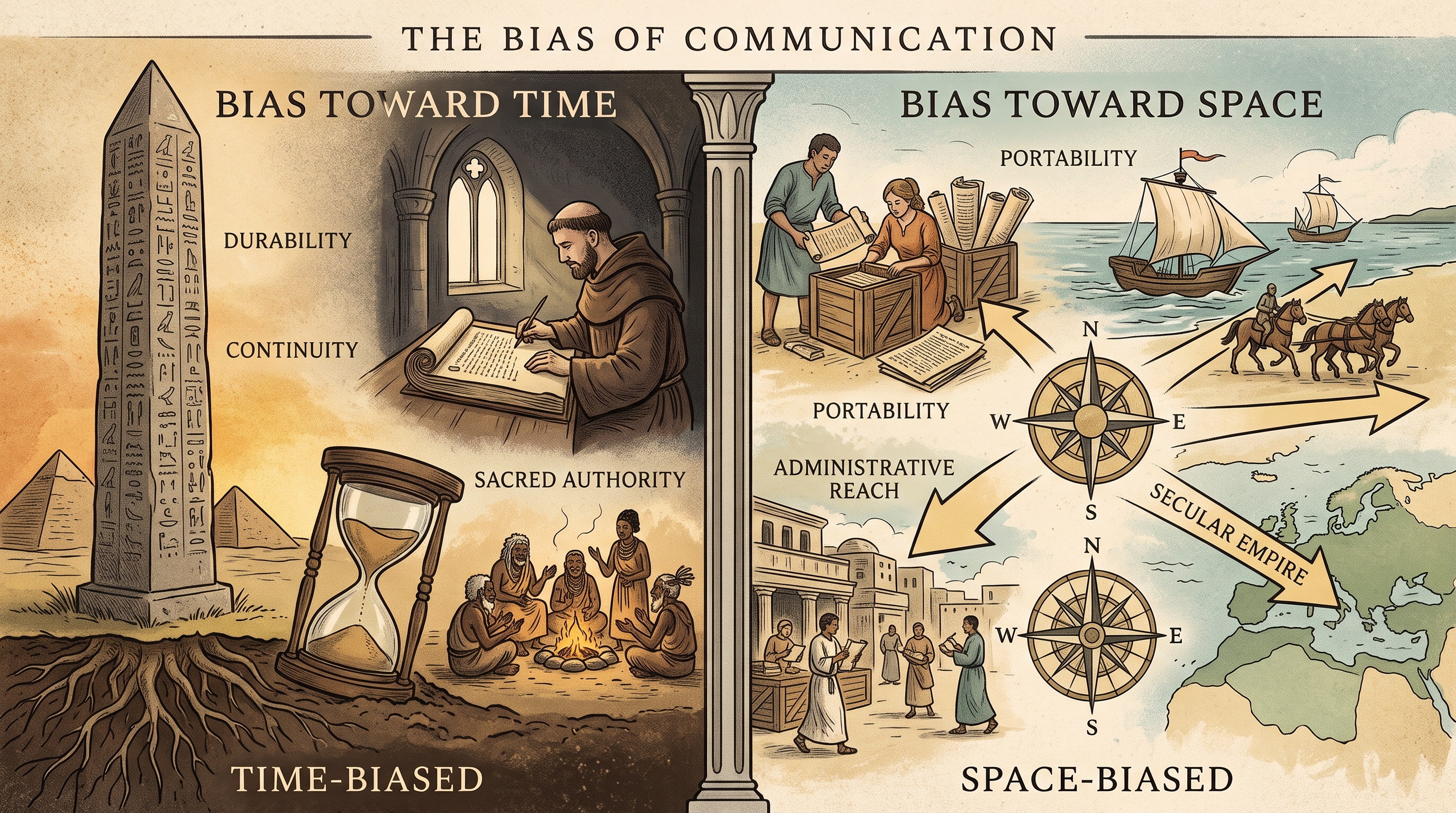
Innis categorized all dominant media along an inescapable material axis: time-biased media (durable, heavy, labor-intensive substrates like carved stone, baked clay, and animal parchment) foster decentralized governance, sacred hierarchy, religious ritual, and deep temporal continuity across generations; conversely, space-biased media (light, portable, ephemeral, scalable substrates like papyrus, rag paper, industrial newsprint, telegraphy, and electronic signals) facilitate centralized administration, territorial expansion, military deployment, and secular legalism across wide geographical frontiers.[1:3][2:3]
The long-term vitality of any civilization depends on achieving an imperial equilibrium between these two opposing forces.[1:4] Civilizations that succumb to an unmitigated space-bias inevitably experience administrative overstretch, militaristic centralization, and a chronic cultural amnesia that Innis famously diagnosed as "present-mindedness"—an obsession with immediate, real-time ephemera that obliterates historical depth.[1:5][2:4] Whenever a complex medium dominates a society, it gives rise to a monopoly of knowledge guarded by an entrenched scribal, priestly, or bureaucratic elite, which ultimately ossifies until disruptive counter-media emerge from the geographic or social margins to shatter the monopoly and reorganize political power.[1:6][2:5][3:1]
1. Intellectual Genealogy: From Resource Staples to the Political Economy of Communication
To understand Harold Innis’s media ecology, one must trace its emergence from Canadian economic history and the geography of the northern frontier.[1:7][4] Innis did not approach communication as a literary theorist or an abstract epistemologist; he approached it as an economic historian trained in the physical realities of resource extraction, transportation corridors, and imperial exploitation.[4:1][5]
The Staples Thesis: Geography, Commodities, and Imperial Metropoles
During the 1920s and 1930s at the University of Toronto, Innis formulated the Staples Thesis through exhaustive archival and field research, culminating in two economic masterworks: The Fur Trade in Canada: An Introduction to Canadian Economic History (1930) and The Cod Fisheries: The History of an International Economy (1940).[4:2][5:1]
Innis inverted the conventional historiographical assumption that Canada developed through the gradual outward expansion of European settlement.[4:3] Instead, he demonstrated that Canada was created by the structural demands of European imperial centers (Great Britain and France) for raw staple commodities:
- Resource Extraction and Spatial Corridors: The extraction of beaver pelts, codfish, square timber, and wheat dictated Canadian political geography. The pursuit of the beaver forced trading companies (the Hudson's Bay Company and the North West Company) to navigate interconnected river drainage basins across the Canadian Shield, establishing continental transcontinental routes long before the political confederation of 1867.[4:4]
- Center-Periphery Dependency: Canada emerged not as an autonomous, self-generating economy, but as an exploited periphery locked into structural dependency on imperial metropoles.[4:5][5:2] The periphery exported raw, unprocessed staples to the center in exchange for manufactured, high-value finished goods.[4:6]
- Heavy Overhead Costs and Rigidity: Staples economies require immense, front-loaded capital investments in transportation infrastructure (canals, port facilities, transcontinental railways).[4:7][5:3] These fixed overhead costs create severe economic vulnerability: when market demand shifts or raw supplies deplete, the society is burdened with enormous debt structures and administrative rigidities that resist technological change.[4:8]
The Radical Theoretical Pivot: Information as an Economic Staple
Following the trauma of World War I—where Innis was severely wounded in the trenches of the Battle of Passchendaele, instilling in him a lifelong horror of nationalist warfare and militarized propaganda—and the completion of his monumental economic volumes, Innis turned his attention in the 1940s to the pulp and paper industry.[4:9][5:4]
Investigating Canada's massive export of softwood pulp to supply the industrial newspaper presses of New York, Chicago, and London, Innis experienced an intellectual epiphany:[1:8][2:6][4:10]
- The Physicality of Communication: Information is not a disembodied essence floating through culture. It requires physical raw materials (papyrus reeds, sheepskins, rag pulp, telegraph wires, electromagnetic spectra) that must be gathered, processed, transported, and financed.[1:9][2:7]
- Media as Staples: Communication media are themselves economic staples. Just as the fur trade structured the spatial boundaries and institutional alliances of seventeenth-century North America, the dominant communication media of any era dictate how knowledge is gathered, stored, distributed, and monopolized across space and time.[1:10][2:8]
- From Physical Transport to Cultural Organization: The physical properties of the transport medium—its weight, durability, speed, and distribution cost—exert an inescapable shaping force on political governance, legal systems, religious hierarchies, and civic consciousness.[1:11][3:2]
"A medium of communication has an important influence on the dissemination of knowledge over space and over time and it becomes necessary to study its characteristics in order to appraise its influence in its cultural setting." — Harold A. Innis, The Bias of Communication (1951)[1:12]
2. The Core Theoretical Architecture: Time-Bias, Space-Bias, and Imperial Equilibrium
At the heart of Innis's media ecology lies a fundamental materialist taxonomy: the physical constitution of a communication technology imparts an unavoidable, structural bias toward either temporal duration or spatial extension.[1:13][2:9]
1. Time-Biased Media: Durability, Tradition, and Moral Hierarchy
Time-biased media are constructed from heavy, durable, resilient, and labor-intensive materials—such as carved stone, baked clay, animal parchment, or oral verse transmitted through trained mnemonic traditions.[1:14][2:10]
- Material Inelasticity: Because these substrates are heavy and difficult to transport across physical distances, they do not lend themselves to rapid territorial administration or centralized trans-continental rule.[1:15]
- Institutional Alignment: Time-biased media favor institutions that specialize in continuity, long-term preservation, and cosmic order: religious hierarchies, sacred priesthoods, monasteries, customary legal assemblies, and aristocratic genealogies.[1:16][2:11]
- Cultural Ethos: Societies dominated by time-biased media foster deep historical memory, reverence for ancestors and sacred texts, metaphysical and philosophical contemplation, and tight communal solidarity. However, their physical immobility renders them vulnerable to military conquest and territorial encirclement by expansionist neighbors.[1:17][2:12]
2. Space-Biased Media: Portability, Administration, and Secular Empire
Space-biased media are constructed from lightweight, portable, uniform, and easily replicable materials—such as papyrus scrolls, rag paper, machine-made wood-pulp newsprint, telegraph wires, radio waves, and digital packets.[1:18][2:13]
- Material Elasticity: Because these substrates are light and easily transported across vast distances, they circulate rapidly, facilitating real-time military coordination, bureaucratic record-keeping, and market synchronization.[1:19][2:14]
- Institutional Alignment: Space-biased media favor centralized secular monarchies, administrative bureaucracies, commercial trading networks, legalistic codifications, and standing armies.[1:20][2:15]
- Cultural Ethos: Societies dominated by space-biased media excel at geographical conquest, territorial integration, and trade efficiency. However, their hyper-accelerated communication cycles foster secularization, imperial overstretch, systemic present-mindedness, and an indifference toward historical depth and philosophical reflection.[1:21][2:16]
Systematic Comparative Matrix: Time-Bias vs. Space-Bias
| Analytical Dimension | Time-Biased Media | Space-Biased Media |
|---|---|---|
| Material Substrate | Carved stone monuments, baked clay tablets, animal parchment codices, oral cadence and mnemonic rhythm.[1:22][2:17] | Papyrus scrolls, rag paper, industrial wood-pulp newsprint, telegraph wires, radio waves, optical fiber, digital packets.[1:23][2:18] |
| Physical Attributes | Heavy, durable, resilient, scarce, labor-intensive, difficult to transport across geographic distances.[1:24] | Lightweight, portable, ephemeral, cheap, highly replicable, optimized for rapid physical or electronic transit.[1:25] |
| Production Economics | High unit cost; decentralized artisan crafting; scarce raw materials requiring specialized hand labor.[2:19] | Low unit cost; centralized, industrialized mass production; massive volume throughput and rapid obsolescence.[1:26][2:20] |
| Velocity of Circulation | Slow, localized, generational; information moves at the speed of human foot transit or animal pack.[1:27] | Rapid, wide-ranging, instantaneous; information circulates at the speed of river navigation, rail, or electromagnetic signals.[1:28][2:21] |
| Governing Institutions | Ecclesiastical hierarchies, temple priesthoods, monastic scriptoria, customary tribal councils, oral assemblies.[1:29][2:22] | Centralized state bureaucracies, imperial command centers, military standing armies, commercial cartels, central banks.[1:30][2:23] |
| Spatial Architecture | Decentralized, regional, insular, bounded by localized geography and defensible sanctuaries.[1:31] | Centralized imperial metropole projecting administrative command over expansive peripheral colonies and provinces.[1:32][2:24] |
| Temporal Horizon | Long-term, generational, metaphysical, cyclical; preservation of sacred origins and ancestral memory.[1:33][2:25] | Short-term, immediate, linear, transactional; fixated on daily updates, tactical movements, and fiscal cycles.[1:34] |
| Dominant Social Elite | Priestly castes, theological scholars, cloistered monks, oral bards, customary elders.[1:35][2:26] | Bureaucratic scribes, civil administrators, military generals, merchant cartels, press barons, algorithmic engineers.[1:36][3:3] |
| Cultural & Epistemic Ethos | Reverence for tradition, sacred ritual, moral philosophy, qualitative craftsmanship, contemplative stillness.[1:37][2:27] | Secular rationalism, legalistic codification, technical calculation, commercial speed, quantitative metrics.[1:38][2:28] |
| Inherent Civilizational Hazard | Insular stagnation, religious dogmatism, administrative paralysis, and physical vulnerability to foreign conquest.[1:39][2:29] | Administrative overstretch, militarization, imperial collapse, and structural amnesia ("present-mindedness").[1:40][2:30] |
The Imperial Balance Principle
In Empire and Communications, Innis formulated what can be termed the Imperial Balance Principle:[2:31]
The rise, endurance, and collapse of empires depend upon the capacity of their governance structures to maintain a dynamic equilibrium between the demands of space and the demands of time.[1:41][2:32]
A civilization that relies exclusively on space-biased media expands rapidly over geographic territory, but its lack of temporal continuity and moral ballast causes its administrative apparatus to become brittle, resulting in militaristic overextension, cultural amnesia, and eventual collapse.[1:42][2:33] Conversely, a civilization that relies exclusively on time-biased media develops deep religious cohesion and historical memory, but its inability to project administrative and military power across physical space leaves it helpless against external invaders.[1:43][2:34]
The rarest and most fertile moments in human history—such as classical Greece—occur when a society successfully balances the time-binding virtues of an oral dialogue tradition with the space-binding precision of an accessible written script.[1:44][2:35]
3. Monopolies of Knowledge and the Dialectic of Center and Margin
A cornerstone of Innis's political economy of communication is his theory of monopolies of knowledge (monopolies of knowledge).[1:45][3:4] Innis recognized that communication technologies are rarely distributed democratically across an entire populace; rather, their technical complexity, capital cost, and institutional requirements concentrate control in the hands of specialized ruling classes.[1:46][3:5]
The Triadic Life-Cycle of a Knowledge Monopoly
Innis traced a recurring three-phase historical dialectic governing how communication monopolies form, harden, and inevitably shatter:[1:47][2:36][3:6]
[Phase 1: Elite Consolidation]
Dominant class masters complex medium ➔ Centralizes administrative & sacred power
               │
               ▼
[Phase 2: Institutional Sclerosis]
Monopoly calcifies ➔ Enforces rigid orthodoxy ➔ Neglects systemic temporal/spatial imbalances
               │
               ▼
[Phase 3: Marginal Revolt]
Peripheral / excluded groups adopt cheaper, lighter, counter-media ➔ Monopoly shatters ➔ Empire realigns
- Phase 1: Elite Consolidation: Whenever a society adopts a communication system that is technically difficult to master (such as Egyptian hieroglyphics or Babylonian cuneiform) or physically expensive to produce (such as hand-copied parchment codices), a specialized elite arises.[1:48][2:37] Priests, scribes, lawyers, or technocrats spend years acquiring esoteric literacy and technical fluency. They leverage this specialized capability to monopolize religious truth, legal interpretation, and administrative power, extracting economic rent from the illiterate populace.[1:49][3:7]
- Phase 2: Institutional Sclerosis and Imperial Rigidity: As the monopoly of knowledge becomes entrenched, the ruling caste develops vested ideological and economic interests in preserving the medium exactly as it is.[1:50][3:8] The institutions surrounding the medium calcify into protective orthodoxies. Intellectual exploration ossifies into scholastic commentary; alternative perspectives are branded heretical and suppressed; and the imperial center becomes blind to emerging socio-economic crises and geographical imbalances on its frontiers.[1:51][3:9]
- Phase 3: The Revolt from the Margins (Periphery): Revolutionary media breakthroughs rarely originate at the imperial center, where ruling elites are invested in defending their sunk capital and privileged positions.[1:52][3:10] Instead, innovation emerges from the margins—the geographic frontiers, the disenfranchised colonies, or the lower socio-economic strata. Facing administrative exploitation and lacking access to the elite medium, marginal groups adopt or invent simpler, cheaper, more portable, or vernacular media to bypass the central gatekeepers:[1:53][3:11]
- Peripheral Semitic nomads along Mediterranean trade routes adapted complex Egyptian hieroglyphic pictograms into the phonetic alphabet.[1:54][2:38]
- Early Christian communities on the margins of the Roman Empire abandoned the elite pagan papyrus roll in favor of the cheap, portable parchment codex.[2:39]
- German vernacular printers and Protestant reformers on the geographical periphery of the Holy Roman Empire mobilized movable type to demolish the Latin scribal monopoly of the Papacy.[1:55][2:40]
Historical Trajectory of Knowledge Monopolies
| Civilizational Era | Dominant Media System | Controlling Monopoly Elite | Institutional Center | Nature of Sclerosis | Marginal Insurgency | Disruptive Counter-Medium | Structural Civilizational Transformation |
|---|---|---|---|---|---|---|---|
| Old Kingdom Egypt | Monumental carved stone inscriptions and hieroglyphic pictograms.[2:41] | Theocratic divine monarchy and Royal funerary bureaucracy.[2:42] | Memphis; royal necropolis complexes (pyramids).[2:43] | Monopolization of immortality; astronomical capital diversion to tomb construction.[2:44] | Provincial nomarchs and rising priestly classes of Upper Egypt.[2:45] | Lightweight papyrus scrolls and flowing hieratic script.[2:46] | Democratization of the afterlife; decentralization of power into feudal Middle Kingdom.[2:47] |
| Mesopotamia / Babylonia | Alluvial clay tablets and intricate cuneiform syllabaries.[2:48] | Temple priesthoods, royal accountants, and specialized scribes.[2:49] | Ziggurats, temple granaries, and palace archives of Ur and Babylon.[2:50] | Hundreds of complex wedge signs requiring lifelong apprenticeship; legal rigidity.[2:51] | Peripheral nomadic invaders (Assyrians, Medes, Persians).[2:52] | Flexible Aramaic alphabet on lightweight parchment and papyrus.[2:53] | Military centralization; creation of expansive administrative world-empires.[2:54] |
| Late Roman Empire | Egyptian papyrus scrolls, Roman civil law rolls, imperial cursus publicus.[2:55] | Roman senatorial aristocracy, imperial prefects, and military legates.[2:56] | Rome and Constantinople; centralized imperial bureaucracy.[2:57] | Extreme space-bias; administrative overstretch; vulnerability of maritime papyrus routes.[2:58] | Early Christian sects and peripheral Germanic successor kingdoms.[2:59] | Parchment codex (notebook format) and Latin monastic scriptoria.[2:60] | Collapse of centralized Mediterranean empire; fragmentation into localized European feudalism.[2:61] |
| High Middle Ages | Hand-copied Latin parchment codices and scholastic glossaries.[2:62] | Roman Catholic monastic orders, cardinals, and the Papal curia.[2:63] | Monasteries (Cluny, Cîteaux), Cathedral schools, Papal Rome.[1:56][2:64] | Absolute monopoly over biblical interpretation, Latin literacy, and spiritual salvation.[1:57] | German burghers, humanists, and Protestant reform theologians.[1:58][2:65] | Movable metal type printing press (Gutenberg) and cheap rag paper.[1:59][2:66] | The Protestant Reformation, destruction of unified Christendom, rise of sovereign nation-states.[1:60][2:67] |
| Nineteenth-Century Britain / USA | Mechanized steam-driven rotary presses, rag-paper broadsheets.[1:61] | Parliamentary political parties, aristocratic publishing oligarchs.[1:62] | London political clubs, elite New York party broadsheet editors.[1:63] | Partisan gatekeeping; expensive subscription prices excluding the industrial working class.[1:64] | Urban working-class journalists and independent commercial publishers.[1:65] | Industrial wood-pulp newsprint, the Penny Press, and advertising revenue.[1:66] | Rise of modern mass-circulation commercial journalism, sensationalism, and tabloid populism.[1:67] |
| Twenty-First Century Digital | Proprietary algorithmic feeds, cloud server platforms, closed AI models.[3:12] | Silicon Valley platform monopolies, Big Tech executives, data engineers.[3:13] | Northern California tech campuses, hyperscale cloud data centers.[3:14] | Black-box algorithmic gatekeeping, surveillance capture, behavioral monetization.[3:15] | Open-source software movements, cryptography developers, peer-to-peer networks. | Distributed open protocols, end-to-end encryption, local open-weight AI models. | Decentralized challenge to platform monopolies; contested battles over digital sovereignty. |
4. The Historical Sweep of Empire and Communications (1950): Five Millennia of Media Trajectories
In Empire and Communications, Innis deployed his time-space framework to conduct a sweeping, materialist investigation across five millennia of Western civilization, showing how the physical media of communication determined the rise and fall of successive imperial systems.[2:68]
1. Ancient Egypt: The Dualism of Stone and Papyrus
Egyptian civilization originated as an absolute theocracy organized around the time-binding medium of stone.[2:69]
- The Stone Monarchy of the Old Kingdom: The early pharaoh was not merely a political ruler; he was a god on earth, the literal incarnation of Horus and the son of Ra.[2:70] Carved stone monuments, bas-relief hieroglyphics, and monumental pyramids bound time by guaranteeing the pharaoh's eternal immortality.[2:71] Because stone was virtually indestructible but immensely difficult to transport, power remained centralized in the royal court, and the economy was mobilized to construct massive architectural tombs designed to defy physical decay.[2:72]
- The Papyrus Revolution: The development of papyrus—manufactured from the fibrous pith of reeds harvested in the Nile delta—shattered this stone equilibrium.[2:73] Papyrus was light, portable, and easily inscribed with ink and brush, enabling the rapid development of cursive scripts (hieratic and demotic).[2:74]
- The Shift from Monarch to Scribe: Papyrus dramatically reduced administrative overhead, facilitating the taxation and coordination of distant provinces. However, because hieroglyphic and hieratic writing remained highly complex, an elite caste of professional scribes and temple priests (centered around the worship of Amun-Ra at Thebes) acquired a stranglehold over administrative and religious literacy.[2:75]
- Democratic Revolution of Religion: In the transition to the Middle and New Kingdoms, immortality ceased to be the exclusive monopoly of the royal pharaoh; through papyrus funerary texts (the Book of the Dead), anyone who could afford a scribal scroll could secure safe passage to the afterlife.[2:76] The resulting struggle between the secular monarchy (seeking spatial administration) and the entrenched priestly monopoly of Thebes (seeking temporal and religious dominance) created continuous political instability, leaving Egypt vulnerable to invasion by the Hyksos and subsequent imperial powers.[2:77]
2. Mesopotamia and Babylonia: Clay Tablets and Cuneiform Legalism
In the alluvial plains of the Tigris and Euphrates rivers, civilization encountered an entirely different material substrate: soft river clay and the reed stylus.[2:78]
- The Inherent Qualities of Clay: Unlike Egyptian papyrus, clay was heavy, bulky, and difficult to transport across great distances, but it was virtually fireproof and permanent once sun-dried or baked in kilns.[2:79] Writing took the form of cuneiform (wedge-shaped impressions pressed into wet clay with a cut reed).[2:80]
- Temple Accounting and Priestly Monopolies: Cuneiform originated not for poetic expression, but as an accounting technology to track temple grain inventories, livestock, and sacrificial offerings.[2:81] The sheer difficulty of mastering hundreds of complex cuneiform characters ensured that temple priests maintained an absolute monopoly of knowledge over commercial transactions and sacred rites.[2:82]
- The Space-Binding Challenge: Because heavy clay tablets could not easily be transported over long distances, Mesopotamian polities initially organized as localized, autonomous city-states (Ur, Lagash, Uruk) governed by temple hierarchies.[2:83]
- Hammurabi’s Legal Synthesis: King Hammurabi of Babylon (c. 1750 BCE) achieved an imperial breakthrough by integrating time-binding and space-binding strategies: he inscribed his comprehensive legal code onto towering, durable stone stelae (The Code of Hammurabi) erected in central public squares, while deploying lightweight clay copies to provincial courts.[2:84] By establishing fixed civil laws, Hammurabi curbed the arbitrary power of local temple priests and laid the institutional foundation for Babylonian imperial administration.[2:85]
- The Persian Synthesis: Successive military conquerors—the Assyrians and the Persians—eventually supplemented clay with lighter media (Aramaic written on parchment and imported papyrus), establishing royal courier relay systems along paved imperial highways to administer vast territorial empires spanning from Egypt to India.[2:86]
3. Classical Greece: The Oral Tradition and the Phonetic Alphabet
Innis regarded classical Greece as the supreme historical embodiment of civilizational equilibrium—a rare, fertile alignment where the time-binding virtues of an oral culture were energized, rather than crushed, by a democratic written script.[1:68][2:87]
- The Supremacy of the Greek Oral Tradition: Classical Greek culture was fundamentally an oral medium. The Homeric epics (The Iliad and The Odyssey) were not read silently from manuscripts; they were performed aloud by traveling rhapsodes, functioning as living tribal encyclopedias that preserved ethical codes, military history, and cultural identity through acoustic rhythm and metric rhyme.[1:69][2:88]
- The Phonetic Alphabet from the Margins: Around the eighth century BCE, Greek traders adapted the consonantal alphabet developed by Phoenician maritime merchants, adding vowels to create the first fully phonetic, phoneticized writing system.[1:70][2:89]
- The Democratization of Literacy: Unlike the complex hieroglyphics of Egypt (which required mastering hundreds of pictorial ideograms) or Babylonian cuneiform, the Greek alphabet required learning only twenty-four simple characters.[1:71][2:90] This shattered the economic basis for a scribal monopoly. Reading and writing could be acquired by ordinary citizens, merchants, and soldiers, fostering civic literacy and participatory democracy in the Athenian polis.[1:72][2:91]
- Oral Dialectic and the Athenian Golden Age: Crucially, the arrival of writing did not immediately destroy Greek oral culture. For two centuries, writing was utilized merely to record and support oral debate. The Athenian democratic assembly (Ecclesia), the tragic theater of Sophocles and Aeschylus, and the philosophical dialectic of Socrates all took place aloud, in face-to-face public space.[1:73][2:92]
- The Decay into Written Prose: By the late fourth century BCE, the delicate balance tipped. In the writings of Plato and Aristotle, written prose triumphed over spoken poetry and living dialogue.[1:74][2:93] As philosophy shifted from living Socratic conversation into specialized written treatises, intellectual life retreated into academic institutions. The oral cohesion of the polis fractured into individualism, cynicism, and civic apathy, facilitating the conquest of Greece by the militarized Macedonian empire of Philip and Alexander the Great.[1:75][2:94]
4. The Roman Empire: Papyrus Logistics, Military Roads, and Codified Law
The Roman Republic and Empire constructed the most formidable space-biased empire of the ancient Mediterranean basin, leveraging a synchronized apparatus of lightweight papyrus, paved roads, and codified civil law.[2:95]
- Papyrus as the Administrative Engine of Rome: The Roman administrative state was entirely dependent upon vast quantities of imported Egyptian papyrus.[2:96] While stone monuments celebrated military victories in the Forum, the day-to-day command of the empire—levying taxes across twenty provinces, paying distant legions along the Rhine and Danube, issuing imperial edicts, and administering the census—was conducted on lightweight papyrus scrolls.[2:97]
- Codified Roman Law as Infrastructure: To maintain administrative cohesion across diverse ethnicities, Rome replaced the oral customs of localized tribes with universal, written civil law (Corpus Juris Civilis).[2:98] Codified law operated as a space-binding technology, providing uniform legal predictability that allowed Roman merchants and governors to operate identically in Hispania, Gaul, Egypt, and Syria.[2:99]
- The Structural Fragility of the Papyrus Monopoly: Rome's reliance on papyrus created a profound material vulnerability.[2:100] Papyrus could be cultivated and manufactured in only one geographic location: the Nile Delta of Egypt. If Egyptian agricultural yields failed, or if maritime supply lines across the Mediterranean were disrupted by piracy, civil war, or foreign conquest, the entire administrative nervous system of the empire paralyzed.[2:101]
- The Fall of Rome and Feudal Fragmentation: As the Western Roman Empire buckled under economic decay and Germanic invasions, international trade routes disintegrated. When Arab conquests in the seventh century permanently severed Mediterranean trade and cut off Western Europe's access to Egyptian papyrus, centralized imperial bureaucracy became physically impossible.[2:102] Lacking a light, portable medium to coordinate central administration, Western Europe fragmented into localized, self-sufficient feudal manors.[2:103]
5. Medieval Europe: Parchment Scriptoria and Ecclesiastical Hegemony
The collapse of the Roman papyrus supply forced Western Europe to retreat into a localized, intensely time-biased media regime grounded in animal parchment.[2:104]
- The Materiality of Parchment: Parchment (and vellum) was crafted from the laboriously scraped and treated hides of sheep, calves, and goats.[2:105] Producing a single large Bible required the hides of several hundred animals and months of skilled artisan labor by monastic scribes.[2:106] Unlike papyrus, parchment was heavy, bulky, and scarce, but it was exceptionally durable, capable of enduring for a millennium without decaying.[2:107]
- The Monastic Monopoly of Knowledge: Because parchment production and manuscript illumination were concentrated in isolated rural monasteries (such as those of the Benedictine and Cistercian orders), the Roman Catholic Church established an absolute monopoly of knowledge over European intellectual life.[1:76][2:108]
- The Supremacy of the Church over the Secular State: The scarcity and cost of parchment reinforced the feudal political structure.[2:109] Secular kings and feudal dukes were largely illiterate, depending on clerical chancellors to draft treaties and keep accounts.[2:110] The Church bound time through the liturgical calendar, Latin theological continuity, and the preservation of sacred scripture, holding undisputed moral and institutional hegemony over European civilization for eight centuries.[1:77][2:111]
- The Byzantine Contrast: In the Eastern Roman (Byzantine) Empire, centralized rule survived for a millennium because Constantinople preserved access to papyrus, manufactured early forms of paper, maintained an educated civil service, and balanced the temporal authority of the Orthodox Church with the space-binding authority of the secular Emperor (Caesaropapism).[2:112]
6. The Modern Era: Paper, Movable Print, and the Rise of the Nation-State
The transition from the Middle Ages to the modern era was catalyzed by the arrival of two interconnected media technologies that demolished the monastic parchment monopoly: rag paper and movable metal type.[1:78][2:113]
- The Migration of Paper: Developed in China around the second century CE, paper made from macerated cloth rags migrated westward through the Islamic world, reaching European markets via Moorish Spain and Italy in the twelfth and thirteenth centuries.[1:79][2:114] Rag paper was dramatically cheaper, lighter, and more scalable than animal parchment, though fiercely resisted for centuries by ecclesiastical scribes who condemned it as an ephemeral, secular material.[2:115]
- Gutenberg’s Movable Type (c. 1440): Johannes Gutenberg's synthesis of movable cast-metal type, oil-based ink, and the mechanical screw press in Mainz, Germany, industrialized the production of texts.[1:80][2:116] Books could now be produced in weeks rather than taking years of manual scribal copying.
- The Protestant Reformation as Media Revolution: Martin Luther was the first historical figure to recognize the power of the press as a weapon against a knowledge monopoly.[1:81][2:117] Translating the Bible into vernacular German, Luther bypassed the Latinate hierarchy of Rome, flooding the German provinces with hundreds of thousands of cheap printed pamphlets.[1:82][2:118] The press broke the universal ecclesiastical authority of the Catholic Church, fractured Western Christendom, and catalyzed over a century of catastrophic religious warfare.[1:83][2:119]
- Print Capitalism and the Sovereign Nation-State: As analyzed by Benedict Anderson and prefigured by Innis, commercial printers needed to sell books in large print runs to recover their capital investments.[1:84][2:120] Because Latin was read by only a tiny elite, printers standardized regional vernaculars (English, French, German, Spanish), creating national reading publics that fostered national identity, centralized legal systems, and the rise of sovereign, bordered nation-states.[1:85][2:121]
- The Industrial Press and Present-Mindedness: By the nineteenth century, the invention of the steam-powered rotary press, the discovery of chemical wood pulp (replacing scarce cloth rags with abundant timber), and the invention of the electric telegraph transformed the newspaper into an industrial mass commodity.[1:86][2:122] Communication accelerated into real-time velocity, inaugurating the extreme space-bias of twentieth-century industrial society.[1:87][2:123]
5. The Topical Treatises in The Bias of Communication (1951)
While Empire and Communications provides a continuous chronological narrative of world history, Innis’s companion volume, The Bias of Communication (1951), collects his most penetrating and polemical topical essays.[1:88] In these essays, Innis engaged in a prophetic, humanist diagnosis of the pathologies afflicting twentieth-century Western civilization.[1:89][3:16]
1. "Minerva's Owl": Twilight Consciousness and Imperial Decline
Delivered as his presidential address to the Royal Society of Canada in 1947, "Minerva's Owl" serves as the theoretical gateway to the collection.[1:90] Innis borrowed his title from G.W.F. Hegel’s famous aphorism in the Philosophy of Right:
"The owl of Minerva begins its flight only with the falling of the dusk."[6]
Innis applied Hegel's philosophical insight directly to media ecology: a civilization develops acute philosophical and technological awareness of its communication systems only when those systems have reached their structural apex and are sliding into terminal decline.[1:91]
- The Retrospective Illusion: Societies do not perceive the structural biases of their media while they are young, vigorous, and expanding.[1:92] In the morning and midday of an empire, the dominant medium is taken for granted as a natural, unchallengeable environment.[1:93]
- Twilight Illumination: Only when the imperial balance between time and space fractures—when knowledge monopolies calcify, economic contradictions mount, and institutions begin to crumble—do intellectuals and critics suddenly produce profound analyses of communication.[1:94][3:17] The very flourishing of media theory in the twentieth century, Innis warned, was not a sign of triumphant civilizational vitality, but the diagnostic twilight of Western industrial hegemony.[1:95]
2. "A Plea for Time": The Pathology of "Present-Mindedness"
"A Plea for Time" is Innis's most passionate, urgent moral and institutional critique.[1:96] Writing amidst the horrors of the early Cold War and the atomic standoff, Innis argued that modern Western civilization was suffering from an unprecedented, life-threatening psychiatric condition: pathological present-mindedness (present-mindedness).[1:97][3:18]
The Architecture of Present-Mindedness
- The Velocity of Ephemera: Industrialized wood-pulp newsprint, continuous-roll rotary printing presses, transatlantic telegraph cables, radio broadcasting, and advertising agencies had combined to flood public consciousness with a nonstop cascade of instant bulletins, breaking headlines, and sensationalized updates.[1:98]
- The Annihilation of Duration: Because commercial news media depend on rapid turnover and advertising revenue, they possess an inherent commercial incentive to erase the past.[1:99][3:19] Yesterday’s news is rendered worthless wastepaper; long-term historical causality is ignored; and the public is kept in a permanent state of high-velocity emotional agitation focused entirely on the immediate moment.[1:100]
- Democratic Decay: Innis argued that genuine democratic deliberation requires time—unhurried contemplation, historical reflection, civil dialogue, and the capacity to weigh generational consequences.[1:101][3:20] Space-biased mass media replace deliberative citizenship with continuous public-opinion polling, visceral emotional manipulation, and state propaganda, reducing the public to an easily stampeded mob.[1:102][3:21]
The University as a Time-Binding Sanctuary
To counter this catastrophic spatial acceleration, Innis made an impassioned plea to preserve and defend the liberal university:[1:103]
- The university must not allow itself to be converted into a trade school, a servant of corporate commercialization, or an administrative arm of the national warfare state.[1:104]
- The university's sacred civilizational duty is to function as a time-binding sanctuary—a counter-environment protected from commercial velocity, preserving deep historical memory, sustained philosophical critique, and the living oral dialogue of the Socratic seminar.[1:105][3:22]
3. "The Problem of Space": Imperial Expansion and Militarization
In "The Problem of Space," Innis examined the technological mechanisms through which modern industrial nations conquer physical geography.[1:106]
- The Spatial Imperative: Following the Industrial Revolution, Western empires developed steam locomotives, continental rail networks, steamship lanes, telegraph grids, and postal systems that obliterated physical distance.[1:107]
- Centralized Command and Control: Conquering space requires continuous bureaucratic coordination.[1:108] Distant territories cannot be governed through informal oral consensus; they demand centralized bureaucracies, standardized legal codes, quantitative metricization, and standing militarized police forces.[1:109]
- The Drift toward Totalitarianism: Innis demonstrated that the technological obsession with space-binding inevitably corrupts constitutional republics into authoritarian, expansionist empires.[1:110][3:23] As the administrative state mobilizes resources to defend its vast spatial frontiers, domestic civil liberties are curtailed, executive power expands, and society is permanently mobilized for imperial defense.[1:111]
4. "Industrialism and Cultural Values" & "Technology and Public Opinion in the USA"
In these two penetrating essays, Innis turned his critical gaze toward the United States, analyzing how the commercialization of the press transformed public opinion from an instrument of democratic oversight into a weapon of commercial and geopolitical hegemony.[1:112]
- The Penny Press and Commercial Commodification: The mid-nineteenth-century development of the penny press severed journalism from political party subscriptions, financing newspapers instead through mass commercial advertising.[1:113] To maximize advertising rates, newspapers had to maximize circulation, creating an irresistible market incentive to abandon serious political analysis in favor of sensationalism, crime reporting, human-interest scandals, and fabricated crises (yellow journalism).[1:114]
- The Telegraphic Standardization of News: The alliance between the electric telegraph and news cartels (such as the Associated Press) forced journalism into a standardized, truncated, headline-driven format.[1:115] The telegraph stripped information of local context, nuance, and historical background, reducing global events to isolated, urgent fragments designed to trigger emotional shocks.[1:116][3:24]
- Radio and the Return of Acoustic Demagoguery: Innis presciently analyzed how radio broadcasting retrieved the raw emotional contagion of pre-literate oral culture, but on a continental scale.[1:117] Because radio appeals directly to the ear, bypassing the critical, analytical reflection fostered by private print literacy, it enabled charismatic demagogues (such as Adolf Hitler, Father Coughlin, or populist American politicians) to synchronize mass emotions and rally entire populations behind militaristic aggression.[1:118][3:25]
6. The Toronto School of Communication: Innis, McLuhan, and the Intellectual Matrix
Harold Innis’s media ecology laid the structural, historical, and economic foundation for what became celebrated worldwide as the Toronto School of Communication.[3:26][7] The defining intellectual relationship of this school was the complex, fruitful dialogue between Innis and his younger University of Toronto colleague, Marshall McLuhan.[3:27][7:1]
The Innis–McLuhan Nexus: Macro-Economics vs. Micro-Phenomenology
While Marshall McLuhan achieved global celebrity during the 1960s with iconic aphorisms ("the medium is the message," "the global village," "hot vs. cool media"), McLuhan was explicit regarding his intellectual debt to Innis.[7:2][8] In his introduction to the 1964 reprint of Innis's The Bias of Communication, McLuhan wrote that his own masterpiece, The Gutenberg Galaxy (1962), was merely an extended footnote to Innis's work.[7:3]
The two thinkers operated as complementary halves of a unified media-ecological paradigm:[3:28][7:4]
- Innis (The Macro-Economic View from Without): Approached media as an economic historian examining the external architecture of civilization—raw material staples, physical transport corridors, geographical empires, bureaucratic institutions, and knowledge monopolies.[1:119][2:124][7:5]
- McLuhan (The Micro-Phenomenological View from Within): Approached media as a literary critic and cognitive phenomenologist examining the internal ecology of human consciousness—sensory ratios (eye vs. ear), cognitive restructuring, psychic amputations, and media as technological extensions of the central nervous system.[7:6][8:1]
Comprehensive Comparative Matrix: Innis vs. McLuhan
| Theoretical Axis | Harold Adams Innis | Marshall McLuhan |
|---|---|---|
| Native Discipline | Political economy, Canadian economic history, staples theory.[4:11][5:5] | English literature, Cambridge New Criticism, semiotics, Renaissance rhetoric.[7:7][8:2] |
| Analytical Vantage Point | Macro-Institutional & Structural: Examines media from the outside (empires, borders, trade, bureaucracies).[1:120][2:125] | Micro-Phenomenological & Cognitive: Examines media from the inside (human sensorium, psychic ratios, consciousness).[7:8][8:3] |
| Conception of Media | Economic Staples: Material substrates with physical weight, production costs, and institutional alignments.[1:121][2:126] | Technological Extensions: Enhancements and amputations of human sensory organs and the central nervous system.[8:4] |
| Core Diagnostic Metric | Time-Bias vs. Space-Bias: The balance between geographical reach and historical continuity.[1:122][2:127] | Hot vs. Cool Media / Acoustic vs. Visual Space: High vs. low sensory definition and audience participation.[8:5] |
| Institutional Focus | Monopolies of knowledge, legal codification, state bureaucracies, priesthoods, military expansion.[1:123][2:128] | Tribal village dynamics, print individualism, television sensory immersion, cybernetic networks.[8:6] |
| View of the Oral Tradition | A precious, democratic, time-binding medium that preserves civic dialectic, ethics, and human balance.[1:124][2:129] | Acoustic space: a multi-sensory, high-participation, tribal matrix retrieved by electronic media.[8:7] |
| Political & Ethical Outlook | Anti-imperialist humanist; fiercely critical of American commercialism and militarized present-mindedness.[1:125] | Detached, satirical observer; descriptive rather than prescriptive ("probe" methodology without moralizing).[8:8] |
| Primary Masterworks | Empire and Communications (1950); The Bias of Communication (1951).[1:126][2:130] | The Gutenberg Galaxy (1962); Understanding Media: The Extensions of Man (1964).[8:9] |
The Wider Toronto School Ecosystem
The Toronto School of Communication was not limited to Innis and McLuhan; it constituted a multi-disciplinary circle of scholars who cross-fertilized historical economics, classicism, literary criticism, and anthropology:[3:29]
- Eric A. Havelock (Preface to Plato, 1963): Collaborating with Innis and McLuhan at Toronto, classicist Havelock operationalized Innis's insights into ancient Greece, demonstrating that Plato’s banishment of the poets from the Republic was not an aesthetic eccentricity, but the decisive historical transition from an oral mnemonic educational system to abstract, alphabetic print literacy.[3:30]
- Northrop Frye (Anatomy of Criticism, 1957; The Bush Garden, 1971): Frye examined how literary archetypes and verbal structures construct a mental home against the intimidating emptiness of Canadian geography.[3:31] Frye’s famous concept of the Canadian "garrison mentality"—communities tightly enclosed behind physical and psychological walls to shield against a terrifyingly vast wilderness—serves as the literary and aesthetic counterpart to Innis’s space-binding railway and communication networks.[3:32]
- Edmund Carpenter (Explorations, 1953–1959): Anthropologist Carpenter conducted fieldwork with Inuit communities, demonstrating how their cognitive mastery of "acoustic space"—navigating featureless Arctic snowscapes by sound and proprioception rather than visual horizons—validated Innis's and McLuhan's theories of sensory non-visual orientation.[3:33]
7. Contemporary Relevance: Digital Networks, Platform Monopolies, and Algorithmic Present-Mindedness
Although Harold Innis died in 1952 at the dawn of the television age, his analytical framework provides twenty-first-century media theory with its most penetrating diagnostic toolkit for decoding the digital ecosystem.[1:127][3:34]
1. The Internet as the Ultimate Space-Biased Medium
The global internet, packet-switched routing networks, satellite constellations, and fiber-optic grids represent the absolute technological realization of space-bias:[3:35]
- Total Physical Erasure of Geography: Communication has achieved zero-marginal-cost, instantaneous global velocity.[3:36] A financial order, algorithmic directive, or social media post circulates around the planet at light speed, completely unconstrained by physical borders or topographical friction.[3:37]
- The Climax of Administrative Centralization: While early cyber-utopians proclaimed that the internet would decentralize society into egalitarian digital democracies, Innisian media ecology predicted the exact opposite: extreme space-biased media inevitably produce hyper-centralized administrative monopolies.[1:128][2:131] Today, global digital commerce and communication are consolidated within a tiny handful of transnational platform conglomerates (Alphabet, Meta, Amazon, Microsoft, Apple) that coordinate international markets and sovereign behavior far more comprehensively than Roman legions or British naval fleets.[3:38]
2. Digital Monopolies of Knowledge: The Algorithmic Priesthood
The tech giants of Silicon Valley have constructed the most formidable monopolies of knowledge in human history, operating under the exact three-phase dialectic Innis diagnosed in ancient Egypt and medieval Europe:[1:129][3:39]
- Esoteric Literacy and Black-Box Systems: In ancient Babylon, only temple scribes could decipher cuneiform wedge markings; in the medieval Church, only ordained clergy could interpret Latin scripture.[2:132] In contemporary digital capitalism, only proprietary neural networks, machine-learning data scientists, and algorithmic engineers understand the black-box algorithms that curate news feeds, allocate credit scores, rank search results, and modulate human behavior.[3:40]
- Institutional Sclerosis and Value Extraction: Platform monopolies leverage their network effects and closed data silos to extract economic surplus from content creators, merchants, and users, while defending their monopolies through patent wars, aggressive acquisitions, and lobbying.[3:41]
- The Center-Margin Battle in Cyberspace: In accordance with Innis's dialectic, resistance emerges from the technological margins: open-source software developers, peer-to-peer decentralized file systems (IPFS), end-to-end encrypted messaging, and open-weight foundation models represent peripheral attempts to bypass the centralized gatekeepers and break the platform monopoly.[3:42]
3. Radical Present-Mindedness 2.0: The Amnesiac Feed
Innis’s diagnosis of "present-mindedness" has evolved into a full-blown civilizational crisis within the modern attention economy:[1:130][3:43]
- The Annihilation of History in the Infinite Scroll: The design architecture of social media feeds (algorithmic timelines, vanishing 24-hour "stories," push notifications) permanently locks human consciousness into an urgent, reactive "now."[3:44] Historical depth, institutional continuity, and reflective synthesis are liquidated in favor of high-arousal, micro-ephemeral stimuli designed to harvest dwell time.[3:45]
- The Fragmentation of Civic Memory: Because algorithmic systems optimize content for immediate emotional contagion and viral outrage rather than contextual truth, contemporary societies suffer from profound historical amnesia.[1:131][3:46] Public debate lurches from one manufactured daily outrage to the next, fulfilling Innis's warning that an unmitigated space-bias destroys a society’s capacity to remember its past, diagnose its present, or plan for its future.[1:132][3:47]
Civilizational Evolution Across Innisian Epochs
| Epoch / Media Regime | Dominant Technological Substrate | Primary Structural Bias | Controlling Monopoly Class | Spatial Scope of Power | Temporal Horizon of Society | Peripheral Counter-Medium |
|---|---|---|---|---|---|---|
| Archaic / Theocratic | Carved stone monuments, temple bas-reliefs, oral sacred hymns.[2:133] | Extreme Time-Bias | Divine Pharaohs, royal tomb builders, solar temple priests.[2:134] | Regional; bounded by Nile or river valley topography.[2:135] | Cosmic eternity, ancestral veneration, cyclical seasonal myth.[2:136] | Cursive hieratic script on lightweight papyrus reeds.[2:137] |
| Classical / Democratic | Phonetic alphabet on imported papyrus; public oral assembly.[1:133][2:138] | Dynamic Equilibrium (Time & Space) | Citizen-orators, elected magistrates, tragic playwrights.[1:134][2:139] | Civic polis; Mediterranean maritime trade routes.[1:135][2:140] | Civic historical memory, philosophical dialectic, democratic debate.[1:136] | Standardized written prose treatises (Platonic/Aristotelian scholasticism).[2:141] |
| Late Imperial / Roman | Standardized papyrus rolls, paved roads, codified civil law.[2:142] | Aggressive Space-Bias | Roman senatorial aristocracy, imperial prefects, military legates.[2:143] | Continental empire (Mare Nostrum); Spain to Mesopotamia.[2:144] | Short-term tactical command, administrative fiscal cycles.[2:145] | Durable animal parchment codex (notebook format).[2:146] |
| Medieval / Feudal | Hand-copied animal parchment codices in Latin scriptoria.[2:147] | Extreme Time-Bias | Benedictine/Cistercian monks, Catholic bishops, Papal Curia.[1:137][2:148] | Decentralized feudal manors; universal Christendom.[1:138][2:149] | Generational liturgical calendar, biblical salvation history.[1:139][2:150] | Cheap rag paper and movable cast-metal print.[1:140][2:151] |
| Modern / Industrial | Steam rotary presses, wood-pulp newsprint, telegraph wires.[1:141] | Aggressive Space-Bias | Capitalist publishers, news syndicates, national party organs.[1:142] | Sovereign industrial nation-states, transcontinental empires.[1:143] | 24-hour news cycles, daily breaking updates (present-mindedness).[1:144] | Radio broadcasting, underground pamphlet presses, pirate radio.[1:145][3:48] |
| Digital / Algorithmic | Fiber optics, server clouds, packet routing, algorithmic feeds.[3:49] | Absolute Space-Bias | Big Tech executives, cloud monopolists, AI data cartels.[3:50] | Borderless, planetary, instantaneous cybernetic web.[3:51] | Microsecond algorithmic trades, real-time infinite scroll feeds.[3:52] | Cryptographic protocols, decentralized open-source networks, local AI models. |
🎴 Interactive Web Practice (Comprehension Check)
Question 1 (Staples Theory to Media Ecology & Time-Bias vs. Space-Bias): How did Harold Innis's economic "staples thesis" lead directly to his theory of media bias, and how do time-biased and space-biased media differ in their material attributes and institutional impacts?
Answer: Harold Innis formulated the Staples Thesis while analyzing Canadian economic history, proving that Canada's geography, borders, and institutions were shaped by the extraction and export of primary raw materials (fish, fur, timber, wheat) to European imperial centers. In the 1940s, while examining the pulp and paper industry, Innis made a profound theoretical leap: he recognized that information media are themselves economic staples. Just as physical commodities require transport infrastructure and organize space, communication media dictate how knowledge is gathered, stored, and monopolized across territory and duration.
Innis categorized all communication media according to their material properties:
- Time-Biased Media (e.g., carved stone, baked clay, animal parchment, oral mnemonic verse) are heavy, durable, scarce, and labor-intensive. Because they are difficult to transport across geographic space, they bind time—fostering decentralized political systems, sacred religious authority, customary law, deep historical memory, and long-term generational continuity. Their vulnerability is insular stagnation and military weakness against expansionist neighbors.
- Space-Biased Media (e.g., papyrus, cheap paper, industrial newsprint, telegraphy, radio, digital packets) are lightweight, portable, uniform, and easily replicable. They bind space—facilitating centralized imperial administration, military coordination, territorial expansion, legal codification, and commercial networks. Their vulnerability is administrative overstretch, militarization, and an acute cultural amnesia that Innis termed "present-mindedness."
Question 2 (Monopolies of Knowledge, Center-Margin Dialectics, and Imperial Collapse): What constitutes an Innisian "monopoly of knowledge," how does it ossify, and why do revolutionary technological breakthroughs typically originate on the geographic or institutional margins rather than at the imperial center?
Answer: A monopoly of knowledge arises when a complex, expensive, or labor-intensive communication medium requires specialized technical skills, esoteric literacy, or heavy capital infrastructure to operate. A specialized elite (such as Egyptian hieroglyphic scribes, Babylonian cuneiform priests, medieval Latin monks, or modern Silicon Valley algorithmic engineers) consolidates control over the medium, translating technical mastery into political, economic, and moral authority.
Over time, the monopoly undergoes institutional sclerosis:
- The ruling caste develops vested interests in preserving the existing medium, enforcing strict orthodoxy, suppressing heterodoxy, and extracting economic rent.
- The imperial center becomes structurally rigid, failing to perceive growing social friction or balance spatial reach with temporal depth.
Revolutionary disruptions emerge from the margins (periphery) because established elites at the center are ideologically blinded by their privileges and burdened by massive sunk capital in the dominant infrastructure. Marginal groups—facing economic exploitation, geographic exclusion, and administrative control—have every incentive to adopt or invent cheaper, lighter, more flexible, or vernacular counter-media (such as the Phoenician phonetic alphabet on the edge of Egypt/Mesopotamia, or Luther's vernacular print on the edge of Papal Christendom) to bypass elite gatekeepers and dismantle the central monopoly.
Question 3 (Minerva's Owl, Modern Present-Mindedness, and the Defense of Time): How did Innis apply Hegel's aphorism of "Minerva's Owl" to media ecology, what did he diagnose as the pathology of modern "present-mindedness," and why did he champion the university as a time-binding sanctuary?
Answer: In his presidential address "Minerva's Owl," Innis borrowed G.W.F. Hegel's aphorism ("the owl of Minerva begins its flight only with the falling of the dusk") to establish a fundamental law of media history: a civilization achieves profound philosophical and analytical consciousness of its communication apparatus only when that system has reached its apex and begun its structural decline. Media theory is not a sign of youthful imperial vigor, but the twilight illumination of an overextended civilization facing systemic crisis.
In "A Plea for Time," Innis diagnosed modern Western civilization as afflicted with "present-mindedness"—a pathological condition wherein the unending barrage of real-time industrialized media (rotary press headlines, telegraphic bulletins, radio broadcasts, and advertising) traps consciousness in a continuous, high-velocity "now." By pandering to immediate emotional shocks to sell news as a commercial commodity, modern media destroy historical memory, intergenerational responsibility, and contemplative depth, leaving citizens vulnerable to state propaganda and authoritarian demagogues.
To counteract this spatial obsession, Innis made a passionate defense of the liberal university. He insisted that universities must resist commercialization, vocational training, and state military capture, acting instead as sacred time-binding sanctuaries that protect unhurried scholarship, deep historical consciousness, and the living oral dialogue of the Socratic seminar against the destabilizing velocity of industrial ephemera.
Resonant Notes
The following notes in the vault share direct thematic, sociological, and literary connections with Harold Innis's media ecology:
🔴 Media Ecology, The Toronto School & Technological Determinism
- Innis (1950) - Empire and Communications — Foundational historical monograph deriving from Innis's 1948 Oxford Beit Lectures, establishing the five-millennium historical case studies (Egypt, Babylonia, Greece, Rome, the Middle Ages, print modernity) integrated into this study.
- Innis (1951) - The Bias of Communication — The companion theoretical collection gathering Innis's landmark essays ("Minerva's Owl", "A Plea for Time", "The Problem of Space"), diagnosing modern present-mindedness and knowledge monopolies.
- Marshall McLuhan (1911-1980) & McLuhan's The Medium is the Message — The primary intellectual sibling and heir of Innis at the University of Toronto; McLuhan translated Innis's macro-economic and historical analysis of physical staples into a cognitive and sensory phenomenology of media as extensions of the nervous system.
- Northrop Frye & Northrop Frye's - Anatomy of Criticism — The literary pillar of the Toronto School; while Innis examined how physical transport media conquer spatial geography, Frye analyzed how mythic archetypes and literary imagination erect verbal sanctuaries against spatial alienation.
- Martin Heidegger — Heidegger's critique of modern technology in The Question Concerning Technology defines modern technics as Gestell (enframing), which reduces nature and human beings into standing reserve (Bestand), directly paralleling Innis's analysis of how space-binding industrial media commodify culture into administrative data.
- Timothy John Berners-Lee & How the Internet Works — Berners-Lee's creation of the World Wide Web and TCP/IP packet-switching infrastructure represents the ultimate historical instantiation of Innis's space-biased medium: global, instantaneous, borderless, and relentlessly ephemeral.
- The Internet of Things (IoT) — Charts the physical expansion of space-binding digital networks into material domestic appliances and urban hardware, embedding continuous administrative surveillance directly into civil architecture.
- Entropy — Claude Shannon's mathematical theory of communication and thermodynamic entropy demonstrates how the hyper-acceleration of high-throughput spatial networks degrades message coherence, drowning civil discourse in informational noise and cognitive exhaustion.
🟡 Monopolies of Knowledge, Bureaucratic Power & Digital Network Hegemony
- George Orwell (1903-1950) & Dystopian Counterpoints - Brave New World vs. Nineteen Eighty-Four — Orwell's Ministry of Truth dramatizes the ultimate totalitarian monopoly of knowledge, utilizing space-binding telescreens and the continuous rewriting of print archives to erase historical time and enforce perpetual present-mindedness.
- Postscript on the Societies of Control & Dividual — Gilles Deleuze’s transition from physical disciplinary enclosures to continuous digital modulation and algorithmic tracking updates Innis's space-bias framework for the cybernetic era, where subjects are fractured into measurable data points across unbounded networks.
- Jürgen Habermas's The Structural Transformation of the Public Sphere — Habermas charts the rise and commercial degeneration of the bourgeois public sphere (Öffentlichkeit), mirroring Innis's account of how seventeenth-century print fostered rational debate, only to be corrupted by nineteenth-century commercial advertising and yellow journalism.
- Walter Lippmann's Public Opinion (1922) & Edward Bernays' seminal 1928 work, Propaganda — Foundations of modern public opinion management; Lippmann's "pseudo-environment" and Bernays' commercial public relations operationalize Innis's thesis that mechanized mass media allow ruling elites to manufacture consent across continental populations.
- The Propaganda Model — Herman and Chomsky’s institutional analysis of mass media filters (advertising, ownership, sourcing) provides the twentieth-century political-economic mechanics for Innis's monopolies of knowledge.
- Shoshana Zuboff-The Age of Surveillance Capitalism & Platform Enshittification — Modern critique of digital monopolies; analyzes how platform conglomerates deploy black-box algorithms and behavioral telemetry to extract surplus value, functioning as the corporate priesthoods of the digital age.
- The Enclosure of the Intangible Commons — Intellectual Property, Artificial Scarcity, and the Colonization of Knowledge — Demonstrates how legal elites construct exclusionary copyright monopolies around dominant communication media (from the Stationers' Company to modern DRM algorithms) to consolidate imperial and corporate control.
- The Freeze-Drying of Language — The Dictionary (1755), Prescriptive Grammar, and the Social Stratification of Speech — Explores how imperial elites deployed standardized print dictionaries and prescriptive grammar as space-binding tools to impose linguistic legibility on peripheral oral dialects.
- Defining a Simulacrum — Jean Baudrillard’s hyperreality represents the ultimate terminus of Innis's space-bias: when ephemeral electronic media completely supplant historical duration, signs sever connection with physical referents to generate self-perpetuating digital spectacles.
- Don DeLillo Major Themes Analysis — DeLillo's postmodern literature dramatizes the lived existential terror of modern space-bias: human subjects adrift in shopping malls glowing with brand mantras, deafened by televisual "white noise," and detached from historical continuity.
🟢 Canadian Political Economy, Space, Literature & Cultural Forms
- English-language Canadian Literature (English CanLit) — Innis's staples thesis and center-margin dialectic provide the foundational economic framework for Canadian literature's recurring thematic obsessions: survival in harsh geography, regional alienation against central metropoles, and resistance to imperial cultural monopolies.
- From Walls of Wood to Walls of Glass - Northrop Frye’s Geography of Isolation — Traces the architectural and spatial evolution of Canadian cultural survival, directly pairing Innis's space-binding railway corridors with Frye's "garrison mentality," tracing the progression into contemporary glass condo towers.
- Group of Seven (also known as the Algonquin School) — The visual counterpart to Innis's political economy; traveling along industrial railway corridors through the Canadian Shield, the Group of Seven translated the mineral and timber hinterland into a distinct national visual iconography.
- Why Canada Will Never Have a WeChat — Explores how Canadian geopolitical geography, regional fragmentation, and strict regulatory balances mirror Innis's warning against hyper-centralized commercial communication monopolies.
- The Renaissance — Illustrates Innis's center-margin thesis in practice: how Gutenberg's movable print and paper shattered the Roman Catholic Church's parchment monopoly of knowledge, fostering secular nation-states, vernacular print capitalism, and merchant banking.
- The Enlightenment — Explores the expansion of print networks, encyclopedias, and salons that mobilized space-binding print to challenge monarchical and ecclesiastical monopolies of authority.
- The Transformation of the Roman World-Knowledge, Culture, and Society in the Early Middle Ages — Analyzes the civilizational shift from Roman papyrus networks (which enabled administrative Mediterranean empire) to medieval monastic parchment (which bound Europe to a localized, time-biased ecclesiastical order).
- The Metropolis and Mental Life & The Philosophy of Money (Philosophie des Geldes) — Georg Simmel's formal sociology mirrors Innis's media ecology; Simmel demonstrates how monetary abstraction and urban sensory overstimulation accelerate life tempo, cultivating the blasé attitude as a defense against modern present-mindedness.
- Simmel and the Attention Economy — Abstraction, Alienation, and Cognitive Capture — Bridges Simmelian overstimulation with modern algorithmic platforms, exploring how the hyper-acceleration of spatial media harvests human attention and amputates sustained contemplation.
- Adam Smith's An Inquiry into the Nature and Causes of the Wealth of Nations — Validates Smith's dictum that the division of labor is bounded by the extent of the market, which Innis demonstrates is physically determined by the transport and communication infrastructure available to bind space.
- The Mind-Body Dichotomy — Cross-disciplinary study of Cartesian estrangement; explores how visual, linear print media fostered the cultural illusion of a disembodied, detached intellect separated from somatic corporeality.
- Control — Traces the historical and cybernetic evolution of administrative control mechanisms, highlighting Innisian space-binding technologies as the physical apparatus of imperial statecraft.
- Signal vs Static - Breaking Down Communication Noise — Connects Innis's media bias framework to organizational communication, illustrating how choosing ephemeral spatial channels over durable temporal documentation creates systemic organizational noise and destroys institutional continuity.
- The Great Classroom Screen Debate - Device Bans vs. Digital Integration in Higher Education — Translates Innis’s "Plea for Time" into modern pedagogy, analyzing the institutional struggle between the unhurried time-binding oral seminar and the distracting space-bias of personal laptop screens in university classrooms.
References
Harold Adams Innis / The Bias of Communication / University of Toronto Press ↩︎ ↩︎ ↩︎ ↩︎ ↩︎ ↩︎ ↩︎ ↩︎ ↩︎ ↩︎ ↩︎ ↩︎ ↩︎ ↩︎ ↩︎ ↩︎ ↩︎ ↩︎ ↩︎ ↩︎ ↩︎ ↩︎ ↩︎ ↩︎ ↩︎ ↩︎ ↩︎ ↩︎ ↩︎ ↩︎ ↩︎ ↩︎ ↩︎ ↩︎ ↩︎ ↩︎ ↩︎ ↩︎ ↩︎ ↩︎ ↩︎ ↩︎ ↩︎ ↩︎ ↩︎ ↩︎ ↩︎ ↩︎ ↩︎ ↩︎ ↩︎ ↩︎ ↩︎ ↩︎ ↩︎ ↩︎ ↩︎ ↩︎ ↩︎ ↩︎ ↩︎ ↩︎ ↩︎ ↩︎ ↩︎ ↩︎ ↩︎ ↩︎ ↩︎ ↩︎ ↩︎ ↩︎ ↩︎ ↩︎ ↩︎ ↩︎ ↩︎ ↩︎ ↩︎ ↩︎ ↩︎ ↩︎ ↩︎ ↩︎ ↩︎ ↩︎ ↩︎ ↩︎ ↩︎ ↩︎ ↩︎ ↩︎ ↩︎ ↩︎ ↩︎ ↩︎ ↩︎ ↩︎ ↩︎ ↩︎ ↩︎ ↩︎ ↩︎ ↩︎ ↩︎ ↩︎ ↩︎ ↩︎ ↩︎ ↩︎ ↩︎ ↩︎ ↩︎ ↩︎ ↩︎ ↩︎ ↩︎ ↩︎ ↩︎ ↩︎ ↩︎ ↩︎ ↩︎ ↩︎ ↩︎ ↩︎ ↩︎ ↩︎ ↩︎ ↩︎ ↩︎ ↩︎ ↩︎ ↩︎ ↩︎ ↩︎ ↩︎ ↩︎ ↩︎ ↩︎ ↩︎ ↩︎ ↩︎ ↩︎ ↩︎ ↩︎
Harold Adams Innis / Empire and Communications / University of Toronto Press ↩︎ ↩︎ ↩︎ ↩︎ ↩︎ ↩︎ ↩︎ ↩︎ ↩︎ ↩︎ ↩︎ ↩︎ ↩︎ ↩︎ ↩︎ ↩︎ ↩︎ ↩︎ ↩︎ ↩︎ ↩︎ ↩︎ ↩︎ ↩︎ ↩︎ ↩︎ ↩︎ ↩︎ ↩︎ ↩︎ ↩︎ ↩︎ ↩︎ ↩︎ ↩︎ ↩︎ ↩︎ ↩︎ ↩︎ ↩︎ ↩︎ ↩︎ ↩︎ ↩︎ ↩︎ ↩︎ ↩︎ ↩︎ ↩︎ ↩︎ ↩︎ ↩︎ ↩︎ ↩︎ ↩︎ ↩︎ ↩︎ ↩︎ ↩︎ ↩︎ ↩︎ ↩︎ ↩︎ ↩︎ ↩︎ ↩︎ ↩︎ ↩︎ ↩︎ ↩︎ ↩︎ ↩︎ ↩︎ ↩︎ ↩︎ ↩︎ ↩︎ ↩︎ ↩︎ ↩︎ ↩︎ ↩︎ ↩︎ ↩︎ ↩︎ ↩︎ ↩︎ ↩︎ ↩︎ ↩︎ ↩︎ ↩︎ ↩︎ ↩︎ ↩︎ ↩︎ ↩︎ ↩︎ ↩︎ ↩︎ ↩︎ ↩︎ ↩︎ ↩︎ ↩︎ ↩︎ ↩︎ ↩︎ ↩︎ ↩︎ ↩︎ ↩︎ ↩︎ ↩︎ ↩︎ ↩︎ ↩︎ ↩︎ ↩︎ ↩︎ ↩︎ ↩︎ ↩︎ ↩︎ ↩︎ ↩︎ ↩︎ ↩︎ ↩︎ ↩︎ ↩︎ ↩︎ ↩︎ ↩︎ ↩︎ ↩︎ ↩︎ ↩︎ ↩︎ ↩︎ ↩︎ ↩︎ ↩︎ ↩︎ ↩︎ ↩︎ ↩︎ ↩︎ ↩︎ ↩︎ ↩︎ ↩︎
Paul Heyer / Harold Innis / Rowman & Littlefield Publishers, 2003 ↩︎ ↩︎ ↩︎ ↩︎ ↩︎ ↩︎ ↩︎ ↩︎ ↩︎ ↩︎ ↩︎ ↩︎ ↩︎ ↩︎ ↩︎ ↩︎ ↩︎ ↩︎ ↩︎ ↩︎ ↩︎ ↩︎ ↩︎ ↩︎ ↩︎ ↩︎ ↩︎ ↩︎ ↩︎ ↩︎ ↩︎ ↩︎ ↩︎ ↩︎ ↩︎ ↩︎ ↩︎ ↩︎ ↩︎ ↩︎ ↩︎ ↩︎ ↩︎ ↩︎ ↩︎ ↩︎ ↩︎ ↩︎ ↩︎ ↩︎ ↩︎ ↩︎ ↩︎
Harold Adams Innis / The Fur Trade in Canada: An Introduction to Canadian Economic History / University of Toronto Press, 1930; rev. ed. 1956 ↩︎ ↩︎ ↩︎ ↩︎ ↩︎ ↩︎ ↩︎ ↩︎ ↩︎ ↩︎ ↩︎ ↩︎
Harold Adams Innis / The Cod Fisheries: The History of an International Economy / Yale University Press / Ryerson Press, 1940 ↩︎ ↩︎ ↩︎ ↩︎ ↩︎ ↩︎
G.W.F. Hegel / Elements of the Philosophy of Right / Translated by H.B. Nisbet, Cambridge University Press, 1991 ↩︎
Marshall McLuhan / "Introduction" in Harold A. Innis, The Bias of Communication / University of Toronto Press, 1964 ↩︎ ↩︎ ↩︎ ↩︎ ↩︎ ↩︎ ↩︎ ↩︎ ↩︎
Marshall McLuhan / Understanding Media: The Extensions of Man / McGraw-Hill, 1964; MIT Press, 1994 ↩︎ ↩︎ ↩︎ ↩︎ ↩︎ ↩︎ ↩︎ ↩︎ ↩︎ ↩︎