The Road to the Enlightenment — From Divine Revelation to Empirical Reason
🗂️ Interactive Notebook: Open Study Companion (Video Summary, Flashcards, Mind Map) ↗
Historical & Epistemological Thesis: The European Enlightenment did not emerge in an intellectual vacuum; it was the cumulative product of four centuries-long transformations that gradually dismantled medieval monopolies on truth, cosmos, and sovereignty.[1] Beginning in the Middle Ages, where divine revelation and feudal hierarchy anchored human existence, Western civilization progressed through the Renaissance recovery of classical agency (humanitas), the Protestant Reformation fracture of ecclesiastical hegemony, and the Scientific Revolution, which proved that empirical observation and mathematical law could decode physical reality without theological mediation.[1:1][2] When this new mechanistic epistemology collided with the unchecked political sovereignty of the Age of Absolutism, early modern thinkers applied empirical critique to political institutions—sparking the modern campaign for constitutional liberty, individual rights, and secular governance.[1:2][3]
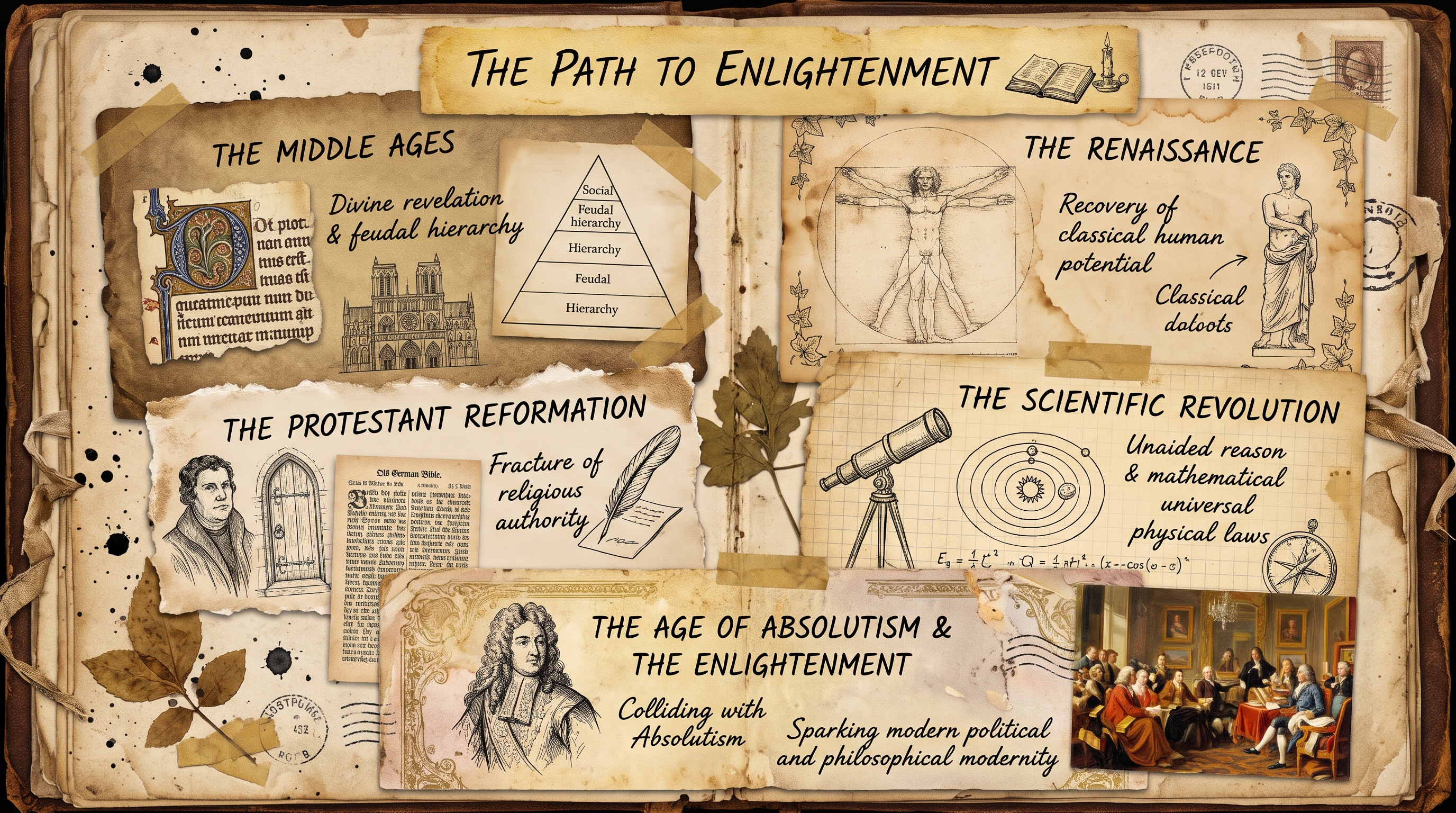
Chronological Synthesis
| Era | Timeframe | Primary Epistemology (Source of Truth) | Socio-Political Order | Core Shift Toward the Enlightenment |
|---|---|---|---|---|
| The Middle Ages | c. 500 – 1400s | Divine revelation, Scripture, Church Fathers, and Scholastic synthesis. | Decentralized feudalism, manorial serfdom, and ecclesiastical universalism. | Preserved classical logic within cathedral universities and formulated natural law traditions. |
| The Renaissance | 1300s – 1600s | Classical antiquity (ad fontes) paired with direct empirical observation and civic humanism. | Urban commercial city-states, mercantile oligarchies, and princely patronage networks. | Reoriented culture toward humanitas—secular inquiry, anatomical realism, civic eloquence, and earthly flourishing. |
| The Protestant Reformation | 1517 – 1648 | Sola scriptura (Scripture alone), individual conscience, and vernacular translation. | Confessional territorial states, sectarian warfare, culminating in the Peace of Westphalia. | Shattered Catholic monopoly, expanded mass vernacular literacy, and forced the adoption of legal toleration. |
| Scientific Revolution & Absolutism | 1543 – Late 1600s | Mathematical deduction, controlled experimentation, and universal mechanistic laws. | Centralized sovereign nation-states governed by Divine Right or secular absolute sovereignty. | Demonstrated universal natural laws govern the cosmos, prompting thinkers to challenge arbitrary sovereign decrees. |
1. The Middle Ages (c. 500 – 1400s)
Following the disintegration of the Western Roman Empire in the late fifth century, Western Europe fragmented into localized territorial principalities lacking standing armies, centralized imperial taxation, and uniform legal systems.[4] Out of this prolonged political turbulence emerged a civilization structurally organized by landed obligation and spiritually unified under the Roman Catholic Church.
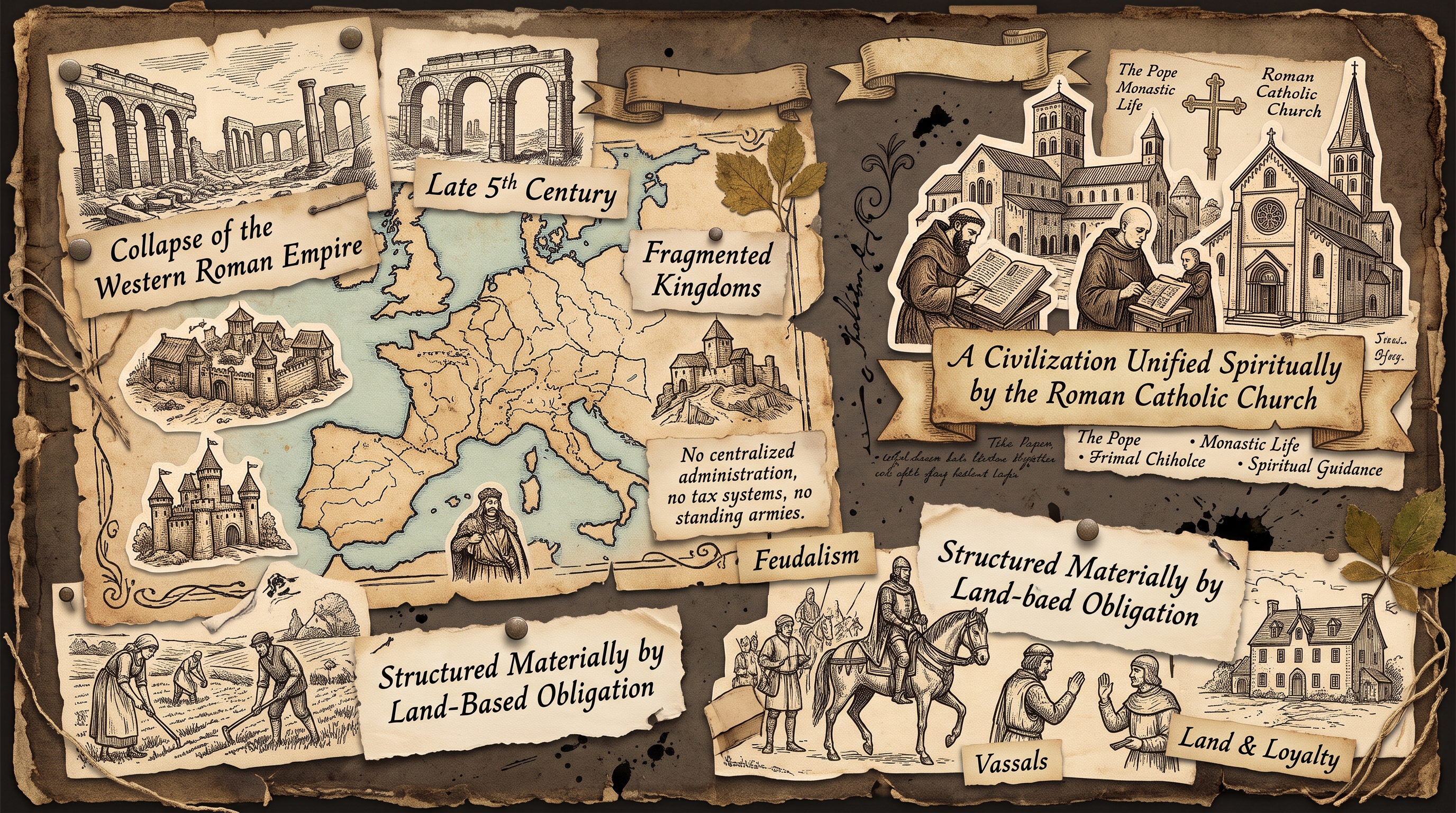
Epistemology: Revelation and Scholastic Authority
In the medieval worldview, ultimate ontological and moral truth originated in divine revelation as mediated through Sacred Scripture, early Church Fathers (predominantly Augustine of Hippo), and the institutional magisterium of the Catholic Church.[5] When complete Latin translations of Aristotle alongside Islamic and Jewish commentaries (such as those by Ibn Sina, Ibn Rushd, and Maimonides) entered Western cathedral schools and nascent universities during the twelfth and thirteenth centuries, medieval Scholasticism sought to harmonize pagan philosophy with Christian doctrine.[5:1]
- The Handmaiden of Theology: Within universities such as Paris, Bologna, and Oxford, the faculty of theology occupied the undisputed summit of the academic hierarchy (philosophia ancilla theologiae); logical disputation was rigorously cultivated, yet speculative inquiry was strictly bounded by orthodox dogma.[5:2]
- Teleological Cosmos: Drawing upon Christianized Aristotelian physics and Neoplatonism, medieval thinkers conceived of the universe as a purposeful, static hierarchy—the Great Chain of Being—wherein every created entity and social estate occupied a divinely ordained rank extending from mineral clay up to the angelic host.
- Preparation for the Afterlife: Because mortal earthly existence (saeculum) was understood as a fallen, transient vale of tears, human life functioned primarily as a moral pilgrimage toward salvation or damnation rather than an autonomous sphere for secular material progress.[5:3]
Socio-Political Structure: Feudalism and Manorialism
In the absence of centralized state infrastructure capable of repelling invasions and pacifying regional violence, medieval society crystallized into a rigid, hereditary order anchored by two complementary economic and political institutions:[4:1]
- Feudal Vassalage: Kings and regional magnates distributed landed estates (fiefs) to noble vassals and armored knights in reciprocal ceremonies of homage and fealty; in exchange, vassals furnished mounted military service, political counsel, and customary dues.[4:2]
- Manorial Serfdom: At the economic base, bonded agricultural laborers (serfs or villeins) were legally tied to the estate manor, rendering compulsory labor and crop rents to their lord in exchange for access to subsistence strips and military sanctuary within castle battlements.[4:3]
- Dual Sovereign Jurisdiction: Medieval monarchs rarely exercised absolute domestic authority; their royal decrees were continually circumscribed by armed feudal nobility, customary regional law, and a supranational Church that commanded its own ecclesiastical courts, controlled nearly a third of European arable land, and maintained an absolute monopoly over Latin literacy.[4:4]
Although later eighteenth-century philosophes caricatured the medieval millennium as an epoch of unmitigated intellectual darkness, medieval university culture fostered habits of rigorous dialectical argumentation, textual categorization, and legal jurisprudence that inadvertently trained the intellectual class to demand systematic, rational coherence—laying the conceptual groundwork that would later cause scholastic dogma to collapse under empirical scrutiny.[5:4]
2. The Renaissance (1300s – 1600s)
Beginning in the affluent commercial republics of fourteenth-century northern Italy—with Florence, Venice, and Milan at the forefront—and diffusing trans-alpineto northern Europe over the subsequent two centuries, The Renaissance redirected intellectual attention from cloistered contemplation toward active engagement with the empirical and civic sphere.[6]
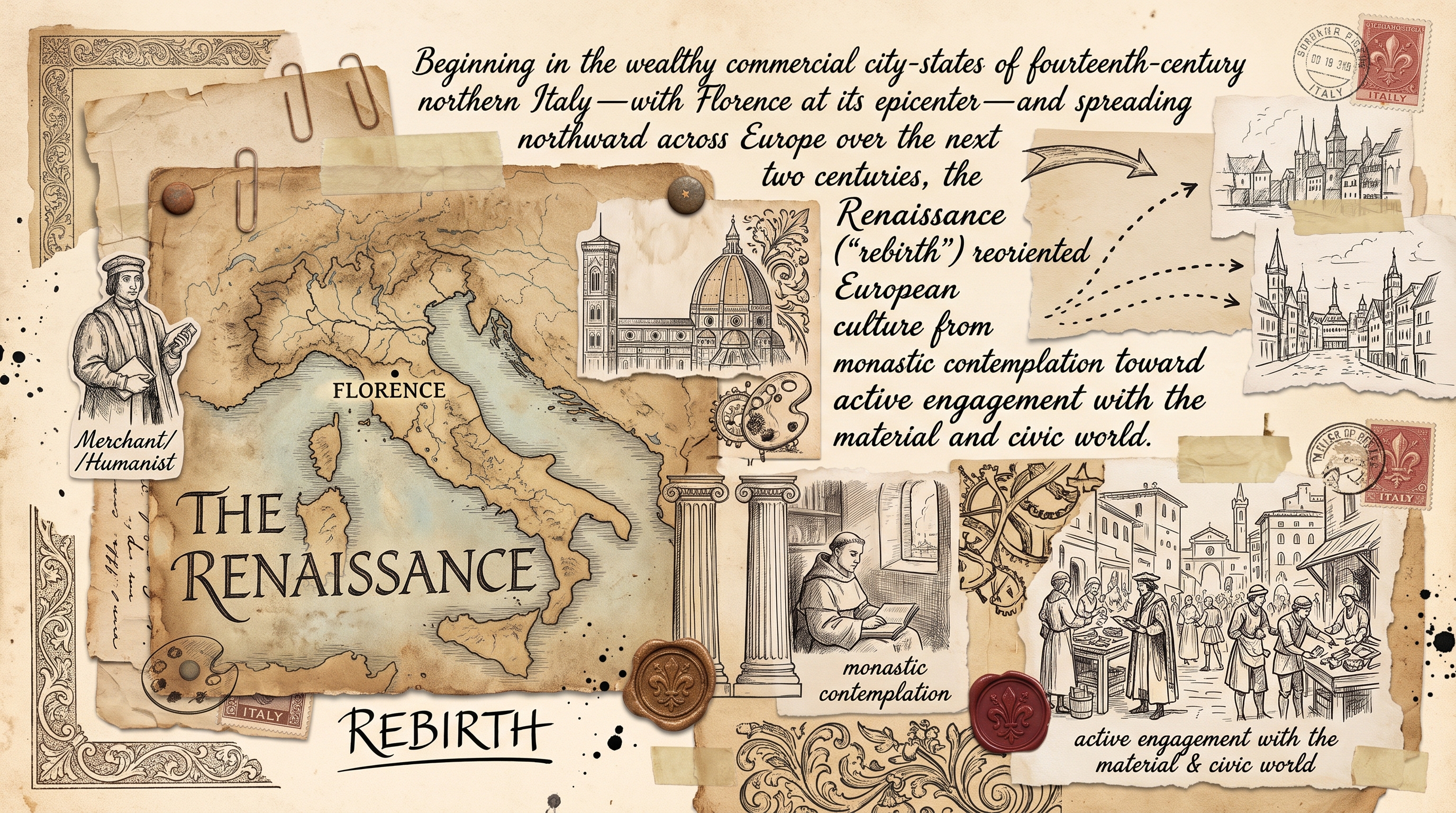
Classical Rediscovery and the Ideal of Humanitas
Underwritten by mercantile fortunes, patrician patronage (such as the Medici oligarchy in Florence), and the influx of Byzantine scholars bearing ancient Greek codices following the 1453 Ottoman conquest of Constantinople, scholars initiated an exhaustive recovery of classical Greek and Roman literature.[6:1] Rather than reading ancient philosophers merely to quarry proof-texts for Christian scholasticism, pioneers like Francesco Petrarch, Giovanni Boccaccio, and Coluccio Salutati advanced the curriculum of Humanism (studia humanitatis).[6:2]
- Curricular Revolution: Humanists displaced abstract Aristotelian syllogisms in favor of five core disciplines grounded in human eloquence: grammar, rhetoric, poetry, history, and moral philosophy.[6:3]
- Dignity and Human Agency: Figures like Giovanni Pico della Mirandola (Oration on the Dignity of Man, 1486) celebrated humanity's plastic capacity for self-determination and earthly mastery, while Northern Christian humanists like Desiderius Erasmus deployed philological precision and biting satire (Praise of Folly, 1511) to dismantle clerical corruption and superstition.[6:4]
- Active Civic Virtue: Humanists resurrected the Roman republican ideal of civitas, arguing that philosophical insight without public engagement was sterile; genuine virtue (virtù) demanded active civic stewardship, administrative reform, and historical self-consciousness.[6:5]
Secular Realism, Anatomy, and Print Culture
By legitimizing direct, unmediated empirical scrutiny of natural phenomena, Renaissance Humanism transformed visual representation, political philosophy, and information technology:
- Naturalism, Perspective, and Anatomy: As explored in A Treatise on Painting (Trattato della pittura), The Specular Revolution - Optics, Interiority, and the Modern Self, and Leonardo da Vinci, artists discarded two-dimensional medieval iconography for mathematical linear perspective, chiaroscuro, and empirical dissection. Figures such as Leonardo and Flemish anatomist Andreas Vesalius (De humani corporis fabrica, 1543) performed direct human cadaver dissections, demonstrating that ancient Galenic anatomy was riddled with empirical errors.
- Secular Political Realism: In The Prince (1513), Florentine diplomat Niccolò Machiavelli executed a radical break with medieval moral theology; analyzing political authority as it actually functioned in historical practice, Machiavelli stripped statecraft of providential illusions, asserting that maintaining order required pragmatic mastery over Fortuna rather than pious subservience to theological precepts.[6:6]
- The Typography Revolution: Johannes Gutenberg's perfection of movable metal type around 1440 transformed European communication ecology (as analyzed in McLuhan's The Medium is the Message and Innis (1950) - Empire and Communications). Print dramatically lowered book production costs, broke monastic scriptoria monopolies, and allowed radical political and theological critiques to circulate widely across vernacular reading publics.[6:7]
Renaissance Humanism remained predominantly Christian, yet its foundational maxim—ad fontes ("back to the primary sources")—supplied a revolutionary methodological solvent. By comparing contemporary ecclesiastical claims against original Hebrew and Greek biblical manuscripts, humanists proved that foundational Catholic authorities (such as the forged Donation of Constantine, exposed by Lorenzo Valla in 1440) rested on linguistic errors and administrative fabrications, equipping reformers with devastating critical tools.[6:8]
3. The Protestant Reformation (1517 – 1648)
When Renaissance philological textual criticism and movable-type print intersected with long-standing grievances regarding papal taxation and indulgences, the spiritual and administrative hegemony of Latin Christendom disintegrated.[6:9][7]
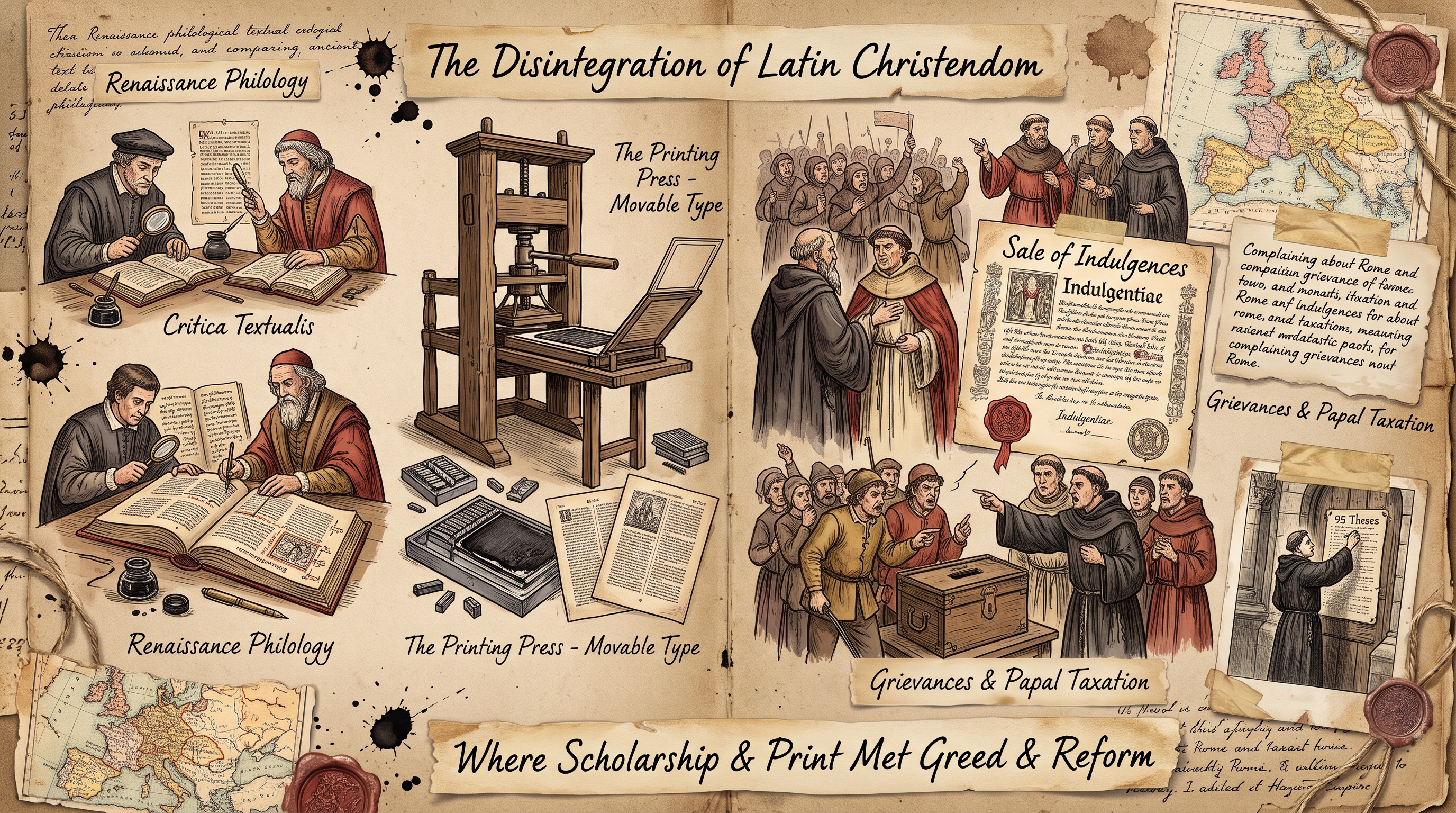
Fracturing the Ecclesiastical Monopoly on Truth
On October 31, 1517, German Augustinian monk and university professor Martin Luther circulated his Ninety-five Theses at Wittenberg, challenging Dominican friar Johann Tetzel's commercial sale of papal indulgences for the remission of purgatorial suffering.[7:1][8] Excommunicated by Pope Leo X in 1520 and defying Holy Roman Emperor Charles V at the Diet of Worms in 1521, Luther—soon accompanied by Huldrych Zwingli in Zurich and John Calvin in Geneva—dismantled the sacramental hierarchy of Rome.[7:2][8:1]
- Sola Scriptura (Scripture Alone): Protestant reformers rejected the doctrine that papal decrees and ecumenical councils carried authority equal to the Bible, insisting that canonical Scripture served as the sole normative standard of Christian faith and practice.[7:3]
- Sola Fide (Justification by Faith Alone): Overthrowing the sacramental economy of merit—wherein salvation was mediated through Church sacraments, monastic vows, and pilgrimage acts—Luther argued that salvation was a gracious gift received exclusively through unmerited divine faith.[8:2]
- The Priesthood of All Believers & Mass Literacy: Translating the New Testament into vernacular German while hidden at the Wartburg Castle (1521–1522), Luther insisted that every Christian possessed a direct spiritual relationship with God without sacerdotal mediation.[8:3] By requiring ordinary believers to read scripture for themselves, Protestantism triggered a dramatic surge in vernacular literacy across northern Europe, dismantling the Latinate monopoly that had historically kept lay populations in the dark.
Sectarian Bloodshed and the Peace of Westphalia (1648)
The dissolution of a single spiritual arbiter precipitated an acute systemic crisis: once competing factions asserted exclusive possession of absolute divine truth, European confessional politics degenerated into more than a century of catastrophic religious warfare, including the French Wars of Religion (1562–1598) and the catastrophic Thirty Years' War (1618–1648), which devastated the German principalities.[9]
Negotiated in Münster and Osnabrück, the Peace of Westphalia (1648) halted continental slaughter and established modern international relations:[9:1]
- Westphalian Territorial Sovereignty: The treaties recognized the internal jurisdictional autonomy of roughly three hundred German territorial states, establishing the legal principle that sovereign heads of state possessed exclusive authority within their borders without external interference from the Holy Roman Emperor or the Roman Pontiff.[9:2]
- Confessional Legal Pluralism: Westphalia expanded legal recognition to Lutheranism and Calvinism alongside Roman Catholicism, bringing a definitive end to pan-European military campaigns waged to enforce theological uniformity.[9:3]
By demonstrating that no religious confession could eradicate its ideological rivals by sword without dismantling the fabric of society, a century of sectarian slaughter exhausted theological extremism. Thinkers across England, France, and the Dutch Republic recognized that civil peace required separating political governance from doctrinal orthodoxy, transforming religious toleration and freedom of private conscience from heretical concessions into political necessities.[1:3][9:4]
4. The Scientific Revolution & Age of Absolutism (1543 – Late 1600s)
Between the mid-sixteenth and late seventeenth centuries, European civilization experienced a profound institutional divergence: while natural philosophers overturned two millennia of ancient Greek physics, political rulers assembled unprecedented mechanisms of centralized, absolute state control.[2:1][3:1]
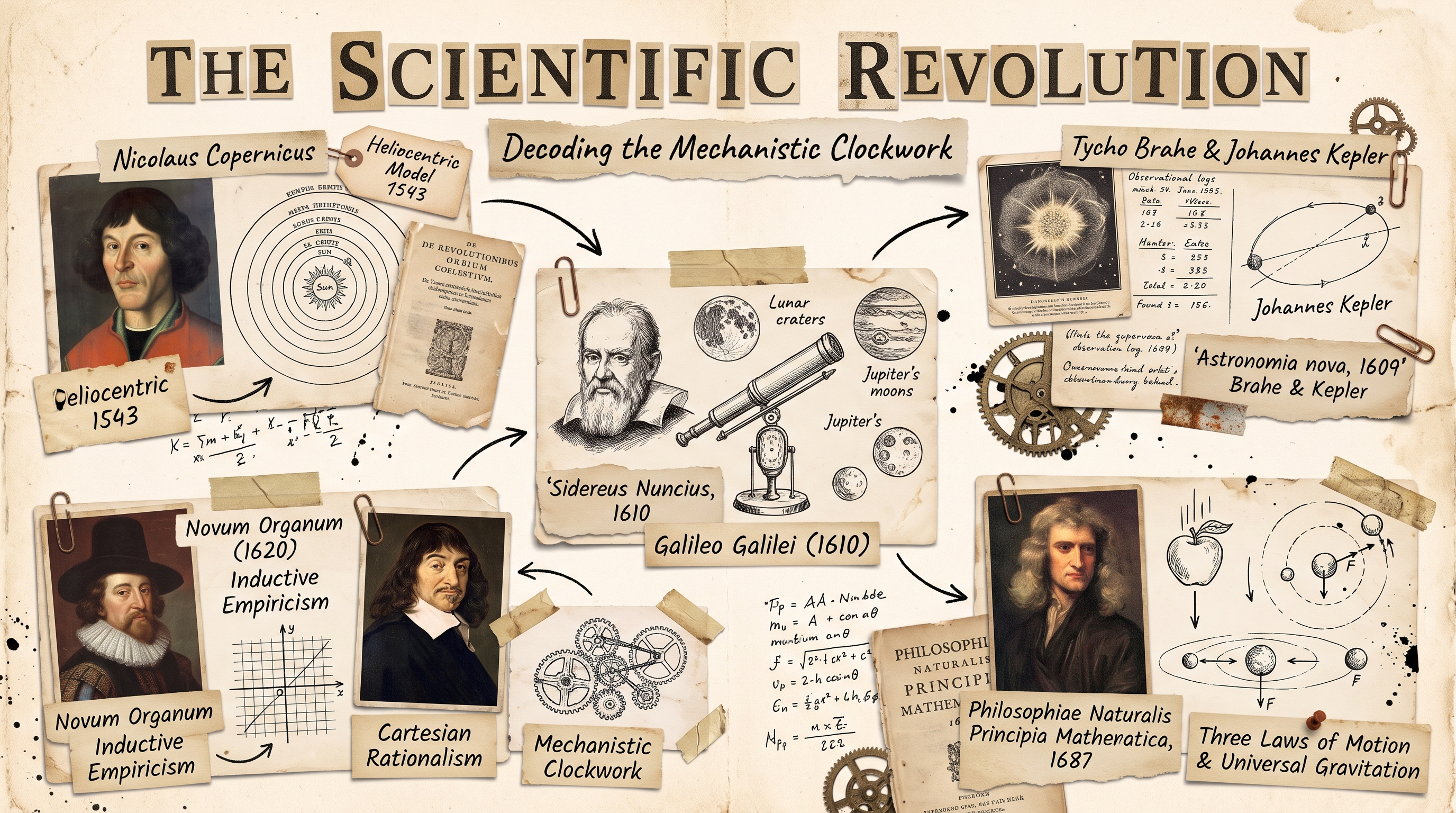
The Scientific Revolution: Decoding the Mechanistic Clockwork
For nearly two millennia, natural philosophy rested upon Aristotelian physics and Ptolemaic cosmology, which envisioned a stationary, corruptible Earth encircled by immutable celestial spheres moved by divine prime movers.[2:2] Between 1543 and 1687, quantitative geometry, precision instrumentation, and rigorous experimentation dissolved this geocentric model:[2:3]
- Nicolaus Copernicus (1543): In De revolutionibus orbium coelestium, Nicolaus Copernicus (1473–1543) formulated the heliocentric model, displacing the Earth from the physical center of the universe and demonstrating that cosmic motions could be computed through elegant solar mathematics.[2:4]
- Tycho Brahe & Johannes Kepler (Late 1500s – 1609): Brahe's naked-eye observation of the 1572 supernova proved that the celestial sphere was mutable; analyzing Brahe's meticulous observational logs, Kepler demolished the ancient dogma of uniform circular planetary orbits, proving mathematically that planets traverse elliptical orbits (Astronomia nova, 1609).[2:5]
- Galileo Galilei (1610): Directing the newly invented telescope toward the night sky (Sidereus Nuncius, 1610), Galileo discovered lunar craters, the four largest moons of Jupiter, and the complete cycle of the phases of Venus—providing visual proof against Ptolemy while mathematically formulating terrestrial laws of acceleration and falling bodies.[2:6]
- Baconian Inductive Empiricism & Cartesian Rationalism: In England, Francis Bacon (Novum Organum, 1620) championed inductive methodology, empirical data collection, and applied technology to reclaim dominion over nature; in France, René Descartes (Discours de la méthode, 1637) applied radical methodological doubt and analytical geometry, codifying the universe as a mechanistic clockwork of matter in motion, an ontological model examined in The Mind-Body Dichotomy and Ghost in the Machine.[2:7]
- Isaac Newton (1687): In Philosophiae Naturalis Principia Mathematica, Newton united terrestrial mechanics and celestial astrophysics under three universal laws of motion and the law of universal gravitation, proving that the physical cosmos operated as a seamless, mathematically intelligible machine governed by uniform natural laws.[2:8]
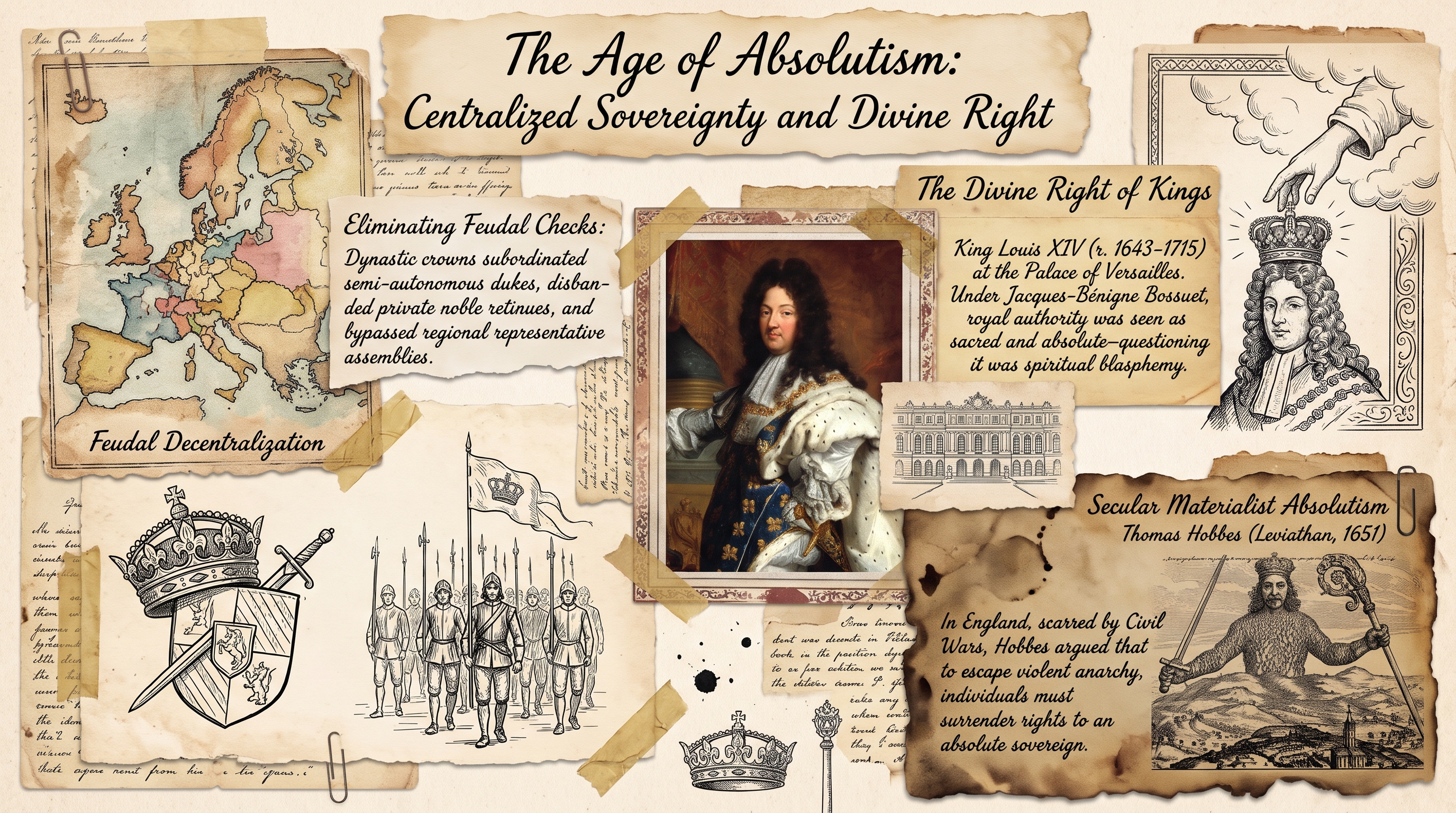
The Age of Absolutism: Centralized Sovereignty and Divine Right
Simultaneously, European monarchs capitalized on the demise of feudal decentralization to construct absolute monarchies—concentrating judicial, fiscal, and military apparatuses directly within the centralized crown.[3:2]
- Eliminating Feudal Checks: Dynastic crowns subordinated semi-autonomous feudal dukes, disbanded private noble retinues, bypassed regional representative assemblies (such as the French Estates-General), and established professional standing armies and centralized bureaucracies.[3:3]
- The Divine Right of Kings: Exemplified by King Louis XIV of France (r. 1643–1715)—who concentrated aristocratic life under his theatrical gaze at Versailles, embodying absolutist display (as examined in Nocturnalization - The Industrialization of Light)—rulers claimed sovereign legitimacy directly from God. Under bishop Jacques-Bénigne Bossuet's formulation of divine-right monarchy, royal authority was sacred, paternal, and absolute; questioning royal decrees constituted spiritual blasphemy and civic treason.[3:4]
- Secular Materialist Absolutism: In England, scarred by the regicide of Charles I and the English Civil Wars, philosopher Thomas Hobbes (Leviathan, 1651) articulated an influential secular justification for absolute power: to escape the brutish, violent anarchy of the natural state, self-interested individuals must surrender their sovereign rights to an undivided, absolute sovereign (The Leviathan) charged with enforcing domestic order.[3:5]
From Divine Authority to Rational Constitutionalism:

  Medieval Episteme      Scientific Episteme      Enlightenment Episteme
┌───────────────────┐  ┌─────────────────────┐  ┌────────────────────────┐
│ Divine Revelation │  │ Mathematical Laws   │  │ Universal Reason       │
│ Scriptural Dogma  │─>│ Empirical Induction │─>│ Natural Inherent Rights│
│ Feudal Obligation │  │ Mechanistic Cosmos  │  │ Constitutional Consent │
└───────────────────┘  └─────────────────────┘  └────────────────────────┘
5. Convergence: Crossing the Threshold into the Enlightenment
By the late seventeenth century, the dynamic convergence of Newtonian natural science and monarchical absolutism generated an irresistible intellectual catalyst.[1:4][2:9]
The Enlightenment emerged directly from the institutional and intellectual legacies of its four preceding eras:
- From the Middle Ages: Cathedral universities, legal codification, and the enduring vocabulary of natural law (lex naturalis).[5:5]
- From the Renaissance: Secular valuation of earthly human potential (humanitas), empirical observation, and critical philological methodology.[6:10]
- From the Reformation: Mass vernacular literacy, the inviolability of private conscience, and the hard-won imperative of religious toleration.[7:4][9:5]
- From the Scientific Revolution & Absolutism: Empirical demonstration that natural law governs the cosmos—colliding with centralized absolutist regimes whose claims to unchecked divine rule increasingly appeared as an irrational facade built on sand.[2:10][3:6]
If Isaac Newton could reveal that the physical cosmos operates not by arbitrary divine intervention, but through elegant, immutable mathematical laws accessible to human reason, the foundational thinkers of the eighteenth century—including John Locke, the Baron de Montesquieu, Voltaire, Jean-Jacques Rousseau, and the thinkers of the Scottish Enlightenment (such as David Hume and Adam Smith)—drew the revolutionary corollary:[1:5]
Could human reason, unassisted by ecclesiastical dogma or royal decree, uncover the universal natural laws governing human psychology, ethics, political legitimacy, economics, and constitutional governance?[1:6]
When John Locke asserted in Two Treatises of Government (1689) that human beings possess inherent natural rights to life, liberty, and property, and that political sovereignty resides conditionally in the consent of the governed rather than divine appointment, the medieval synthesis was permanently dismantled. The intellectual road had arrived at its destination: the dawn of the European Enlightenment.
🎴 Interactive Web Practice (Comprehension Check)
Question 1 (Epistemological Shift): Contrast the medieval scholastic source of truth with the epistemology of the Scientific Revolution. What specific role did mathematics play in this transition?
Answer: In the medieval scholastic tradition, truth was grounded in divine revelation, Sacred Scripture, and the authoritative writings of the Church Fathers, harmonized through Aristotelian deductive logic. Natural philosophy was teleological and qualitative: nature was studied to uncover moral and theological purpose (the *Great Chain of Being*), with physical inquiries strictly bounded by ecclesiastical orthodoxy.
In contrast, the Scientific Revolution instituted an epistemology anchored in empirical observation, controlled experimentation, and mathematical deduction (advanced by Copernicus, Kepler, Galileo, Descartes, and Newton). Crucially, mathematics ceased to be regarded merely as a convenient computational abstraction and was recognized as the actual language of physical reality. By proving that identical mathematical equations (such as Newton's inverse-square law of gravitation) explained both celestial planetary orbits and terrestrial mechanics, the Scientific Revolution demonstrated that physical phenomena operated according to uniform, universal, and mechanistic laws accessible directly to human reason without theological mediation.
Question 2 (The Political Aftermath of the Reformation): How did the Protestant Reformation and the subsequent Peace of Westphalia (1648) contribute to the development of modern secular political theory and religious toleration?
Answer: The Protestant Reformation shattered the spiritual and institutional monopoly of the Roman Catholic Church by establishing sola scriptura and the priesthood of all believers, empowering individual conscience and expanding mass vernacular literacy. However, because rival Catholic and Protestant authorities each claimed exclusive possession of absolute divine truth, Europe descended into more than a century of catastrophic sectarian warfare (culminating in the Thirty Years' War, 1618–1648).
The Peace of Westphalia (1648) recognized that attempting to enforce universal religious uniformity through military conquest threatened to destroy European civilization itself. By formally establishing territorial state sovereignty (insulating domestic jurisdictions from imperial or papal intervention) and legally validating confessional pluralism, Westphalia exhausted theological dogmatism. Political theorists across Europe increasingly argued that civil stability and economic prosperity required divorcing state legitimacy from sectarian theology, establishing religious toleration, private conscience, and secular civil law as practical necessities for governance.
Question 3 (The Convergence on Absolutism): In what way did the collision between Newtonian physics and monarchical absolutism provide the intellectual spark for Enlightenment political philosophy?
Answer: By the late seventeenth century, European monarchies had dismantled feudal checks to construct centralized absolute states, justifying their unchecked power through the theological doctrine of the Divine Right of Kings (as embodied by Louis XIV of France). Under this framework, monarchical decrees were seen as sanctified, paternal, and immune from human criticism.
However, the synchronous triumph of Newtonian physics demonstrated that the entire universe was an orderly, rational clockwork governed by universal, predictable natural laws. This created an irreconcilable intellectual tension: if natural laws governed the vast movements of planets and oceans, thinkers questioned why human society, justice, and governance should remain subject to the arbitrary, irrational whims of an absolute sovereign claiming divine sanction. Enlightenment philosophers—most notably John Locke—applied the empirical and rational methods of the new sciences to human society, arguing that legitimate government is not divinely ordained, but is an artificial social compact founded upon universal natural rights (life, liberty, property) and the consent of the governed.
Resonant Notes
The following notes in the vault share direct thematic, historical, and epistemological connections with The Road to the Enlightenment:
🔴 Historical Transitions, Epistemology & Scholasticism
- The Renaissance — Explores the fourteenth- to sixteenth-century Italian and Northern European rebirth of classical humanism (studia humanitatis), civic virtue, and philological textual criticism that challenged medieval scholastic orthodoxies.
- The Specular Revolution - Optics, Interiority, and the Modern Self — Companion historical study investigating how flat glass mirrors, linear perspective, and early modern optical science dismantled pre-modern intersubjective identity, constructing the bounded, introspective Cartesian individual.
- A Treatise on Painting (Trattato della pittura) & Leonardo da Vinci — Leonardo's revolutionary aesthetic treatises demonstrating how empirical anatomical dissection and linear optical geometry transformed art into an intellectual science (scienza e discorso mentale).
- The Enclosure of the Intangible Commons — Intellectual Property, Artificial Scarcity, and the Colonization of Knowledge — Traces how early modern Venetian patent statutes (1474) and English copyright laws (1710) emerged out of the print revolution and commercial capitalism to commodify human ideas.
- Nocturnalization - The Industrialization of Light — Examines how early modern royal absolutism deployed nocturnal illumination as an apparatus of sovereign spectacle, anticipating the disciplinary visibility regimes analyzed by Michel Foucault.
- The Freeze-Drying of Language — The Dictionary (1755), Prescriptive Grammar, and the Social Stratification of Speech — Companion historical inquiry into how eighteenth-century Enlightenment thinkers sought to discipline, codify, and standardize the oral commons into rationalized national languages.
🟡 Scientific Revolution, Mechanism & Philosophy of Mind
- Nicolaus Copernicus (1473–1543) — Foundational astronomical treatise De revolutionibus orbium coelestium, which initiated the Scientific Revolution by mathematically displacing the Earth from the cosmic center.
- The Mind-Body Dichotomy & Ghost in the Machine — Descartes' radical bifurcation of reality into thinking mind (res cogitans) and mechanical body (res extensa), which codified the mechanistic worldview of the seventeenth century.
- Gilbert Ryle's-The Concept of Mind — Deconstructs the Cartesian dualism established during the Scientific Revolution, diagnosing the dogma of an internal mental spectator as a category mistake.
- David Hume's Bundle Theory (1739) — Radical Scottish Enlightenment empiricism that took the experimental method of Newton and applied it to human psychology, demonstrating that introspective inquiry reveals no permanent, unified self.
- Vital Materialism & Animism — Posthuman and ecological critiques that challenge the Cartesian and Baconian conception of nature as inert, dead matter engineered purely for instrumental human exploitation.
🟢 Institutional Power, Sovereignty & Media Ecology
- Michel Foucault — Disciplinary power, classical epistemic ruptures, and the emergence of modern sovereign surveillance, analyzing how early modern centralized states reorganized penal law, bodily discipline, and visibility.
- Jürgen Habermas's The Structural Transformation of the Public Sphere — Traces how the expansion of vernacular literacy, print capitalism, coffeehouses, and Enlightenment salons fostered the bourgeois public sphere (Öffentlichkeit) that held monarchical authority accountable to rational critique.
- Max Weber (1864-1920) — Weber's sociological frameworks of formal rationalization (Zweckrationalität), legal-rational authority, and the historical "disenchantment of the world" (Entzauberung der Welt) triggered by mechanistic science and Protestant ascetics.
- Innis (1950) - Empire and Communications & Innis (1951) - The Bias of Communication — Harold Innis's media theory analyzing how movable print operated as a space-binding medium that broke the Latinate ecclesiastical monopoly of Rome and decentralized imperial governance.
- McLuhan's The Medium is the Message — Marshall McLuhan's analysis of how print typography conditioned Western human perception to privilege linear causality, detachment, individualism, and mechanistic science.
- a-facade — Metaphoric expression capturing how monarchical divine-right theories and scholastic dogmas projected an outward illusion of sacred permanence that concealed structural socio-political decay.
- built-on-sand — Metaphoric expression illustrating the intellectual fragility of feudal claims and geocentric cosmological models once subjected to rigorous empirical testing.
- in-the-dark — Metaphoric expression illustrating the pre-Reformation lay condition, wherein ordinary populations were excluded from vernacular literacy and theological debate.
- the-fabric-of-society — Metaphoric expression capturing how more than a century of sectarian religious bloodshed threatened to dissolve European communal and civil cohesion.
References
Stanford Encyclopedia of Philosophy / Enlightenment / plato.stanford.edu ↩︎ ↩︎ ↩︎ ↩︎ ↩︎ ↩︎ ↩︎
Margaret J. Osler, Stephen G. Brush, & J. Brookes Spencer / Scientific Revolution: Definition, History, Scientists, Inventions, & Facts / britannica.com ↩︎ ↩︎ ↩︎ ↩︎ ↩︎ ↩︎ ↩︎ ↩︎ ↩︎ ↩︎ ↩︎
The Editors of Encyclopaedia Britannica / Absolutism: Definition, History, & Examples / britannica.com ↩︎ ↩︎ ↩︎ ↩︎ ↩︎ ↩︎ ↩︎
Encyclopaedia Britannica / Feudalism: Definition, Examples, History, & Facts / britannica.com ↩︎ ↩︎ ↩︎ ↩︎ ↩︎
Stanford Encyclopedia of Philosophy / Medieval Philosophy / plato.stanford.edu ↩︎ ↩︎ ↩︎ ↩︎ ↩︎ ↩︎
Robert Grudin / Humanism: Definition, Principles, History, & Influence / britannica.com ↩︎ ↩︎ ↩︎ ↩︎ ↩︎ ↩︎ ↩︎ ↩︎ ↩︎ ↩︎ ↩︎
The Editors of Encyclopaedia Britannica / Reformation: Definition, History, Summary, Reformers, & Facts / britannica.com ↩︎ ↩︎ ↩︎ ↩︎ ↩︎
Encyclopaedia Britannica / Martin Luther: Biography, Protestant Reformation, Beliefs / britannica.com ↩︎ ↩︎ ↩︎ ↩︎
The Editors of Encyclopaedia Britannica / Peace of Westphalia: Definition, Map, Results, & Significance / britannica.com ↩︎ ↩︎ ↩︎ ↩︎ ↩︎ ↩︎