Postmodernism — The Collapse of Grand Narratives, Simulacra, and the Cultural Logic of Late Capitalism
🗂️ Interactive Notebook: Open Study Companion (Video Summary, Flashcards, Mind Map) ↗
Postmodernism denotes the broad cultural, intellectual, aesthetic, and philosophical movement that emerged in the mid-to-late twentieth century (peaking between the 1960s and 1990s) as a radical departure from the foundational premises of Modernism and the universalist rationalism established during The Enlightenment. Defined famously by Jean-François Lyotard as an "incredulity toward metanarratives," Postmodernism interrogates totalizing epistemological frameworks, the stability of linguistic reference, and claims to objective, transcendent truth. In place of Modernist seriousness, formal purity, and the tragic lament over cultural fragmentation, Postmodernism celebrates ironic detachment, pastiche, intertextuality, playful simulation, and the erasure of traditional boundaries between elite high culture and commercial mass kitsch.
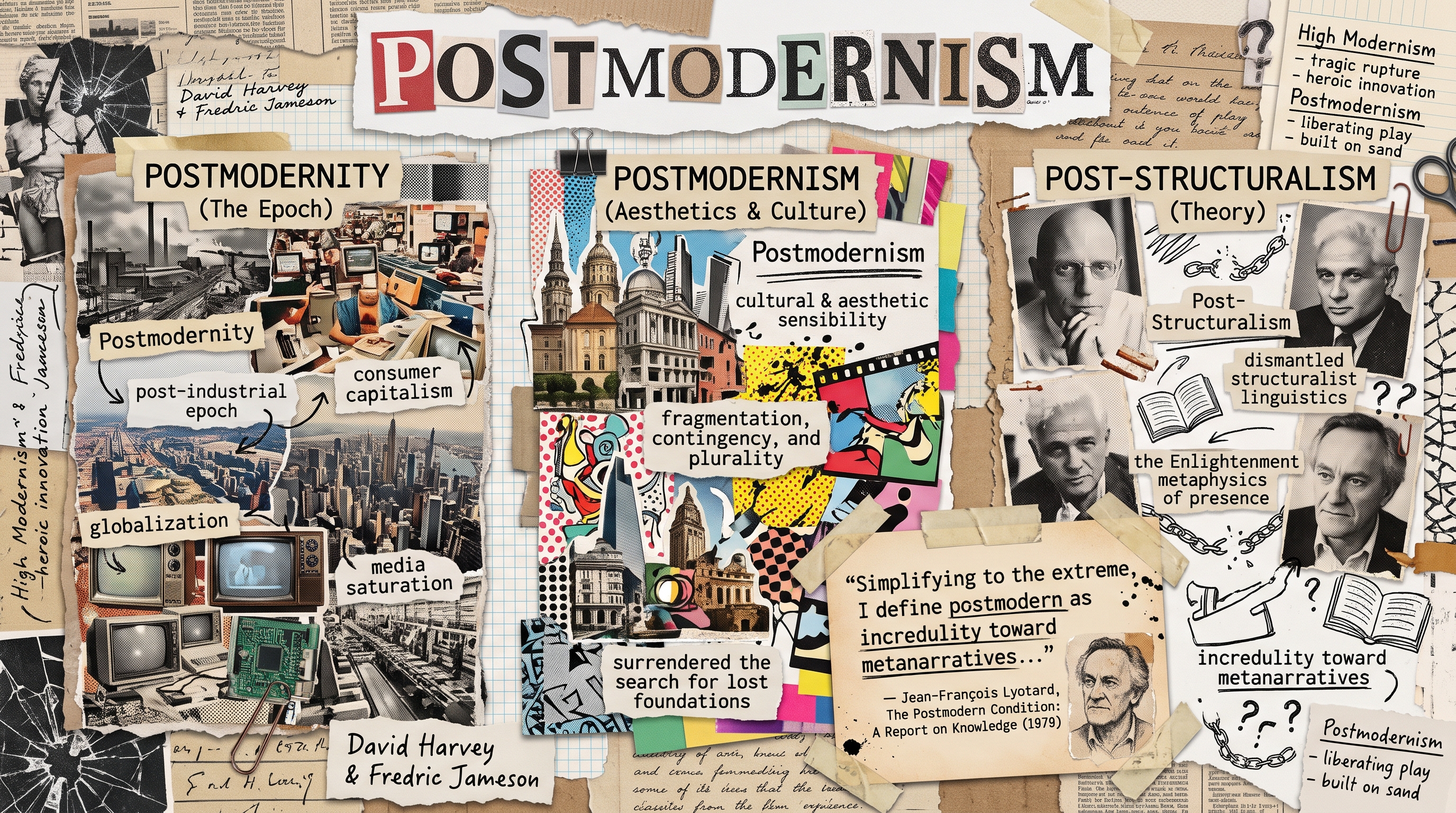
Defining Postmodernism, Postmodernity, & Post-Structuralism
To navigate Postmodernism with intellectual rigor, scholars distinguish between the objective socioeconomic condition, the aesthetic and cultural movement, and the philosophical critique of language and power:[1]
- Postmodernity refers to the historical, economic, and technological epoch that solidified in the aftermath of World War II—characterized by post-industrial economies, consumer capitalism, multinational corporate globalization, rapid media saturation, computerization, and flexible labor regimes (as conceptualized by David Harvey and Fredric Jameson).[2]
- Postmodernism denotes the cultural, stylistic, and aesthetic sensibility that reacted against the institutionalized orthodoxy of High Modernism across architecture, literature, visual arts, film, and music.[1:1]
- Post-Structuralism represents the philosophical and critical theory framework—spearheaded primarily in France by figures such as Jacques Derrida, Michel Foucault, Jean-François Lyotard, Gilles Deleuze, and Roland Barthes—that dismantled structuralist linguistics, essentialist humanism, and the Enlightenment metaphysics of presence.[3]
While High Modernism viewed the fragmentation of the twentieth century as a tragic rupture to be redeemed through aesthetic discipline, myth, or heroic avant-garde innovation, Postmodernism surrendered the search for lost metaphysical foundations.[4] Inherited institutions, teleological narratives, and philosophical systems—once venerated as absolute anchors—were exposed as an ideological facade built on sand. Rather than despairing over this epistemic absence, Postmodernism embraced fragmentation, contingency, and plurality as liberating fields of play.[1:2]
"Simplifying to the extreme, I define postmodern as incredulity toward metanarratives... To the obsolescence of the metanarratives apparatus of legitimation corresponds, most notably, the crisis of metaphysical philosophy and of the university institution which in the past relied on it."
— Jean-François Lyotard, The Postmodern Condition: A Report on Knowledge (1979)[5]
Historical Catalysts & Socioeconomic Shifts
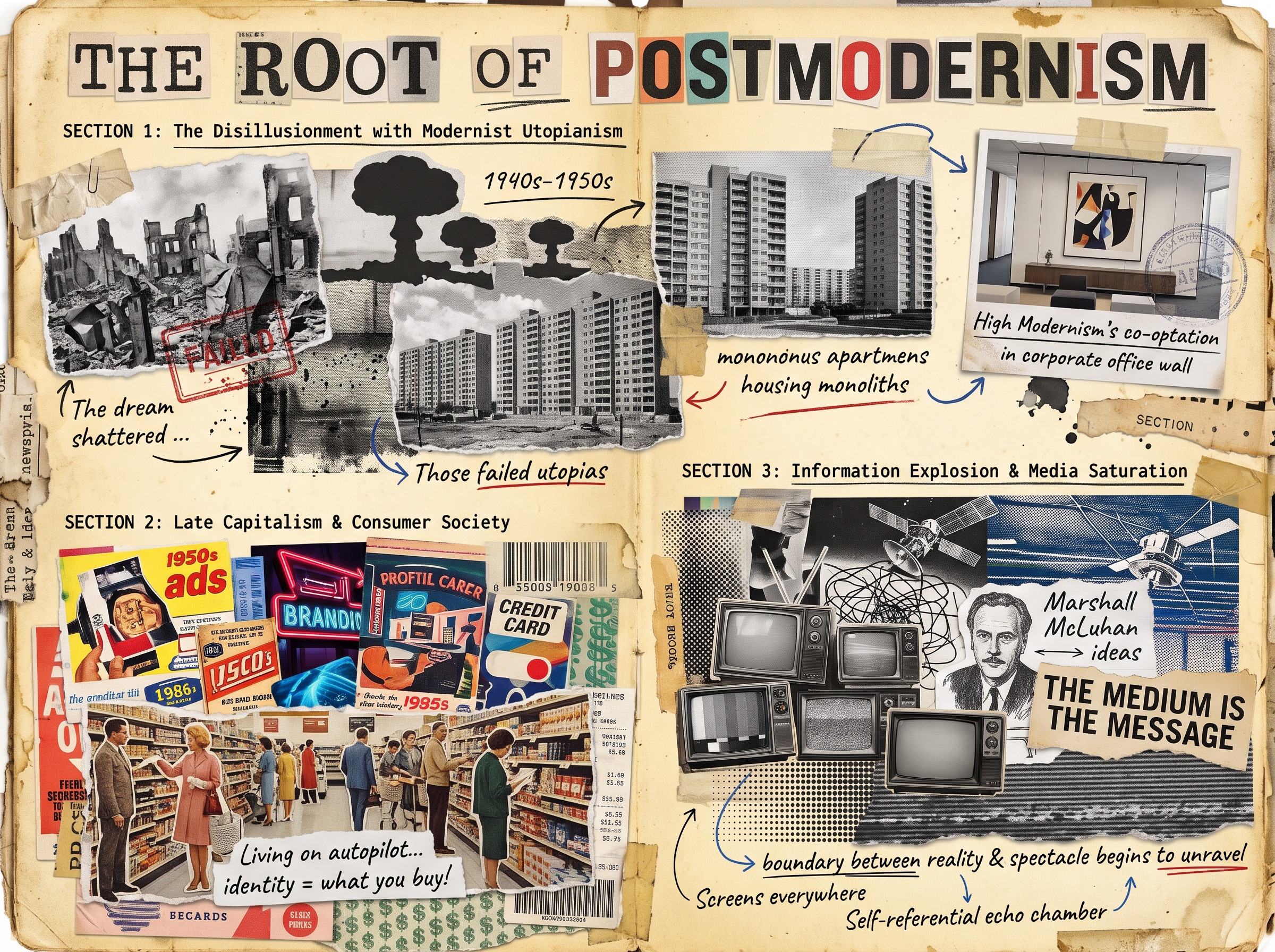
Postmodernism did not arise as an arbitrary stylistic whim; it was catalyzed by massive historical transformations that reshaped global culture following the Second World War:[2:1]
1. The Disillusionment with Modernist Utopianism
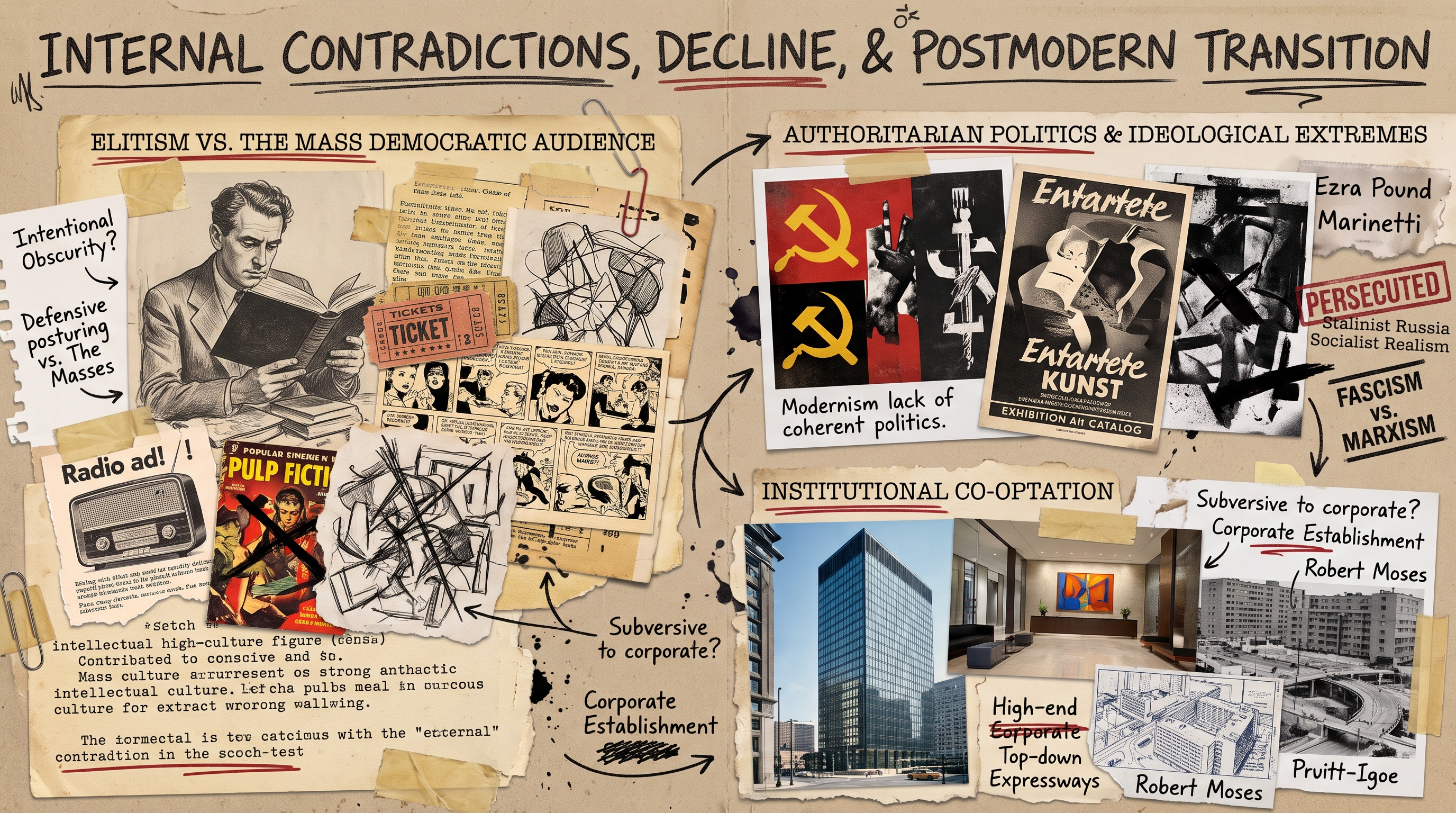
The horrors of total industrialized warfare, Auschwitz, the atomic bombings of Hiroshima and Nagasaki, and Cold War nuclear brinkmanship shattered the optimistic Enlightenment belief in linear moral and scientific progress.[6] Furthermore, High Modernism's utopian social engineering—exemplified by International Style urban housing monoliths that alienated communities—coalesced with bureaucratic technocracy. The dynamic avant-garde that once sought to overthrow bourgeois institutions was itself domesticated, with radical abstract canvases adorning corporate headquarters and banking atriums.[1:3]
2. The Rise of Late Capitalism & Consumer Society
As analyzed by Marxist cultural theorist Fredric Jameson and geographer David Harvey, the transition from Fordist mass manufacturing to post-Fordist "flexible accumulation" reorganized daily life.[2:2] Driven by rapid telecommunications, multinational finance, credit networks, and relentless advertising, commodities ceased to be valued primarily for their physical utility. Instead, commodities became saturated with symbolic, lifestyle meanings, turning consumption into the primary vehicle for identity formation and drawing consumers to navigate everyday commercial environments on autopilot.[2:3]
3. The Information Explosion & Media Saturation
As explored in McLuhan's The Medium is the Message, the shift from typographic print culture to electronic broadcast media (television, satellite communications, computing) created an acoustic, instantaneous media surround.[7] When reality is constantly mediated, packaged, and retransmitted through screens, the boundary separating original events from manufactured spectacles begins to unravel, leaving citizens inside an echo chamber of self-referential imagery.[8]
Core Philosophical & Theoretical Pillars
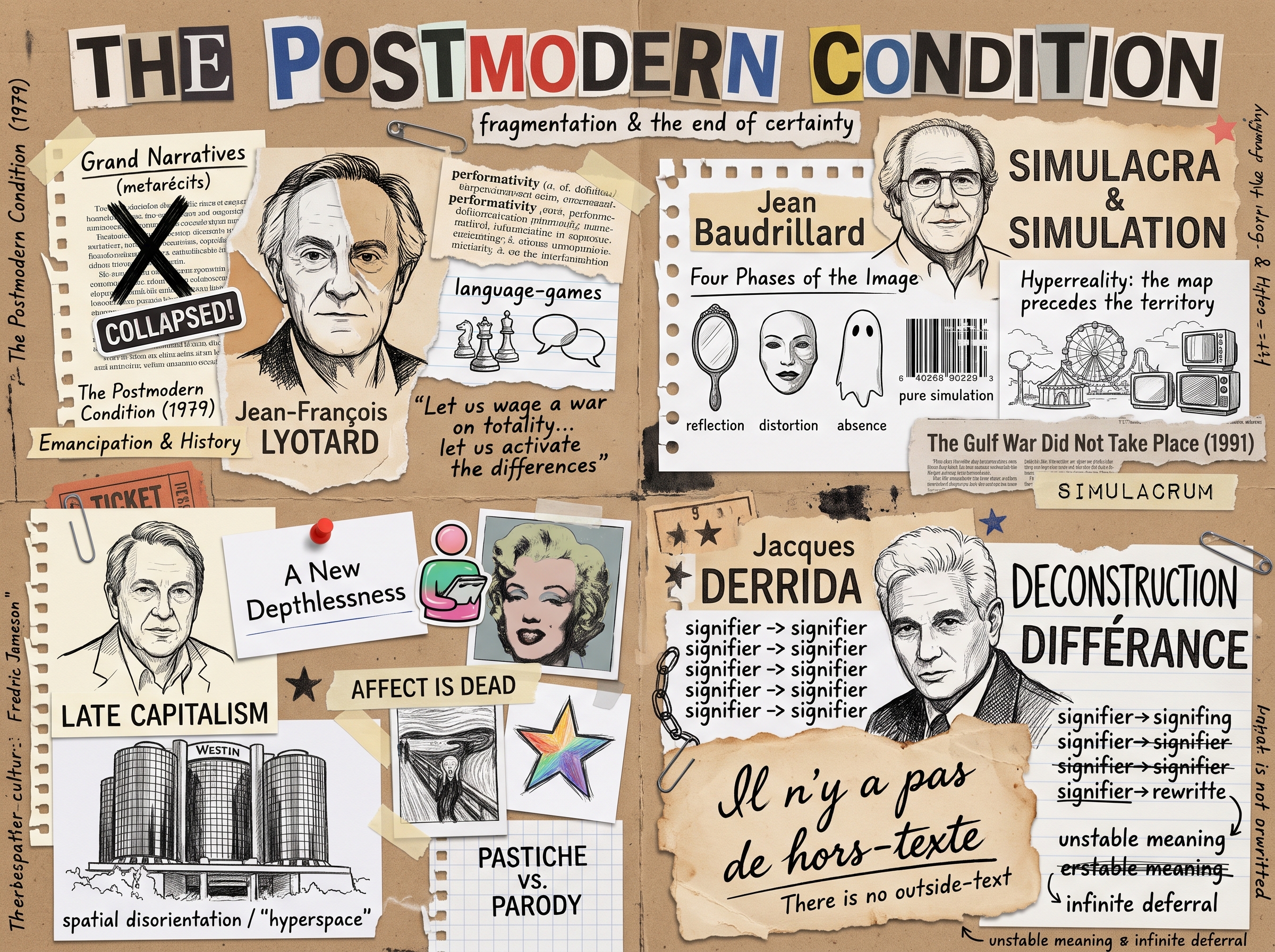
Jean-François Lyotard: The Collapse of Grand Narratives
In The Postmodern Condition: A Report on Knowledge (1979), commissioned by the government of Quebec, Lyotard diagnosed an acute crisis in the legitimation of knowledge.[5:1] Throughout modernity, scientific inquiry and political institutions justified their authority by appealing to universal "grand narratives" (métarécits):
- The Enlightenment Narrative of Emancipation: The belief that expanding scientific reason and literacy progressively liberates humanity from ignorance, superstition, and tyranny.[5:2]
- The Hegelian/Marxist Narrative of Teleological Realization: The belief that human history moves progressively through dialectical stages toward universal freedom, classless brotherhood, and self-conscious spirit.[5:3]
Lyotard demonstrated that post-industrial society had lost faith in these overarching promises. Science no longer searches for absolute truth, but operates according to performativity—optimizing input/output efficiency and market utility.[5:4] Knowledge has fragmented into heterogeneous, local "language-games" (adapting Ludwig Wittgenstein) with contextual, incommensurable rules.[5:5] Attempts to enforce a single universal consensus inevitably commit intellectual terror, leading Lyotard to issue his famous injunction: "Let us wage a war on totality; let us be witnesses to the unpresentable; let us activate the differences and save the honor of the name."[5:6]
Jean Baudrillard: Simulacra, Simulation, & Hyperreality
In treatises such as Simulacra and Simulation (1981), French sociologist Jean Baudrillard argued that contemporary society had entered an epoch of hyperreality—a condition where models and signs of the real substitute for the real itself.[8:1] Tracing the historical genealogy of the sign, Baudrillard identified four successive phases of the image:
- Reflective Phase: The image is the reflection of a profound reality (the sacramental representation of classical art).[8:2]
- Masking Phase: The image masks and perverts a profound reality (the ideological distortion of bourgeois propaganda, operating as a deceptive facade).[8:3]
- Absence Phase: The image masks the absence of a profound reality (the image pretends to represent something, but conceals that there is nothing underneath—pure smoke and mirrors).[8:4]
- Pure Simulation (The Simulacrum): The image bears no relation to any reality whatsoever; it is its own pure simulacrum, a copy for which no original ever existed.[8:5]
In hyperreality, the map precedes and engenders the territory (the "precession of simulacra").[8:6] Disneyland, reality television, financial derivatives, and political photo-ops do not conceal external reality; rather, they conceal the unsettling fact that the entire surrounding cultural apparatus has become an engineered simulation. As Baudrillard controversially proclaimed in The Gulf War Did Not Take Place (1991), modern war is consumed as a pre-programmed electronic spectacle and video-game interface, severed from somatic visceral encounter.[8:7]
Fredric Jameson: Postmodernism as the Cultural Logic of Late Capitalism
In his landmark 1984 essay and 1991 monograph Postmodernism, or, the Cultural Logic of Late Capitalism, Marxist scholar Fredric Jameson anchored postmodern aesthetics within the historical evolution of capitalism (drawing on Ernest Mandel's three stages: market capitalism, imperialist monopoly capitalism, and multinational late capitalism).[2:4] Jameson identified several key cultural symptoms:
- A New Depthlessness: Contemporary culture abandons modernist hermeneutics of depth (such as Freud's latent/manifest unconscious, Marx's base/superstructure, or existentialist authenticity/alienation). In their place reigns a culture of flat surfaces, glossy images, and literal projections.[2:5]
- The Waning of Affect: The profound, tortured subjective anguish of High Modernism (exemplified by Edvard Munch's The Scream or Vincent van Gogh's peasant boots) is replaced by the cool, impassive, and commodified euphoria of Pop Art (such as Andy Warhol's silk-screened Marilyn Diptych or Diamond Dust Shoes).[2:6]
- Pastiche vs. Parody: While modernist parody mocked idiosyncratic linguistic styles while maintaining a normative standard of speech, postmodern culture relies on pastiche—blank parody, neutral mimicry of dead styles, and architectural quotation without satirical intent.[2:7]
- The Nostalgia Mode & Spatial Disorientation: Incapable of envisioning a genuine historical future or confronting the present, media culture recycles retro stereotypes of past eras (the "nostalgia film"). In physical architecture, megastructures like John Portman's Westin Bonaventure Hotel in Los Angeles create an unnavigable "hyperspace" that exceeds the human body's capacity for cognitive mapping.[2:8]
Jacques Derrida & Deconstruction: The Play of Différance
As explored in post-structuralist thought, Jacques Derrida challenged Western philosophy's foundational "logocentrism"—the unexamined belief in an ultimate, stable ground of meaning (God, Reason, Being, the Subject) that guarantees truth outside language.[3:1] Through deconstruction, Derrida demonstrated that linguistic signs do not point to fixed, external essences. Instead, meaning is generated through a perpetual matrix of differences and delays—a neologistic double-operation he termed différance (combining to differ and to defer).[3:2]
Because every signifier refers only to other signifiers in an infinite chain of textual deferral, meaning is fundamentally undecidable, unstable, and context-dependent. Derrida's famous aphorism, "Il n'y a pas de hors-texte" ("There is no outside-text"), does not deny the physical world, but insists that human consciousness cannot step outside interpretive, sign-mediated networks to access unvarnished reality.[3:3]
Core Manifestations Across Disciplines
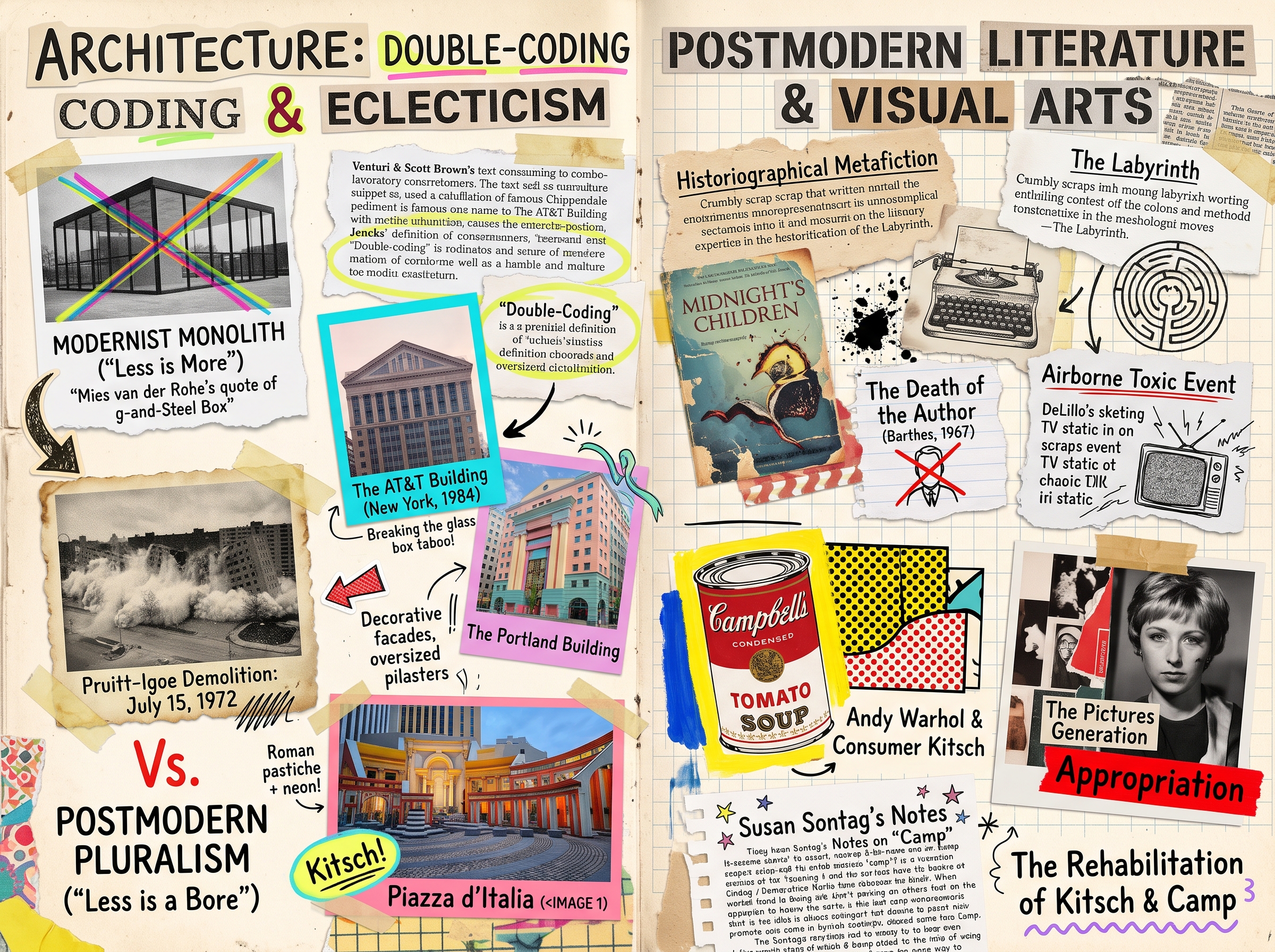
Architecture: Double-Coding & Eclecticism
Architecture served as the literal birthplace and most visible battleground of Postmodernism.[9] Modernist functionalism—governed by Mies van der Rohe's austere maxim "Less is more" and the International Style's monolithic glass-and-steel boxes—had stripped cities of historical identity, civic joy, and human scale.[1:4]
Modernist Monolith (Functionalism / "Less is More")
           │
           ▼
[Pruitt-Igoe Demolition: July 15, 1972]
           │
           ▼
Postmodern Pluralism (Eclecticism / "Less is a Bore")
The symbolic death of Modern architecture was famously dated by architectural historian Charles Jencks to July 15, 1972, at 3:32 PM, when the Pruitt-Igoe public housing complex in St. Louis—a prize-winning monument of Le Corbusier-inspired rationalist design—was systematically dynamited after descending into unlivable social devastation.[9:1]
- Robert Venturi & Denise Scott Brown: In Complexity and Contradiction in Architecture (1966) and Learning from Las Vegas (1972), Venturi declared: "Less is a bore." Venturi urged architects to look to everyday commercial vernaculars, roadside neon signs, and historical ornamentation, celebrating hybridity, contradiction, and irony over dogmatic structural purity.[9:2]
- Charles Jencks & "Double-Coding": In The Language of Post-Modern Architecture (1977), Jencks defined postmodern architecture through double-coding: the simultaneous combination of modern construction technologies with traditional or vernacular historical references, allowing a building to communicate simultaneously to a popular public and an educated architectural elite.[9:3]
- Iconic Landmarks:
- The AT&T Building (New York, 1984): Designed by former High Modernist Philip Johnson, this skyscraper capped a sleek corporate tower with a monumental Chippendale pediment, breaking the unadorned flat-top glass box taboo.[9:4]
- The Portland Building (Oregon, 1982): Michael Graves utilized pastel colors, oversized classical pilasters, and decorative ribbons on an institutional civic facade.[9:5]
- Piazza d'Italia (New Orleans, 1978): Charles Moore arranged neon-lit Roman colonnades, stainless-steel Corinthian capitals, and vibrant fountains into a playful public pastiche of Italian architectural history.[9:6]
Literature: Historiographical Metafiction & Intertextuality
In literature, Postmodernism moved beyond Modernist experiments with psychological interiority to interrogate the artificiality of fiction and the narrative construction of historical reality.[10]
- Historiographical Metafiction: Coined by Canadian literary theorist Linda Hutcheon, this term describes novels that are intensely self-reflexive about their fictional artifice while simultaneously engaging with real historical events, proving that history is always textualized and contested.[10:1] Examples include Michael Ondaatje's The English Patient, John Fowles's The French Lieutenant's Woman, and Salman Rushdie's Midnight's Children.[10:2]
- Irony, Black Humor, & Paranoia: Postmodern novelists depicted characters trapped inside vast, labyrinthine systems of corporate, bureaucratic, or technological control. In Thomas Pynchon's The Crying of Lot 49 and Gravity's Rainbow, protagonist quests for objective meaning degenerate into paranoid rabbit holes where signs multiply uncontrollably.[10:3]
- Consumer Satire & Toxic Systems: In Don DeLillo Major Themes Analysis and White Noise (1985), Don DeLillo captured late-twentieth-century hyperreality, depicting suburban families navigating supermarket aisles, pharmaceutical dependencies, and an "Airborne Toxic Event" that is experienced primarily as a televised media simulation.[10:4]
- Borgesian Fabulation & The Labyrinth: Argentine writer Jorge Luis Borges provided the intellectual blueprint for postmodern literature with metaphysical fables like The Library of Babel and The Garden of Forking Paths, exploring infinite branching narratives, imaginary encyclopedias, and self-swallowing fictions.[10:5]
- The Death of the Author: In 1967, Roland Barthes published his celebrated essay The Death of the Author, arguing that a text is not a unified message transmitted from a singular creator, but a multidimensional space of citations and cultural codes where meaning is produced solely by the reader at the moment of consumption.[1:5]
Visual Arts: Pop Art, Appropriation, & The Pictures Generation
In the visual arts, Postmodernism demolished the Clement Greenberg doctrine of medium specificity and the autonomous, uncorrupted artwork.[11]
- Pop Art: Emerging in the late 1950s and 1960s, artists like Andy Warhol, Roy Lichtenstein, and Claes Oldenburg drew direct inspiration from comic strips, soup cans, supermarket packaging, and Hollywood celebrities. By deploying industrial silk-screening and assembly-line fabrication ("The Factory"), Warhol eliminated individual brushwork, demonstrating that consumer kitsch and high art were inextricably intertwined.[11:1]
- Appropriation & The Pictures Generation: In the late 1970s and 1980s, an exhibition titled Pictures curated by Douglas Crimp launched a movement of artists—including Cindy Sherman, Barbara Kruger, Richard Prince, and Sherrie Levine—who directly appropriated advertising photographs, film stills, and canonical art.[11:2] By rephotographing existing media imagery or staging fictional film stills, these artists revealed that identity, gender, and desire are socially staged representations rather than natural essences.[11:3]
- The Rehabilitation of Kitsch & Camp: As examined in Kitsch, Postmodernism rescued sentimental, mass-market, and decorative forms from modernist contempt. Susan Sontag's Notes on "Camp" (1964) provided an aesthetic framework celebrating theatricality, artifice, and playful exaggeration over earnest moralism.[12]
Modernism vs. Postmodernism
The following comparative breakdown illustrates the fundamental epistemological and aesthetic shifts separating High Modernism from Postmodernism:[1:6][4:1]
| Dimension | Modernism (c. 1890–1950) | Postmodernism (c. 1960–Present) |
|---|---|---|
| Epistemological Outlook | Epistemological crisis: truth is difficult to access, but art seeks to reveal underlying reality.[1:7] | Ontological pluralism: truth is constructed, multiple, discursive, and relative; reality is simulated.[1:8] |
| Attitude Toward Fragmentation | Tragic lament: mourns fragmentation as a loss of unity; uses myth and formal order to shore up ruins.[4:2] | Euphoric celebration: embraces fragmentation, bricolage, randomness, and open-ended play.[4:3] |
| Cultural Hierarchy | Strict boundary separating serious, autonomous "high art" from commercial mass kitsch.[1:9] | Radical collapse of boundaries; synthesizes high theory with Pop Art, comic books, advertising, and television.[1:10] |
| Authorship & Originality | The avant-garde hero: valorizes individual genius, radical originality, and Ezra Pound's "Make It New."[4:4] | The death of the author: emphasizes intertextual remixing, appropriation, pastiche, and collaborative readership.[1:11] |
| Linguistic Medium | Expressive vehicle: language may be strained or fragmented, but it conveys interior subjective truth.[1:12] | Discursive cage: signs refer only to other signs (différance); meaning is endlessly deferred and unstable.[3:4] |
| Aesthetic Stance | Earnest seriousness, existential anguish, heroic self-sacrifice, and formal purity.[2:9] | Ironic detachment, parody, pastiche, double-coding, camp, and stylistic eclecticism.[2:10] |
| Architectural Maxim | "Form follows function" (Sullivan); "Less is more" (Mies van der Rohe); austere functionalism.[9:7] | "Less is a bore" (Venturi); double-coding, decorative wit, historical quotation, and vernacular neon.[9:8] |
| Socioeconomic Anchor | Industrial capitalism, assembly-line manufacturing, nation-state hegemony, and bureaucratic statehood.[2:11] | Multinational late capitalism, consumer culture, telecommunications, and flexible global markets.[2:12] |
Key Theorists, Masterworks, & Core Concepts
The intellectual architecture of Postmodernism was forged across a network of interrelated monographs and critical frameworks:
| Theorist | Landmark Text | Core Epistemological Concept | Cultural Significance |
|---|---|---|---|
| Jean-François Lyotard | The Postmodern Condition (1979) | Incredulity toward metanarratives (métarécits) | Diagnosed the delegitimation of Enlightenment emancipation and the rise of performative language-games.[5:7] |
| Jean Baudrillard | Simulacra and Simulation (1981) | Hyperreality & The Precession of Simulacra | Demonstrated how media signs and simulations precede and replace physical reality in consumer capitalism.[8:8] |
| Fredric Jameson | Postmodernism, or, the Cultural Logic of Late Capitalism (1991) | Pastiche, Depthlessness, & Cognitive Mapping | Established a rigorous Marxist materialist periodization linking postmodern style to multinational capitalism.[2:13] |
| Jacques Derrida | Of Grammatology (1967) | Deconstruction & Différance | Exposed Western logocentrism, revealing that textual meaning is permanently deferred and internally contradictory.[3:5] |
| Michel Foucault | Discipline and Punish (1975); The History of Sexuality (1976) | Power/Knowledge (pouvoir-savoir) & Discursive Formations | Analyzed how institutional discourses and panoptic mechanisms construct human subjectivity and social truth.[13] |
| Robert Venturi | Complexity and Contradiction in Architecture (1966) | Vernacular Irony & "Less is a bore" | Overthrew International Style functionalism, pioneering architectural eclecticism and commercial quotation.[9:9] |
| Linda Hutcheon | A Poetics of Postmodernism (1988) | Historiographical Metafiction | Conceptualized novels that paradoxically use fiction to contest, interrogate, and demythologize historical reality.[10:6] |
Critiques, Contradictions, & The Metamodern Aftermath
1. Political Impotence & Complicity with Capital
Marxist and critical theorists have argued that by reducing political struggle to linguistic play and ironic subversion, Postmodernism inadvertently disarmed radical resistance.[2:14] If all truth claims are merely competing rhetorical fictions, on what normative ground can one critique systemic injustice, exploitation, or fascism? As German philosopher Jürgen Habermas vigorously argued, the Enlightenment was not a totalitarian prison, but an "unfinished project" of democratic emancipation and communicative rationality that must be defended against neoconservative and postmodern irrationalism.[14]
2. The Post-Truth Predisposition
In the twenty-first century, conservative commentators and political operatives weaponized postmodern epistemological skepticism—such as the rejection of objective empirical facts and consensus reality. The proliferation of digital "fake news," algorithmic disinformation feeds, and alternative facts demonstrated that radical skepticism toward objective truth could easily serve reactionary demagogues rather than democratic liberation.[8:9]
3. Beyond Postmodernism: Metamodernism & Post-Irony
By the early 2000s, critics recognized that the cultural dominance of Postmodernism had exhausted its critical energy. Sarcasm, irony, and deconstructive cynicism had themselves become the standard operating procedure of corporate advertising and social media feeds.[15] In response, cultural theorists Timotheus Vermeulen and Robin van den Akker proposed Metamodernism (2010), characterizing contemporary culture not by unyielding cynicism, but by a continuous oscillation between Modernist sincerity and Postmodern irony, utopian hope and pragmatic doubt.[15:1] Similarly, sociological frameworks like Zygmunt Bauman's sociological framework of Liquid Modernity demonstrate that solid modern institutions have not merely dissolved into irony, but into precarious, hyper-individualized currents of global risk.[16]
Nevertheless, Postmodernism permanently reshaped human consciousness, bequeathing an enduring vigilance against dogmatic authoritarian truths, a deep appreciation for marginal perspectives, and a critical lens for decoding media spectacle.[1:13]
🎴 Interactive Web Practice (Comprehension Check)
Question 1 (Epistemological Rupture & Grand Narratives): Explain Jean-François Lyotard's definition of Postmodernism as an "incredulity toward metanarratives." Why did the grand narratives of Enlightenment emancipation and Marxist teleology lose their power of legitimation in post-industrial society?
Answer: Jean-François Lyotard defined Postmodernism as an "incredulity toward metanarratives" (métarécits)—the totalizing philosophical, political, and historical frameworks that Western civilization used to legitimize its institutions and scientific research.
Throughout modernity, two primary grand narratives predominated:
1. The Enlightenment Narrative of Emancipation: The teleological belief that the universal expansion of empirical science, autonomous human reason, and secular education would steadily liberate humanity from tyrannical authority, physical suffering, and superstition.
2. The Hegelian/Marxist Narrative of Historical Realization: The belief that historical conflict progresses along an inevitable dialectical chain toward the ultimate emancipation of the collective subject (the proletariat) and the realization of universal human freedom.
In post-industrial society, these narratives collapsed under multiple pressures:
- The historical catastrophes of the twentieth century (Auschwitz, the Gulag, the atomic bomb, imperialist wars) proved that scientific and technological acceleration does not guarantee moral or political emancipation; rather, rationalized systems can be mobilized for industrialized slaughter.
- Under late capitalism, computerization and information technology transformed knowledge into a market commodity. Society no longer asks whether an idea is "true" in a grand metaphysical sense, but whether it is "performative"—efficient, marketable, and computationally actionable.
- Consequently, universal truth fractured into countless autonomous, localized "language-games" (adapting Wittgenstein). Each game operates under contingent, contextual rules, rendering any universal attempt to impose a single grand consensus authoritarian and oppressive.
Question 2 (Semiotics & Hyperreality): Detail Jean Baudrillard's four stages of the image, and explain why he argued that contemporary society has transitioned from traditional representation into pure simulation and hyperreality.
Answer: Jean Baudrillard argued in Simulacra and Simulation that human history has witnessed a fundamental mutation in the relationship between signs and physical reality. He identified four historical phases:
1. The Sacramental / Reflective Image: The sign faithfully reflects a profound underlying reality (e.g., traditional religious icons or Renaissance realist painting, where the image is accepted as a transparent window onto a sacred or objective world).
2. The Maleficent / Masking Image: The sign masks and perverts a profound reality (e.g., traditional ideological propaganda, where the sign distorts truth, but an authentic, objective reality still exists behind the deceptive facade).
3. The Sorcerous Image (Masking Absence): The sign masks the unsettling absence of a profound reality (e.g., Disneyland or consumer status symbols, which pretend to represent an authentic magic or social identity, but actually conceal the fact that there is no authentic substance beneath them).
4. Pure Simulation (The Simulacrum): The sign bears no relation to any reality whatsoever; it becomes its own pure simulacrum. Signs refer only to other signs in a self-enclosed, circulating loop.
Baudrillard argued that modern media culture, computerized financial markets, and advertising have catapulted civilization into hyperreality—a state where the generated model, screen image, or digital metric precedes and determines what is perceived as real (the "precession of simulacra"). In hyperreality, the boundary separating real somatic experience from manufactured simulation vanishes, leaving individuals navigating media illusions that are "more real than real."
Question 3 (Aesthetics & Late Capitalism): How does Fredric Jameson distinguish between Modernist parody and Postmodernist pastiche, and how does this aesthetic distinction reflect the economic logic of late capitalism?
Answer: In Postmodernism, or, the Cultural Logic of Late Capitalism, Fredric Jameson identified pastiche as the defining aesthetic symptom of postmodernity, contrasting it sharply with modernist parody:
- Modernist Parody: Parody depends on the existence of an accepted linguistic or moral norm. A satirist mimics an author's unique, idiosyncratic style (e.g., Faulkner's prose or Hemingway's cadence) to ridicule its excesses. Parody possesses a critical, subversive edge because it juxtaposes an eccentric mannerism against an underlying belief in authentic, standard expression.
- Postmodernist Pastiche: Pastiche is "blank parody"—parody that has lost its sense of humor and satirical conviction. In a world where the idea of the autonomous, individual artist has been discarded (the "death of the author"), and all unique stylistic innovations have already been exhausted, artists can no longer invent radically new forms. Instead, pastiche mechanically quotes, remixes, and mimics dead historical styles from the cultural museum without critical judgment or subversive intent.
Jameson demonstrated that pastiche directly reflects the economic demands of late, multinational capitalism:
- Post-industrial capitalism requires the continuous, accelerated production of novel consumer goods and media entertainment.
- Because capitalism has commodified all geographic spaces and exhausted historical traditions, it cannibalizes the past, converting history into flat aesthetic nostalgia (the "nostalgia mode" in film and fashion).
- History is stripped of genuine political conflict and transformed into a supermarket of consumable retro styles, trapping late-capitalist subjects in an eternal, depthless present incapable of imagining genuine alternative futures.
Resonant Notes
The following notes in the vault share direct thematic, sociological, and aesthetic connections with Postmodernism:
🔴 Theory, Semiotics & Epistemology
- Modernism — Direct historical and aesthetic predecessor to Postmodernism; wrestled with epistemological crisis, stream of consciousness, and formal rupture while seeking heroic order against societal collapse.
- The Enlightenment — Foundational eighteenth-century Age of Reason whose universal grand narratives of human progress, autonomous reason, and secular emancipation Postmodernism systematically deconstructed.
- The Road to the Enlightenment — Traces the emergence of the mechanistic, law-governed cosmos that Postmodernism's linguistic and epistemological skepticism ultimately dismantled.
- Jacques Derrida — French philosopher of deconstruction whose concepts of différance, logocentrism, and the instability of textual signification anchor post-structuralist thought.
- Michel Foucault — Landmark genealogist of power/knowledge, disciplinary surveillance, and panopticism, tracing how historical discourses construct the modern subject.
- Defining a Simulacrum — Theoretical investigation into Jean Baudrillard's four orders of the image, the precession of simulacra, and the emergence of hyperreality.
- The Sublime & The Sublime, Awe, and Epiphany — Interdisciplinary study of aesthetic terror and magnitude, tracing how the Kantian sublime was reinterpreted by Lyotard (présenter l'imprésentable) and Jameson (the postmodern/informational sublime).
- Martin Heidegger — Existential phenomenologist whose radical critique of Western metaphysics and Cartesian subjectivity provided the foundation for post-structuralist deconstruction.
- Friedrich Nietzsche — Proto-postmodern philosopher whose perspectivism, critique of absolute truth, and diagnosis of the death of God anticipated twentieth-century antifoundationalism.
🟡 Literature, Media & Aesthetic Pastiche
- Don DeLillo Major Themes Analysis — Literary critique of America's preeminent postmodern novelist; anatomizes hyperreality, consumer mediation, paranoia, and the "Airborne Toxic Event" in White Noise.
- Kitsch — Aesthetic treatise examining how Postmodernism collapsed the modernist boundary dividing high art from popular sentimentality, giving rise to camp and neo-kitsch.
- The Avant-Garde — Sociological investigation into artistic vanguards, analyzing how late capitalism and postmodern pluralism exhausted the historical avant-garde's linear teleology.
- The Work of Art in the Age of Mechanical Reproduction & Walter Benjamin (1892–1940) — Landmark analysis of how technological reproduction destroyed the sacred "aura" of traditional art, anticipating postmodern appropriation and simulation.
- McLuhan's The Medium is the Message — Foundational media ecology treatise demonstrating how electric media environments condition human perception into acoustic, non-linear hyperreality.
- English-language Canadian Literature (English CanLit) — Traces historiographical metafiction and narrative experimentation in authors like Michael Ondaatje (The English Patient) and Margaret Atwood.
- A Treatise on Painting (Trattato della pittura) — Contrastive Renaissance aesthetic treatise grounded in single-point linear perspective and empirical optical geometry that Postmodernism fractured.
🟢 Urban Space, Late Capitalism & Successors
- Jürgen Habermas's The Structural Transformation of the Public Sphere — Critical defense of Enlightenment communicative rationality and public debate against postmodern relativism, championing modernity as an "unfinished project."
- Zygmunt Bauman's sociological framework of Liquid Modernity — Companion sociological diagnosis of the transition from solid, heavy modern institutions to the precarious, hyper-individualized flows of liquid modernity.
- Anthony Vidler-The Architectural Uncanny — Architectural critique demonstrating how modernism's rational glass transparency backfired into urban alienation, setting the stage for postmodern double-coding.
- From Walls of Wood to Walls of Glass - Northrop Frye’s Geography of Isolation — Frye's critique of modernist high-rise architectural isolation, anticipating postmodern critiques of urban hyperspace.
- The Metropolis and Mental Life & Georg Simmel (1858-1918) — Foundational urban sociology analyzing how metropolitan overstimulation and monetary calculation laid the psychic groundwork for postmodern detachment.
- The Specular Revolution - Optics, Interiority, and the Modern Self — Historical analysis of how early modern mirror technologies constructed the introspective individual ego that postmodern theory subsequently de-centered.
- a-facade — Metaphoric expression illustrating how totalizing ideologies and commercial brands construct an outward surface of coherence to disguise systemic fragility.
- built-on-sand — Metaphoric expression characterizing the philosophical vulnerability of Enlightenment grand narratives when confronted with post-structuralist critique.
- smoke-and-mirrors — Metaphoric expression capturing Baudrillardian hyperreality, where circulating media images create an illusory spectacle severed from material reference.
- sleight-of-hand — Metaphoric expression illustrating the linguistic misdirection by which modern institutions claim transcendent neutrality while exercising disciplinary power.
- in-plain-sight — Metaphoric expression capturing how commodity saturation and algorithmic mediation operate visibly across daily life while habituating human subjects.
- unravel — Metaphoric expression depicting how stable sign systems, linear historical teleologies, and Cartesian certainties systematically unwound under deconstruction.
- the-fabric-of-society — Metaphoric expression representing the communal bonds fractured by post-industrial flexibility, consumer atomization, and media echo chambers.
- cog-in-the-machine — Metaphoric expression framing the alienated subject of industrial modernism, which postmodern late capitalism re-engineered into a consumer of lifestyle signs.
- on-autopilot — Metaphoric expression capturing the reflexive, dissociative state of individuals navigating hyperreal consumer landscapes and digital interface feeds.
References
Kathleen Kuiper & The Editors of Encyclopaedia Britannica / Postmodernism: Philosophy, Art, & Literature / britannica.com ↩︎ ↩︎ ↩︎ ↩︎ ↩︎ ↩︎ ↩︎ ↩︎ ↩︎ ↩︎ ↩︎ ↩︎ ↩︎ ↩︎
Fredric Jameson / Postmodernism, or, the Cultural Logic of Late Capitalism / Duke University Press (1991). ↩︎ ↩︎ ↩︎ ↩︎ ↩︎ ↩︎ ↩︎ ↩︎ ↩︎ ↩︎ ↩︎ ↩︎ ↩︎ ↩︎ ↩︎
Jacques Derrida (trans. Gayatri Chakravorty Spivak) / Of Grammatology / Johns Hopkins University Press (1976). ↩︎ ↩︎ ↩︎ ↩︎ ↩︎ ↩︎
Matei Calinescu / Five Faces of Modernity: Modernism, Avant-Garde, Decadence, Kitsch, Postmodernism / Duke University Press (1987). ↩︎ ↩︎ ↩︎ ↩︎ ↩︎
Jean-François Lyotard (trans. Geoff Bennington & Brian Massumi) / The Postmodern Condition: A Report on Knowledge / University of Minnesota Press (1984). ↩︎ ↩︎ ↩︎ ↩︎ ↩︎ ↩︎ ↩︎ ↩︎
Theodor W. Adorno & Max Horkheimer / Dialectic of Enlightenment / Verso Books (1944/1997). ↩︎
Marshall McLuhan / Understanding Media: The Extensions of Man / McGraw-Hill (1964). ↩︎
Jean Baudrillard (trans. Sheila Faria Glaser) / Simulacra and Simulation / University of Michigan Press (1994). ↩︎ ↩︎ ↩︎ ↩︎ ↩︎ ↩︎ ↩︎ ↩︎ ↩︎ ↩︎
Charles Jencks / The Language of Post-Modern Architecture / Rizzoli (1977). ↩︎ ↩︎ ↩︎ ↩︎ ↩︎ ↩︎ ↩︎ ↩︎ ↩︎ ↩︎
Linda Hutcheon / A Poetics of Postmodernism: History, Theory, Fiction / Routledge (1988). ↩︎ ↩︎ ↩︎ ↩︎ ↩︎ ↩︎ ↩︎
Douglas Crimp / Pictures (October, Vol. 8) / MIT Press (1979). ↩︎ ↩︎ ↩︎ ↩︎
Susan Sontag / Notes on "Camp" / Partisan Review (1964). ↩︎
Michel Foucault (trans. Alan Sheridan) / Discipline and Punish: The Birth of the Prison / Pantheon Books (1977). ↩︎
Jürgen Habermas / Modernity: An Unfinished Project / The MIT Press (1980/1997). ↩︎
Timotheus Vermeulen & Robin van den Akker / Notes on Metamodernism (Journal of Aesthetics & Culture) / tandfonline.com ↩︎ ↩︎
Zygmunt Bauman / Liquid Modernity / Polity Press (2000). ↩︎