Durkheimian Sociology
🗂️ Interactive Notebook: Open Study Companion (Video Summary, Flashcards, Mind Map) ↗
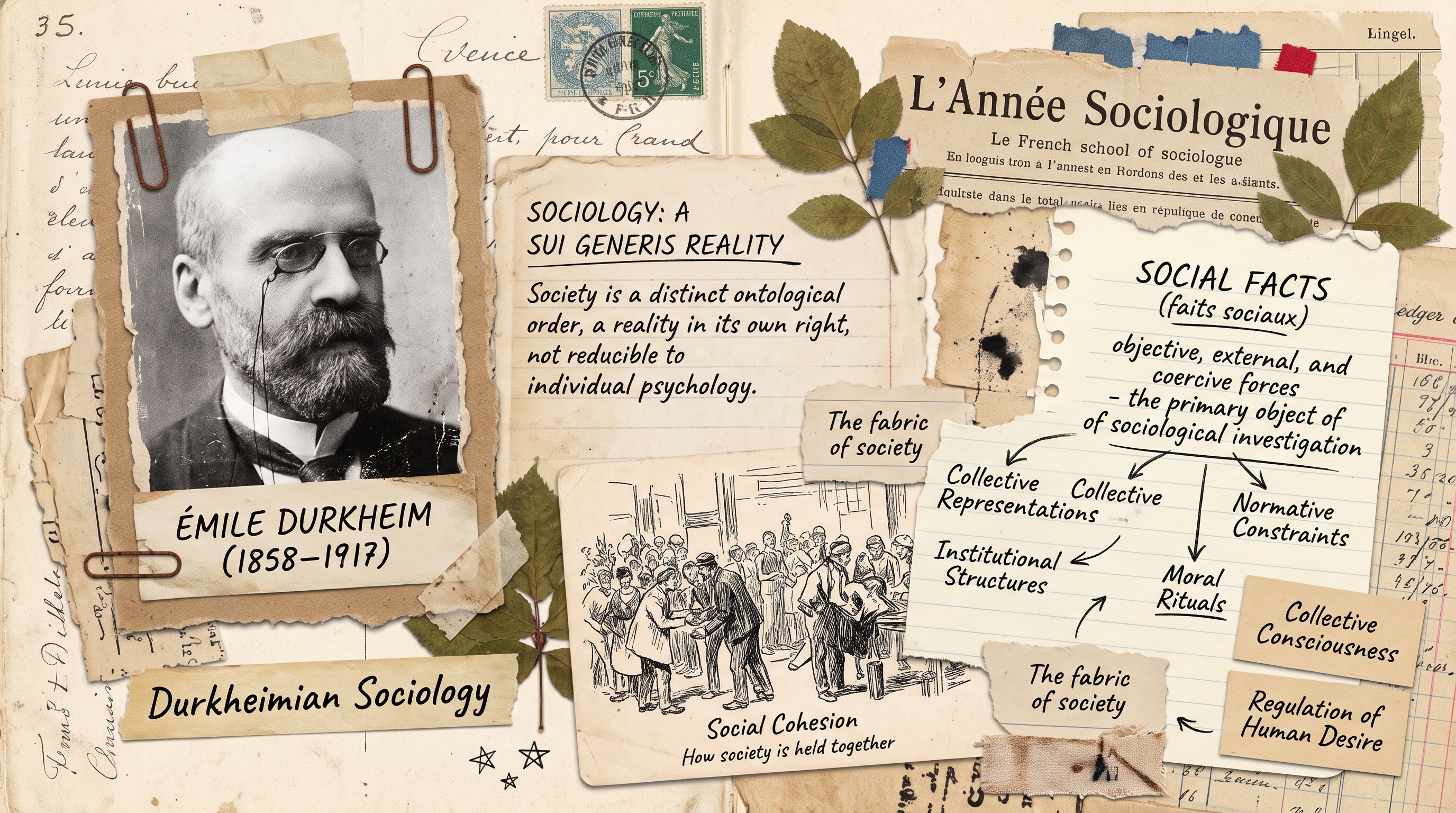
Durkheimian sociology encompasses the theoretical paradigm, epistemological axioms, and methodological architecture established by Émile Durkheim (1858–1917) and developed by the French sociological school (L'Année Sociologique). Formulated to establish sociology as an autonomous, empirically rigorous academic discipline distinct from speculative metaphysics and psychological reductionism, Durkheimian analysis posits that society is a sui generis reality—a distinct ontological order whose emergent properties cannot be reduced to the psychological states or biological drives of individual actors. By defining social facts as its primary object of investigation, Durkheimian sociology examines how collective representations, normative constraints, institutional structures, and moral rituals sustain the fabric of society, regulate human desire, and secure social cohesion across historical epochs.
1. Epistemological Foundations: The Reality of Social Facts
In The Rules of Sociological Method (1895), Durkheim formulated the central epistemological rule of modern social science: "Treat social facts as things" (Considérer les faits sociaux comme des choses).[1] Rather than deducing the nature of society from a priori philosophical ideals or individual psychological dispositions, sociology investigates objective phenomena that exist externally to the individual consciousness and exercise causal power over human behavior.
Defining Criteria of a Social Fact
A social fact (fait social) is any way of acting, thinking, or feeling that exhibits three structural characteristics:
- Externality (Extériorité): Social facts exist prior to, outside of, and independent from any single individual. Language systems, monetary codes, moral duties, legal statutes, and religious practices are inherited through intergenerational socialization. The individual does not author these frameworks; rather, they enter an already structured social environment.
- Coercive Power (Contrainte): Social facts exert an external regulatory force upon individual actors. While habitual conformity often renders this constraint invisible—disguising external regulation as personal inclination—any conscious attempt to deviate or resist immediately triggers sanctions. These sanctions range from formal statutory penalties (imprisonment, fines) to informal social reactions (ostracism, ridicule, moral censure, or communicative failure).
- Generality (Généralité): Social facts are collective conditions distributed throughout a society. They represent structural properties of the collectivity rather than the statistical aggregation or accidental summation of idiosyncratic individual preferences.
Material vs. Non-Material Social Facts
Durkheim divided the social world into two fundamental structural domains:
| Category | Structural Definition | Empirical Examples | Primary Social Function |
|---|---|---|---|
| Material Social Facts | Directly observable, physical crystallizations and spatial manifestations of collective life. | Architectural layouts, urban street plans, communication grids, written legal codes, demographic densities (morphologie sociale). | Provides the physical scaffolding and morphological channels through which human interaction takes place. |
| Non-Material Social Facts | Intangible, intersubjective normative forces, shared meanings, and collective beliefs. | The collective consciousness (conscience collective), social currents (courants sociaux), moral imperatives, religious dogmas, shared cultural values. | Regulates individual appetites, generates social solidarity, and produces shared moral boundaries. |
Real-World Manifestations and Contemporary Applications
- Fiat Currencies and Financial Infrastructure: Fiat money possesses zero intrinsic biological utility; a banknote is merely dyed cellulose, and modern digital bank balances are magnetic traces on a server. Yet no individual can unilaterally declare their own drawings as legal tender for debts. Money exists as an external, coercive social fact backed by state sovereignty, collective belief, and institutional enforcement.
- Linguistic Structures and Communicative Syntax: When an infant learns a language, they encounter an objective lexical and syntactical structure that precedes them by centuries. If a speaker invents a private grammar or arbitrary vocabulary, the coercive power of the linguistic social fact manifests as immediate incomprehension and isolation.
- Algorithmic Protocols and Digital Architectures: Modern digital platforms enforce behavioral compliance through automated social facts. Social credit scoring systems, recommendation feed parameters, and digital identity verifications confront the modern citizen as unyielding, coercive architectures that dictate economic participation and social visibility.
- Corporate Bureaucracies and Institutional Inertia: As documented in William H. Whyte's The Organization Man and Durkheimian Sociology and Reified Gestalt, an employee entering an enterprise encounters a pre-existing apparatus of reporting hierarchies, compliance standards, and corporate cultures that operate independently of any individual tenure. When an employee departs, the institution persists unaffected.
2. The Functional Theory of Crime and Deviance
One of the most revolutionary and counterintuitive contributions of Durkheimian sociology is the thesis that crime and deviance are normal, universal, and socially functional phenomena in every healthy society.[1:1]
The Universality and Normality of Crime
Durkheim rejected the pathological view that classified crime as an unnatural sickness or moral disease. He pointed out that crime occurs in all societies of all types throughout history. Because a phenomenon observed universally across all healthy social structures cannot be categorized as an anomaly, crime must be recognized as an integral element of normal social life.
A society completely free from crime is a sociological impossibility. For deviance to disappear entirely, every member of a community would have to hold identical moral convictions with absolute, unwavering intensity. In such a hypothetical "society of saints," the collective conscience would become so suffocatingly uniform that minor solecisms or trivial breaches of manners would be elevated to major offenses, generating a new threshold of criminality.
The Systemic Functions of Deviance
Durkheim established three primary sociological functions performed by crime and deviance:
- Clarification and Reinforcement of Moral Boundaries: A moral norm or social value remains abstract until it is publicly violated and visibly punished. When a community unites to sanction a criminal act, the collective conscience is awakened and rejuvenated. The public trial and punishment of a crime reasserts the boundaries between the permissible and the forbidden, reminding the law-abiding majority of their shared moral values.
- Amplification of Social Cohesion: Confronting a dramatic moral transgression draws citizens together in mutual indignation. The shared emotional shock creates collective solidarity among otherwise disparate individuals, uniting them against a common transgressor and actively strengthening the social bond.
- Crucible for Moral Innovation and Social Transformation: Deviance serves as the indispensable catalyst for social evolution. Historical moral progress requires that existing legal and normative boundaries be challenged by nonconformists. Figures such as Socrates, Jesus of Nazareth, and modern civil rights pioneers were condemned as criminals under the legal codes of their eras. By breaking the established law, the deviant anticipates the moral standards of the future, preventing the collective conscience from ossifying into repressive stagnation.
3. The Division of Labour and the Evolution of Social Solidarity
In The Division of Labour in Society (1893), Durkheim examined the moral and structural reorganization of society as human civilization shifts from simple, agrarian settlements to complex, industrial nation-states.[2] Rather than viewing modernization merely as an economic pursuit of technical efficiency (as argued by classical political economists like Adam Smith), Durkheim demonstrated that modernization involves a profound metamorphosis in social solidarity—the normative glue that binds individuals into an integrated community.
Mechanical vs. Organic Solidarity
| Dimension | Mechanical Solidarity (Solidarité Mécanique) | Organic Solidarity (Solidarité Organique) |
|---|---|---|
| Social Morphology | Segmental, kinship-based, traditional, small-scale, undifferentiated clans or villages. | Industrial, urbanized, highly differentiated, and occupationally specialized. |
| Division of Labour | Minimal; individuals perform identical subsistence tasks and hold equivalent societal roles. | Advanced; extensive specialization and functional interdependence across diverse domains. |
| Collective Consciousness | Overwhelming, intense, rigid, religious, and leaving no room for individual divergence. | Secularized, abstract, flexible, and centered on the sacred dignity of the individual personality. |
| Dominant Legal System | Repressive (Penal) Law: Deviance is punished with severe retributive violence or public shaming. | Restitutive (Civil / Contract) Law: Infractions disrupt specific contractual duties; law seeks restoration. |
| Pervasive Sanction Mode | Vengeance and communal moral vindication aimed at healing the collective consciousness. | Compensation, restitution, and re-establishing functional cooperation between actors. |
| Basis of Social Cohesion | Uniformity, identity, and shared collective representations. | Structural interdependence; the mutual necessity of complementary specialized organs. |
The Evolution of Law: Repressive vs. Restitutive Sanctions
Durkheim identified the legal system as the visible, empirical index (symbole visible) of invisible social solidarity:
- Repressive Law (Penal Sanctions): In communities bound by mechanical solidarity, any crime is experienced as a direct, sacrilegious assault on the sacred collective consciousness. The punishment is not intended to reform the criminal or restore property; rather, it is an emotional, public act of vengeance designed to heal the wounded feelings of the community and reaffirm collective authority.
- Restitutive Law (Civil, Administrative, and Contract Law): In societies characterized by organic solidarity, legal infractions typically violate specific bilateral agreements rather than the collective moral core. A breach of a commercial delivery contract does not arouse universal moral outrage. The modern legal system intervenes with restitutive remedies—awarding financial damages, enforcing contract compliance, or ordering specific performance—to restore equilibrium and ensure that the interconnected economic machinery continues to function smoothly.
The Cult of the Individual (Le Culte de l'Individu)
A common misreading of Durkheim assumes that organic solidarity eliminates the collective consciousness. Durkheim clarified that the collective consciousness does not vanish; rather, its content becomes secularized and transformed into the cult of the individual (le culte de la personne humaine).
Unlike utilitarian individualism or selfish egoism, this moral individualism is a collective social fact. Society itself sanctifies human rights, universal legal protection, and individual liberty as sacred values. In advanced organic societies, respecting the autonomy, equality, and dignity of the individual person becomes the shared religion holding diverse populations together.
4. Pathologies of Modernity: Anomie, Forced Specialization, and Structural Remedies
Durkheim rejected the uncritical nineteenth-century optimism that industrial expansion and technological innovation would automatically produce peace and human fulfillment. He observed that when economic transformation outpaces moral and institutional evolution, severe systemic pathologies emerge.
The Malady of Infinite Desires and Anomic Deregulation
In Suicide (1897), Durkheim formulated his analysis of anomie (derived from the Greek a-nomos, meaning without law or norms)—a state of social deregulation wherein collective benchmarks collapse, leaving individual passions unguided and unrestrained.[3]
Durkheim identified a fundamental distinction between biological needs and socio-psychological desires:
- Biological Appetites: Physical hunger, thirst, and fatigue have natural bodily boundaries; consumption produces physical satiety.
- Social and Psychological Desires: Ambitions for wealth, prestige, status, and luxury are inherently limitless. Left to themselves, human passions can never reach a point of natural satisfaction.
Because human desires are boundless, they require an external, trusted moral authority to establish legitimate limits and realistic horizons of aspiration. When stable moral frameworks break down—whether caused by catastrophic economic panics or sudden, speculative financial booms—the collective regulation collapses. Individuals enter a state of infinite striving, where every attained goal reveals another unattainable horizon, producing chronic dissatisfaction, existential exhaustion, and moral disorientation.
Pathological Forms of the Division of Labour
In the final book of The Division of Labour in Society, Durkheim emphasized that organic solidarity does not emerge automatically. He diagnosed two major abnormal forms:
- The Anomic Division of Labour: Occurs when economic specialization advances rapidly without the simultaneous development of moral rules, regulatory frameworks, and mutual understanding between capital and labor. Specialized departments or classes operate in friction and antagonism because shared norms to mediate conflicts are absent.
- The Forced Division of Labour (La Division du Travail Contrainte): Occurs when the distribution of occupational roles does not correspond to the natural talents and aptitudes of individuals, but is imposed through hereditary privilege, caste barriers, or economic coercion. When social inequality prevents talented individuals from accessing appropriate vocations, organic solidarity fractures into resentment and class struggle.
The Structural Remedy: Occupational Groups and Professional Corporations
In the Preface to the second edition of The Division of Labour (1902) and his lectures on Professional Ethics and Civic Morals, Durkheim outlined his institutional remedy for modern anomie: the revitalization of occupational groups (groupements professionnels) or modern corporations.[2:1]
Durkheim argued that modern society suffers because the institutional structure has a critical vacuum:
- The Modern State: Too distant, bureaucratic, and detached to provide intimate moral guidance for the daily struggles of individual occupations.
- The Modern Family: Too fragile, privatized, and economically diminished to anchor individuals in the wider economic order.
- The Isolated Individual: Left completely exposed to the relentless demands of the competitive market.
Durkheim proposed the formation of public, legally recognized professional associations spanning entire industries, incorporating both workers and management. These intermediate bodies would establish binding labor standards, set fair pricing and wage schedules, organize vocational education, manage mutual health and retirement funds, and build localized civic rituals. By standing as an intermediate moral community between the isolated citizen and the centralized state, the occupational corporation provides the structural regulation and social integration needed to extinguish anomie.
5. Aetiology of Self-Destruction: The Sociological Typology of Suicide
In Suicide: A Study in Sociology (1897), Durkheim established the foundational model of quantitative empirical sociology.[3:1] By gathering and analyzing statistical suicide records across diverse European regions, religious denominations, marital states, and political crises, he demonstrated that an act traditionally regarded as the ultimate personal, idiosyncratic tragedy is actually governed by external social currents (courants suicidogènes).
Durkheim demonstrated that suicide rates exhibit stable, predictable regularities within given populations over time, yet vary distinctly across different social environments. He mapped these variations along two fundamental structural axes:
- Integration: The intensity and strength of the individual's social bonds, shared belonging, and attachment to the collective community.
- Regulation: The strength of the moral boundaries, societal rules, and normative constraints imposed on individual desires and appetites.
| Suicide Type | Structural Condition | Sociological Mechanism | Manifestations & Real-World Contexts |
|---|---|---|---|
| Egoistic Suicide | Insufficient Integration | The individual feels detached from the social fabric; excessive individualism leaves the person isolated without shared purpose, protection, or mutual obligations. | - Unmarried, widowed, or divorced individuals living without familial support. - Atomized urban singles experiencing severe loneliness. - Contemporary digital isolation and disaffiliation as explored in Pulse (Kairo) — Existential Dread and Digital Alienation. |
| Altruistic Suicide | Excessive Integration | Ego boundaries are completely dissolved into the group; the individual views their biological existence as entirely subordinate to the honor, duty, or survival of the community. | - Military personnel sacrificing their lives in combat to shield comrades. - Insular ideological cults executing collective self-destruction on command (e.g., Jonestown). - Traditional honor suicides (e.g., historical Japanese seppuku). |
| Anomic Suicide | Insufficient Regulation | Societal norms and benchmarks collapse abruptly, plunging individual desires into boundless vertigo and deregulation. | - Sudden surges in suicide during acute financial depressions (e.g., 1929 stock crash, 2008 collapse). - Paradoxical spikes during speculative market booms and overnight windfalls where previous lifestyles shatter. - Sudden catastrophic life disruptions, divorce, or viral public disgrace. |
| Fatalistic Suicide | Excessive Regulation | Personal passions, future horizons, and agency are violently suffocated by unyielding, despotic institutional tyranny. | - Enslaved populations enduring inescapable chattel bondage. - Inmates serving life sentences in extreme solitary confinement in totalitarian penal facilities. - Individuals trapped under rigid caste systems or authoritarian domestic coercion. |
6. The Sociology of Religion, Cognitive Classification, and Collective Effervescence
In his final theoretical masterpiece, The Elementary Forms of Religious Life (1912), Durkheim examined the religious organization of Australian Indigenous clans (totemism) to identify the foundational architecture of all religious experience and human cognitive classification.[4] He concluded that religion is neither an epistemological delusion nor primitive superstition, but the symbolic system through which human societies celebrate, sustain, and sanctify their own collective existence.
The Sacred and the Profane
Durkheim identified the fundamental conceptual dichotomy ordering human perception: the division of reality into two strictly segregated domains:
- The Sacred (Le Sacré): Things set apart, elevated, forbidden, and surrounded by protective taboos, solemn rituals, and collective reverence. Anything can be sacred—a tree, an animal, a rock, a flag, a text, or an idea—provided the community invests it with collective emotional value.
- The Profane (Le Profane): The routine, mundane, utilitarian realm of everyday biological survival, individual labor, and economic transactions. Contact between the sacred and profane is rigorously regulated through purification rituals to prevent ritual pollution.
Totemism: Society Deifying Itself
In clan totemism, each social group adopts an emblem—the totem (typically a local animal or plant)—which simultaneously serves as the tangible representation of the divine principle and the symbol of the clan identity. Durkheim posed a foundational sociological question: Why does the same sacred symbol represent both the deity and the social group?
His answer constitutes one of the most radical insights in intellectual history: God and society are ontologically identical. Society possesses every attribute traditionally assigned to divinity:
- It precedes the individual and outlives them.
- It exercises overwhelming power and moral authority over individual actions.
- It demands self-sacrifice and devotion.
- It supplies the individual with language, moral values, and conceptual tools.
When the clan gathers to venerate the sacred totem, believers are unconsciously worshipping their own collective social organism.
Collective Effervescence (Effervescence Collective)
The experiential origin of the sacred resides in collective effervescence—the heightened emotional and physiological energy generated when human beings assemble in close physical proximity to participate in synchronized collective rituals.[5]
The mechanics of collective effervescence operate in a recognizable sequence:
- Periodic Assembly: Individuals abandon their isolated, mundane tasks in the profane realm and gather in a unified spatial arena.
- Synchronized Ritual Practice: Through rhythmic chanting, dancing, shared gestures, and mutual sensory contact, individual self-consciousness dissolves.
- Emotional Contagion: Shared excitement circulates through the crowd, amplifying until it reaches a crescendo of collective delirium and moral ecstasy.
- Totemic Anchoring: Participants experience themselves as transformed by a transcendent, superhuman power. Because this surge of social energy cannot remain permanently in its volatile emotional state, the community projects the energy onto external emblems (totems, relics, flags, icons). These objects become permanently invested with sacred authority, serving as symbolic batteries that preserve collective solidarity until the next ritual assembly.
Homo Duplex and the Sociological Genesis of Knowledge
In The Dualism of Human Nature and Its Social Conditions (1914) and Primitive Classification (1903, co-authored with Marcel Mauss), Durkheim extended his sociology into a revolutionary epistemology, challenging Immanuel Kant's a priori categories of thought:
- The Homo Duplex Architecture: The human being is inherently divided into two conflicting natures:
- The Biological Animal: Rooted in the physical organism, sensations, private appetites, and egoistic impulses.
- The Socialized Being: Rooted in society, moral duties, conceptual thought, language, and universal reason.
- The Social Origin of Categories: Durkheim argued that the fundamental categories of human understanding—time, space, class, causality, and hierarchy—are social in origin:
- Time is structured by collective social rhythms: calendars, market cycles, holidays, and seasonal assemblies.
- Space is modeled after the spatial arrangement of the tribe: village camp orientations, sacred cardinal directions, and clan territories.
- Classification (Genus and Species) reflects clan phratries, totemic moieties, and social divisions. Human beings first classified objects into groups because their own human communities were divided into clans.
7. Pedagogical and Political Philosophy: Secular Morality and Moral Education
During the French Third Republic, Durkheim played a leading role in restructuring national education (L'Éducation Morale), designing a rigorous secular morality (laïcité) to replace religious instruction in state schools without collapsing into utilitarian selfishness.[6]
Durkheim identified three essential components of secular moral character:
- The Spirit of Discipline (L'Esprit de Discipline): Morality requires the habituation of self-restraint. By learning to accept external rules, the child develops the psychological capacity to regulate boundless personal appetites, escaping the misery of anomic striving.
- Attachment to Social Groups (L'Attachement aux Groupes Sociaux): Morality is inherently social; it requires devotion to collective interests beyond the ego. Through the classroom community, the child learns solidarity, altruism, and voluntary cooperation within family, civic institutions, and the national republic.
- Autonomy of the Will (L'Autonomie de la Volonté): Durkheim insisted that modern democratic morality cannot rest on blind, authoritarian obedience or superstitious fear. The individual must rationally understand the functional necessity of the moral rule and grant enlightened, conscious assent to its social purpose.
The Role of the Democratic State
In Professional Ethics and Civic Morals, Durkheim defined the democratic state not as an oppressive leviathan, but as the specialized organ of social reflection (l'organe de la pensée sociale). The state's functional mission is to distill the diffuse, instinctive feelings of the collective consciousness into clear, rational principles of justice.
To prevent the state from degenerating into bureaucratic tyranny, Durkheim emphasized the necessity of strong, autonomous secondary groups (occupational associations, civic unions, and municipal councils) that act as a democratic counterweight, protecting individual liberties while channeling societal needs into state policy.
8. Sociological Legacy, Theoretical Extensions & Critical Debates
Durkheimian sociology laid the structural and methodological foundation for major twentieth-century traditions across the human sciences:
- Structural Functionalism: Systematized by Talcott Parsons, Robert K. Merton, and A. R. Radcliffe-Brown, this tradition adapted Durkheim's physiological models of equilibrium, institutional integration, and functional prerequisites into the dominant mid-century sociological paradigm.
- The Social Construction of Knowledge: In The Social Construction of Reality - A Treatise in the Sociology of Knowledge, Peter L. Berger and Thomas Luckmann operationalized Durkheim's sui generis social facts: social institutions are externalized by human actors, objectivated into unyielding external realities, and subsequently internalized through socialization.
- Contemporary Ritual and Neo-Durkheimian Theory: Randall Collins developed the theory of Interaction Ritual Chains, proving that micro-sociological interactions (conversational turns, body language, physical co-presence) generate emotional energy in the same manner as macro-level religious effervescence.
- Brand Totemism and Modern Tribes: As explored in Difference Between Product vs Brand and Durkheimian Sociology and Reified Gestalt, modern corporations employ group rituals, corporate retreats, and commercial logos to generate collective effervescence, converting the corporation into a secular totem that commands employee sacrifice and consumer brand loyalty.
Critical Appraisals and Methodological Controversies
Despite its enduring influence, Durkheimian sociology has faced substantive theoretical critiques:
- Underestimation of Power and Social Conflict: Conflict theorists from the Marxist and critical traditions point out that Durkheim's focus on consensus, solidarity, and equilibrium often treated class struggle and structural inequality as temporary "pathologies" rather than permanent, structural features of capitalist production.
- Methodological Determinism and the Over-Socialized Concept of Man: Critics such as Dennis Wrong argued that Durkheim's emphasis on external constraint and coercive social facts risks depicting human beings as passive cultural automatons, ignoring subjective human agency, deliberate resistance, and creative reinterpretations.
- Positivism vs. Interpretivism: In contrast to Max Weber's interpretive sociology (Verstehen), which begins with the subjective meanings actors attach to their actions, Durkheim's insistence on treating social facts "as things" has been critiqued for importing natural-science methodology too rigidly into the study of human culture.
🎴 Interactive Web Practice (Comprehension Check)
Question 1 (Social Facts & Epistemological Realism): What are the three defining criteria of a Durkheimian "social fact," and why did Durkheim demand that they be investigated "as things" (comme des choses)?
Answer: A Durkheimian social fact is defined by three interrelated criteria:
- Externality (Extériorité): It exists prior to, outside of, and independent from the consciousness of any individual actor, having been created by past generations and transmitted through institutional socialization (e.g., language, currency, moral codes).
- Coercive Power (Contrainte): It exerts external regulatory pressure on the individual, where compliance feels natural but defiance triggers immediate statutory, economic, or social sanctions.
- Generality (Généralité): It is diffused across the whole society, expressing a collective property of the social system rather than being an accidental sum of personal choices.
Question 2 (The Solidarity Transition & Legal Systems): How does the transition from mechanical solidarity to organic solidarity reflect changes in the collective consciousness and legal frameworks?
Answer: In societies governed by mechanical solidarity, social cohesion depends on similarity, uniformity, and an intense, all-encompassing collective consciousness that leaves little room for individual divergence. Any crime or deviance is experienced as a direct, sacrilegious assault on the sacred collective mind; consequently, the legal system relies on repressive (penal) law to inflict emotional, public, and physical punishment, reasserting the violated moral order.
In contrast, modern societies characterized by organic solidarity rely on task specialization, structural differentiation, and mutual interdependence across specialized organs. The collective consciousness becomes secularized, diffuse, and focused on protecting the sacred rights of the individual. Infractions disrupt specific functional interactions rather than universal moral tenets; hence, the legal system shifts to restitutive (civil, commercial, and contract) law, aiming to restore prior balance, enforce contracts, and maintain functional cooperation across specialized actors.
Question 3 (The Functional Theory of Crime & Deviance): Why did Durkheim consider crime to be a "normal" and socially functional phenomenon rather than an unnatural pathology?
Answer: Durkheim considered crime normal because it is universally observable in every healthy society of every type throughout human history. A society completely free of crime is sociologically impossible because it would require an absolute, suffocating uniformity of the collective conscience that would eliminate all individual freedom and original thought.
Crime performs three indispensable social functions:
- Boundary Maintenance: Punishing a crime publicly clarifies and reinforces the moral boundaries of the community, reminding law-abiding citizens of their shared values.
- Social Cohesion: Collective outrage against a shocking crime draws citizens together in mutual indignation, strengthening social bonds across diverse groups.
- Social Evolution: Deviance serves as the necessary precursor to moral and legal progress. Progressive reformers and innovators are frequently branded as criminals by the established legal order before their nonconformist actions become the foundation of new societal standards.
Question 4 (Anomie, Suicide & Occupational Groups): How does anomie generate self-destruction in modern economies, and why did Durkheim advocate for occupational groups as the structural remedy?
Answer: Anomie is a state of social deregulation or normlessness where collective boundaries collapse and fail to regulate human desires. While biological appetites have natural physical limits, social and psychological desires are inherently infinite and require trusted moral benchmarks. During sudden economic booms or depressions, traditional standards disintegrate; unbounded striving leads to chronic frustration, existential exhaustion, and elevated rates of anomic suicide.
Durkheim advocated for occupational groups (*groupements professionnels*) because modern society suffers from an institutional vacuum: the state is too distant and bureaucratic to regulate daily occupational life, while the nuclear family is too privatized and economically fragile. Legally recognized professional associations encompassing workers and employers within each industry provide intermediate moral communities that set labor standards, resolve disputes, offer mutual support, and anchor the individual in a proximate moral framework, neutralizing anomic drift.
Question 5 (Collective Effervescence & Primitive Classification): Explain how collective effervescence generates the experience of the sacred, and how Durkheim connected this dynamic to human cognitive categories.
Answer: Collective effervescence occurs when individuals assemble in close physical proximity for synchronized ritual action (chanting, rhythmic movement, shared symbols). Individual self-consciousness dissolves, and emotional contagion amplifies shared energy into a state of collective delirium. Participants experience themselves as elevated by a transcendent force greater than themselves; this social energy is then projected onto nearby symbols (totems, relics, flags), which are consecrated as sacred.
Durkheim connected this directly to epistemology in Primitive Classification and The Elementary Forms: the fundamental categories of human thought (time, space, class, and causality) are not innate cognitive structures (*Kant*), but social crystallizations. Time is structured by collective ritual calendars; space is mapped onto tribal camp arrangements; and logical classification (grouping things into genus and species) originated directly from the division of human tribes into clans, phratries, and moieties.
Resonant Notes
The following notes in the vault share direct thematic, sociological, and literary connections with Durkheimian sociology:
🔴 Structural Functionalism, Social Facts & Institutional Systems
- David Émile Durkheim (1858–1917) — The biographical monograph and comprehensive intellectual profile documenting Durkheim's historical context, empirical studies, and founding role in academic social science.
- Structural Functionalism — Durkheim serves as the direct forefather of structural functionalism; his foundational concepts of social facts, functional integration, equilibrium, and institutional roles were systematized by Talcott Parsons, Robert K. Merton, and A. R. Radcliffe-Brown.
- The Organic Analogy — Tracing back to Auguste Comte and Herbert Spencer, this physiological model of society was refined by Durkheim into the theory of organic solidarity, demonstrating how differentiated specialized organs maintain systemic equilibrium.
- The Social Construction of Reality - A Treatise in the Sociology of Knowledge — Peter L. Berger and Thomas Luckmann's institutional dialectic builds directly on Durkheim's thesis that humanly constructed social practices solidify into external, coercive sui generis realities.
- William H. Whyte's The Organization Man & William H. Whyte's Social Ethics — Whyte's mid-century corporate conformist illustrates a secular corporate collective consciousness, wherein individual autonomy is subordinated to institutional belonging.
- Durkheimian Sociology and Reified Gestalt — Synthesizes Durkheimian sui generis social facts with Gestalt psychology, demonstrating how corporations operate as reified totalities that exert coercive moral power over employees.
- Max Weber (1864-1920) — Weber's interpretive sociology (Verstehen) and methodological individualism stand as the primary nineteenth-century methodological counterpoint to Durkheim's positivist emphasis on external social facts.
- Karl Marx - Economic and Philosophic Manuscripts of 1844 — While Marx located historical progression in material class struggle and economic alienation, Durkheim diagnosed social crises as moral pathologies (anomie) to be remediated through civic solidarity.
- Freedom from a Sociological Perspective — Explores the classical Durkheimian paradox: authentic human freedom is not the absence of social restraint, but the product of robust moral regulation that shields individuals from boundless, self-destructive desires.
- B. R. Ambedkar — Ambedkar utilized sociological and institutional critiques of caste hierarchies in India, demonstrating how repressive, hereditary traditional structures enforce the "forced division of labour" and prevent organic solidarity.
- The Consumer Credit Score - Quantifying the Soul — Demonstrates how modern institutional metrics operate as coercive material and non-material social facts, regulating individual economic agency through automated surveillance.
- The Industrialization of Inquiry — The Science Citation Index (1960), Bibliometric Surveillance, and the Commodification of Truth — Examines how academic metrics construct external, coercive social facts that enforce compliance and shape scholarly behavior.
- The Metricization of Mind — Standardized Testing, State Legibility, and the Domestication of Childhood — Details how standardized educational metrics function as coercive institutional channels designed to sort and integrate children into the modern division of labor.
- The Standardization of Suffering — The DSM (1952), Intersubjective Consensus, and the Looping Effects of Psychiatric Classification — Explores how psychiatric classifications crystallize into external social facts, illustrating the looping effects and social construction of diagnosis.
- the-fabric-of-society — The cognitive metaphor connecting organic solidarity and mutual civic trust to the interwoven stability of institutional life.
🟡 Ritual, The Sacred & Collective Consciousness
- Arnold van Gennep (1873–1957) — Van Gennep's universal three-stage framework of rites of passage (separation, liminality, incorporation) builds upon Durkheimian analyses of ritual as a mechanism for collective boundary maintenance and status transition.
- Mircea Eliade — Eliade's morphological investigation of the sacred and the profane (The Sacred and the Profane, 1957) extends Durkheim's binary classification from functional sociology into phenomenology and comparative religion.
- Rudolf Otto’s The Idea of the Holy — Otto's formulation of the numinous (mysterium tremendum et fascinans) provides a phenomenological complement to Durkheim's collective effervescence, capturing the visceral awe experienced before transcendent power.
- The Secularization of Religious Holidays — Documents the historical shift wherein sacred collective effervescence is progressively co-opted and replaced by privatized commercial consumption in consumer capitalism.
- Difference Between Product vs Brand — Demonstrates how modern commercial brands function as secular totems, serving as collective representations that assemble and coordinate consumer tribes.
- Consumer Behavior and the Architecture of Influence — Explores how contemporary marketing architectures harness collective representations and tribal identity to direct consumer behavior.
- The Eliza Effect — Illustrates how computer users collectively reify digital systems, projecting consciousness and social agency onto statistical algorithms in a manner mirroring the reification of social facts.
- Group of Seven (also known as the Algonquin School) & English-language Canadian Literature (English CanLit) — Analyzes how artistic movements and national literature manufacture secular "collective representations," providing young nations with shared symbolic landscapes.
- From Walls of Wood to Walls of Glass - Northrop Frye’s Geography of Isolation — Frye's "garrison mentality" embodies a defensive, inward-facing collective consciousness where external perils enforce strict moral uniformity.
🟢 Anomie, Alienation & Modern Disenchantment
- Émile Durkheim - Sociology of Chaos — Directly applies Durkheimian diagnostics to contemporary organizational volatility, investigating how rapid economic disruptions and anomic deregulation fragment institutional coherence.
- Zygmunt Bauman's sociological framework of Liquid Modernity — Bauman's analysis of precarious individualization and dismantled safety nets illustrates the acute manifestation of modern anomie, where institutional bonds dissolve into liquid precarity.
- Simmel and the Attention Economy — Abstraction, Alienation, and Cognitive Capture — Georg Simmel's critique of the money economy and the blasé attitude parallels Durkheim's diagnosis of modern metropolitan atomization.
- The Metropolis and Mental Life — Simmel's analysis of sensory overstimulation and intellectualized defense mechanisms in the metropolis directly complements Durkheim's investigation of organic differentiation and egoism.
- Georg Simmel's Tragedy of Culture — Examines the widening gulf between hypertrophic objective culture and finite subjective absorption, mirroring Durkheim's analysis of technical modernization outpacing moral integration.
- Lipman-Blumen - The Allure of Toxic Leaders — Explores how anomic disorientation and existential anxiety drive populations to surrender their critical agency to authoritarian figures promising total security.
- Pulse (Kairo) — Existential Dread and Digital Alienation — Kiyoshi Kurosawa's cinematic masterpiece serves as a contemporary visual allegory for extreme egoistic suicide and digital isolation within atomized modern metropolises.
- The Digital Infrastructure of Delusion-A Buddhist Economic and Psychological Analysis of Corporate Culture — Bridges Buddhist concepts of insatiable craving (taṇhā) with Durkheimian anomie, demonstrating how modern commercial architectures systematize boundless desires.
- Don DeLillo Major Themes Analysis — DeLillo's postmodern fiction captures isolated individuals who seek refuge from existential dread by surrendering to mass stadium crowds and commercial mantras, enacting a degraded form of collective effervescence.
References
Émile Durkheim / The Rules of Sociological Method (1895) / Edited by Steven Lukes, translated by W. D. Halls / Free Press / Simon & Schuster ↩︎ ↩︎
Émile Durkheim / The Division of Labour in Society (1893) / Translated by W. D. Halls / Palgrave Macmillan ↩︎ ↩︎
Émile Durkheim / Suicide: A Study in Sociology (1897) / Translated by John A. Spaulding and George Simpson / Free Press / Simon & Schuster ↩︎ ↩︎
Émile Durkheim / The Elementary Forms of Religious Life (1912) / Translated by Carol Cosman, edited by Mark S. Cladis / Oxford University Press ↩︎
Christian Kronsted / Collective Effervescence as Self-Organization and Enaction / Journal of Social Ontology ↩︎
Émile Durkheim / Moral Education (1902–1903 lectures, published 1925) / Translated by Everett K. Wilson and Herman Schnurer / Free Press, 1961 ↩︎