The Direct Path and Contemporary Non-Duality - Klein, Spira, Adyashanti, and Bodian
🗂️ Interactive Notebook: Open Study Companion (Video Summary, Flashcards, Mind Map) ↗
This comparative study operates under the master taxonomic umbrella of Traditional vs. Secular Buddhist vs. General Spiritual Teachers, specifically elaborating the General Spiritual / Contemporary Non-Dual paradigm across its lineage transmissions, epistemological methodologies, somatic inquiries, and psychotherapeutic integrations.
The emergence of contemporary Western non-duality represents a radical pedagogical departure from both traditional monastic gradualism and disembodied intellectualism.[1][2][3][4] Across the interconnected lineages and teachings of Jean Klein, Rupert Spira, Adyashanti (born Steven Gray, 1962), and Stephen Bodian, spiritual realization is stripped of exotic religious vestments, ancient scholastic dogmatism, and the teleological myth of the "spiritual ladder."[1:1][2:1][3:1][4:1]
Rather than treating awakening as an elusive, future attainment purchased through decades of ascetic discipline, these four masters articulate the Direct Path (sadyomukti): the immediate recognition that open, unconditioned awareness is already the ever-present, non-objective ground of all experience.[1:2][2:2][3:2][4:2]
Crucially, this contemporary Western lineage rescues non-duality from the cold, nihilistic detachment of "Neo-Advaita" by anchoring realization in somatic embodiment and psychological integration.[1:3][2:3][3:3][4:3] From Klein's Kashmiri "body approach" and Spira's deconstruction of the somatic "I-feeling," to Adyashanti's gut-level grounding and Bodian's psychotherapeutic confrontation with spiritual bypassing, awakening is mapped not as a flight from humanity into transcendent abstraction, but as the total, vulnerable descent of awareness into the flesh, the heart, and the messy friction of everyday life.[1:4][2:4][3:4][4:4]
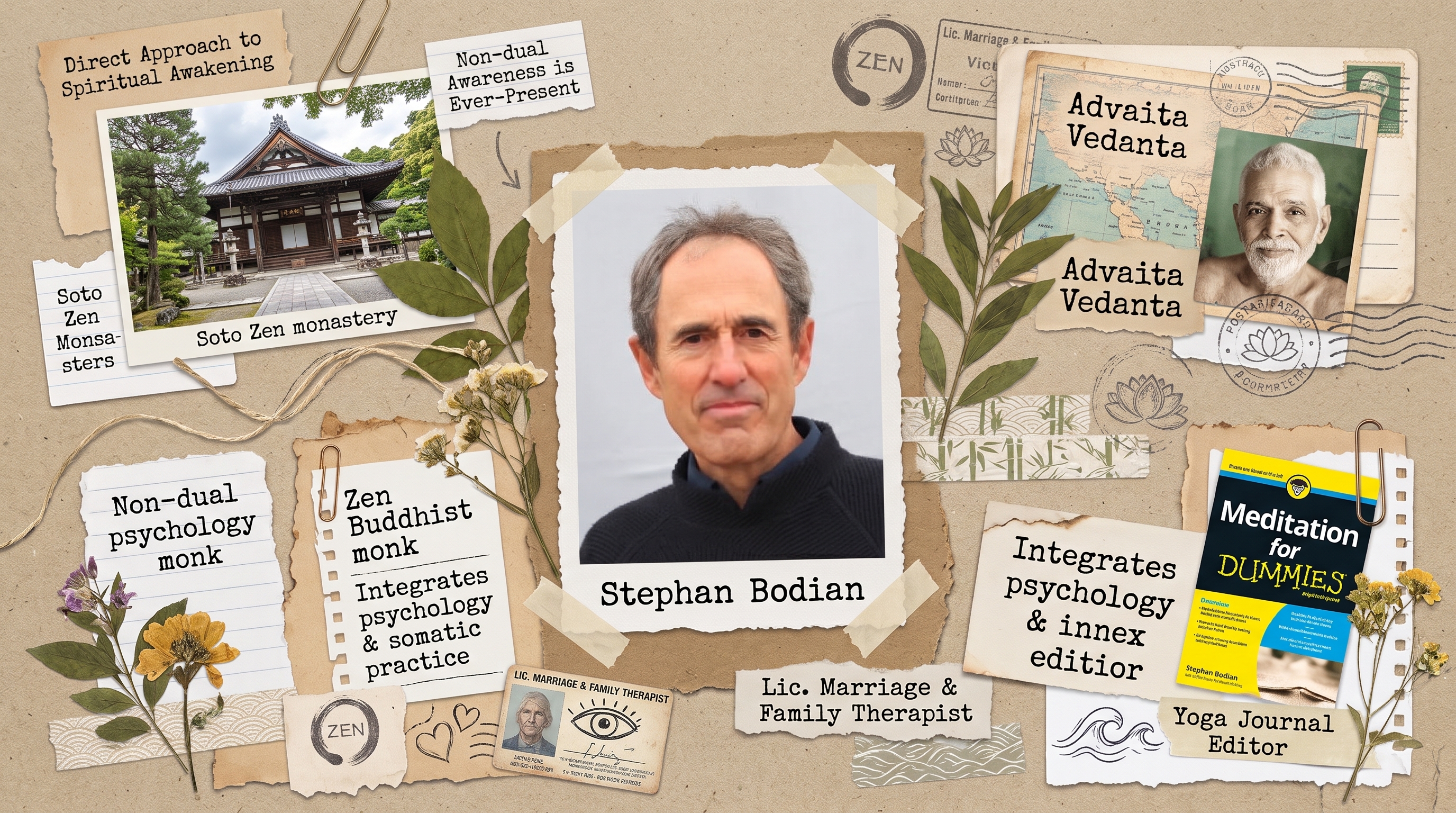
1. Lineage Genealogy and Master Taxonomic Mapping
Contemporary Western non-duality is not an arbitrary cultural amalgam; it is an organic, highly disciplined lineage transmission spanning classical Indian Advaita, Kashmiri Tantra, Japanese Zen monasticism, and Western depth psychology.[1:5][2:5][3:5][4:5]
The Lineage Tree
- Classical Roots:
- Advaita Vedānta (Direct Path): Sri Atmananda Krishna Menon (1883–1959)
Jean Klein (1912–1998)[1:6] - Kashmir Shaivism (Pratyabhijñā & Spanda): Pandit Veeraraghavachar ("Panditji")
Jean Klein[1:7] - Japanese Soto/Rinzai Zen: Taizan Maezumi Roshi / Kobun Chino Otogawa Roshi
Arvis Justi Adyashanti (born Steven Gray, 1962) & Stephen Bodian[3:6][4:6]
- Advaita Vedānta (Direct Path): Sri Atmananda Krishna Menon (1883–1959)
- The Transatlantic Synthesis:
- Jean Klein
Francis Lucille Rupert Spira[2:6] - Jean Klein
Stephen Bodian (Somatic Listening & Direct Approach)[1:8][4:7] - Adyashanti (born Steven Gray, 1962)
Stephen Bodian (Formal Dharma Transmission, 2001)[3:7][4:8]
- Jean Klein
| Root Lineage / Tradition | Foundational Transmitters | Primary Western Heirs | Contemplative Focus |
|---|---|---|---|
| Direct Path Advaita Vedānta | Sri Atmananda Krishna Menon (1883–1959) | Jean Klein | Pure non-objective knowing; deconstructing objecthood; dialectical inquiry |
| Kashmir Shaivism (Pratyabhijñā & Spanda) | Pandit Veeraraghavachar ("Panditji") | Jean Klein | Somatic listening (écoute); dissolution of neuromuscular tension knots |
| Sōtō & Rinzai Zen Monasticism | Taizan Maezumi Roshi & Kobun Chino Otogawa Roshi | Arvis Justi | Non-manipulation; "True Meditation"; multi-centered awakening (Mind/Heart/Gut) |
| Non-Dual Psychotherapy & Trauma Work | John Welwood & California School of Professional Psychology | Stephen Bodian & Adyashanti (born Steven Gray, 1962) | Unmasking spiritual bypassing; Two Truths integration; shadow work |
Master Comparative Taxonomy
| Analytical Dimension | Jean Klein | Rupert Spira | Adyashanti | Stephen Bodian |
|---|---|---|---|---|
| Primary Work | I Am: A Creative Leap into Being (2006)[1:9] | The Transparency of Things (2008) & The Nature of Consciousness (2017)[2:7] | Emptiness Dancing (2004) & The End of Your World (2008)[3:8] | Wake Up Now (2007) & Beyond Mindfulness (2017)[4:9] |
| Lineage Line | Advaita Vedānta (Atmananda Krishna Menon) & Kashmir Shaivism | Direct Path Advaita via Francis Lucille & Jean Klein | Soto/Rinzai Zen (Arvis Justi / Maezumi Roshi); independent lay non-duality | Soto Zen (Kobun Chino Otogawa), Advaita (Jean Klein), Dharma transmission from Adyashanti |
| Philosophical Focus | Pure listening (écoute); Kashmiri somatic decontraction; musical resonance | Phenomenological idealism; non-objective knowing; triad of Thinking/Sensing/Perceiving | Cessation of striving; "True Meditation"; multi-centered awakening (Mind/Heart/Gut) | Effortless mindfulness; psychotherapeutic shadow work; unmasking spiritual bypassing |
| Model of Consciousness | Unconditioned, non-objective "primal awareness" prior to thought | The sole, irreducible, infinite fabric and container of all reality | Primordial silence and spacious being beyond conceptual identity | Timeless, ever-present ground of open presence, accessible here and now |
| View of the Body | Sacred musical resonator; frozen defense knots released through listening | Somatic contraction ("I-feeling") dissolved into spacious, open vibration | Dynamic somatic vehicle; gut-level (hara) root presence defeating existential dread | Bodily holding pattern storing unresolved emotional and developmental trauma |
| Stance on the "Seeker" | The seeker is an illusory phantom; every volitional effort reinforces the ego | The seeker is a conceptual label applied to episodic thoughts and bodily tensions | The seeker trap: spiritual ambition weaponized by the ego to maintain continuity | The "seeker identity" is a defensive strategy avoiding immediate presence |
| Pedagogical Dynamic | Egalitarian "tuning fork"; silent transmission during a "coming together" | Dialectical inquiry and experiential dialogues deconstructing objecthood | Informal lay satsang; compassionate dismantling of spiritual romanticism | Non-dual psychotherapy; mentoring within the School for Awakening |
| Shadow / Trauma Integration | Indirect somatic unwinding; allowing tensions to dissolve in open space | Differentiating the I-thought from the I-feeling; meeting feelings without defense | Granular navigation of post-awakening disorientation and unintegrated shadow | Explicit clinical psychotherapeutic integration; meeting contractions in awareness |
2. Epistemological Foundations: The Direct Path vs. The Progressive Path
The defining intellectual intervention uniting Klein, Spira, Adyashanti, and Bodian is their rejection of the Progressive Path in favor of the Direct Approach.[1:10][2:8][3:9][4:10]
In traditional religious frameworks—whether classical monastic Buddhism climbing the stages of samatha and vipassanā, or orthodox Advaita demanding years of preliminary purification (sādhana catuṣṭaya)—enlightenment is constructed as an altered, transcendent state situated at the distant end of a linear temporal horizon.[1:11][2:9][5]
The Fatal Flaw of Progressive Seeking
The four teachers identify a foundational paradox at the heart of progressive spiritual seeking:
- The Teleological Trap: Progressive spiritual paths assume that the seeker is an unenlightened, deficient, and fragmented ego bound in space and time, who must perform actions (meditation, asceticism, chanting) to produce awakening in a future moment.[1:12][2:10][4:11]
- Causal Fallacy: Reality (pure awareness or the unconditioned ground) is by definition uncaused, uncreated, and eternal.[1:13][2:11] Therefore, no conditioned, temporal cause-and-effect technique can manufacture an uncaused reality.[1:14][2:12]
- Reifying the Controller: Every volitional movement of the will—every effort to quiet the mind, concentrate on the breath, or eliminate negative thoughts—implicitly reinforces the very illusion it seeks to dissolve: the existence of an autonomous "controller" or "seeker."[1:15][2:13][3:10] As Gilbert Ryle demonstrated in Gilbert Ryle's-The Concept of Mind, this assumes an indwelling Ghost in the Machine directing cognition.[2:14][6]
| Diagnostic Dimension | The Progressive Path (Gradual Cultivation) | The Direct Path (Immediate Recognition) |
|---|---|---|
| Foundational Premise | The individual is an unenlightened seeker who must climb a spiritual mountain.[1:16][2:15] | Awareness is already fully present, whole, and unblemished; seeking obscures it.[1:17][2:16] |
| Temporal Dynamic | Horizontal, chronological, future-oriented: [Ignorance] ➔ (Time / Effort) ➔ [Awakening].[2:17] | Vertical, timeless, instantaneous: resting directly in the ever-present ground Now.[2:18][4:12] |
| Role of Volition | Focused concentration, mental manipulation, thought suppression, breath control.[3:11] | Non-manipulation, choiceless listening, effortless presence, radical allowance.[1:18][3:12] |
| Status of the Ego | Purified, disciplined, and gradually transformed into a spiritual character.[3:13] | Deconstructed as an episodic conceptual phantom and somatic contraction.[1:19][2:19] |
| Treatment of Phenomena | Filtered into "wholesome" vs. "unwholesome" states to be acquired or eliminated.[4:13] | Welcomed unconditionally as modulations arising within the seamless field of awareness.[1:20][2:20] |
Foundational Pedagogical Allegories
To clarify this radical shift, the teachers deploy precise phenomenological allegories that dissolve intellectual confusion:
- The Living Room and the Weary Traveler (Klein): An exhausted traveler spends decades journeying across treacherous oceans and climbing rugged mountains searching for an elusive sanctuary called "Home." One day, the traveler stops, looks closely at the walls, and realizes with astonishment that they have been sitting in their own living room the entire time.[1:21] The progressive path is the exhausting travel itinerary; the Direct Path is opening your eyes and recognizing that you never left home.[1:22]
- The Flashlight Seeking Darkness (Klein): Imagine a high-intensity flashlight that passionately desires to understand what total darkness looks like. It races into dark basements, darts behind pillars, and shines into deep crevices. Yet, no matter how fast it moves, it can never find darkness—because the very effort of searching casts the beam that dispels it.[1:23] The ego striving for enlightenment through effort is that flashlight; every act of spiritual willpower is another burst of egoic light concealing the effortless darkness of pure being.[1:24]
- The Cinema Screen and the Drama (Spira): When an epic movie is projected onto a cinema screen—featuring a raging forest fire followed by a catastrophic flood—the audience weeps and gasps.[2:21] Yet, when the film finishes, the screen is completely unburned by the flames, dry after the deluge, and unstained by the blood.[2:22] Consciousness is the screen; human emotions, thoughts, and spiritual identities are the moving film.[2:23] Pure awareness is never wounded by sorrow, stained by trauma, or improved by spiritual attainment.[2:24]
- King Lear and John Smith (Spira): An actor named John Smith plays King Lear on stage. When Lear descends into tragic madness on the heath, John Smith is neither insane nor in pain.[2:25] When the curtain falls, John Smith does not need to undergo therapy to recover from Lear's tragedies; he simply remembers who he was all along.[2:26] Liberation is John Smith remembering his true identity amidst the drama of life.[2:27]
3. Somatic Phenomenology: From Character Armor to Transparent Resonator
A critical failure of modern "Neo-Advaita" is its disembodied intellectualism: teachers frequently proclaim that "there is no self, the body is an illusion, and nobody exists," leaving students dissociated, emotionally numb, and trapped in intellectual concepts.[2:28][4:14]
In sharp contrast, the lineage of Klein, Spira, Adyashanti, and Bodian is fundamentally somatic.[1:25][2:29][3:14][4:15] Drawing deeply from Kashmir Shaivism, Zen, and modern somatic psychology, these teachers recognize that ego-identity is not merely an intellectual mistake (an I-thought); it is a chronic, physiological contraction in the flesh (an I-feeling).[1:26][2:30][3:15][4:16]
| Somatic Dimension | Jean Klein | Rupert Spira | Adyashanti | Stephen Bodian |
|---|---|---|---|---|
| Somatic Lineage | Kashmir Shaivism (Spanda & Pratyabhijñā); European medicine | Kashmiri Yoga of Sensation via Lucille & Jean Klein | Classical Zen physical sitting (zazen); body athletics | Somatic Psychotherapy (MFT); Gestalt bodywork; Soto Zen |
| Nature of the Ego | Chronic neuromuscular tension knots and defensive armoring | The "I-feeling": a localized somatic knot of fear and defense | Emotional clutching in the chest; root dread in the belly/gut | Somatic holding patterns encoding developmental trauma |
| Investigative Method | "Listening" (Écoute): Feeling sensations without conceptual anatomy | Experiential Deconstruction: Feeling the body without mental visualization | True Meditation: Dropping physical manipulation; allowing body to settle | Somatic Unwinding: Inviting bodily contractions into open awareness |
| Spatial Boundary | Epidermal boundaries dissolve; body becomes open energetic space | Edges soften into boundaryless, weightless vibration in awareness | Centering consciousness down through head, heart, and belly (hara) | Meeting painful physical contractions without narrative storytelling |
| Phenomenological Endpoint | The body as a transparent, resonant musical instrument of presence | The body is experienced as an appearance taking place inside awareness | Unshakeable somatic stillness; fearless embodiment in mundane life | Integrated, relaxed nervous system; embodiment of non-dual wisdom |
Deconstructing the "Character Armor" (Connecting to Becker and Thanatology)
This somatic focus directly illuminates the depth psychology of Ernest Becker examined in Terror Management Theory, Becker's Denial of Death, and Buddhist Contemplation.[7] Becker showed that the human organism constructs character armor—calcified behavioral and muscular defenses—to shield itself from the terrifying awareness of biological decay and cosmic insignificance.[7:1][8]
- Klein's Musical Instrument: Jean Klein observed that whenever the concept of a separate "I" is activated, an involuntary physical spasm occurs in the throat, chest, diaphragm, or pelvic floor.[1:27] The body becomes an armored bunker. By cultivating passive, receptive "listening" (écoute)—feeling tactile sensation without mental images—these defense knots naturally soften, converting the leaden body into a transparent, acoustic violin that resonates freely with conscious space.[1:28]
- Spira's "I-Thought" vs. "I-Feeling": Rupert Spira makes a crucial diagnostic distinction: an intellectual insight into non-duality easily dissolves the I-thought, but the separate self takes refuge in the body as the I-feeling—a dense, visceral knot of resistance, longing, and existential fear.[2:31] To liberate the body, Spira guides seekers through the "Yoga of Sensation": sitting without visualizing the anatomical shape of the head or limbs, discovering that physical sensations have no fixed perimeter or density, but are fluid ripples floating in infinite awareness.[2:32]
- Adyashanti's Gut-Level Grounding: Adyashanti notes that seekers frequently achieve mental freedom while remaining somatic cowards: their guts remain tight with animal survival terror.[3:16] Realization must descend into the hara (belly), confronting the primal biological dread of annihilation until the gut relaxes into primordial root silence.[3:17]
- Bodian's Somatic Unwinding: As a psychotherapist, Bodian warns that attempting to transcend the body leads to dissociation. Instead, he instructs practitioners to bring awareness directly into the physical contraction—breathing into the tight chest or clenched throat without dramatizing the mental story, allowing stored trauma to metabolize naturally within open presence.[4:17]
4. The Multi-Dimensional Architecture of Awakening and Post-Awakening Trajectory
One of the greatest hazards in contemporary spirituality is the myth of the "finish line"—the belief that spiritual awakening is a single, lightning-bolt event that permanently resolves all human problems, dissolves neurosis, and grants instant perfection.[3:18][4:18]
Adyashanti and Stephan Bodian have performed an invaluable service for Western contemplative culture by demystifying the post-awakening trajectory.[3:19][4:19]
Adyashanti's Tri-Center Model of Awakening
Awakening does not occur exclusively in the intellect. Adyashanti maps awakening as an ongoing structural descent through three physiological and psychological centers:[3:20]
| Center | Anatomical Locus | Breakthrough & Shift in Consciousness | Psychological & Existential Freedom |
|---|---|---|---|
| The Mind | Head / Cranial Vault (Ajna) | Empty Awareness: Realizing that one is not one's thoughts; the mind becomes quiet, spacious, and transparent.[3:21] | Freedom from conceptual dogmas, cognitive delusions, and obsessive rumination in the Default Mode Network (DMN).[3:22] |
| The Heart | Chest / Solar Plexus (Anahata) | Awakening of Love: Dissolution of the emotional wall between self and other; boundless empathy, tenderness, and oneness.[3:23] | Freedom from chronic emotional defensiveness, relational guardedness, shame, and existential alienation.[3:24] |
| The Gut | Lower Abdomen (Hara / Tanden) | Primordial Grounding: Consciousness anchors into the root of being; unshakeable, silent, immovable stability.[3:25] | Freedom from the existential dread of non-existence, death anxiety, and mammalian biological panic.[3:26][7:2] |
Demystifying "The Finish Line" and Post-Awakening Disorientation
In The End of Your World, Adyashanti details the profound psychological disorientation that frequently follows initial awakening—a phenomenon Bodian terms the "post-awakening trajectory":[3:27][4:20]
- Glimpse vs. Abidance: There is a fundamental difference between an awakening experience (a temporary peek through the veil that passes) and abiding realization (the permanent, irreversible shifting of identity from the ego to awareness).[3:28] Many seekers experience a glimpse, mistake it for final enlightenment, and develop spiritual arrogance.[3:29][4:21]
- The "Honeymoon" and the Crash: Initial awakening is often accompanied by ecstatic peace and boundaryless joy.[3:30] However, as the honeymoon phase wanes, the unawakened aspects of the psyche—unresolved childhood trauma, emotional scars, financial stresses, and relationship dysfunctions—resurface with fierce intensity.[3:31][4:22]
- The Shadow Re-emerges: Awakening clears the conscious mind, but it leaves the unconscious shadow untouched.[3:32][4:23] Repressed complexes and emotional wounds must be processed in the light of awareness, a dynamic rooted in Jungian depth psychology.[3:33][4:24]
- Relational Humanness: Enlightenment does not produce an invulnerable superhero; it produces an ordinary, humble, fully functioning human being who can experience grief, fatigue, and anger without getting caught in psychological resistance.[3:34][4:25]
5. The Psychotherapeutic Frontier: Healing the Split and Overcoming Spiritual Bypassing
The most prominent contemporary evolution within the Direct Path lineage—spearheaded decisively by Stephen Bodian—is the reconciliation of non-dual realization with Western psychotherapy and trauma healing.[4:26]
The Pathology of Spiritual Bypassing
First coined by psychologist John Welwood, spiritual bypassing denotes the tendency of spiritual practitioners to use transcendent concepts and non-dual philosophies to prematurely evade unhealed psychological wounds, developmental deficits, emotional shame, and interpersonal accountability.[4:27][9]
Bodian notes that Neo-Advaita and certain misinterpretations of the Direct Path represent the ultimate engine for spiritual bypassing:[4:28]
- A person suffering from deep attachment trauma proclaims: "There is no 'me' to be wounded; feelings are an illusion."[4:29]
- A teacher engaging in predatory sexual or financial abuse defends themselves: "There are no others; who is harming whom? Everything is simply consciousness."[4:30]
- An individual terrified of intimacy retreats into meditative detachment: "Relationships are merely appearances in the dream."[4:31]
| Dimension | Intellectual Spiritual Bypassing (Neo-Advaita) | Integrated Direct Path (Bodian & Adyashanti) |
|---|---|---|
| Attitude to Psychology | Dismisses therapy, trauma, and personal history as unreal illusions.[4:32] | Views psychological healing as the necessary embodiment of realization.[4:33] |
| Treatment of Emotional Pain | Detaches from feelings; claims "nobody is suffering" to avoid pain.[4:34] | Somatically meets contractions; breathes into wounds with open awareness.[3:35][4:35] |
| View of the Relative World | Denies the validity of morality, social justice, and personal ethics.[4:36] | Fully honors the Two Truths: absolute non-duality expressed via Sīla - Buddhist Ethics.[4:37] |
| Relational Stance | Aloof, detached, superior, dismissive of human vulnerability.[4:38] | Intimate, warm, humble, accountable to relational friction and feedback.[3:36][4:39] |
The Two Truths in Contemporary Practice
Bodian resolves this crisis by resurrecting and modernizing the Mahāyāna Buddhist doctrine of the Two Truths:[4:40]
- The Absolute Truth (Paramārtha): From the ultimate standpoint, there is no separate self, awareness is eternal and unblemished, and nothing has ever been broken or needed fixing.[2:33][4:41]
- The Relative Truth (Saṃvṛti): From the human standpoint, we inhabit biological bodies, navigate developmental stages, carry attachment injuries, and owe ethical care, honesty, and compassion to our families, communities, and society.[3:37][4:42]
True spiritual maturity does not choose between these two poles. It holds them in dynamic equilibrium: resting effortlessly in the absolute ground of awareness while taking full, tender responsibility for one's relative humanity.[3:38][4:43]
6. Contrast with Orthodox Traditions and Neo-Advaita
To situate the Direct Path accurately within the vault's master taxonomy ([[Traditional vs. Secular Buddhist vs. General Spiritual Teachers]]), we must clarify its boundaries with both traditional Asian orthodoxy and reactive Neo-Advaita.
| Analytical Vector | Traditional Asian Orthodoxy (Monastic Advaita / Zen) | Contemporary Direct Path (Klein, Spira, Adyashanti, Bodian) | Reactive Neo-Advaita ("Radical Non-Duality") |
|---|---|---|---|
| Epistemic Authority | Unbroken monastic lineage; scriptural canon (Upanishads, Vinaya); clerical ordination.[5:1] | First-person phenomenological inquiry; direct recognition verified in lived experience.[1:29][2:34][3:39][4:44] | Charismatic dogmatism; literal repetition of non-dual slogans without pedagogical skill.[4:45] |
| View of Spiritual Practice | Mandatory progressive cultivation; arduous multi-decade or multi-lifetime sādhana.[5:2] | Direct resting in ever-present awareness; inquiry as a provisional "thorn to remove a thorn."[2:35][4:46] | Absolute rejection of all practice, inquiry, and dialogue ("There is nothing to do").[2:36] |
| Cosmology & Metaphysics | Literal karma, trans-generational rebirth, thirty-one cosmological planes.[5:3] | Agnostic or non-dogmatic; focuses strictly on the immediate architecture of consciousness.[1:30][2:37][4:47] | Rejects cosmology, but often falls into metaphysical solipsism or nihilism.[4:48] |
| Ethics & Morality | Strict monastic vows (Vinaya), karmic merit, moral precepts (śīla).[5:4] | Spontaneous ethical alignment (śīla); relational responsibility; shadow integration.[3:40][4:49] | Moral nihilism; claims ethics are irrelevant because "good and evil are illusions."[4:50] |
| Pedagogical Structure | Hierarchical guru-disciple relationship; obedience and devotional surrender.[1:31][5:5] | Egalitarian "coming together"; teacher acts as a resonance mirror or tuning fork.[1:32][3:41] | Confrontational dismissal of seeker questions; refusing pedagogical engagement.[2:38] |
Divergence from Traditional Orthodoxy
- Advaita Orthodoxy: Traditional Vedāntins (such as those of the Shankara mathas) argue that the Sanskrit scriptures (Śabda Pramāṇa) are the sole valid mirror for cancelling ignorance. They accuse Direct Path teachers of teaching an unauthorized, rootless philosophy without scriptural authority.[2:39]
- Buddhist Orthodoxy: Classical Theravāda and Zen traditionalists critique the Direct Path for conflating non-self (anattā) with an absolute, cosmic consciousness. Buddhism deconstructs consciousness (viññāṇa) as a conditioned, impermanent aggregate, whereas the Direct Path often treats pure awareness as an uncreated Divine Ground.[4:51][5:6]
Divergence from Neo-Advaita Nihilism
Direct Path teachers have been the most vocal critics of Western "Neo-Advaita" (e.g., Tony Parsons, Jim Newman):
- While Neo-Advaita dogmatically insists that "there is no path, no teacher, and nobody to awaken," Direct Path masters recognize that until the separate self is experientially unmasked, pedagogical guidance, meditative inquiry, and somatic unwinding are indispensable provisional tools.[2:40][3:42][4:52]
- Unlike Neo-Advaita's cold intellectual dismissal of human pain, the Direct Path embraces suffering with profound tenderness, guiding the practitioner to unknot chronic contractions in the body and integrate unconscious psychological wounds.[2:41][4:53]
🎴 Interactive Web Practice (Comprehension Check)
Question 1 (The Epistemological Fallacy of the Progressive Path): Why do Jean Klein and Rupert Spira argue that progressive spiritual practices (such as effortful concentration, breath management, or trying to silence thoughts) paradoxically reinforce the very ego-illusion they are attempting to dissolve?
Answer: Progressive spiritual paths operate on a fundamental causal and temporal fallacy:
- The Teleological Assumption: They treat spiritual awakening as an altered state or an objective attainment located in future time, achieved through the accumulation of effort, techniques, and purification.
- The Causal Contradiction: True nature (pure awareness or the unconditioned ground) is already present, uncaused, and eternal. It is the background awareness that illuminates all effort, all thought, and all states. Therefore, no conditioned, temporal action of the will can produce that which is already uncaused and eternally present.
- Reifying the Central Controller: When a practitioner sits down to \"control the mind\" or \"stop thoughts,\" they implicitly reinforce the core illusion of dualism: the assumption of an autonomous, separate \"seeker\" or \"controller\" inside the head directing the process. As Klein illustrated with the analogy of the flashlight searching for darkness, every movement of spiritual volition casts another ray of egoic grasping, concealing the effortless silence that is already our natural state.
The Direct Path circumvents this trap by beginning directly from the goal: recognizing that awareness is already here, and inviting the mind to relax and recognize its own luminous nature.
Question 2 (The Somatic \"I-Feeling\" vs. The Conceptual \"I-Thought\"): How does contemporary Western non-duality differentiate the intellectual realization of no-self from the somatic release of the separate self, and why is the Kashmiri \"body approach\" essential to prevent disembodied bypass?
Answer: Rupert Spira and Jean Klein make a vital distinction between two layers of egoic conditioning:
- The \"I-Thought\" (Conceptual Layer): The intellectual belief or mental image that one is a localized thinker residing in the brain. This intellectual misconception can dissolve relatively quickly through philosophical dialectic, logical inquiry, or a brief glimpse of consciousness.
- The \"I-Feeling\" (Somatic Layer): The separate self does not merely live in the intellect; it takes refuge in the physical body as a dense, localized knot of muscular tension, defense holding patterns, and visceral fear (often centered in the throat, chest, diaphragm, or belly).
If a seeker only addresses the conceptual layer, they risk falling into the disembodied intellectualism of Neo-Advaita—proclaiming that \"there is no self\" while their body remains frozen in chronic animal defense.
The Kashmiri \"Body Approach\": Derived from Kashmir Shaivism (Pratyabhijñā and Spanda), the body approach bypasses mental storytelling and attends strictly to raw tactile sensation without conceptual labels or anatomical maps. By resting attention in bodily tensions with open \"listening\" (écoute), chronic defense armor dissolves. The body ceases to be experienced as a heavy, leaden bunker containing consciousness and is realized as a weightless, porous, transparent resonator vibrating within open awareness.
Question 3 (The Psychology of Spiritual Bypassing and the Two Truths): How does Stephen Bodian diagnose spiritual bypassing within non-dual communities, and how does integrating the doctrine of the Two Truths heal the split between spiritual transcendence and psychological shadow work?
Answer: Stephen Bodian diagnoses spiritual bypassing as the weaponization of non-dual concepts to evade unhealed psychological wounds, developmental deficits, shame, and relational responsibility:
- The Bypass Mechanism: Seekers adopt absolute truths (\"there is no self,\" \"everything is a projection,\" \"nothing matters\") as psychological defense mechanisms. Instead of processing trauma, grief, or narcissistic injuries, they intellectually transcend them, becoming emotionally detached, aloof, and unaccountable to others.
- The Split: Awakening transforms consciousness, but it does not automatically heal the psychological unconscious. Unresolved attachment injuries, shadow material, and emotional patterns remain intact, often erupting destructively in personal relationships or institutional abuses of power.
Healing through the Two Truths: Bodian heals this split by holding absolute and relative truth in dynamic balance:
- The Absolute Truth (Paramārtha): We recognize that our true nature is unblemished, ever-present, non-dual awareness, untouched by time, trauma, or identity.
- The Relative Truth (Saṃvṛti): We simultaneously acknowledge that we inhabit vulnerable human bodies, possess unique psychological conditioning, and exist in deep relational interdependence with others.
Rather than fleeing into transcendence, the integrated practitioner brings spacious, non-judgmental awareness directly into relative psychological pain—welcoming emotional contractions, engaging in shadow work, and embodying realization through compassionate, ethical action in daily life.
Resonant Notes
The following notes in the vault share direct thematic, contemplative, and philosophical connections with The Direct Path and Contemporary Non-Duality:
🔴 Core Lineage Masters, Thinkers & Biographies
- Western Theravāda and American Vipassanā - Goldstein, Kornfield, Fronsdal, and the Ajahn Chah Lineage — Sibling comparative study establishing the traditional Theravāda and American Vipassanā pillar, contrasting gradual cultivation with the Direct Path.
- Secular Buddhism and Naturalized Dharma - Batchelor, Flanagan, Wright, and Harris — Sibling comparative study establishing the secular naturalized pillar, contrasting non-dual idealism with physicalist and modular deconstructions.
- Jean Klein — The foundational European fountainhead profile; details his synthesis of Advaita Vedānta and Kashmir Shaivism, the art of listening (écoute), the somatic body approach, and the egalitarian tuning-fork model.
- Rupert Spira — Direct Path idealist profile; analyzes the triad of Thinking/Sensing/Perceiving, the dissolution of the "I-thought" and "I-feeling," the transparency of objects, and his critique of Neo-Advaita nihilism.
- Adyashanti (born Steven Gray, 1962) — Post-Zen non-dual profile; documents the cessation of spiritual striving, "True Meditation" as non-manipulation, the tri-center awakening (Mind, Heart, Gut), and post-awakening disorientation.
- Stephen Bodian — Psychotherapeutic and non-dual profile; details his Soto Zen monasticism, dharma transmission from Adyashanti, effortless mindfulness, unmasking spiritual bypassing, and shadow integration.
- Traditional vs. Secular Buddhist vs. General Spiritual Teachers — The master taxonomic parent note classifying the General Spiritual / Non-Dual paradigm alongside monastic orthodoxy and secular naturalism.
🟡 Non-Dual Contemplative Lineages & Epistemology
- The Core Instruction - Turning the Gaze Inward — The operational contemplative mechanics of reversing attention back onto the witnessing source; forms the common experiential engine shared by Klein, Spira, Adyashanti, and Bodian.
- Constructs of the Mind-Unmasking Consciousness in East and West — Direct philosophical bridge examining how Advaita non-duality, Kashmir Shaivism, and Buddhist Madhyamaka deconstruct the subject-object divide.
- Dzogchen — Tibetan Vajrayāna tradition of the Great Perfection; shares the Direct Path's starting premise that primordial awareness (rigpa) is already unconditioned, ever-present, and complete, requiring immediate recognition rather than progressive production.
- Anam Thubten — Contemporary Tibetan parallel; teaches effortless resting (gom-me) and the radical dismantling of spiritual ambition, directly mirroring Adyashanti's and Bodian's core messages.
- Eckhart Tolle — Popular contemporary non-dual teacher; popularized the direct apprehension of the "Now" and somatic anchoring in the inner body, mirroring key elements of Klein's Kashmiri approach for mass audiences.
- Perennial Philosophy & Aldous Huxley's The Perennial Philosophy — Macro-theoretical umbrella contextualizing contemporary non-duality within the cross-traditional recognition of an unconditioned ground of being.
- Dogma vs. Dharma — Analytical companion exploring the dialectic between rigid institutional forms (traditional monasticism) and living, unmediated experiential insight (dharma).
🟢 Somatic Phenomenology, Depth Psychology & Western Philosophy
- The Mind-Body Dichotomy — Philosophical inquiry examining how dualistic frameworks artificially sever mind from matter; highlights Klein's and Spira's non-duality as the dissolution of Cartesian estrangement.
- Carl Gustav Jung — Depth psychology foundation; supplies the theoretical framework for Adyashanti's and Bodian's shadow integration, explaining why unintegrated complexes resurface following spiritual breakthroughs.
- Terror Management Theory, Becker's Denial of Death, and Buddhist Contemplation — Thanatological companion; illuminates how the "seeker identity" functions as a Beckerian immortality project, and how somatic grounding dissolves character armor.
- Louis Sass - Phenomenological Psychopathology and the Self — Clinical phenomenology; articulates the vital diagnostic boundary demarcating grounded non-dual realization from pathological forms of dissociative depersonalization or schizophrenia.
- Default Mode Network (DMN) — Cognitive neuroscience correlate; maps the recursive narrative self and the compulsive "seeker identity" onto midline default-mode cortical activity.
- Gilbert Ryle's-The Concept of Mind & Ghost in the Machine — Analytic philosophical critique; refutes Cartesian dualism, supporting the Direct Path's deconstruction of an inner homunculus or central controller.
- Husserl's Internal Time-Consciousness & Internal Time-Consciousness and Buddhist Psychology — Temporal phenomenology; demonstrates how the ego projects liberation into future horizons, reinforcing the Direct Path's insistence on immediate timeless presence.
- Time as Change — Relational ontology; affirms that linear duration is inferred from observing transformations in forms, validating the insight that consciousness itself has no temporal boundaries.
- William James & William James and the Landscape of Eastern Thought — James's radical empiricism and formulation of pure "sciousness" prefigure Klein's and Spira's phenomenology of awareness prior to conceptual categorization.
- American Transcendentalism & Ralph Waldo Emerson — 19th-century American forebear; Emerson's insistence on direct, unmediated intuitive communion with the Oversoul anticipates the post-traditional American non-duality of Adyashanti and Bodian.
- Sīla - Buddhist Ethics — Ethical foundation; grounds Bodian's and Adyashanti's repudiation of Neo-Advaita moral nihilism by demanding that realization demonstrate integrity, love, and compassion in daily life.
References
Jean Klein / I Am: A Creative Leap into Being / Non-Duality Press ↩︎ ↩︎ ↩︎ ↩︎ ↩︎ ↩︎ ↩︎ ↩︎ ↩︎ ↩︎ ↩︎ ↩︎ ↩︎ ↩︎ ↩︎ ↩︎ ↩︎ ↩︎ ↩︎ ↩︎ ↩︎ ↩︎ ↩︎ ↩︎ ↩︎ ↩︎ ↩︎ ↩︎ ↩︎ ↩︎ ↩︎ ↩︎ ↩︎
Rupert Spira / The Transparency of Things: Contemplating the Nature of Experience / Non-Duality Press ↩︎ ↩︎ ↩︎ ↩︎ ↩︎ ↩︎ ↩︎ ↩︎ ↩︎ ↩︎ ↩︎ ↩︎ ↩︎ ↩︎ ↩︎ ↩︎ ↩︎ ↩︎ ↩︎ ↩︎ ↩︎ ↩︎ ↩︎ ↩︎ ↩︎ ↩︎ ↩︎ ↩︎ ↩︎ ↩︎ ↩︎ ↩︎ ↩︎ ↩︎ ↩︎ ↩︎ ↩︎ ↩︎ ↩︎ ↩︎ ↩︎ ↩︎
Adyashanti / The End of Your World: Uncensored Straight Talk on the Nature of Enlightenment / Sounds True ↩︎ ↩︎ ↩︎ ↩︎ ↩︎ ↩︎ ↩︎ ↩︎ ↩︎ ↩︎ ↩︎ ↩︎ ↩︎ ↩︎ ↩︎ ↩︎ ↩︎ ↩︎ ↩︎ ↩︎ ↩︎ ↩︎ ↩︎ ↩︎ ↩︎ ↩︎ ↩︎ ↩︎ ↩︎ ↩︎ ↩︎ ↩︎ ↩︎ ↩︎ ↩︎ ↩︎ ↩︎ ↩︎ ↩︎ ↩︎ ↩︎ ↩︎ ↩︎
Stephan Bodian / Wake Up Now: A Guide to the Journey of Spiritual Awakening / McGraw-Hill ↩︎ ↩︎ ↩︎ ↩︎ ↩︎ ↩︎ ↩︎ ↩︎ ↩︎ ↩︎ ↩︎ ↩︎ ↩︎ ↩︎ ↩︎ ↩︎ ↩︎ ↩︎ ↩︎ ↩︎ ↩︎ ↩︎ ↩︎ ↩︎ ↩︎ ↩︎ ↩︎ ↩︎ ↩︎ ↩︎ ↩︎ ↩︎ ↩︎ ↩︎ ↩︎ ↩︎ ↩︎ ↩︎ ↩︎ ↩︎ ↩︎ ↩︎ ↩︎ ↩︎ ↩︎ ↩︎ ↩︎ ↩︎ ↩︎ ↩︎ ↩︎ ↩︎ ↩︎ ↩︎
Bhikkhu Bodhi / In the Buddha's Words: An Anthology of Discourses from the Pali Canon / Wisdom Publications ↩︎ ↩︎ ↩︎ ↩︎ ↩︎ ↩︎ ↩︎
Ernest Becker / The Denial of Death / Simon & Schuster ↩︎ ↩︎ ↩︎
Sheldon Solomon, Jeff Greenberg, & Tom Pyszczynski / The Worm at the Core: On the Role of Death in Life / Penguin Random House ↩︎
John Welwood / Toward a Psychology of Awakening: Buddhism, Psychotherapy, and the Path of Personal and Spiritual Transformation / Shambhala Publications ↩︎