The Lexical Paradigm - Lewis's Lexical Approach, Hoey's Lexical Priming, and Collocational Competence
🗂️ Interactive Notebook: Open Study Companion (Video Summary, Flashcards, Mind Map) ↗
This master monograph consolidates three interconnected linguistic frameworks—Michael Lewis's The Lexical Approach (1993, 1997), Michael Hoey's Lexical Priming: A New Theory of Words and Language (2005), and corpus-based Collocational Competence—into an exhaustive, unified analysis of lexicogrammar. It eliminates previously scattered pedagogical redundancies, harmonizes working memory chunking explanations, synthesizes the foundational aphorism across its cognitive and instructional dimensions, and provides an integrated psycholinguistic, structural, and curricular architecture for native-like communicative fluency.
The Lexical Paradigm represents the most radical epistemological disruption in second language acquisition (SLA) and linguistic theory since Noam Chomsky's cognitive revolution.[1][2][3] For over four decades, mainstream structuralist and generative linguistics operated on an autonomous "slot-and-filler" syntax model: language was conceptualized as an overarching, mathematical rule matrix (the syntactic slots) into which arbitrary, interchangeable vocabulary items (the lexical fillers) were slotted.[2:1][4]
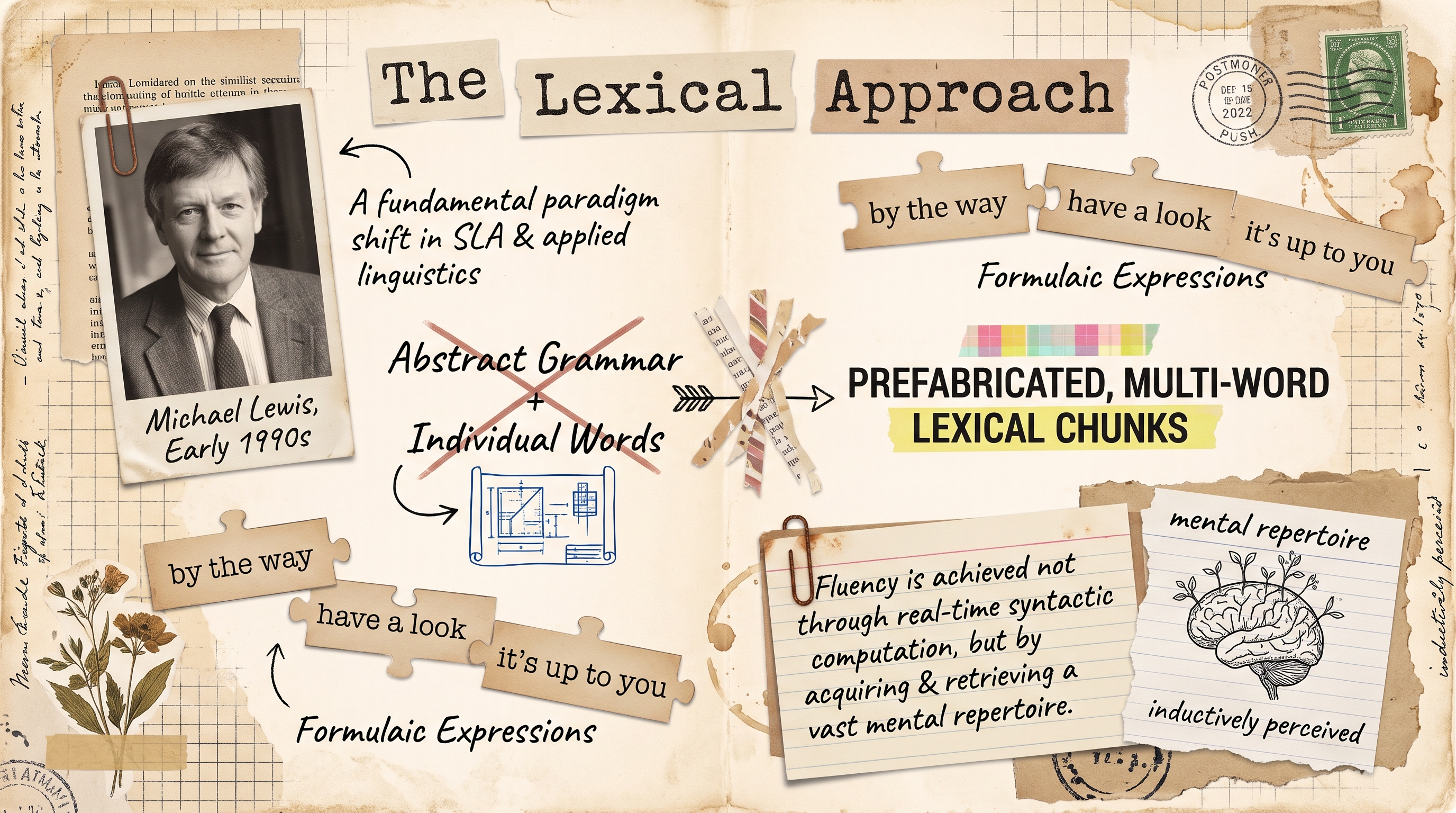
Across the pioneering corpus-driven research of John Sinclair, the applied pedagogical frameworks of Michael Lewis, and the psycholinguistic theory of Michael Hoey, this relationship is completely inverted.[1:1][2:2][3:1] Fluent natural language does not emerge from real-time syntactic calculations executed upon isolated dictionary entries; rather, "language consists of grammaticalised lexis, not lexicalised grammar."[1:2]
Under this unified paradigm:
- Structural Reality (Lewis): Native-speaker fluency is driven by the retrieval of vast inventories of prefabricated multi-word units—polywords, collocations, institutionalized utterances, and semi-fixed sentence frames—stored directly in long-term memory.[1:3][5]
- Cognitive Reality (Hoey): Syntax is not an innate, hardwired biological organ, but an emergent statistical phenomenon.[2:3] Through cumulative lifetime encounters with situated discourse, the human mind operates as a highly sensitive recording engine—a mental concordance—that subconscious layers each word with probabilistic primings for specific collocates, colligations, semantic preferences, and pragmatic functions.[2:4][6]
- Neurocognitive Efficiency: Grounded in Cognitive Load Theory and working memory constraints, retrieving pre-assembled lexical chunks as single cognitive gestalts circumvents the working memory bottleneck, liberating executive bandwidth for real-time strategic interaction, nuance, and contextual alignment.[7][8]
- Pedagogical Inversion: Deductive PPP (Presentation, Practice, Production) instruction is dismantled in favor of inductive, consciousness-raising OHE (Observe, Hypothesise, Experiment) cycles and emergent dialogue, moving learners past the "intermediate plateau" through collocational calibration.[1:4][9]
1. Historical & Epistemological Foundations: The Generative Fallacy vs. The Corpus Revolution
To understand the magnitude of the Lexical Paradigm, one must trace its emergence against the dominant twentieth-century linguistic orthodoxies.
The Generative "Slot-and-Filler" Orthodoxy
Throughout the mid-to-late twentieth century, generative linguistics—dominated by Noam Chomsky's formalist program—asserted that human language competence resides in a specialized, innate biological faculty: the Language Acquisition Device (LAD) or Universal Grammar (UG).[4:1] This framework established a strict, hierarchical dualism between grammar and lexis:
- Autonomous Syntax: Grammar was treated as a computational algorithm—an autonomous, abstract generative engine governed by universal structural principles and phrase-structure rules.[4:2]
- The Subordinate Lexicon: The lexicon was conceptualized merely as an appendix of arbitrary phonetic labels and morphological specifications. Words were passive "fillers" inserted into pre-existing syntactic "slots."[2:5][4:3]
This theoretical segregation exerted an overwhelming, distorting influence on global language teaching. Traditional pedagogical methodologies (such as Grammar-Translation and structural audio-lingualism) treated language acquisition as the mastery of an abstract rule apparatus: students memorized verb conjugation paradigms and syntactic permutations, subsequently attempting to assemble spontaneous sentences by slotting bilingual vocabulary words into grammatical equations.[1:5][5:1]
John Sinclair and the Birmingham Corpus Revolution
The empirical demolition of the generative slot-and-filler model began in the late 1970s and 1980s at the University of Birmingham, led by linguist John Sinclair.[3:2] Sinclair directed the revolutionary COBUILD (Collins Birmingham University International Language Database) project, creating the first multi-million-word computerized corpus of authentic, real-world English text.[3:3][10]
When computerized software began scanning millions of words of natural speech and writing, computational analysis uncovered statistical realities that completely contradicted native-speaker intuitions and Chomskyan abstractions:[3:4][6:1]
- Native speakers do not continually exercise their theoretically limitless grammatical capacity to generate novel sentences.[3:5]
- Instead, genuine communicative discourse consists of staggering recurrences of conventionalized, multi-word word partnerships.[3:6]
Sinclair formalized this discovery into a landmark dual-system principle governing linguistic behavior:[3:7]
| Linguistic Dimension | The Open-Choice Principle | The Idiom Principle |
|---|---|---|
| Operational Definition | Language production as a series of complex choices where the only constraint is broad grammatical grammaticality.[3:8] | Language production as the retrieval of semi-preconstructed, multi-word formulaic phrases that function as single choices.[3:9] |
| Structural Architecture | Traditional slot-and-filler syntax; words are selected independently to satisfy formal syntactic slots.[3:10][4:4] | Chunks, collocations, and phraseological units; lexical selections co-determine surrounding words and structures.[1:6][3:11] |
| Cognitive Resource Allocation | Demands continuous, high-latency computational processing in working memory for each clausal component.[7:1][8:1] | Demands rapid, low-latency memory lookup of pre-assembled units directly from long-term storage.[1:7][7:2] |
| Communicative Role | Reserved for highly technical, specialized, creative, or anomalous communicative moments.[3:12] | The foundational default engine accounting for the overwhelming majority of authentic communicative discourse.[1:8][3:13] |
Sinclair proved that the idiom principle is primary: human beings operate on pre-assembled phrases by default, reverting to the open-choice principle only when prefabricated lexical routines fail to satisfy an atypical communicative demand.[3:14]
Comprehensive Comparative Matrix: Three Evolutionary Paradigms
| Analytical Vector | Chomskyan Generative Grammar | Michael Lewis's Lexical Approach | Michael Hoey's Lexical Priming |
|---|---|---|---|
| Primary Organizing Unit | Abstract syntactic tree structures and transformation rules (UG).[4:5] | Multi-word lexical chunks, collocations, and formulaic frames.[1:9] | The individual word (node) primed across multi-dimensional linguistic vectors.[2:6] |
| Status of Grammar | Autonomous, hardwired computational algorithm preceding lexis.[4:6] | Grammaticalized lexis; grammar is the organizational refinement of words.[1:10] | Emergent property; grammar is the macroscopic outcome of microscopic word primings.[2:7] |
| Status of the Lexicon | Subordinate dictionary of arbitrary phonetic and semantic fillers.[4:7] | The foundational engine of meaning and primary carrier of communicative competence.[1:11] | Dynamic, cumulative mental concordance updating with every textual encounter.[2:8] |
| Model of Fluency | Infinite generative capacity producing novel, mathematically valid syntax.[4:8] | Rapid memory retrieval of prefabricated chunks with minimal modification.[1:12][7:3] | Harmonious matching of shared lexical, colligational, and semantic primings.[2:9] |
| Epistemic Source | Introspective native-speaker grammatical acceptability intuitions.[4:9] | Corpus linguistics databases and applied communicative classroom analysis.[1:13][3:15] | Large-scale computer corpora coupled with cognitive psychological priming theory.[2:10][6:2] |
| Treatment of Collocation | Peripheral, idiosyncratic stylistic preference; non-structural anomaly.[4:10] | Core structural building block bridging vocabulary and syntax.[1:14] | First dimension of priming; statistical affinity between recurrent lexical nodes.[2:11] |
| Pedagogical Prescription | Deductive rule presentation, syntactic tree analysis, mechanical drills.[1:15][5:2] | Inductive OHE cycles, chunk notebooks, noticing tasks, authentic texts.[1:16][9:1] | Massive contextualized input, corpus-driven awareness, speech-community immersion.[2:12] |
2. Michael Lewis's Lexical Approach: Structural Taxonomy of the Mental Lexicon
Building directly upon Sinclair's corpus findings, British linguist and educator Michael Lewis published two seminal treatises—The Lexical Approach: The State of ELT and a Way Forward (1993) and Implementing the Lexical Approach: Putting Theory into Practice (1997)—that translated phraseological linguistics into an actionable pedagogical methodology.[1:17][5:3]
The Core Inversion
Lewis encapsulated his pedagogical paradigm in a singular aphorism that systematically inverted the generative hierarchy:
"Language consists of grammaticalised lexis, not lexicalised grammar." — Michael Lewis (1993)[1:18]
Language acquisition does not progress from mastering abstract syntax to populating it with vocabulary. Rather, acquisition begins with acquiring high-frequency, holistic, meaningful lexical chunks. As learners accumulate an expansive mental inventory of these chunks, their cognitive architecture inductively perceives underlying structural patterns, gradually abstracting grammatical regularities from the lexical store.[1:19][5:4]
The Four-Tier Taxonomy of Multi-Word Lexical Units
To operationalize this insight, Lewis categorized the human mental lexicon into four discrete classes of lexical units, varying across a continuum of syntactic flexibility, internal compositionality, and communicative function:[1:20][5:5]
| Lexical Unit Category | Structural Characteristics | Degrees of Invariance | Pragmatic / Communicative Function | Authentic Corpus Examples |
|---|---|---|---|---|
| 1. Words and Polywords | Single vocabulary items and short, multi-word phrases that function as unified, indivisible semantic concepts.[1:21] | Completely fixed; cannot be syntactically altered, inserted into, or inverted without destroying meaning.[1:22] | Essential discourse markers, sentence transitionals, and compact descriptive tags.[1:23] | by the way, in a nutshell, upside down, all of a sudden, as a matter of fact, out of the blue |
| 2. Collocations | The habitual, statistically predictable co-occurrence of independent lexical items across grammatical pairings.[1:24][3:16] | Medium-to-high fixedness; governed by customary usage rather than absolute grammatical logic.[1:25] | Provides natural idiomatic phrasing, semantic precision, and native-speaker authenticity.[1:26][3:17] | bridge the gap, mitigate risk, profoundly grateful, glaring omission, incur debt, fervent hope |
| 3. Fixed Expressions | Prefabricated, immutable whole clauses or complete sentences retrieved in their entirety without grammatical calculation.[1:27][5:6] | Totally immutable; produced as standardized social formulas or transactional routines.[1:28] | Social lubricators, ritualized pleasantries, politeness mitigation, and classroom management.[1:29][5:7] | "I'd like to make a reservation," "How do you do?" "See you later," "Don't mention it," "Have a safe flight" |
| 4. Semi-Fixed Expressions (Sentence Frames) | Structural formulaic templates featuring fixed lexical scaffolding combined with variable open slots.[1:30][5:8] | Highly versatile; framework remains constant while open slots accept context-specific lexical arguments.[1:31] | Scaffold complex intellectual argumentation, hypothesis framing, and nuanced interpersonal negotiation.[1:32] | "The problem is not that [X], but that [Y];" "Could you pass the [item], please?" "It has been [time] since we [event]" |
The Spectrum of Collocational Binding
Collocations are not uniform; they exist along a fluid spectrum ranging from completely loose combinations to frozen, non-compositional idioms:[1:33][3:18]
- Free / Open Combinations: Words that pair freely based purely on semantic compatibility without statistical exclusivity (e.g., read a book, drive a car, blue sky).
- Medium-Strength Collocations: Words that exhibit strong mutual affinity, occurring together far more frequently than random chance or synonymous substitution would predict (e.g., run a risk, harbor doubts, bitter disappointment, pose a threat).
- Strong / Unique Collocations: Words whose occurrences are almost exclusively bound to a single partner (e.g., ulterior motive, shrug shoulders, curry favor, foot the bill).
3. Michael Hoey's Lexical Priming: The Psycholinguistic Engine of Emergent Grammar
While Michael Lewis formulated the pedagogical and descriptive architecture of the Lexical Approach, British corpus linguist Michael Hoey provided its definitive psycholinguistic and theoretical foundation in his landmark monograph, Lexical Priming: A New Theory of Words and Language (2005).[2:13]
The Psychological Root: Priming in the Cognitive Sensorium
Hoey adapted the established concept of priming from cognitive psychology.[2:14][11] In experimental psychology, exposure to an initial perceptual or conceptual stimulus unconsciously activates associated neural networks, accelerating reaction time and recognition for subsequent related stimuli (e.g., exposure to the word doctor primes the brain to recognize nurse significantly faster than butter).[11:1]
Hoey extended this mechanism into a comprehensive, radical theory of language architecture:[2:15]
"Lexis is complexly and systematically structured and that grammar is an outcome of this lexical structure." — Michael Hoey (2005)[2:16]
Every time a human being encounters a word in speech or text, the brain acts as an active, sensitive recording instrument—a mental concordance.[2:17][6:3] Subconsciously, the cognitive apparatus registers not merely the word's dictionary definition, but the entire situational, grammatical, and lexical environment in which it appeared.[2:18] Through thousands of cumulative encounters over a lifetime, the word becomes primed to evoke, and be evoked by, specific textual conditions.[2:19]
The Multi-Dimensional Architecture of Priming
Hoey demonstrated that lexical priming is not restricted to simple word-to-word pairing; rather, every word is systematically primed across multiple interlocking linguistic dimensions:[2:20][6:4]
| Dimension of Priming | Operational Definition | Cognitive & Structural Mechanics | Illustrative Linguistic Exemplars |
|---|---|---|---|
| 1. Collocation | Statistical affinity between specific lexical items.[2:21] | The word primes, and is primed by, the presence of specific lexical partners in adjacent positions.[2:22][3:19] | Winter primes harsh, bleak, or approaching; unmitigated primes disaster or gall.[2:23] |
| 2. Colligation | Statistical preference for specific grammatical categories, syntactic functions, or clause positions.[2:24][6:5] | The word is primed to appear in specific syntactic environments (e.g., passive voice, negative polarity, subject vs. object).[2:25] | The noun consequence is primed to colligate with the prepositional chunk as a consequence of, appearing clause-initially.[2:26] |
| 3. Semantic Association (Semantic Preference) | Tendency to keep company with an entire semantic category or evaluative field.[2:27][6:6] | The word primes an abstract semantic category, regardless of the individual lexical words filling the slot.[2:28] | The verb cause is overwhelmingly primed for negative nouns (harm, delays, damage); provide primes positive resources.[2:29] |
| 4. Pragmatic Association | Priming to perform specific communicative functions, speech acts, or social rituals.[2:30][12] | The word or phrase is primed to convey interpersonal meaning, such as hedging, mitigation, irony, or politeness.[2:31] | Phrases like with all due respect are primed to precede sharp disagreement; you know what I mean primes conversational bonding.[12:1] |
| 5. Textual Collocation & Colligation | Priming for specific locations and cohesion roles within macro-text structures.[2:32] | Words are primed to appear at the beginning or end of paragraphs, sections, academic abstracts, or conversational turns.[2:33] | The phrase in summary is primed to initiate final paragraphs; sixty years ago is primed to open narrative paragraphs.[2:34] |
The Mutual Comprehension Paradox and Speech Communities
One of the most profound theoretical dilemmas arising from Hoey's theory is the Mutual Comprehension Paradox:[2:35]
- If priming is an autobiographical record of an individual's unique historical encounters with language—the specific books read, conversations heard, socioeconomic background, and regional immersion—then no two speakers possess an identical linguistic system.[2:36]
- If everyone's mental concordance is idiosyncratic, why does human communication not disintegrate into complete solipsism and mutual incomprehension?[2:37]
Hoey resolves this through the concepts of speech communities and normative harmonization:[2:38]
[Individual Lifetime Linguistic Encounters]
                     │
                     ▼
  [Idiosyncratic Mental Concordance]
                     │
                     ▼
  [Participation in Shared Speech Communities]
(Institutional Media, Professional Discourse, Educational Canons)
                     │
                     ▼
      [Normative Harmonization]
(Calibration of Collocational, Colligational & Semantic Priors)
                     │
                     ▼
[Intersubjective Linguistic Consensus ("The Illusion of a Fixed Code")]
When individuals belong to the same social, educational, professional, and cultural networks, they are exposed to massive, overlapping pools of common discourse.[2:39] This shared immersion continuously calibrates, tests, and harmonizes their individual lexical primings.[2:40]
This dynamic directly bridges corpus linguistics with the phenomenological sociology of Alfred Schütz (1899–1959) and The Social Construction of Reality - A Treatise in the Sociology of Knowledge: intersubjective communication relies on typifications and shared stocks of knowledge.[2:41] The pervasive alignment across a speech community constructs the persistent illusion of an immutable, objective grammar code, when in reality language is a dynamic, self-organizing consensus maintained within shared forms of life—a reality presaged by Ludwig Wittgenstein's concept of language-games.[2:42]
Conversely, when speakers from divergent social, regional, or professional backgrounds interact, discordant primings generate communicative friction, producing the semantic interference analyzed in Signal vs Static - Breaking Down Communication Noise.[2:43]
4. Collocational Competence and Cognitive Architecture
The convergence of Lewis's phraseology and Hoey's psycholinguistics explains why collocational mastery is the true engine of human communicative fluency.[1:34][2:44][7:4]
Cognitive Load Theory and the Working Memory Bottleneck
Human working memory operates under severe neurobiological constraints. In foundational cognitive psychology, George Miller (1956) established that working memory can process only
| Processing Metric | Atomistic Generative Computation (Rule-Assembly) | Lexical Chunk Retrieval (Schema-Driven) |
|---|---|---|
| Cognitive Unit | Individual morphemes, isolated words, and grammatical rule-checks.[1:35][7:6] | Integrated multi-word chunks, prefabricated frames, and collocations.[1:36][7:7] |
| Working Memory Burden | Severe Overload: Each word selection, agreement check, and syntactic rule consumes an independent working memory slot.[7:8][13:1] | Minimal Load: An entire 4-to-6-word formulaic sequence occupies a single working memory slot as an informational gestalt.[7:9][8:2] |
| Retrieval Velocity | High latency; pauses, hesitations, and false starts caused by online syntactic assembly.[1:37][7:10] | Real-time, instantaneous retrieval directly from long-term memory structures.[1:38][7:11] |
| Attentional Focus | Exhausted by lower-order mechanical encoding (e.g., Did I conjugate the verb correctly?).[1:39] | Preserved for higher-order pragmatic nuance, rhetorical strategy, and empathy.[1:40][7:12] |
| Fluency Profile | Fragmented, robotic delivery characteristic of the "Intermediate Plateau" (CEFR B2).[1:41][5:9] | Smooth, native-like rhythmic cadence characteristic of Advanced Mastery (CEFR C1–C2).[1:42] |
As Alan Baddeley's multi-component model of working memory proves, the phonological loop and episodic buffer handle language far more efficiently when input is chunked into pre-packaged acoustic and semantic units.[8:3] Fluent speech is not an act of fast computation; it is an act of efficient memory retrieval.[1:43][7:13]
Delexicalized Verbs: The Functional Core of Natural Collocations
A critical breakthrough of the Lexical Approach was identifying the vital role of delexicalized verbs (also known as light verbs or empty verbs): make, do, take, have, give, get, put, and set.[1:44][5:10]
In traditional grammar, these verbs are treated with suspicion because they lack rich, independent semantic definitions. However, corpus linguistics demonstrates that these eight verbs are among the highest-frequency words in the English language, operating as grammatical anchors that generate thousands of indispensable collocations:[1:45][3:20]
| Delexicalized Verb | Core Collocational Network | Semantic Nuance / Underlying Pattern | Typical L1 Negative Transfer Error |
|---|---|---|---|
| Make | make amends, make a concession, make headway, make an inquiry, make a fuss | Constructive outcome; bringing about a new state, agreement, or communicative event.[1:46] | *do a concession, *do an inquiry |
| Do | do justice, do research, do chores, do someone a favor, do more harm than good | Performance of duties, ongoing processes, non-specific actions, and maintenance labor.[1:47] | *make research, *make a favor |
| Take | take precedence, take exception, take measures, take the initiative, take for granted | Proactive agency, defensive absorption, appropriation of authority, or temporal duration.[1:48] | *make measures, *give precedence |
| Have | have reservations, have a say, have an impact, have second thoughts, have the floor | Experiential state, possessed influence, internal cognitive posture, or temporary right.[1:49] | *make reservations (confused with booking) |
| Give | give leeway, give credence to, give an account of, give rise to, give the green light | Bestowal of credibility, granting of permission, communicative delivery, or causation.[1:50] | *make credence, *take leeway |
| Get | get wind of, get the hang of, get down to business, get a grip, get cold feet | Dynamic transition of state, sensory reception, rapid acquisition, or onset of fear.[1:51] | *take wind of, *make cold feet |
When language learners master delexicalized collocations, they shift from translating literal native-language verbs into English toward deploying English's natural phraseological combinations.[1:52][5:11]
The "Intermediate Plateau" and Collocational Dissonance
Language learners frequently stall at the CEFR B2 boundary—a phenomenon known as the Intermediate Plateau.[1:53][5:12] At this stage, the learner has acquired a massive single-word vocabulary and possesses an explicit understanding of formal grammar rules. However, their speech remains unmistakably foreign, awkward, and computationally strained.[1:54]
The root of this stagnation is collocational dissonance:[1:55][2:45]
- The student constructs sentences that are structurally flawless according to syntax, but statistically unnatural according to corpus primings.[1:56][2:46]
- A student might say: "The government launched an energetic campaign to eradicate the thick traffic and cure the sickness."
- Every word is grammatically viable and semantically interpretable. Yet, an authentic corpus-informed native speaker would immediately say: "The government launched an aggressive campaign to alleviate heavy traffic and treat the disease."
- Fluency is not the ability to combine arbitrary words according to grammar; fluency is knowing which words naturally keep company with one another.[1:57][3:21]
5. Pedagogical Re-Engineering: Classroom Methodology, Curricular Design, and Dogme ELT
The Lexical Paradigm demands the complete dismantling of legacy instructional models, replacing teacher-centric lecture methods with inductive, corpus-informed consciousness-raising.[1:58][9:2]
Dismantling the PPP Fallacy
For generations, teacher training colleges and published ESL coursebooks relied dogmatically upon the PPP (Presentation, Practice, Production) paradigm:[1:59][9:3]
- Presentation: The teacher presents an isolated grammatical rule deductively (e.g., the structure of the third conditional).
- Practice: Students complete controlled, decontextualized exercises (gap-fills, substitution drills).
- Production: Students are pressured to produce the target structure in a simulated communicative dialogue.
Lewis condemned PPP as an unscientific, behaviorist fraud that misconstrues the nature of human language acquisition.[1:60][5:13] Language learning is not a linear, additive factory process where discrete grammatical rules are mastered one-by-one and permanently integrated into productive competence on command.[1:61] In reality, acquisition is organic, cyclical, and holistic.[1:62]
The Inductive OHE Cycle
In place of PPP, Lewis instituted the OHE (Observe, Hypothesise, Experiment) pedagogical framework, aligning classroom tasks with inductive cognitive discovery:[1:63][5:14]
                  [1. OBSERVE]
    Immerse in authentic, contextualized discourse;
         Actively notice recurring multi-word chunks.
                        │
                        ▼
                [2. HYPOTHESISE]
    Analyze observations; compare with native primings;
    Inductively formulate working rules on lexical behavior.
                        │
                        ▼
                [3. EXPERIMENT]
    Deploy chunks in dynamic communicative tasks;
    Test collocational boundaries through guided interaction.
- Observe: Learners are immersed in rich, authentic spoken transcripts, journalism, literature, or professional texts. The teacher’s role is not to explain grammar, but to guide students to notice multi-word chunks, delexicalized verb pairings, and institutionalized frames.[1:64][9:4]
- Hypothesise: Students analyze their observations, formulating their own working hypotheses regarding collocational restrictions, register nuances, and colligational patterns (e.g., Why does this author write "conduct an experiment" rather than "make an experiment"?).[1:65]
- Experiment: Learners test their hypotheses in communicative tasks, adapting semi-fixed frames and integrating newly noticed collocations into dynamic dialogue, receiving immediate, natural feedback on communicative efficacy.[1:66][5:15]
Richard Schmidt's Noticing Hypothesis as Cognitive Gateway
The cognitive engine connecting OHE with real-world acquisition is Richard Schmidt’s Noticing Hypothesis (1990).[14] Schmidt proved that mere passive exposure to rich input is insufficient for acquisition; subliminal language acquisition does not occur in adult learners.[14:1]
To convert ambient communicative input into internalized linguistic intake, the learner’s focal consciousness must actively notice the formal properties of the target feature.[1:67][14:2] Lexical pedagogy systematically scaffolds this noticing through specialized classroom interventions:[1:68][5:16]
- Collocation Highlighting: Students scan texts with colored highlighters, tagging entire verb-noun partnerships, polywords, and discourse markers rather than individual unfamiliar words.[1:69]
- Lexical Notebook Design: Students abandon alphabetical, single-word bilingual lists, organizing notebooks instead around semantic nodes, situational frames, and collocational webs.[1:70]
- Collocation Discrimination Tasks: Exercises that contrast competing combinations (e.g., harbor doubts vs. *hold doubts; gain momentum vs. *win momentum) to sharpen intuitive pattern recognition.[1:71][3:22]
Scott Thornbury's Dogme ELT (Teaching Unplugged)
The logical culmination of the Lexical Paradigm in contemporary pedagogy is Scott Thornbury’s Dogme ELT (Teaching Unplugged).[9:5] Inspired by the Dogme 95 Danish cinema movement, Thornbury proposed stripping the language classroom of published, commercial coursebooks, grammar worksheets, and technological apparatus.[9:6]
Dogme ELT operates on three core principles:[9:7]
- Materials-Light: The classroom relies entirely on the lived experiences, thoughts, and emergent interactions of the human beings in the room.[9:8]
- Conversation-Driven: Language is acquired through authentic, dialogic interaction rather than artificial textbook scenarios.[9:9]
- Focus on Emergent Language: The teacher does not impose a pre-packaged, synthetic syllabus; instead, the teacher captures the emergent language produced by students as they struggle to articulate real meaning, refining, correcting, and recasting that language into natural, high-currency lexical chunks directly on the whiteboard.[9:10]
Dogme ELT operationalizes Michael Hoey's insight: learners acquire authentic primings not through artificial grammar exercises, but through real-time communicative encounters that reflect how words are actually primed within living speech communities.[2:47][9:11]
6. Comprehensive Pedagogical and Taxonomic Matrices
Comprehensive Matrix: The Spectrum of Formulaic Language
| Category of Formulaic Unit | Canonical Defining Feature | Degree of Syntactic Flexibility | Cognitive Processing Unit | Primary Pedagogical Target | Vault Architectural Manifestation |
|---|---|---|---|---|---|
| Polywords | Multi-word sequences operating as indivisible lexical wholes.[1:72] | Zero Flexibility: Absolute syntactic freezing.[1:73] | Single atomic lexical chunk.[7:14] | Discourse flow, coherence, sentence transitions.[1:74] | 03-Chunks (e.g., [[by-the-way]], [[all-of-a-sudden]]) |
| Collocations (Verb + Noun) | Delexicalized or lexical verb paired with a conventional noun argument.[1:75][3:23] | Moderate Flexibility: Allows tense, aspect, and modifier insertion.[1:76] | Compound collocational pair.[2:48][7:15] | Eradicating unnatural literal L1 translations.[1:77][5:17] | 02-Patterns (e.g., make amends, take measures) |
| Collocations (Adj + Noun / Adv + Adj) | Descriptive modifier habituated to specific nominal or adjectival heads.[1:78] | Low-to-Moderate: Morphological inflections apply.[1:79] | Attributive descriptive chunk.[2:49] | Expressive precision and register calibration.[1:80][6:7] | 01-Nodes (e.g., bitter disappointment, deeply rooted) |
| Fixed Expressions | Complete clauses standardized for pragmatic social interaction.[1:81][5:18] | Zero Flexibility: Immutable social ritual.[1:82] | Unitary social script / formula.[7:16] | Pragmatic competence, transactional confidence.[1:83] | Formulaic Chunks (e.g., [[pleased-to-meet-you]]) |
| Sentence Frames / Heads | Scaffolding templates with open slots for clausal arguments.[1:84] | High Flexibility: Variable slot arguments.[1:85] | Structural syntactic schema.[7:17] | Advanced discourse organization and debate.[1:86] | Semi-fixed Templates (e.g., [[it-goes-without-saying]]) |
| Metaphoric Idioms | Figurative expressions grounded in embodied physical source domains.[1:87] | Variable: Generally high semantic non-compositionality.[1:88] | Conceptual cognitive metaphor.[15] | Cognitive fluency, cultural literacy, rhetorical poise.[15:1] | Metaphoric Language/02 Expressions/ |
Systematic Comparative Matrix: Pedagogical Methodologies
| Pedagogical Axis | Presentation, Practice, Production (PPP) | Lewis's Lexical Approach (OHE) | Thornbury's Dogme ELT (Teaching Unplugged) | Corpus-Informed ESP Curriculum |
|---|---|---|---|---|
| Epistemological Basis | Behaviorist structuralism; linear additive acquisition.[1:89][5:19] | Inductive cognitive discovery; grammaticalized lexis.[1:90] | Critical pedagogy; emergent conversational dialogue.[9:12] | Empirical lexicogrammar; statistical frequency analysis.[3:24][6:8] |
| Primary Classroom Currency | Decontextualized grammar rules and isolated vocabulary lists.[1:91] | Multi-word chunks, collocations, and authentic input texts.[1:92][5:20] | Spontaneous student conversation and emergent whiteboard recasts.[9:13] | Domain-specific collocational bands and genre colligations.[6:9] |
| Role of the Teacher | Authoritarian instructor; presents rules and controls practice.[1:93] | Facilitator of noticing; orchestrator of OHE discovery cycles.[1:94] | Active conversational participant and linguistic curator.[9:14] | Corpus analyst, linguistic coach, and discourse mentor.[10:1] |
| Role of Coursebooks | Indispensable; dictates structural syllabus and exercise order.[1:95] | Subordinated; replaced by authentic literature and articles.[1:96] | Completely Eliminated: Classes operate materials-light.[9:15] | Curated specialist corpora, industry whitepapers, case studies.[10:2] |
| Cognitive Learning Mechanism | Deductive rule memorization followed by mechanical drills.[1:97] | Schmidt's Noticing Hypothesis; inductive pattern extraction.[14:3] | Intersubjective scaffolding during immediate communicative need.[9:16] | Statistical priming recalibration within professional registers.[2:50] |
| Target Competence | Formal grammatical correctness (often syntactically sterile).[1:98] | Idiomatic naturalness, fluency speed, collocational depth.[1:99] | Authentic personal voice, conversational agility, autonomy.[9:17] | Executive poise, professional precision, genre authority.[10:3] |
🎴 Interactive Web Practice (Comprehension Check)
Question 1 (The Foundational Inversion & Sinclair's Idiom Principle): How does the foundational maxim "language consists of grammaticalised lexis, not lexicalised grammar" dismantle Chomskyan generative models, and how did John Sinclair's corpus discovery of the "idiom principle" validate this claim?
Answer: In traditional Chomskyan generative linguistics and conventional structuralist pedagogies, language is conceptualized as an autonomous, mathematical syntax engine (the rules/slots) into which individual vocabulary items are inserted as passive fillers. In this view, syntax is the primary generative engine of meaning, and vocabulary is merely subordinate.
Michael Lewis and John Sinclair radically invert this hierarchy:
- The Lexical Primacy: Language is fundamentally composed of multi-word lexical units, prefabricated chunks, and conventional collocations that carry culturally settled meanings. Grammar does not precede vocabulary; rather, grammatical structures emerge inductively as regularized patterns across accumulated lexical combinations. In native-speaker production, speakers do not calculate sentences from scratch using abstract syntax; they retrieve pre-assembled lexical units and make minimal grammatical adjustments as required. Therefore, lexis is the bedrock of language, and grammar is the organizational refinement of that lexis.
- The Idiom Principle: John Sinclair’s pioneering computerized corpus work at the University of Birmingham demonstrated that human language does not operate predominantly on the Open-Choice Principle (freely selecting words constrained only by grammar). Instead, it operates overwhelmingly on the Idiom Principle: language users have at their disposal a vast inventory of semi-preconstructed, multi-word phrases that represent single communicative choices. Speakers revert to open-choice grammatical computation only when formulaic resources fail to satisfy an unusual communicative demand.
Question 2 (Hoey's Lexical Priming & The Emergence of Grammar): Explain Michael Hoey's psychological mechanism of "priming." How do the dimensions of collocation, colligation, semantic association, and pragmatic association operate together, and what does it mean to state that grammar is an "outcome" of lexical priming?
Answer: Michael Hoey adapts the cognitive psychological concept of priming to linguistic theory:
- The Psychological Mechanism: Whenever an individual encounters a word in speech or text, the brain operates as an active recording instrument—a mental concordance. The cognitive sensorium registers not only the word's semantic denotation, but the entire syntactic, lexical, and situational context surrounding it. Through cumulative repetition, the word becomes psychologically primed to co-occur with specific textual features.
- The Four Core Dimensions:
- Collocation: The word is primed to co-occur with specific partner words (e.g., unmitigated priming disaster).
- Colligation: The word is primed to prefer or avoid specific grammatical environments, clause positions, or syntactic functions (e.g., consequence preferentially colligating clause-initially as as a consequence of).
- Semantic Association (Semantic Preference): The word is primed to keep company with an entire semantic category or evaluative field (e.g., cause consistently associating with negative nouns like harm or crisis, whereas provide primes positive resources).
- Pragmatic Association: The word is primed to execute specific communicative moves or social rituals (such as politeness mitigation, irony, or conversational hedging).
- Grammar as an Outcome: Traditional linguistics treats grammar as an overarching master blueprint that dictates how words behave. Hoey proves that "grammar" is actually an optical illusion created by the macroscopic overlap of thousands of individual words exhibiting their own microscopic, highly structured behavioral primings. Syntax is not an independent cognitive engine; it is the statistical outcome of cumulative lexical primings harmonized across a speech community.
Question 3 (Cognitive Load Theory, Working Memory & The OHE Pedagogical Paradigm): Why does rule-based sentence production induce disfluency under Cognitive Load Theory, and how does the Observe-Hypothesise-Experiment (OHE) cycle structurally replace the behaviorist PPP model in language education?
Answer: The transition from traditional grammar-translation to the Lexical Approach resolves fundamental neurocognitive constraints:
- Cognitive Load & Working Memory: According to John Sweller's Cognitive Load Theory and George Miller's working memory capacity ($7 \pm 2$ chunks), human working memory is severely limited. If a non-native speaker attempts to produce spontaneous speech by selecting individual words, looking up bilingual definitions, determining grammatical categories, applying conjugation paradigms, and checking word-order algorithms, their working memory experiences catastrophic cognitive overload. This computational bottleneck causes hesitation, pausing, and fragmented delivery. In contrast, retrieving a prefabricated multi-word chunk (e.g., "at the end of the day," "make a concession") occupies only a single working memory slot as an informational gestalt, freeing vital cognitive bandwidth for communicative nuance and discourse monitoring.
- The OHE Cycle vs. PPP: The legacy PPP (Presentation, Practice, Production) model assumes an artificial, behaviorist, linear acquisition path: the teacher explains a discrete rule deductively, students drill it mechanically, and are expected to produce it on command. Michael Lewis replaced PPP with the inductive OHE cycle:
- Observe: Learners are exposed to rich, authentic discourse and guided to actively notice (via Richard Schmidt's Noticing Hypothesis) multi-word chunks, collocations, and fixed expressions.
- Hypothesise: Learners examine the observed chunks and inductively formulate working hypotheses regarding their structural boundaries, contextual restrictions, and pragmatic functions.
- Experiment: Learners deploy these observed chunks in communicative tasks, testing their hypotheses in dynamic interaction and refining their linguistic intuition based on communicative feedback.
Resonant Notes
The following notes in the vault share direct thematic, linguistic, and cognitive connections with the Lexical Paradigm, Lexical Priming, and Collocational Competence:
🔴 Applied Linguistics, Corpus Studies & Pedagogical Reform
- The Lexical Approach by Michael Lewis — Foundational monograph note detailing Lewis's historical texts (1993, 1997), the critique of deductive grammar, and the four categories of lexical units integrated into this master study.
- Lexical Priming - A New Theory of Words and Language — Foundational monograph note detailing Michael Hoey's 2005 theory, the mental concordance, multi-dimensional primings, and speech community harmonization integrated into this master study.
- Collocations — Foundational operational note detailing habitual co-occurrences, delexicalized verb networks, and the diagnostic signatures of the intermediate plateau integrated into this master study.
- Scott Thornbury's Teaching Unplugged (Dogme ELT) — Shares Lewis's and Hoey's rejection of pre-packaged coursebooks and mechanical PPP drills, creating a materials-light, conversation-driven classroom where lexicogrammar emerges naturally from student dialogue.
- Grammar C2 - Collocation and Register — Advanced curricular application of the Lexical Paradigm, demonstrating that mastery of high-level English depends entirely on navigating genre-specific collocational bands and stylistic constraints rather than syntactic rules.
- The Teacherpreneur — Educational sociology analysis examining how independent teacherpreneurs liberate themselves from commercial coursebooks by deploying the Lexical Approach and Dogme pedagogy to deliver authentic, high-impact instruction.
- The Freeze-Drying of Language — The Dictionary (1755), Prescriptive Grammar, and the Social Stratification of Speech — Historical critique of how prescriptive eighteenth-century grammarians and dictionary makers artificially divorced vocabulary from authentic living syntax, creating the generative fallacy that the Lexical Paradigm overturns.
🟡 Cognitive Architecture, Schema Theory & Working Memory
- Cognitive Load Theory — John Sweller's cognitive architecture provides the neurocognitive proof for the Lexical Approach: retrieving pre-assembled formulaic chunks from long-term memory bypasses the working memory bottleneck, enabling fluent real-time speech production.
- Cognitive Schemas — Formulaic lexical chunks, delexicalized collocations, and semi-fixed sentence frames function as linguistic schemas—pre-packaged cognitive templates that automate communicative processing.
- Gestalt Psychology-The Mechanics of the Whole — Lewis's and Hoey's insistence that multi-word chunks are acquired, stored, and retrieved as holistic communicative entities validates Gestalt theory's foundational axiom that the psychological whole is distinct from the sum of its grammatical parts.
- Theory of Mind - The Cognitive Architecture of Social Intelligence — Hoey's concept of pragmatic association—how words are primed for specific interpersonal moves, politeness, and mitigation—presupposes a speaker's capacity to model the mental states and social expectations of their conversational partner.
- Iain McGilchrist — McGilchrist’s hemispheric dichotomy mirrors the debate between Chomsky and the Lexical Paradigm: the left hemisphere’s atomistic, decontextualized parsing corresponds to generative grammar's slot-and-filler syntax, while the right hemisphere's contextual, embodied, and holistic grasp reflects the associative networks of lexical priming.
- The Flow State — Mihaly Csikszentmihalyi's flow state occurs when task challenges match automated schema competence; mastering prefabricated lexical chunks eliminates communicative anxiety, allowing speakers to enter linguistic flow.
🟢 Epistemology, Ordinary Language & Sociolinguistics
- Ordinary Language Philosophy — Ludwig Wittgenstein's and J.L. Austin's therapeutic return to everyday linguistic usage prefigures the Lexical Paradigm; Wittgenstein's doctrine that "meaning is use" within situated "language-games" directly underpins Hoey's theory that words are primed through authentic social encounters.
- Ludwig Wittgenstein — Wittgenstein's rejection of formal ideal languages in favor of ordinary language-games provides the philosophical bedrock for the Lexical Paradigm, establishing that words derive meaning exclusively through customary usage.
- Alfred Schütz (1899–1959) & The Social Construction of Reality - A Treatise in the Sociology of Knowledge — Schütz's phenomenological concepts of typification and shared stocks of knowledge explain how individuals with idiosyncratic mental concordances achieve mutual comprehension through speech-community harmonization.
- Signal vs Static - Breaking Down Communication Noise — Collocational mismatches and conflicting lexical primings generate acute semantic noise, demonstrating that idiomatic naturalness is vital to clear, frictionless interpersonal communication.
- Portmanteau (also known as a lexical blend or blend word) — Demonstrates the extreme morphological boundary of lexical priming, where two habitually co-occurring concepts collapse into a single lexical item through communicative efficiency.
- McLuhan's The Medium is the Message — Marshall McLuhan's media ecology provides a critical perspective on language materials; commercial grammar coursebooks function as restrictive pedagogical media whose rigid structural exercises distort authentic linguistic behavior.
References
Michael Lewis / The Lexical Approach: The State of ELT and a Way Forward / Language Teaching Publications, 1993 ↩︎ ↩︎ ↩︎ ↩︎ ↩︎ ↩︎ ↩︎ ↩︎ ↩︎ ↩︎ ↩︎ ↩︎ ↩︎ ↩︎ ↩︎ ↩︎ ↩︎ ↩︎ ↩︎ ↩︎ ↩︎ ↩︎ ↩︎ ↩︎ ↩︎ ↩︎ ↩︎ ↩︎ ↩︎ ↩︎ ↩︎ ↩︎ ↩︎ ↩︎ ↩︎ ↩︎ ↩︎ ↩︎ ↩︎ ↩︎ ↩︎ ↩︎ ↩︎ ↩︎ ↩︎ ↩︎ ↩︎ ↩︎ ↩︎ ↩︎ ↩︎ ↩︎ ↩︎ ↩︎ ↩︎ ↩︎ ↩︎ ↩︎ ↩︎ ↩︎ ↩︎ ↩︎ ↩︎ ↩︎ ↩︎ ↩︎ ↩︎ ↩︎ ↩︎ ↩︎ ↩︎ ↩︎ ↩︎ ↩︎ ↩︎ ↩︎ ↩︎ ↩︎ ↩︎ ↩︎ ↩︎ ↩︎ ↩︎ ↩︎ ↩︎ ↩︎ ↩︎ ↩︎ ↩︎ ↩︎ ↩︎ ↩︎ ↩︎ ↩︎ ↩︎ ↩︎ ↩︎ ↩︎ ↩︎ ↩︎
Michael Hoey / Lexical Priming: A New Theory of Words and Language / Routledge ↩︎ ↩︎ ↩︎ ↩︎ ↩︎ ↩︎ ↩︎ ↩︎ ↩︎ ↩︎ ↩︎ ↩︎ ↩︎ ↩︎ ↩︎ ↩︎ ↩︎ ↩︎ ↩︎ ↩︎ ↩︎ ↩︎ ↩︎ ↩︎ ↩︎ ↩︎ ↩︎ ↩︎ ↩︎ ↩︎ ↩︎ ↩︎ ↩︎ ↩︎ ↩︎ ↩︎ ↩︎ ↩︎ ↩︎ ↩︎ ↩︎ ↩︎ ↩︎ ↩︎ ↩︎ ↩︎ ↩︎ ↩︎ ↩︎ ↩︎ ↩︎
John Sinclair / Corpus, Concordance, Collocation / Oxford University Press, 1991 ↩︎ ↩︎ ↩︎ ↩︎ ↩︎ ↩︎ ↩︎ ↩︎ ↩︎ ↩︎ ↩︎ ↩︎ ↩︎ ↩︎ ↩︎ ↩︎ ↩︎ ↩︎ ↩︎ ↩︎ ↩︎ ↩︎ ↩︎ ↩︎ ↩︎
Noam Chomsky / Aspects of the Theory of Syntax / MIT Press, 1965 ↩︎ ↩︎ ↩︎ ↩︎ ↩︎ ↩︎ ↩︎ ↩︎ ↩︎ ↩︎ ↩︎
Michael Lewis / Implementing the Lexical Approach: Putting Theory into Practice / Language Teaching Publications, 1997 ↩︎ ↩︎ ↩︎ ↩︎ ↩︎ ↩︎ ↩︎ ↩︎ ↩︎ ↩︎ ↩︎ ↩︎ ↩︎ ↩︎ ↩︎ ↩︎ ↩︎ ↩︎ ↩︎ ↩︎ ↩︎
Susan Hunston / Corpora in Applied Linguistics / Cambridge University Press, 2002 ↩︎ ↩︎ ↩︎ ↩︎ ↩︎ ↩︎ ↩︎ ↩︎ ↩︎ ↩︎
John Sweller / Cognitive Load During Problem Solving: Effects on Learning / Cognitive Science ↩︎ ↩︎ ↩︎ ↩︎ ↩︎ ↩︎ ↩︎ ↩︎ ↩︎ ↩︎ ↩︎ ↩︎ ↩︎ ↩︎ ↩︎ ↩︎ ↩︎ ↩︎
Alan D. Baddeley / Working Memory, Thought, and Action / Oxford University Press, 2007 ↩︎ ↩︎ ↩︎ ↩︎
Scott Thornbury / How to Teach Speaking / Pearson Longman, 2005 ↩︎ ↩︎ ↩︎ ↩︎ ↩︎ ↩︎ ↩︎ ↩︎ ↩︎ ↩︎ ↩︎ ↩︎ ↩︎ ↩︎ ↩︎ ↩︎ ↩︎ ↩︎
John Sinclair / Trust the Text: Language, Corpus and Discourse / Routledge, 2004 ↩︎ ↩︎ ↩︎ ↩︎
David F. G. Tucker / Psychological Priming and Lexical Priming / Google Scholar ↩︎ ↩︎
Michael Pace-Sigge / Lexical Priming in Spoken English Usage / Palgrave Macmillan, 2013 ↩︎ ↩︎
George A. Miller / The Magical Number Seven, Plus or Minus Two: Some Limits on Our Capacity for Processing Information / Psychological Review, 1956 ↩︎ ↩︎
Richard Schmidt / The Role of Consciousness in Second Language Learning / Applied Linguistics, 1990 ↩︎ ↩︎ ↩︎ ↩︎
George Lakoff & Mark Johnson / Metaphors We Live By / University of Chicago Press, 1980 ↩︎ ↩︎