Terror Management Theory (TMT) and Epistemological Defense
🗂️ Interactive Notebook: Open Study Companion (Video Summary, Flashcards, Mind Map) ↗
This master monograph consolidates and comprehensively expands Terror Management Theory (TMT) and Transdisciplinary Analysis of Epistemological Illusion and Cognitive Defense into an exhaustive, transdisciplinary study of existential thanatology, mortality salience, the dual-process cognitive defense architecture, and the epistemological buffering mechanisms that protect human consciousness from ontological dread. It eliminates redundancies across the Beckerian Thanatological Paradox, proximal vs. distal processing models, redundant mortality salience findings, and predictive processing/DMN sections, while replacing legacy ASCII diagrams with structured taxonomic tables and rigorous analytical prose.
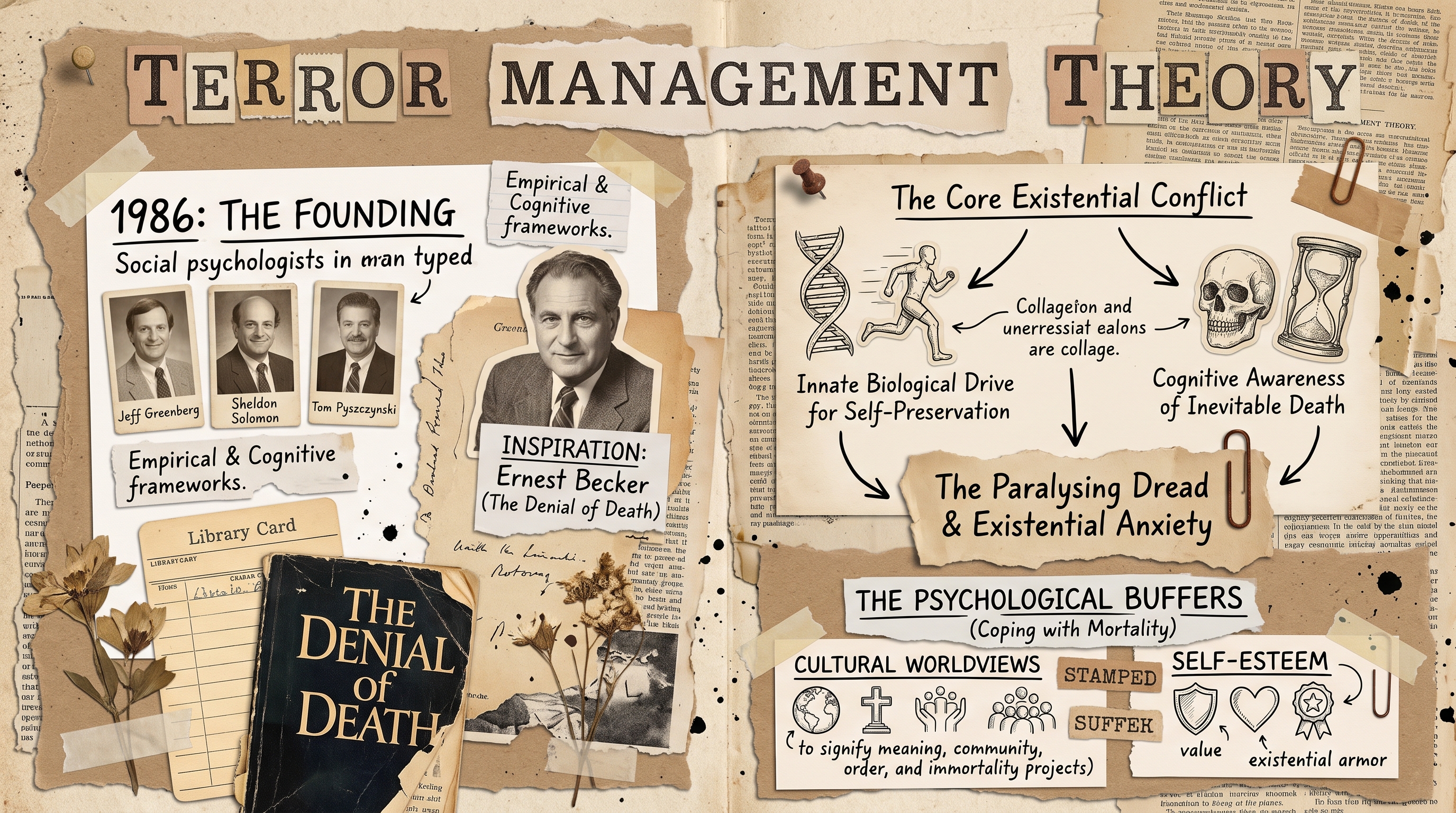
Human consciousness is defined by a radical ontological contradiction: the evolutionary emergence of the neocortex conferred abstract symbolic reflection, self-reflexive apperception, and temporal forecasting, yet these very capacities revealed humanity's absolute physical contingency and guaranteed mortality.[1][2][3] Søren Kierkegaard identified this psychological condition as Angst (the objectless existential dread born of freedom confronting finitude), while cultural anthropologist Ernest Becker diagnosed it in The Denial of Death as the Thanatological Paradox—the torment of being a "god with the body of a worm."[1:1][3:1]
In 1986, social psychologists Jeff Greenberg, Sheldon Solomon, and Tom Pyszczynski operationalized Becker’s thesis into Terror Management Theory (TMT), establishing an empirical laboratory framework for measuring how the human mind defends itself against awareness of its own finitude.[2:1][4] Across more than a thousand empirical studies, the Mortality Salience (MS) paradigm has demonstrated that reminding individuals of their mortality triggers an automated dual-process defense system: immediate conscious suppression and rationalization (proximal defense) followed by subconscious Death-Thought Accessibility (DTA) that drives aggressive cultural worldview defense, outgroup derogation, moral punitiveness, and self-esteem striving (distal defense).[2:2][4:1][5]
Grounded in predictive processing models of cognition (the Free-Energy Principle) and cognitive neuroscience, this defense architecture reveals that epistemological illusions—shared cultural worldviews (nomoi), symbolic immortality projects (causa sui), and rigid self-esteem metrics—are not mere social conventions or cognitive errors; they are functional, low-error predictive priors that insulate the autobiographical ego in the Default Mode Network (DMN) from catastrophic prediction error and thermodynamic entropy.[6][7][8] Consequently, when incoming empirical evidence or outgroup dissent challenges an individual's worldview, the cognitive system does not treat it as an abstract intellectual discrepancy; it registers the anomaly as an existential threat akin to physical predator attack, deploying Identity Protective Cognition, cognitive dissonance, and defensive communication tactics to protect narrative equilibrium at the expense of epistemological truth.[6:1][8:1][9]
1. Philosophical & Anthropological Foundations: The Thanatological Paradox and Kierkegaardian Angst
To comprehend how human cognition manages existential terror, we must first examine the existential and anthropological roots that prefigured modern laboratory psychology.
Kierkegaardian Angst vs. Environmental Fear (Frygt)
In The Concept of Anxiety (1844), Danish philosopher Søren Kierkegaard established a foundational epistemological distinction that anticipated modern existential psychology: the demarcation between concrete fear (Frygt) and existential anxiety (Angst).[10]
- Fear (Frygt): A targeted, adaptive emotional reaction directed toward a specific, identifiable environmental danger (e.g., an approaching predator, a falling boulder, a contagious disease). Fear engages immediate somatic survival mechanisms (fight-or-flight) and subsides once the tangible threat is avoided or neutralized.[10:1]
- Existential Anxiety (Angst): An objectless, pervasive psychological state unique to self-conscious organisms. Angst does not respond to a localized entity; it is the ontological confrontation with pure possibility, absolute freedom, and inevitable physical dissolution.[10:2]
Kierkegaard famously characterized Angst as the "vertigo of freedom"—the psychological dizziness experienced when consciousness peers into the abyss of its own radical contingency and realizes that no external structure guarantees its existence.[10:3] He defined the human self as a dynamic relation that relates itself to itself, suspended between the finite (the decaying biological organism) and the infinite (abstract symbolic thought and eternal aspirations).[10:4] To escape the paralyzing vertigo of this realization, the human being must make an existential commitment or "qualitative leap," anchoring consciousness within cultural beliefs, ethical systems, or metaphysical narratives that impose synthetic order upon ontological chaos.[10:5]
Ernest Becker and the Thanatological Paradox
In his 1973 Pulitzer Prize-winning treatise, The Denial of Death, cultural anthropologist Ernest Becker integrated Kierkegaard’s phenomenology with the psychoanalytic insights of Sigmund Freud and Otto Rank, articulating humanity’s central existential predicament: the Thanatological Paradox.[1:2][3:2]
Becker argued that the evolutionary development of the human neocortex produced an unbridgeable cognitive rift. Human beings possess an expansive symbolic capacity capable of conceptualizing infinity, eternity, universal justice, and transcendent meaning; yet this god-like consciousness remains imprisoned within a vulnerable, decaying, defecating mammalian body doomed to biological annihilation.[1:3]
"Man is a creator with the mind of a god, and a body of a worm... He is hopelessly split in two: he has an awareness of his own splendid uniqueness in that he sticks out of the nature with a towering majesty, and yet he goes back into the ground a few feet in order blindly and dumbly to rot and disappear forever."[1:4]
The Tripartite Anxiety-Buffering Matrix
To function in daily life without succumbing to persistent, incapacitating terror, human evolution favored the emergence of an anxiety-buffering system.[2:3][4:2] This psychological armor transforms raw existential dread into structured, orderly human behavior across three interdependent structures:[2:4][4:3][11]
| Psychological Structure | Core Operational Mechanism | Existential Buffering Function | Literal vs. Symbolic Fulfillment |
|---|---|---|---|
| Cultural Worldview (Nomos) | Shared, intersubjectively validated symbolic systems that imbue the cosmos with order, purpose, stability, and enduring meaning.[2:5][12] | Insulates consciousness against anomic terror and existential absurdity by framing human life within an orderly, permanent reality.[12:1] | Literal: Promises of post-mortem survival (heaven, reincarnation, karma, cosmic union). Symbolic: Identification with enduring secular institutions (nations, arts, sciences, historical movements).[2:6] |
| Self-Esteem | The subjective assessment that one is an object of primary value and dignity within the context of a meaningful universe.[4:4][13] | Acts as an individualized anxiety shield, proving that the self is successfully fulfilling the normative standards of the cultural worldview.[13:1] | Literal: Divine election, moral purity, spiritual righteousness. Symbolic: Professional status, wealth accumulation, intellectual prestige, physical beauty.[13:2] |
| Close Attachments | Secure, intimate interpersonal relationships and validated dyadic relational bonds.[11:1] | Provides visceral, somatic, and developmental security, counteracting feelings of ontological isolation and cosmic vulnerability.[11:2] | Literal: Protective parental holding environments and secure partner attachment shields. Symbolic: Family lineage, generational bloodlines, enduring love narratives.[11:3] |
2. Epistemological Illusion and Symbolic Immortality: Constructing the Cultural Nomos
An epistemological illusion occurs when subjective, culturally constructed representations of reality are reflexively mistaken for objective, immutable metaphysical truths.[12:2][14] Far from being mere cognitive defects, these illusions represent indispensable psychological defenses engineered to mitigate the paralyzing effects of existential dread.[2:7][14:1]
Evolutionary Tuning: The Interface Theory of Perception (ITP)
In accordance with Donald Hoffman's The Interface Theory of Perception (ITP) and the evolutionary Fitness Beats Truth theorem, perceptual and cognitive faculties did not evolve to compute objective metaphysical reality.[14:2] Rather, cognitive architectures evolved to guide adaptive action and maximize organismic survival payoffs.[14:3]
Just as a computer desktop interface uses colorful icons to conceal the incomprehensible reality of transistors, logic gates, and fluctuating voltages, human cultural worldviews project a simplified, reassuring symbolic interface that veils the terrifying physical reality of biological decay and cosmic indifference.[1:5][14:4]
The Construction of the Nomos (Berger and Luckmann)
In The Social Construction of Reality - A Treatise in the Sociology of Knowledge, sociologists Peter Berger and Thomas Luckmann explain how human societies construct an institutionalized nomos (a sacred canopy) to shield collective consciousness from the abyss of anomie (normlessness and chaos):[12:3]
- Externalization: Human organisms continually project mental meanings, physical tools, and social arrangements outward into the world.[12:4]
- Objectivation: Over generations, these subjective projections harden into institutional facts, legal codes, and objective traditions that confront their creators as external, natural realities.[12:5]
- Internalization: Developing individuals absorb these reified social structures through socialization, mistaking contingent human inventions for the eternal fabric of reality.[12:6]
Deconstruction of Immortality Architecture
When the human mind confronts its own mortality, the cultural nomos supplies two distinct categories of protective immortality narratives, translating raw biological dread into structured social motivation:[1:6][2:8][12:7]
| Immortality Dimension | Structural Modality | Operational Vehicle | Primary Existential Function | Cognitive & Behavioral Expression |
|---|---|---|---|---|
| Literal Immortality | Supernatural / Metaphysical | Religious theologies, esoteric doctrines, spiritual cosmologies.[2:9] | Direct promises that personal consciousness survives somatic dissolution.[2:10] | • Post-mortem paradise (Heaven, Pure Lands) • Transmigration of the soul / rebirth • Dissolution into an eternal cosmic consciousness |
| Symbolic Immortality: Heroic Legacy | Individual Secular | Professional achievement, wealth accumulation, high status (causa sui).[1:7] | Securing permanent recognition within human cultural memory.[1:8][13:3] | • Erection of monuments, endowments, foundations • Landmark artistic, literary, or scientific works • Conspicuous luxury consumption and status displays |
| Symbolic Immortality: Collectivist Identity | Tribal / Ingroup | Sovereign nation-states, political parties, ethnic tribes, sports teams.[2:11] | Merging the fragile individual ego into an enduring, collective social body.[2:12][12:8] | • Intense nationalism and flag veneration • Ideological militancy and willingness to die for the tribe • Vilification and dehumanization of outgroup dissenters |
| Symbolic Immortality: Generational Kinship | Biological / Familial | Progeny, lineage continuation, ancestral pedigree.[11:4] | Extending the biological self into future temporal horizons through genetic offspring.[11:5] | • Obsessive focus on family heritage and bloodlines • Investing identity into children's accomplishments • Ancestor worship and patriarchal/matriarchal lineage rites |
By embedding the fragile, decaying biological organism into these symbolic matrixes, human cognition recasts the mortal individual as an essential participant in an enduring cosmic drama.[1:9][2:13]
3. Terror Management Theory: The Empirical Architecture and Experimental Operationalization
Developed in 1986 by social psychologists Sheldon Solomon, Jeff Greenberg, and Tom Pyszczynski, Terror Management Theory (TMT) translates the existential insights of Kierkegaard, Becker, and Rank into a rigorous, empirically falsifiable social-cognitive framework.[2:14][4:5]
The Tripartite Theoretical Hypotheses
TMT articulates three interlocking structural hypotheses that generate testable experimental predictions:[2:15][4:6][5:1]
| Hypothesis | Formal Theoretical Statement | Experimental Operationalization |
|---|---|---|
| 1. The Anxiety-Buffer Hypothesis | If a psychological structure protects against anxiety, strengthening that structure will reduce anxiety under threat, whereas weakening it will elevate vulnerability to anxiety.[4:7][13:4] | Artificially boosting self-esteem (e.g., via positive feedback on an IQ or personality test) eliminates elevated physiological arousal and self-reported anxiety when exposed to graphic threat cues.[13:5] |
| 2. The Mortality Salience (MS) Hypothesis | If cultural worldviews and self-esteem buffer against death anxiety, reminding individuals of their mortality will intensify their reliance on, and defense of, those protective structures.[2:16][4:8] | Reminding participants of death significantly elevates ingroup favoritism, outgroup hostility, punitiveness toward moral transgressors, and compulsive self-esteem striving.[2:17][5:2] |
| 3. The Death-Thought Accessibility (DTA) Hypothesis | If cultural worldviews and self-esteem function to keep death thoughts outside conscious awareness, challenging those buffers will automatically elevate the cognitive accessibility of death-related semantic concepts.[5:3] | Undermining a participant's political ideology or insulting their self-worth causes unconscious death-related thoughts to spike, measurable through implicit lexical and cognitive testing.[5:4] |
The Experimental Laboratory Pipeline
To systematically isolate existential mortality effects from general cognitive threat, researchers implement a rigorous, standardized multi-stage laboratory sequence:[2:18][4:9][5:5]
| Stage | Sequence Phase | Cognitive State | Operational Laboratory Protocol | Psychological Consequence |
|---|---|---|---|---|
| Stage 1 | Mortality Salience Induction | Conscious / Focal | Open-ended MAPS questionnaires, subliminal visual primes, or ecological death proximities.[2:19][5:6] | Explicit thoughts of physical mortality enter active working memory, provoking immediate discomfort.[5:7] |
| Stage 2 | Cognitive Delay & Distraction | Latency Transition | Completion of neutral tasks: solving word searches, answering demographic forms, or reading trivia (3–5 min).[5:8] | Conscious thoughts of death are suppressed from working memory, shifting into accessible implicit networks.[5:9] |
| Stage 3 | DTA Elevation | Subconscious / Accessible | Implicit measurement via word-stem completion tasks (COFF__, SK__L, GRA__) or lexical decision Stroop tasks.[5:10] | High Death-Thought Accessibility (DTA) peaks below conscious awareness, creating latent existential pressure.[5:11] |
| Stage 4 | Compensatory Behavioral Defense | Distal Reaction | Evaluation of ideological dissenters, moral transgressors, resource allocation, or self-esteem tasks.[2:20][5:12] | Worldview defense, outgroup aggression, severe judicial bonding, and aggressive status-seeking.[2:21] |
Standardized Prime-and-Control Methodology
To prove that observed behavioral shifts stem uniquely from awareness of biological death rather than general negative affect, pain, or uncertainty, researchers deploy calibrated experimental controls:[5:13][15]
| Experimental Protocol | Mortality Salience (MS) Condition | Aversive Threat Control | Neutral Control |
|---|---|---|---|
| Open-Ended Prompts (MAPS) | Writing detailed essays describing what will happen physically to their bodies as they die and the somatic sensations of dying.[5:14] | Writing detailed essays describing intense, paralyzing dental pain, severe physical paralysis, or social humiliation.[5:15] | Writing detailed essays describing watching television, browsing a library, or eating dinner.[5:16] |
| Subliminal Priming | Flashing words (DEAD, DEATH, GRAVE) for 28–33 milliseconds, immediately followed by visual masking patterns.[2:22] | Flashing threat words (PAIN, FAIL, VOMIT) at identical millisecond exposure thresholds.[2:23] | Flashing neutral words (DESK, WATER, BOOK) at identical millisecond exposure thresholds.[2:24] |
| Ecological Setting | Interviewing participants directly in front of a funeral parlor, cemetery, or hospital morgue.[2:25] | Interviewing participants adjacent to noisy construction sites, sewer repairs, or DMV queues.[2:26] | Interviewing participants on an ordinary, quiet suburban sidewalk or neutral campus corridor.[2:27] |
| Dependent Variables | Bail bond amounts for moral offenders, punitive hot sauce allocation, nationalistic pride, luxury spending.[2:28][5:17] | Identical dependent metrics to establish whether general pain induces comparable cultural defensiveness.[5:18] | Identical dependent metrics to establish non-threatened baseline social judgment.[5:19] |
Across hundreds of replications, aversive controls (even those involving intense physical agony, such as root canals without anesthesia) fail to produce the downstream symbolic worldview defenses triggered by mortality salience, validating TMT's core premise that the terror of non-existence occupies a unique cognitive category.[2:29][5:20]
4. The Dual-Process Model of Cognitive Defense: Proximal vs. Distal Systems
In 1999, Tom Pyszczynski, Jeff Greenberg, and Sheldon Solomon formulated the Dual-Process Model of Terror Management, establishing a definitive cognitive architecture for how the human mind manages conscious versus accessible death thoughts.[5:21]
Systematic Comparison: Proximal vs. Distal Defenses
| Analytical Dimension | Proximal Defenses (Conscious Threat System) | Distal Defenses (Unconscious / Accessible Threat System) |
|---|---|---|
| Cognitive Trigger | Focal, conscious attention on physical death, terminal disease, fatal accident, or bodily decay.[5:22] | Subconscious, highly accessible Death-Thought Accessibility (DTA) operating outside focal awareness.[5:23] |
| Temporal Window | Immediate; active during and directly following the explicit mortality encounter.[5:24] | Delayed; emerges only after a brief latency interval or cognitive distraction task (typically 3–15 minutes).[5:25] |
| Systemic Logic | Rational, logical, suppressive, threat-mitigating, and problem-focused.[5:26] | Symbolic, experiential, irrational, non-conscious, and identity-affirming.[2:30][5:27] |
| Underlying Mechanism | Conscious suppression, active cognitive distraction, threat minimization, and bias correction.[5:28] | Inflation of cultural worldviews, ingroup favoritism, outgroup derogation, and self-esteem striving.[2:31][5:29] |
| Behavioral Focus | Directly focused on the literal problem of physical vulnerability and biological mortality.[5:30] | Structurally unrelated to physical survival; focused on symbolic immortality and moral righteousness.[2:32][5:31] |
| Representative Behaviors | Pushing thoughts out of mind; promising to adopt a healthier diet, exercise, or quit smoking; asserting personal youth.[5:32] | Recommending punitive fines for moral transgressors; administering painful hot sauce to political rivals; conspicuous spending.[2:33][5:33] |
The Dynamic Workflow of Cognitive Threat Processing
The interaction between conscious suppression and subconscious symbolic defense unfolds across four discrete, sequential phases:
| Processing Phase | Cognitive System | Operational Mechanism | Psychological Manifestation |
|---|---|---|---|
| Phase 1: Conscious Trigger | Working Memory | Focal attention registers explicit mortality threat (e.g., hearing a siren, reading an obituary, receiving medical results).[5:34] | Acute vulnerability, somatic tension, and cognitive alarm. |
| Phase 2: Proximal Suppression | Executive Control Network | Directed suppression actively ejects mortality thoughts from conscious focus; employs rationalizing health defenses.[5:35] | "I am young, in good health, and take vitamins; this threat does not apply to me."[5:36] |
| Phase 3: Subconscious Rebound | Implicit Semantic Networks | Suppressed death thoughts rebound below focal awareness, elevating Death-Thought Accessibility (DTA) in implicit memory.[5:37] | Subterranean existential dread operating without conscious cognitive attribution. |
| Phase 4: Distal Compensation | Symbolic Narrative Architecture | Distal defense mobilizes to purge subconscious DTA by inflating the cultural worldview and seeking heroic self-worth.[2:34][5:38] | Aggressive political tribalism, outgroup hostility, punitive moral judgments, and status-seeking.[2:35] |
Distal defenses do not emerge while an individual is consciously contemplating death.[5:39] If research participants are asked to evaluate an ideological dissenter immediately after writing about death, they deploy proximal rationalizations and exhibit zero bias.[5:40] Only after a brief distraction task (such as answering neutral demographic questions or solving a puzzle) does conscious suppression cease, allowing implicit DTA to crest and unlocking distal worldview defense.[5:41]
5. Empirical Manifestations Across Cultural, Political, and Bodily Domains
Over three decades of empirical testing across diverse global cultures, the Mortality Salience paradigm has documented profound, predictable shifts across law, politics, economics, and human biology:[2:36][5:42][15:1]
| Empirical Domain | Landmark Experiment | Findings Under Mortality Salience (MS) | Theoretical Mechanism & Social Impact |
|---|---|---|---|
| Judicial Sentencing | Rosenblatt et al. (1989) municipal court judge trial.[2:37] | Judges primed with MS imposed an average bail bond of $455 for an alleged prostitute, compared to $50 in the control group.[2:38] | Moral transgressions threaten the protective integrity of the cultural nomos; judges reaffirm cosmic order through punitive sentencing.[2:39] |
| Ideological Aggression | McGregor et al. (1998) hot sauce allocation paradigm.[16] | Participants allocated significantly larger, painfully spicy doses of hot sauce to an essayist who attacked their political convictions.[16:1] | Ideological dissent threatens the epistemic buffer; physical aggression functions as a distal defense to silence or punish dissenters.[16:2] |
| Charismatic Leadership | Landau et al. (2004) post-9/11 presidential studies.[17] | Mortality salience driven by terrorism primes caused voters across the political spectrum to favor aggressive, charismatic leaders.[17:1] | Charismatic leaders serve as heroic totems of collective strength, offering symbolic protection against existential vulnerability.[17:2] |
| Compensatory Physical Risk | Taubman-Ben-Ari et al. (1999) reckless driving simulator.[18] | Drivers whose self-esteem was tied to driving competence drove faster and took reckless risks after an MS prime.[18:1] | Striving for self-esteem overrides somatic self-preservation when self-esteem serves as the primary existential anxiety shield.[18:2] |
| Materialism & Greed | Kasser & Sheldon (2000) resource allocation studies.[19] | MS primes significantly elevated financial greed, projected future wealth desires, and conspicuous luxury consumption.[19:1] | In market societies, financial wealth operates as a core metric of personal value, providing secular causa sui armor against death.[19:2] |
| Corporeal Disgust | Goldenberg et al. (2000) creatureliness experiments.[20] | MS heightened visceral disgust toward bodily fluids (sweat, feces, blood), animal comparisons, and mechanical sex descriptions.[20:1] | Reminders of biological corporeality puncture the symbolic illusion that humans are divine beings elevated above animal decay.[20:2] |
1. Ingroup Polarization, Moral Punitiveness, and Worldview Defense
When mortality salience is activated, individuals exhibit an acute intolerance toward ideological ambiguity. This dynamic operates through two synchronized vectors:[2:40][15:2]
- Ingroup Valorization: Individuals demonstrate heightened reverence for collective cultural symbols (national flags, sacred religious scriptures, founding documents, institutional rituals).[2:41] Ingroup loyalty is elevated to a sacred duty, accelerating the polarization documented in Identity Protective Cognition.
- Outgroup Derogation: Those who hold differing cultural, political, or religious beliefs are no longer viewed merely as people with different perspectives; they are perceived as existential threats attempting to invalidate the symbolic reality that protects the self from the abyss of death.[2:42][16:3]
2. Self-Esteem Striving and the Paradox of Self-Sacrifice
Because self-esteem acts as a personalized shield against existential terror, individuals under mortality salience aggressively pursue validation within their specific domains of contingency:[13:6]
- Individuals who base their self-esteem on physical appearance express heightened willingness to endure dangerous cosmetic surgeries or skin-damaging tanning beds.[13:7]
- When self-esteem is anchored in ideological righteousness or tribal glory, mortality salience explains the paradoxical human willingness to engage in suicidal martyrdom, extreme combat heroism, or self-destructive physical sacrifices for the tribe.[1:10][3:3]
3. Creatureliness and Corporeal Disgust
A cornerstone of Becker’s analysis is that the physical body serves as an unceasing, humiliating reminder of biological animal nature.[1:11] Bodily functions—defecation, copulation, lactation, illness, and aging—shatter the illusion of god-like transcendence:[1:12][20:3]
- Under MS, individuals exhibit significantly heightened disgust toward physiological odors, animal slaughter, and bodily fluids.[20:4]
- MS primes cause people to strongly reject evolutionary assertions that humans are primates, insisting instead upon human exceptionalism, divine origin, or purely rational agency.[20:5]
- Physical sexuality is psychologically sanitized: MS causes people to romanticize sexual intimacy within spiritual love narratives while expressing intense revulsion toward purely biological or mechanical descriptions of sex.[20:6]
6. Cognitive Architecture, Predictive Processing, and the Bayesian Brain
Modern cognitive neuroscience and computational psychology have validated TMT by isolating the exact neural networks and algorithmic processes responsible for existential defense.[6:2][7:1][8:2]
Neural Substrates of Existential Threat
| Cognitive Level | Primary Neural Substrate | Neurofunctional Mechanism in Existential Defense |
|---|---|---|
| Somatosensory Threat Detection | Amygdala & Anterior Insular Cortex | Rapid detection of visceral threat, mortality salience, and interoceptive somatic alarm; suppressed in untrained brains to numb death awareness.[7:2][21] |
| Conflict & Discrepancy Registration | Dorsal Anterior Cingulate Cortex (dACC) | Registers prediction error, existential discrepancy, cognitive dissonance, and affective dread when worldviews are violated.[7:3][21:1] |
| Narrative Self-Stabilization | Default Mode Network (DMN) (mPFC & PCC) | Compensatory hyper-activation sustaining the autobiographical ego (asmimāna), mental time travel, and symbolic immortality projects.[6:3][8:3] |
| Predictive Belief Enforcement | Ventromedial Prefrontal Cortex (vmPFC) | Shuts down prediction-error signals (mismatch negativity) when processing self-mortality, refusing to bind death to the neural self-concept.[22] |
The Default Mode Network (DMN) as Existential Anchor
The Default Mode Network (DMN)—anchored in the medial prefrontal cortex (mPFC), posterior cingulate cortex (PCC), and angular gyrus—is the neurobiological engine of the narrative self.[6:4][8:4] It continuously weaves autobiographical memories, future projections, and self-referential narratives into a cohesive ego construct.[6:5]
- The DMN is the exact neural substrate responsible for temporal foresight; it allows humans to project themselves forward into imaginary future scenarios, which inevitably exposes them to the reality of future non-existence.[6:6][8:5]
- Under mortality salience, fMRI imaging reveals heightened compensatory coupling between the mPFC and affective defense circuits, reflecting the brain's attempt to shore up the autobiographical ego against dissolution.[7:4][21:2]
- Conversely, states that down-regulate the DMN—such as deep contemplative meditation or psychedelic experiences—consistently reduce death anxiety by dismantling the reified narrative ego that fears annihilation.[6:7][8:6]
Predictive Processing and the Free-Energy Principle
Under Karl Friston’s Free-Energy Principle and the Bayesian Brain Hypothesis, the human nervous system functions as an anticipatory inference engine designed to minimize prediction error, surprise, and thermodynamic entropy:[7:5][23]
- Death as Maximal Entropy: Physical death represents the ultimate, catastrophic collapse of predictive regulation—a state of maximal entropy where biological and cognitive homeostasis permanently disintegrates.[7:6]
- Worldviews as Low-Error Priors: Cultural worldviews operate as hyper-rigid, low-error predictive priors that organize incoming sensory input into predictable scripts, insulating consciousness from existential uncertainty.[7:7][8:7]
- Anomalies as Existential Hazards: When an individual encounters an empirical fact or dissenting ideology that contradicts their worldview, the Bayesian brain does not treat it as an inconsequential factual error. It registers the discrepancy as an existential threat to the predictive prior that shields the mind from entropy.[7:8][8:8]
To resolve this catastrophic prediction error without dismantling the protective worldview prior, the cognitive architecture mobilizes motivated reasoning heuristics:
- Apophenia: Projecting intentional agency and meaningful patterns onto random sensory noise to preserve the belief in an orderly, supervised universe.[9:1]
- Confirmation Bias: Selectively filtering, encoding, and recalling worldview-congruent evidence while discarding destabilizing empirical anomalies.[8:9]
- Defensive communication tactics: Executing rhetorical deflections, rapid speech, ad hominem attacks, and conversational stonewalling when confronted with disconfirming facts.[9:2]
7. Transdisciplinary Synthesis: Philosophy, Empirical Psychology, and Cognitive Systems
When Kierkegaardian existentialism, Beckerian thanatology, Terror Management Theory, and cognitive neuroscience are synthesized, a unified matrix of human belief maintenance emerges:
| Transdisciplinary Vector | Kierkegaardian Existentialism | Beckerian Cultural Thanatology | Terror Management Theory (TMT) | Predictive Epistemic Defense |
|---|---|---|---|---|
| Primary Root Driver | Confrontation with radical freedom and non-being (Angst).[10:6] | The Thanatological Paradox: god-like mind trapped in a decaying animal body.[1:13] | Conflict between survival drive and temporal mortality awareness.[2:43][4:10] | Systemic drive to minimize prediction error and thermodynamic entropy.[7:9] |
| Phenomenological Manifestation | Objectless dread; the "vertigo of freedom"; existential guilt.[10:7] | Creaturely terror; fear of insignificance and decay.[1:14] | Mortality salience; elevated Death-Thought Accessibility (DTA).[5:43] | Subjective uncertainty, alarm signaling in dACC, and narrative disorientation.[7:10][21:3] |
| Defensive Architecture | Aesthetic distraction, ethical conformity, or theological leap of faith.[10:8] | Character armor: vital lies and cultural immortality projects (causa sui).[1:15] | Dual-process system: proximal suppression and distal worldview defense.[5:44] | Epistemological illusions, rigid predictive priors, and confirmatory filtering.[8:10][14:5] |
| Neurocognitive Substrate | Self-reflexive consciousness suspended between finite and infinite.[10:9] | Repression of mammalian corporeality and animal vulnerability.[1:16] | Subconscious semantic network activation and DTA rebound.[5:45] | Default Mode Network (DMN) narrative stabilization; insular numbing.[6:8][21:4] |
| Epistemic Status of Worldview | Paradoxical subjective commitment required to avoid despair.[10:10] | A necessary "vital lie" constructed to ward off psychotic madness.[1:17] | Shared symbolic matrix generating self-esteem and existential safety.[2:44] | Functional interface hiding objective reality to preserve fitness payoffs.[14:6] |
| Systemic Psychological Cost | Inauthenticity, aesthetic despair, or surrender of critical autonomy.[10:11] | Neurotic rigidity, ideological intolerance, and ritualized scapegoating.[1:18] | Intergroup aggression, political polarization, and moral punitiveness.[2:45][16:4] | Epistemic sclerosis, confirmation bias, and loss of cognitive plasticity.[8:11][9:3] |
| Ultimate Resolution | The leap of faith: surrendering the ego to the transcendent absurd.[10:12] | Tragic heroism: acknowledging creatureliness while serving a higher cause.[1:19] | Empirical deconstruction: identifying and mitigating defensive triggers.[4:11] | Epistemic humility: calibrating priors through open, unarmored awareness.[6:9][7:11] |
The Adaptive Paradox of Epistemological Defense
This transdisciplinary synthesis reveals a profound evolutionary paradox: the very cognitive and epistemological illusions that protect human beings from existential despair simultaneously fuel collective dogmatism, intergroup hostility, and societal conflict.
To maintain psychological equilibrium in a cosmos where temporal foresight reveals biological decay, the human mind willingly trades epistemological accuracy for existential comfort.[1:20][14:7] Cultural dogmatism, political polarization, and institutional sclerosis are not incidental failures of human reason; they are the direct functional consequences of a cognitive system designed to prioritize narrative survival over objective truth.[2:46][8:12][14:8]
8. Replication Crises, Methodological Debates, and Alternative Theoretical Paradigms
Despite more than a thousand supportive studies, Terror Management Theory and the Mortality Salience paradigm have encountered rigorous methodological critique, particularly during psychology's contemporary replication crisis.[15:3][24]
The "Many Labs 4" Replication Crisis (2019)
In 2019, the large-scale Many Labs 4 replication consortium attempted to replicate the classic Greenberg et al. (1994) study examining whether Mortality Salience elevates pro-U.S. worldview defense among American college undergraduates.[24:1]
- Across 21 independent laboratories and 2,220 participants, the Many Labs 4 consortium failed to find a statistically significant Mortality Salience effect on the primary dependent variable (
), regardless of whether protocols were run independently or vetted directly by original TMT authors.[24:2] - Rebuttal and Theoretical Clarification: TMT founders (Pyszczynski, Solomon, Greenberg, 2022) responded by demonstrating that major demographic, cultural, and political shifts occurred in U.S. university populations between 1994 and 2019.[25] For contemporary progressive undergraduates, "American national identity" no longer functions as a consensual self-esteem buffer, but frequently represents a source of moral ambivalence. When researchers test worldview defenses aligned with participants' actual values (e.g., environmentalism, social justice, or personal moral codes), the MS effect reliably replicates.[25:1]
Alternative Theoretical Paradigms
Several competing cognitive and evolutionary frameworks challenge TMT's assertion that the fear of death is the unique, foundational driver of human belief defense:[15:4]
| Theoretical Model | Primary Architects | Core Motivating Mechanism | Stance on Mortality Salience Effects |
|---|---|---|---|
| Terror Management Theory (TMT) | Greenberg, Solomon, & Pyszczynski (1986).[2:47] | Fear of somatic death and absolute non-existence; survival instinct vs. temporal foresight.[2:48][4:12] | MS effects are unique to death; other threats only produce MS effects if they elevate subconscious Death-Thought Accessibility (DTA).[5:46] |
| The Meaning Maintenance Model (MMM) | Heine, Proulx, & Vohs (2006).[26] | Innate cognitive drive for expected, coherent relational frameworks; aversion to meaninglessness.[26:1] | Mortality is merely one specific type of meaning threat; absurd art, surreal literature, or cognitive dissonance trigger identical worldview defenses.[26:2] |
| Coalitional Psychology | Navarrete & Fessler (2005).[27] | Evolved risk management and coalitional alliance building in response to tangible physical hazards.[27:1] | MS does not activate existential dread; it activates an evolved mechanism that recruits tribal allies to neutralize immediate physical vulnerabilities.[27:2] |
| The Uncertainty Management Model | Van den Bos et al. (2001, 2009).[28] | Fundamental aversion to personal, epistemological, and social uncertainty.[28:1] | Death triggers worldview defense primarily because it represents the ultimate unknown; priming uncertainty often yields stronger effects than priming death.[28:2] |
While debates persist regarding whether existential mortality terror is the unique primary driver or one potent expression of a broader meaning-maintenance architecture, all paradigms converge on a central reality: human cognitive systems instinctively deploy symbolic belief architectures to defend psychological equilibrium against ontological chaos.[2:49][26:3][28:3]
🎴 Interactive Web Practice (Comprehension Check)
Question 1 (Kierkegaardian Angst vs. TMT's Thanatological Paradox): How does Terror Management Theory operationalize Søren Kierkegaard's distinction between fear (Frygt) and existential anxiety (Angst), and how does Ernest Becker's Thanatological Paradox explain the construction of the tripartite anxiety buffer?
Answer: Søren Kierkegaard established that while fear (Frygt) is an adaptive response to a concrete, identifiable environmental threat, anxiety (Angst) is objectless—it is the existential dread generated by temporal foresight, self-reflection, and the realization of radical freedom suspended over inevitable finitude (the "vertigo of freedom").
Ernest Becker translated this into the Thanatological Paradox: the human organism is hopelessly split in two, possessing an abstract symbolic consciousness capable of contemplating infinity and eternity ("the mind of a god") while being trapped in a vulnerable, decaying biological body doomed to die and rot ("the body of a worm").
Terror Management Theory (TMT) operationalizes this dilemma by showing that the human cognitive system evolved a tripartite anxiety-buffering matrix to keep this existential terror quiescent:
- Cultural Worldviews (Nomos): Shared symbolic frameworks that imbue reality with order, moral meaning, and avenues for literal immortality (afterlives, reincarnation) or symbolic immortality (historical legacy, nations, institutions).
- Self-Esteem: The subjective conviction that one is an object of primary value and dignity within the cultural worldview, earned by upholding its prescribed moral and excellence standards.
- Close Interpersonal Attachments: Intimate relational bonds that provide somatic and psychological safety, validating mutual reality and buffering against ontological isolation.
Question 2 (The Dual-Process Defense Model & Death-Thought Accessibility): Differentiate between proximal and distal defenses against mortality awareness, and explain why experimental designs require a temporal latency or distraction task to observe worldview defense.
Answer: The Dual-Process Model of Terror Management categorizes psychological defenses based on the cognitive accessibility of death thoughts:
- Proximal Defenses: Activated when thoughts of mortality reside in conscious, focal working memory (e.g., immediate health scares, explicit prompts). These mechanisms are logical, threat-focused, and directed at the literal physical danger (e.g., consciously suppressing the thought, resolving to adopt a healthier diet, or downplaying personal vulnerability). Their objective is to eject death thoughts from focal attention.
- Distal Defenses: Activated once conscious suppression has succeeded, leaving death thoughts highly accessible in subconscious memory (elevated Death-Thought Accessibility, or DTA). Because the threat is no longer consciously tracked, defenses shift from literal threat mitigation to symbolic, meaning-making architecture: cultural worldview defense, outgroup derogation, moral punitiveness, and self-esteem striving.
The Role of Distraction: Distal defenses do not emerge while the conscious mind is actively focusing on mortality. When participants are asked to evaluate outgroup dissenters immediately after a death prime, they deploy conscious rationalization and show no bias. Only after a 3- to 15-minute distraction task (such as a neutral word puzzle or demographic questionnaire) does conscious thought drop below awareness while subconscious DTA peaks, which is the exact cognitive condition that triggers symbolic worldview defense.
Question 3 (Predictive Processing, Entropy, and Epistemological Illusion): How do Karl Friston's Free-Energy Principle and the Bayesian Brain framework explain why human cognitive systems treat ideological dissent as an existential threat akin to physical danger?
Answer: Under predictive processing and the Free-Energy Principle, the human brain functions as an anticipatory inference engine whose fundamental imperative is minimizing prediction error, surprise, and thermodynamic entropy.
In this computational framework:
- Death as Maximal Entropy: Physical dissolution represents the catastrophic state of maximal entropy—the total, unmodelable breakdown of biological and cognitive homeostasis.
- Worldviews as Hyper-Rigid Priors: Cultural worldviews and epistemological illusions serve as high-level, low-error predictive priors that order sensory input into stable, predictable scripts, shielding consciousness from the terrifying chaos of non-existence.
- Anomalies as Existential Hazards: When an individual encounters empirical evidence, outgroup dissent, or philosophical criticism that challenges their worldview, the Bayesian brain does not process the anomaly as an abstract factual disagreement. Instead, the dorsal anterior cingulate cortex (dACC) and amygdala register the violation as a catastrophic prediction error that threatens to shatter the protective predictive prior shielding the self from entropy.
To neutralize this existential threat, cognition mobilizes identity-protective cognition, confirmation bias, apophenia, and defensive communication tactics—prioritizing subjective narrative coherence over objective epistemological accuracy.
Question 4 (The Adaptive Paradox & Alternative Theoretical Paradigms): What is the adaptive paradox of epistemological defense, and how does the Meaning Maintenance Model (MMM) challenge TMT's assertion that death is the unique driver of cultural defense?
Answer: The Adaptive Paradox: The very cognitive and epistemological illusions that protect human consciousness from existential paralysis simultaneously produce collective dogmatism, ideological polarization, outgroup hostility, and institutional sclerosis. In accordance with Hoffman's Interface Theory of Perception (ITP), human cognition evolved to maximize fitness payoffs and psychological viability rather than objective metaphysical truth. To prevent existential despair, the mind surrenders open-minded epistemological plasticity in favor of rigid, protective narrative buffers.
The Challenge of the Meaning Maintenance Model (MMM): Formulated by Heine, Proulx, and Vohs, the MMM challenges TMT's claim that the terror of somatic death is the unique foundational engine of worldview defense. The MMM argues that humans possess an innate cognitive need for expected, coherent relational frameworks. Mortality is merely one specific type of meaning threat. Experiments demonstrate that exposing individuals to surreal art (e.g., paintings by René Magritte), absurd literature (Franz Kafka), or visual perceptual anomalies triggers the identical compensatory worldview bolstering, outgroup derogation, and moral punitiveness observed under mortality salience—proving that cognitive defense is triggered by violations of relational meaning in general, rather than death alone.
Resonant Notes
The following notes in the vault share direct thematic, sociological, and philosophical connections with Terror Management Theory and Epistemological Defense:
🔴 Existential Dread, Mortality Salience & Thanatological Philosophy
- Ernest Becker — Foundational biographical and theoretical companion analyzing The Denial of Death, the Thanatological Paradox ("god with the body of a worm"), character armor as a vital lie, and causa sui immortality projects.
- Søren Kierkegaard — The existential bedrock of thanatology; articulates Angst as the objectless dread of freedom and possibility, providing the philosophical architecture for Becker's character armor and the leap of faith.
- Martin Heidegger — Analyzes Being-towards-death (Sein-zum-Tode) and the inauthentic flight of Dasein into the conformist "They" (das Man), directly mirroring TMT's distal defenses and the flight into cultural scripts.
- Otto Rank — Becker's primary psychoanalytic inspiration; formulated the vital lie (Lebenslüge) and will therapy, demonstrating that human consciousness requires protective illusions to avoid existential paralysis.
- Albert Camus — Delineates the Absurd as the irreconcilable friction between human longing for meaning and cosmic silence, rejecting protective theological and political worldviews as forms of "philosophical suicide."
- Jean-Paul Sartre — Sartre's concept of bad faith (mauvaise foi) demonstrates how human beings adopt reified social roles and determinist self-deceptions to escape the anguish of radical freedom and ontological contingency.
- Schopenhauerian Pessimism — Arthur Schopenhauer’s metaphysical diagnosis of the blind, insatiable Will clashing against inevitable physical dissolution directly anticipates Beckerian thanatology and Buddhist dukkha.
- Sigmund Freud & Freud's The Uncanny (Das Unheimliche) — The psychoanalytic genesis of unconscious repression, defense mechanisms, and the death drive (Thanatos), which Becker and TMT reformulate around existential finitude.
- Jacques Lacan — Lacanian psychoanalysis maps the tension between the mortal biological body (the unassimilable Real of decay) and cultural hero-systems (the Imaginary ego and Symbolic order designed to veil mortal lack).
- Fyodor Dostoevsky (1821-1881) — Dostoevsky's existential investigations of the Underground Man and the Grand Inquisitor dramatize humanity's deep-seated willingness to surrender personal autonomy in exchange for the psychological safety of collective certainty.
- Woody Allen — Woody Allen’s tragicomic portrait of thanatological defense (epitomized by Annie Hall), dramatizing how intellectualization, romantic obsession, and artistic ambition serve as frantic shields against cosmic decay.
- Terror Management Theory, Becker's Denial of Death, and Buddhist Contemplation — Transdisciplinary companion note; demonstrates how traditional Buddhist rebirth functions as an immortality project, and how contemplative mindfulness de-automates TMT's defensive worldview inflation.
🟡 Cognitive Architecture, Predictive Processing & Neurobiology
- Default Mode Network (DMN) — The neuroanatomical substrate sustaining the autobiographical narrative self, mental time travel, and ego-scaffolding; down-regulated during deep meditation, dismantling the reified ego that fears annihilation.
- Bayesian Brain Hypothesis & Glitches in The Bayesian Brain — Models human perception as an anticipatory inference engine where cultural worldviews operate as hyper-rigid, low-error priors shielding consciousness from the unmodelable entropy of non-being.
- The Interface Theory of Perception (ITP) — Donald Hoffman’s evolutionary Fitness Beats Truth theorem establishes mathematically that cognitive architectures evolved to maximize survival payoffs rather than to compute objective metaphysical reality.
- Identity Protective Cognition — Explores the sociocognitive and coalitional mechanics of distal defense, demonstrating how analytical intelligence and mathematical numeracy are weaponized to shield group belonging and tribal dogmas.
- Cognitive Dissonance — Leon Festinger’s model of affective discomfort explains the visceral tension experienced when empirical evidence challenges an individual's worldview buffer, prompting defensive rationalization to restore equilibrium.
- Confirmation Bias & Confirmation Bias Connections — The foundational computational gatekeeping heuristic through which the human mind selectively filters, encodes, and recalls worldview-consistent data while aggressively discarding destabilizing anomalies.
- Apophenia — The cognitive compulsion to detect intentional agency and meaningful patterns within random noise, mobilized under mortality salience to impose structural coherence upon an indifferent universe.
- Cognitive Schemas — Formulaic multi-word expressions and behavioral scripts that automate cognitive processing, functioning as mental templates that protect cognitive equilibrium.
- Theory of Mind - The Cognitive Architecture of Social Intelligence — The cognitive adaptation enabling humans to infer mental states in others, which paradoxically allowed the mind to foresee its own future non-existence and necessitated the emergence of terror management buffers.
- Louis Sass - Phenomenological Psychopathology and the Self — Examines hyperreflexivity and schizophrenia, illustrating how ungrounded cognitive deconstruction can trigger psychiatric crisis if not anchored by contemplative or social stabilization.
- Carl Gustav Jung — Depth psychology foundation; demonstrates how the collective unconscious generates compensatory symbolic archetypes and religious narratives that insulate consciousness from existential dissolution.
🟢 Social Epistemology, Cultural Worldviews & Institutional Defense
- The Social Construction of Reality - A Treatise in the Sociology of Knowledge — Peter Berger and Thomas Luckmann's landmark work detailing how intersubjective institutionalization erects a collective nomos (a sacred canopy) to protect human consciousness from anomic, existential dread.
- Alfred Schütz (1899–1959) — Schütz's phenomenological sociology of the lifeworld (Lebenswelt) explores the "natural attitude"—the foundational epistemic suspension of ontological doubt that allows individuals to navigate everyday social existence without confronting mortality.
- Durkheimian Sociology & Durkheimian Sociology and Reified Gestalt — Durkheim's formulation of collective effervescence, sacred totems, and mechanical solidarity reveals how group rituals bind the finite individual to an enduring collective body that outlives mortal flesh.
- Consumer Behavior and the Architecture of Influence — Demonstrates how corporate marketing systems, luxury branding, and consumerism leverage subconscious mortality anxieties to drive conspicuous consumption and status acquisition.
- Defensive communication tactics — Details the rhetorical stratagems, linguistic deflections, and psychological maneuvers individuals execute when incoming empirical facts threaten their protective identity structures.
- Defining a Simulacrum — Jean Baudrillard’s hyperreality illustrates how modern consumer societies construct self-referential media spectacles and signs that supersede somatic reality, creating a totalizing symbolic shield against physical finitude.
- Good Taste and Naïve Realism — Explores how subjective cultural values and perceptual heuristics are reflexively projected outward as objective truths, generating intolerance toward alternative epistemological frameworks.
- Science vs. Pseudoscience - The Demarcation Problem — Highlights how dogmatic belief systems construct unfalsifiable auxiliary hypotheses and epistemic immunizations to protect their core dogmas against empirical challenge.
- Dogma vs. Dharma — Analytical counterpart investigating the boundary demarcating rigid propositional orthodoxy from empirical, experiential, and contextual contemplative praxis.
- George Orwell (1903-1950) & Dystopian Counterpoints - Brave New World vs. Nineteen Eighty-Four — Orwell's conceptualization of doublethink and state-managed epistemology in Nineteen Eighty-Four represents the totalitarian weaponization of cognitive defense to enforce ideological uniformity.
References
Ernest Becker / The Denial of Death / Simon & Schuster ↩︎ ↩︎ ↩︎ ↩︎ ↩︎ ↩︎ ↩︎ ↩︎ ↩︎ ↩︎ ↩︎ ↩︎ ↩︎ ↩︎ ↩︎ ↩︎ ↩︎ ↩︎ ↩︎ ↩︎ ↩︎
Sheldon Solomon, Jeff Greenberg, & Tom Pyszczynski / The Worm at the Core: On the Role of Death in Life / Penguin Random House ↩︎ ↩︎ ↩︎ ↩︎ ↩︎ ↩︎ ↩︎ ↩︎ ↩︎ ↩︎ ↩︎ ↩︎ ↩︎ ↩︎ ↩︎ ↩︎ ↩︎ ↩︎ ↩︎ ↩︎ ↩︎ ↩︎ ↩︎ ↩︎ ↩︎ ↩︎ ↩︎ ↩︎ ↩︎ ↩︎ ↩︎ ↩︎ ↩︎ ↩︎ ↩︎ ↩︎ ↩︎ ↩︎ ↩︎ ↩︎ ↩︎ ↩︎ ↩︎ ↩︎ ↩︎ ↩︎ ↩︎ ↩︎ ↩︎ ↩︎
Otto Rank / Will Therapy and Truth and Reality / Ernest Becker Archive ↩︎ ↩︎ ↩︎ ↩︎
Jeff Greenberg, Tom Pyszczynski, & Sheldon Solomon / The Causes and Consequences of a Need for Self-Esteem: A Terror Management Theory / Springer Link ↩︎ ↩︎ ↩︎ ↩︎ ↩︎ ↩︎ ↩︎ ↩︎ ↩︎ ↩︎ ↩︎ ↩︎ ↩︎
Tom Pyszczynski, Jeff Greenberg, & Sheldon Solomon / A Dual-Process Model of Defense Against Conscious and Unconscious Death-Related Thoughts: An Extension of Terror Management Theory / Psychological Review ↩︎ ↩︎ ↩︎ ↩︎ ↩︎ ↩︎ ↩︎ ↩︎ ↩︎ ↩︎ ↩︎ ↩︎ ↩︎ ↩︎ ↩︎ ↩︎ ↩︎ ↩︎ ↩︎ ↩︎ ↩︎ ↩︎ ↩︎ ↩︎ ↩︎ ↩︎ ↩︎ ↩︎ ↩︎ ↩︎ ↩︎ ↩︎ ↩︎ ↩︎ ↩︎ ↩︎ ↩︎ ↩︎ ↩︎ ↩︎ ↩︎ ↩︎ ↩︎ ↩︎ ↩︎ ↩︎ ↩︎
Judson A. Brewer, Patrick D. Worhunsky, Jeremy R. Gray, Yi-Yuan Tang, Jochen Weber, & Hedy Kober / Meditation Experience Is Associated with Differences in Default Mode Network Activity and Connectivity / PNAS ↩︎ ↩︎ ↩︎ ↩︎ ↩︎ ↩︎ ↩︎ ↩︎ ↩︎ ↩︎
Karl Friston / The Free-Energy Principle: A Unified Brain Theory? / Nature Reviews Neuroscience ↩︎ ↩︎ ↩︎ ↩︎ ↩︎ ↩︎ ↩︎ ↩︎ ↩︎ ↩︎ ↩︎ ↩︎
Andy Clark / Surfing Uncertainty: Prediction, Action, and the Embodied Mind / Oxford University Press ↩︎ ↩︎ ↩︎ ↩︎ ↩︎ ↩︎ ↩︎ ↩︎ ↩︎ ↩︎ ↩︎ ↩︎ ↩︎
Leon Festinger / A Theory of Cognitive Dissonance / Stanford University Press ↩︎ ↩︎ ↩︎ ↩︎
Søren Kierkegaard / The Concept of Anxiety / Princeton University Press ↩︎ ↩︎ ↩︎ ↩︎ ↩︎ ↩︎ ↩︎ ↩︎ ↩︎ ↩︎ ↩︎ ↩︎ ↩︎
Mario Mikulincer, Victor Florian, & Gilad Hirschberger / The Existential Function of Close Relationships: Introducing Death Into the Science of Wholeness / Personality and Social Psychology Review ↩︎ ↩︎ ↩︎ ↩︎ ↩︎ ↩︎
Peter L. Berger & Thomas Luckmann / The Social Construction of Reality: A Treatise in the Sociology of Knowledge / Anchor Books ↩︎ ↩︎ ↩︎ ↩︎ ↩︎ ↩︎ ↩︎ ↩︎ ↩︎
Tom Pyszczynski, Jeff Greenberg, Sheldon Solomon, Jamie Arndt, & Jeff Schimel / Why Do People Need Self-Esteem? A Theoretical and Empirical Review / Psychological Bulletin ↩︎ ↩︎ ↩︎ ↩︎ ↩︎ ↩︎ ↩︎ ↩︎
Donald D. Hoffman / The Case Against Reality: Why Evolution Hid the Truth from Our Eyes / W. W. Norton ↩︎ ↩︎ ↩︎ ↩︎ ↩︎ ↩︎ ↩︎ ↩︎ ↩︎
Brian L. Burke, Andy Martens, & Erik H. Faucher / Two Decades of Terror Management Theory: A Meta-Analysis of Mortality Salience Research / Personality and Social Psychology Review ↩︎ ↩︎ ↩︎ ↩︎ ↩︎
Holly A. McGregor, Joel D. Lieberman, Jeff Greenberg, Sheldon Solomon, Jamie Arndt, Linda Simon, & Tom Pyszczynski / Terror Management and Aggression: Evidence That Mortality Salience Motivates Aggression Against Worldview-Threatening Others / Journal of Personality and Social Psychology ↩︎ ↩︎ ↩︎ ↩︎ ↩︎
Mark J. Landau et al. / Deliver Us from Evil: The Effects of Mortality Salience and Scapegoating on Support for Political Leaders / Journal of Personality and Social Psychology ↩︎ ↩︎ ↩︎
Orit Taubman-Ben-Ari, Victor Florian, & Mario Mikulincer / The Impact of Mortality Salience on Reckless Driving: A Test of Terror Management Mechanisms / Journal of Personality and Social Psychology ↩︎ ↩︎ ↩︎
Tim Kasser & Kenneth E. Sheldon / Of Wealth and Death: Materialism, Mortality Salience, and Consumption Behavior / Psychological Science ↩︎ ↩︎ ↩︎
Jamie L. Goldenberg, Tom Pyszczynski, Jeff Greenberg, & Sheldon Solomon / Fleeing the Body: A Terror Management Perspective on the Problem of Human Corporeality / Personality and Social Psychology Review ↩︎ ↩︎ ↩︎ ↩︎ ↩︎ ↩︎ ↩︎
Shihui Han, Lihua Qin, & Yina Ma / Neurocognitive Processes of Emotional Sensitivity to Mortality Salience / PMC ↩︎ ↩︎ ↩︎ ↩︎ ↩︎
Yair Dor-Ziderman, Aviva Lutz, & Abraham Goldstein / Prediction-Based Neural Mechanisms for Shielding the Self from Existential Threat / NeuroImage ↩︎
Andy Clark / Whatever Next? Predictive Brains, Situated Agents, and the Future of Cognitive Science / Behavioral and Brain Sciences ↩︎
Richard A. Klein et al. / Many Labs 4: Failure to Replicate Mortality Salience Effect With and Without Original Author Involvement / Collabra: Psychology ↩︎ ↩︎ ↩︎
Tom Pyszczynski, Sheldon Solomon, & Jeff Greenberg / Thirty Years of Terror Management Theory: From Genesis to Revelation / Advances in Experimental Social Psychology ↩︎ ↩︎
Steven J. Heine, Travis Proulx, & Kathleen D. Vohs / The Meaning Maintenance Model: On the Coherence of Social Motivations / Personality and Social Psychology Review ↩︎ ↩︎ ↩︎ ↩︎
Carlos David Navarrete & Daniel M. T. Fessler / Normative Bias and Adaptive Challenges: A Relational Approach to Coalitional Psychology and a Critique of Terror Management Theory / Evolutionary Psychology ↩︎ ↩︎ ↩︎
Kees van den Bos, Jan Poortvliet, Marjolein Maas, Joost Miedema, & E. Allan Lind / An Enquiry Concerning the Principles of Cultural Norms and Values: The Impact of Uncertainty and Mortality Salience on Reactions to Violations and Bolstering of Cultural Worldviews / Journal of Experimental Social Psychology ↩︎ ↩︎ ↩︎ ↩︎