Eugène Atget (1857–1927)
🗂️ Interactive Notebook: Open Study Companion (Video Summary, Flashcards, Mind Map) ↗
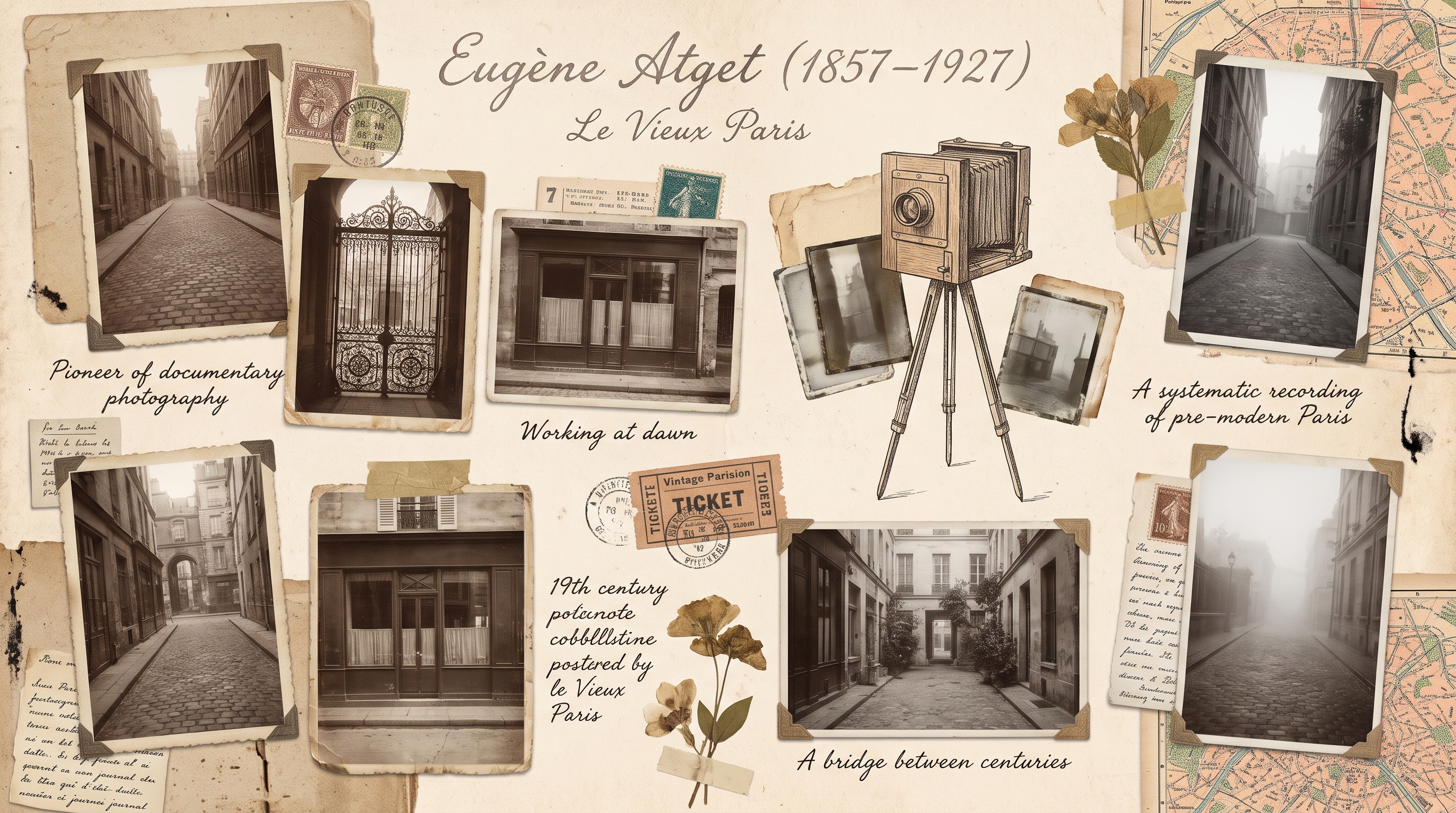
Eugène Atget (1857–1927) was a French pioneer of documentary photography who dedicated roughly thirty years to systematically recording the architectural, social, and atmospheric fabric of Old Paris (le Vieux Paris) before its erasure by modern industrial expansion.[1] Working with an antiquated wooden view camera and glass plates at dawn, Atget produced quiet, deserted streetscapes that bridged nineteenth-century topographical craft and twentieth-century avant-garde modernism.[2] Later championed by Surrealists like Man Ray and Berenice Abbott, and theorized by Walter Benjamin (1892–1940) in The Work of Art in the Age of Mechanical Reproduction as photographs resembling "crime scenes" stripped of bourgeois aura, Atget's exhaustive archive transformed urban documentary into standard evidence for the historical contradictions of modernity.
Early Life and Transition to Photography
Born Jean-Eugène-Auguste Atget on February 12, 1857, in Libourne near Bordeaux, Atget experienced early upheaval when he was orphaned as a young child and raised by his maternal grandparents.[3] Before picking up a camera in his early thirties, he pursued several distinct careers:
- Merchant Navy: After finishing secondary education, he worked as a cabin boy and sailor, traveling transatlantic routes to South America and Uruguay.[3:1]
- Theatrical Career: Returning to France, Atget studied at the National Conservatory of Music and Declamation in Paris in 1879. Expelled due to military conscription obligations, he subsequently spent nearly a decade working as an itinerant provincial actor playing minor supporting roles, during which he met his lifelong partner, the actress Valentine Delafosse Compagnon.[3:2]
- Commercial Pivot: After a vocal cord infection ended his acting career around 1887 and a brief attempt at painting failed, Atget turned to commercial photography in the late 1880s.[4] Moving permanently to Paris around 1890, he hung a sign outside his Montparnasse studio at 17bis rue Campagne-Première reading Documents pour artistes ("Documents for Artists"), supplying reference studies of flowers, foliage, landscapes, and architectural details to painters, illustrators, architects, and stage designers.[1:1]
The Systematic Archive of Vieux Paris
Around 1897–1898, Atget redirected his modest commercial practice toward a monumental historical ambition: preserving the visual memory of Old Paris.[5] Rapidly disappearing beneath ongoing municipal renovations, industrial expansion, and the lingering legacy of Baron Haussmann's mid-nineteenth-century urban restructuring (1853–1869), medieval and Ancien Régime neighborhoods were facing systematic demolition.[6]
Atget's project coincided directly with the founding of the Commission du Vieux Paris in 1897, a municipal heritage committee tasked with cataloging threatened historic structures.[5:1] By 1900, major Parisian institutions—including the Bibliothèque historique de la ville de Paris, the Musée Carnavalet, the École des Beaux-Arts, and the Bibliothèque nationale de France—became steady buyers of his prints, allowing him to expand his topographical survey into a lifelong vocation.[6:1]
Taxonomy and Cataloging System
Rather than treating his photographs as isolated artistic masterpieces, Atget organized his output into an intricate, cross-referenced archival system.[7] Over three decades, he exposed thousands of negatives and grouped them concurrently into thirteen distinct numbered series, scratching catalog numbers directly into the emulsion at the bottom of his glass plates (resulting in reversed numbers on the final prints) and annotating the backs of prints in pencil with precise locations and titles.[7:1]
| Series Title (French & English) | Subject Matter & Visual Focus | Primary Motivations & Thematic Scope |
|---|---|---|
| L'Art dans le Vieux Paris (Art in Old Paris) | Architectural ornaments, wrought-iron balconies, carved keystones, historic staircases, and pre-revolutionary hôtels particuliers. | Preserving decorative craftsmanship and Ancien Régime architectural heritage prior to municipal demolition.[7:2] |
| Paris Pittoresque (Picturesque Paris) | Vanishing street trades (petits métiers), ragpickers (chiffonniers), itinerant vendors, cabarets, and historic shopfronts. | Documenting marginal labor and folk traditions pushed to extinction by industrialization and department stores.[6:2] |
| Topographie du Vieux Paris (Topography of Old Paris) | Street-by-street topographical surveys of historic arrondissements, courtyards, narrow passages, and ancient alleys. | Providing systematic urban visual inventories directly commissioned by heritage libraries and historical societies.[7:3] |
| Intérieurs Parisiens (Parisian Interiors) | Domestic interiors across social strata, from workers' garrets and artisans' workshops to affluent bourgeois salons. | Creating a sociological cross-section of early twentieth-century private life, culminating in his 1910 portfolio album.[8] |
| Environs & Parcs Royaux (Versailles, Saint-Cloud, Sceaux) | Overgrown royal parks, weathered classical statues, overgrown allées, decaying fountains, and rustic suburban villages. | Exploring the melancholy of aristocratic ruins and nature reclaiming historical monuments during his late career in the 1920s.[8:1] |
| Voitures & Véhicules (Cabs and Transport) | Horse-drawn omnibuses, fiacres, delivery carts, handbarrows, and early motor vehicles across Parisian depots. | Recording the technological transition from equine urban transit to mechanized transportation.[7:4] |
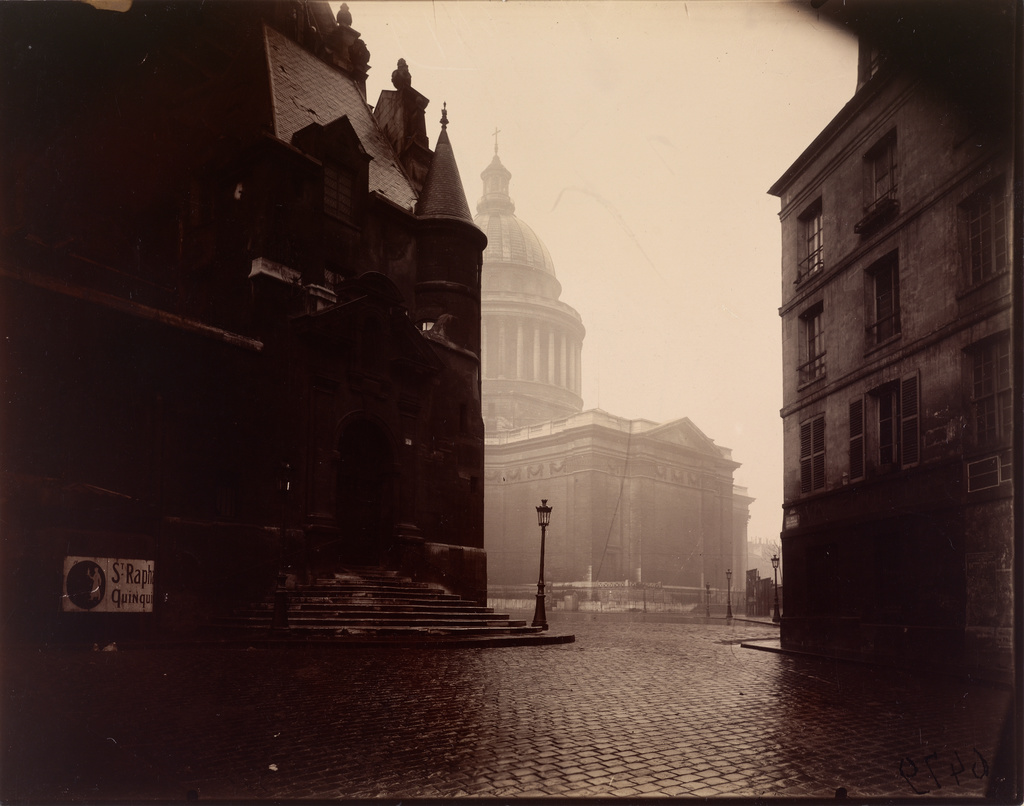
Notably, Atget consciously omitted symbols of modern industrial triumph: across more than thirty years in the French capital, he ignored the Eiffel Tower and generally bypassed the grand Haussmannian boulevards in favor of narrow medieval alleys, interior courtyards, and quiet thresholds.[7:5]
Technical Apparatus and Visual Aesthetic
Atget achieved his unmistakable visual language in large part by refusing to adopt contemporary photographic innovations. Well into the 1920s, when handheld roll-film cameras like the Kodak and early 35mm prototypes dominated street photography, Atget relied exclusively on nineteenth-century equipment.[2:1]
Equipment and Printing Process
- Large-Format View Camera: He carried a heavy wooden bellows view camera mounted on a tall tripod, paired with 18 × 24 cm glass-plate negatives stored in wooden cases—an apparatus weighing upward of forty pounds.[2:2]
- Optics: Atget used older rapid rectilinear lenses, which minimized architectural line distortion while producing subtle optical falloff and gentle vignetting when shifted off-axis to capture tall facades without tilting the camera back.[9]
- Printing-Out Paper (POP): He produced contact prints by placing albumen silver paper (and later gelatin silver chloride matte albumen paper) directly beneath the glass negative in a wooden printing frame and exposing it to natural sunlight, followed by gold-chloride toning that yielded warm, purplish-sepia hues and rich shadow detail.[1:2]
Why the Streets Were Deserted
The haunting depopulation of Atget's Paris around 1900 resulted from an intersection of technical necessity and deliberate compositional clarity:
- Dawn Expeditions: To avoid horse-drawn omnibuses, motor traffic, and crowds blocking architectural sightlines, Atget woke before sunrise to photograph in the soft, diffused early morning light.[9:1]
- Slow Exposure Times: Because glass plates had low light sensitivity and his lenses required small apertures for deep depth of field, exposures lasted several seconds. Moving pedestrians simply failed to register on the emulsion or dissolved into faint spectral blurs.[9:2]
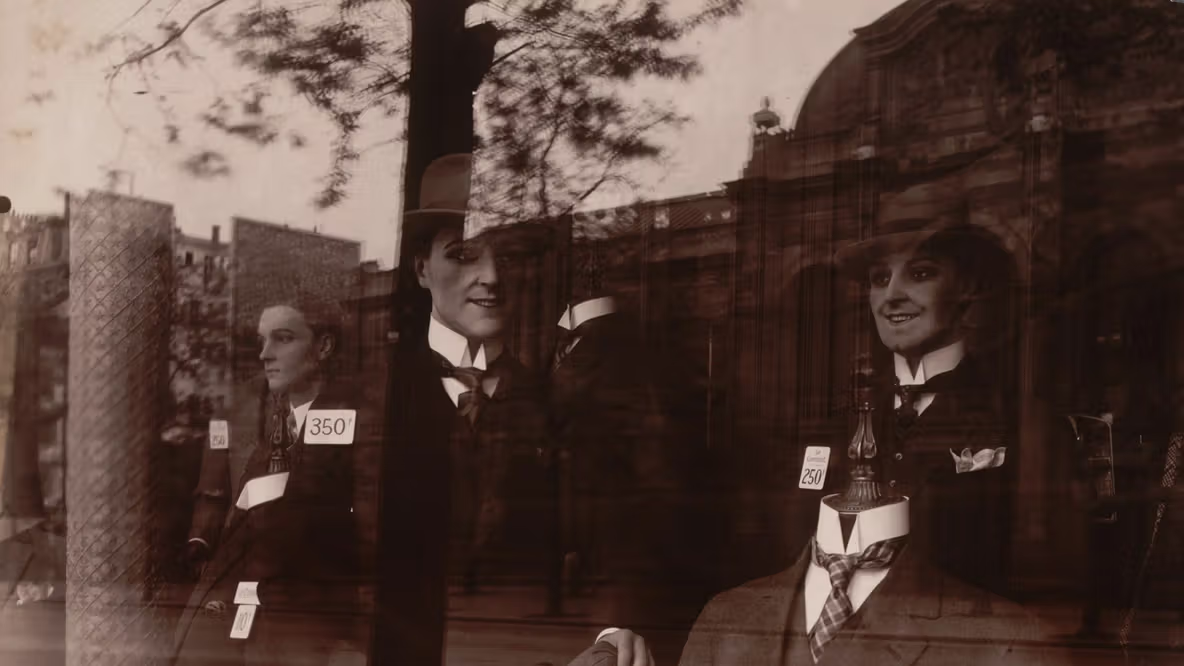
- Reflective Layering: Working in quiet morning streets allowed Atget to study storefront windows (devantures), where reflections of Parisian stone facades merged seamlessly with interior displays of corsets, mannequins, boots, and wares—creating complex spatial ambiguities that captivated modernist viewers.[9:3]
Avant-Garde Reception and Theoretical Legacy
During the final years of his life, Atget's quiet archival labor collided unexpectedly with the Parisian avant-garde. Living just down the street at rue Campagne-Première, the American Dadaist and Surrealist photographer Man Ray discovered Atget's albums in the early 1920s.[10]
Surrealist Appropriation
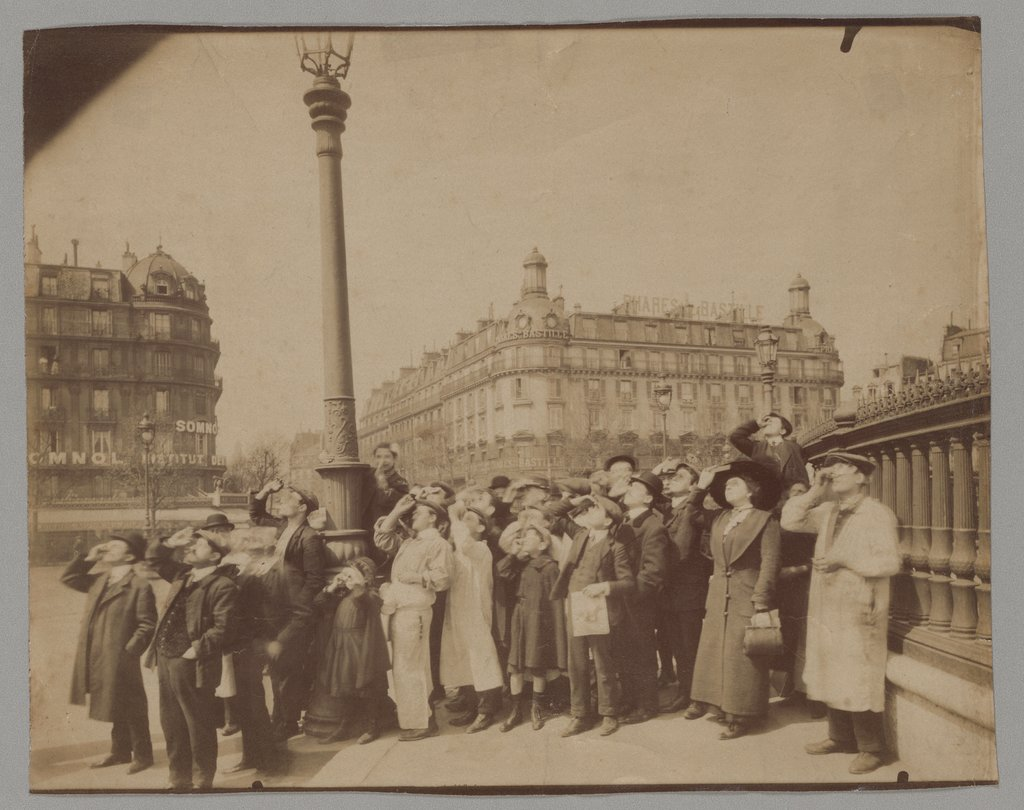
Enchanted by Atget's uncanny shopfront mannequins, eerie reflections, and deserted alleys, the Surrealists hailed him as a naive visionary—dubbed by contemporaries "the Henri Rousseau of photography."[11] In June 1926, Man Ray published Atget's 1912 photograph Pendant l'éclipse (depicting a Parisian crowd staring skyward through smoked glass during a solar eclipse) on the cover of issue no. 7 of La Révolution surréaliste, followed by three additional images inside.[12] True to his self-conception as an artisan rather than a fine artist, Atget famously insisted on anonymity, telling Man Ray: "Don't put my name on it. These are simply documents I make."[12:1]
Walter Benjamin and the "Crime Scene"
In his landmark essays Little History of Photography (1931) and The Work of Art in the Age of Mechanical Reproduction (1935), German cultural theorist Walter Benjamin (1892–1940) positioned Atget as the pivotal figure who emancipated photography from the artificial, painterly "aura" of nineteenth-century Pictorialism.[13]
"And it is having set the scene for this process to occur that gives Atget, the man who captured so many deserted Parisian streets around 1900, his incomparable significance. Quite rightly it has been said of him that he recorded those streets like crime scenes. A crime scene, too, is deserted; it is photographed for the purpose of establishing evidence. With Atget, photographs become standard evidence for historical occurrences, and acquire a hidden political significance."[13:1]
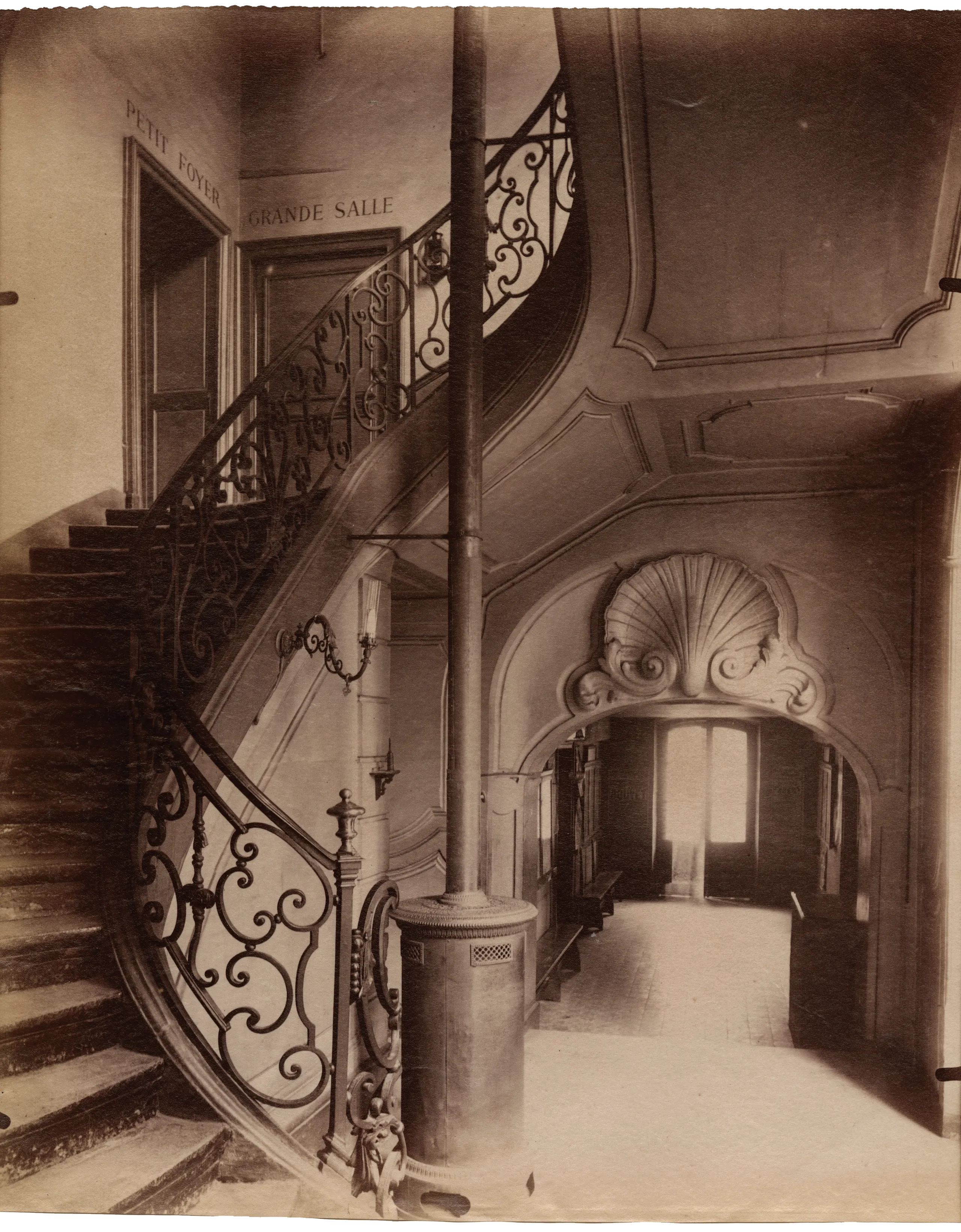
For Benjamin, Atget stripped the city of romantic nostalgia; his empty streets looked "like a lodging that has not yet found a new tenant," transforming urban details into forensic clues of historical and capitalist transformation.[14]
Berenice Abbott and Archival Preservation
Without the intervention of American photographer Berenice Abbott, much of Atget's non-institutional body of work might have perished. Introduced to Atget's prints while working as Man Ray's darkroom assistant between 1923 and 1926, Abbott visited the elderly photographer in his studio and took his portrait shortly before his death on August 4, 1927.[3:3]
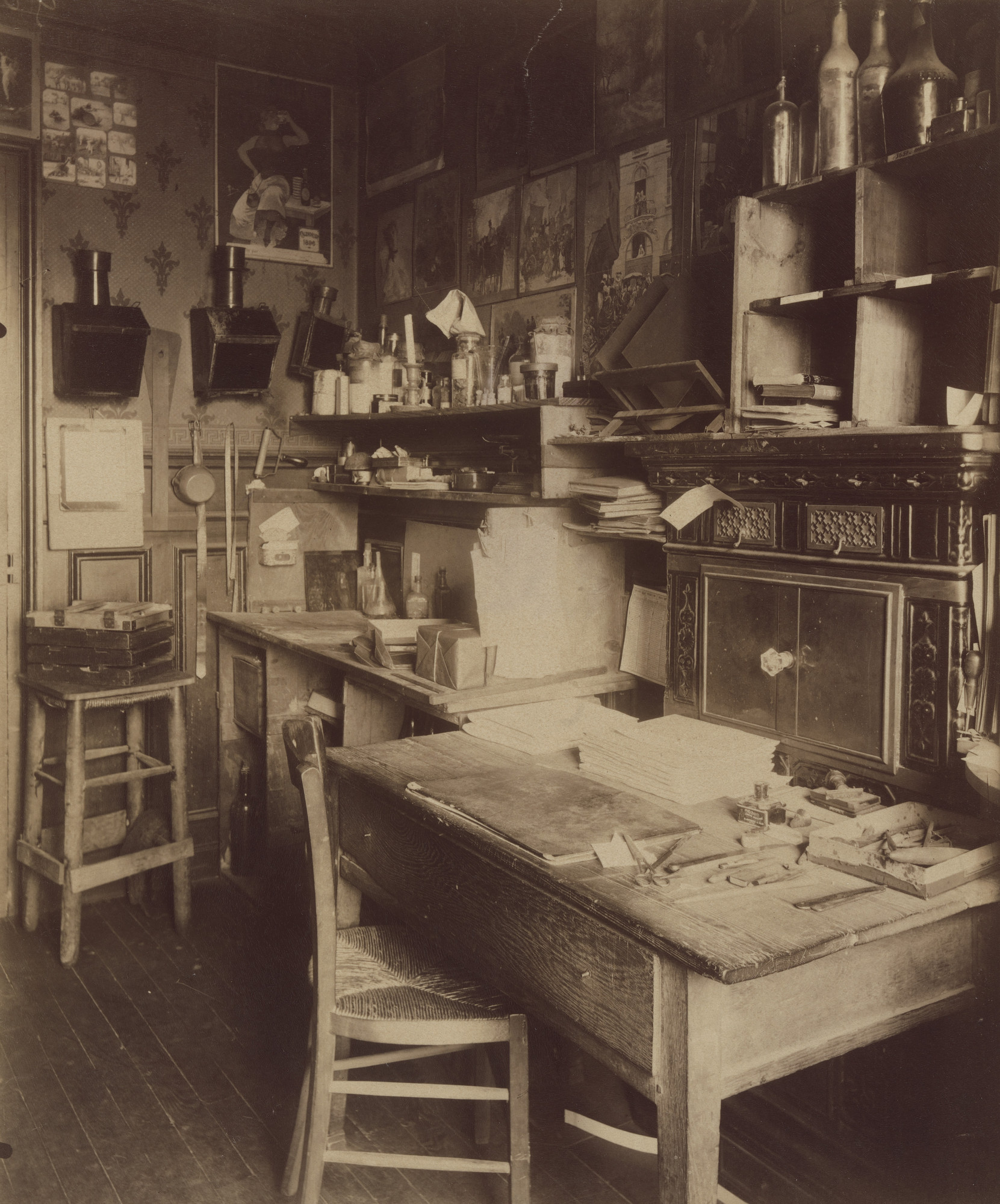
In the autumn of 1928, with financial backing from New York art dealer Julien Levy, Abbott purchased the remaining contents of Atget's studio from his executor and friend André Calmette—securing roughly 1,400 glass-plate negatives and nearly 8,000 prints.[10:1] Over the next forty years, Abbott printed from his negatives, co-published key monographs such as Atget: Photographe de Paris (1930), and championed his work to a generation of American documentary photographers including Walker Evans and Lee Friedlander.[10:2] In 1968, the Museum of Modern Art (MoMA) in New York acquired the Abbott-Levy Collection (comprising roughly 5,000 prints and 1,200 glass negatives), culminating in John Szarkowski and Maria Morris Hambourg's definitive four-volume catalog and exhibition series, The Work of Atget (1981–1985).[7:6]
🎴 Interactive Web Practice (Comprehension Check)
Question 1 (Aesthetic Theory & Walter Benjamin): Why did Walter Benjamin characterize Eugène Atget's deserted streetscapes as resembling "scenes of a crime," and what theoretical shift did this mark in the history of photography?
Answer: In The Work of Art in the Age of Mechanical Reproduction and Little History of Photography, Walter Benjamin argued that early photography had remained captive to bourgeois cult value, preserving an artificial, sentimental "aura" through soft-focus portraiture and pictorialist styling. Atget dismantled this auratic illusion by turning his camera toward unpopulated, ordinary Parisian streets, passages, and courtyards.
Benjamin compared these deserted spaces to "crime scenes" because a crime scene is vacant, deserted, and photographed specifically to secure forensic clues and objective evidence. In Atget's images, the viewer cannot indulge in passive, romantic nostalgia; instead, the photographs demand cognitive interrogation and historical witness. This marked the definitive transition from photography as an auratic artistic commodity to photography as historical and political evidence (Ausstellungswert or exhibition value), exposing the hidden contradictions of capitalist urban transformation.
Question 2 (Technique & Spatial Depopulation): What technical factors and operational choices explain why Eugène Atget's photographs were largely deserted of human pedestrians?
Answer: The depopulated character of Atget's streetscapes was the joint outcome of his physical apparatus and deliberate working methodology:
- Dawn Work Schedule: To capture unobstructed views of historical architecture and eliminate interference from bustling commercial traffic, delivery carts, and crowds, Atget woke before sunrise and worked in the earliest daylight hours when Parisian streets were naturally empty.
- Slow Glass-Plate Emulsions and Long Exposures: Atget used large 18 × 24 cm glass dry plates with low light sensitivity and stopped his rapid rectilinear lens down to small apertures to achieve deep depth of field. This required exposure times ranging from several seconds to minutes. Any moving pedestrians, horses, or omnibuses failed to remain still long enough to expose the emulsion, either dissolving completely into invisibility or registering as faint, transparent ghostly blurs.
- Focus on Structural Materiality: Because Atget's primary mission was topographical and architectural documentation (Documents pour artistes), he deliberately privileged stone facades, ironwork, stairwells, and spatial geometries over transient anecdotal human drama.
Question 3 (Avant-Garde Reception & Surrealism): How did the Parisian Surrealists, led by Man Ray, interpret Atget's commercial documentary photographs, and how did Atget's own self-understanding contrast with their artistic canonization?
Answer: In the 1920s, Man Ray and the Surrealist circle hailed Atget as an unwitting avant-garde master, an intuitive visionary who captured the poetic, dreamlike strangeness of everyday life. They were captivated by his storefront reflections, disembodied shop mannequins, empty nocturnal alleys, and the uncanny juxtaposition of pre-industrial remnants within a modernizing city. Man Ray published Atget's 1912 photograph Pendant l'éclipse on the cover of La Révolution surréaliste in 1926 as a premier example of Surrealist defamiliarization.
However, Atget rejected the label of "artist." He viewed himself strictly as an artisan-craftsman and archivist running a commercial enterprise (Documents pour artistes). When Man Ray sought to credit him on the cover of the journal, Atget famously refused, insisting: "Don't put my name on it. These are simply documents I make." While the Surrealists aestheticized his work as irrational and marvelous, Atget understood his images as precise, functional records of material history.
Question 4 (Archival Taxonomy vs. Flânerie): In what ways did Atget's thirteen numbered series differ from the impressionistic wandering of the nineteenth-century flâneur?
Answer: While the nineteenth-century flâneur celebrated by Charles Baudelaire was a leisurely, bohemian stroller who drifted through the Parisian crowds to absorb transient, fleeting sensory impressions, Atget operated with disciplined, cartographic rigor. Rather than wandering aimlessly, he methodically mapped the city through thirteen distinct taxonomical series (e.g., L'Art dans le Vieux Paris, Paris Pittoresque, Topographie du Vieux Paris, Intérieurs Parisiens).
He inscribed catalog numbers directly into the glass plate emulsions, indexed his prints with municipal accuracy, and coordinated his visual surveys with the preservation efforts of the Commission du Vieux Paris and major municipal libraries. His practice was an exhaustive archival excavation of material culture designed to outlast the physical demolition of the pre-modern city, replacing the flâneur's subjective reverie with objective visual cataloging.
Resonant Notes
The following notes in the vault share direct thematic, sociological, and literary connections with Eugène Atget:
🔴 Avant-Garde Modernism, Surrealism & Documentary Aesthetics
- The Work of Art in the Age of Mechanical Reproduction — Walter Benjamin's foundational aesthetic treatise explicitly analyzes Atget's deserted Parisian streetscapes as the historical tipping point where photography liberated itself from portrait aura and transformed into evidentiary exhibits in a socio-political trial.
- Walter Benjamin (1892–1940) — Benjamin's essays Little History of Photography and The Work of Art in the Age of Mechanical Reproduction canonized Atget as the pioneer who stripped the city of bourgeois sentimentality and exposed the optical unconscious of metropolitan space.
- The Avant-Garde — Explores the institutional and aesthetic revolts of early twentieth-century modernism; Surrealists like Man Ray and Berenice Abbott appropriated Atget's artisanal "documents" to destabilize the boundary between functional record and high art.
- Paul Klee (1879–1940) — Contemporary modernist whose oil-transfer technique similarly mediated between mechanical reproduction and graphic singularity, interrogating the boundary between artisanal craft and modernist vision.
- The Dehumanization of Art — José Ortega y Gasset's 1925 analysis of modernism's purging of sentimental nineteenth-century humanism illuminates Atget's cold, depopulated urban frames, which prioritize formal structure and material traces over individual psychological drama.
🟡 Critical Theory, The Flâneur & Urban Archaeology
- Walter Benjamin's The Arcades Project — Benjamin's unfinished masterwork on nineteenth-century Paris mirrors Atget's systematic visual archaeology, both collecting the fleeting, discarded, and threatened material refuse of le Vieux Paris before its erasure by industrial modernization.
- The flâneur — Atget represents the systematic, photographic transformation of the nineteenth-century urban stroller; while the flâneur experienced the streets through aimless leisure, Atget navigated them with cartographic discipline, converting sensory impressions into archival inventories.
- The Painter of Modern Life, a seminal 1863 essay by French poet and art critic Charles Baudelaire — Baudelaire's formulation of modernité as the transient, fleeting, and contingent found photographic realization in Atget's documentation of vanishing medieval alleys and vanishing artisanal trades (petits métiers).
- Georg Simmel (1858-1918) & The Metropolis and Mental Life — Simmel's sociology of metropolitan rationalization and sensory overstimulation contextualizes Atget's dawn expeditions, which bypassed the frantic tempo of modern street life to isolate the objective architectural forms of the city.
- Georg Simmel's Tragedy of Culture — Simmel's diagnosis of the widening chasm between cumulative objective culture and subjective assimilation directly mirrors Atget's encyclopedic archive of Parisian forms, which sought to preserve cultural memory before its liquidation by capitalist urban planning.
🟢 Urban Space, The Uncanny & Optical Media
- Anthony Vidler-The Architectural Uncanny — Vidler's analysis of architectural estrangement, haunted urban voids, and the unhomely (unheimlich) provides the spatial framework for understanding Atget's deserted courtyards, blind alleyways, and vacant stairwells.
- Freud's The Uncanny (Das Unheimliche) — Sigmund Freud's concept of the uncanny—arising when familiar domestic surroundings suddenly feel alien and repressed—explains the eerie, dreamlike resonance of Atget's storefront mannequins, corsets, and reflected shop windows.
- Defining a Simulacrum — Jean Baudrillard's second-order simulation (industrial mechanical reproduction) clarifies Atget's archival practice, which generated thousands of serialized contact prints capturing an urban reality on the brink of physical demolition.
- Nocturnalization - The Industrialization of Light — Examines the urban expansion of artificial illumination and gaslight; Atget consciously rejected electric modernity, working exclusively with natural dawn daylight and long exposures to preserve the texture of pre-industrial Paris.
- A Treatise on Painting (Trattato della pittura) — Leonardo da Vinci's foundational treatises on optics, linear perspective, and the intersection of visual rays clarify Atget's use of rectilinear optics and rising front view camera adjustments to correct vertical converging lines without digital distortion.
References
Museum of Modern Art / Eugène Atget Artist Profile / moma.org ↩︎ ↩︎ ↩︎
Art Gallery of New South Wales / Atget's Technique: Eugène Atget Exhibition Kit / artgallery.nsw.gov.au ↩︎ ↩︎ ↩︎
Museum of Modern Art / Eugene Atget Archive Collection Press Release (1968) / moma.org ↩︎ ↩︎ ↩︎ ↩︎
J. Paul Getty Research Institute / Union List of Artist Names: Eugène Atget / getty.edu ↩︎
Bibliothèque nationale de France / Eugène Atget: BnF Essentiels / essentiels.bnf.fr ↩︎ ↩︎
Réunion des musées nationaux – Grand Palais / Le Vieux Paris - la photographie documentaire / histoire-image.org ↩︎ ↩︎ ↩︎
Art Blart / Eugène Atget: "Documents pour artistes" at MoMA, New York / artblart.com ↩︎ ↩︎ ↩︎ ↩︎ ↩︎ ↩︎ ↩︎
Wikipedia Contributors / Eugène Atget / wikipedia.org ↩︎ ↩︎
What Camera Gear / Eugène Atget Camera Gear and Optical Technique / whatcameragear.com ↩︎ ↩︎ ↩︎ ↩︎
Mitra Abbaspour, Lee Ann Daffner, and Maria Morris Hambourg / Object:Photo – Atget: Photographe de Paris (1930) / moma.org ↩︎ ↩︎ ↩︎
Guillaume Le Gall / Atget, figure réfléchie du surréalisme (Études photographiques) / openedition.org ↩︎
Christie's / Eugène Atget (1857–1927), Pendant l'Éclipse, 1912 Lot Essay / christies.com ↩︎ ↩︎
Walter Benjamin / The Work of Art in the Age of Mechanical Reproduction / goodreads.com ↩︎ ↩︎
Marcus Bunyan / "Atget's Shadow," on his Paris Photographs / artblart.com ↩︎